Humans and bacteria share strategies to defend against viruses.
We wondered: could they use each other's genes? Yes, both can!
Bacteria can use human immune genes to defend against phages AND
Human cells can use bacterial genes for viral defense.
https://t.co/PzZIHFKgfA
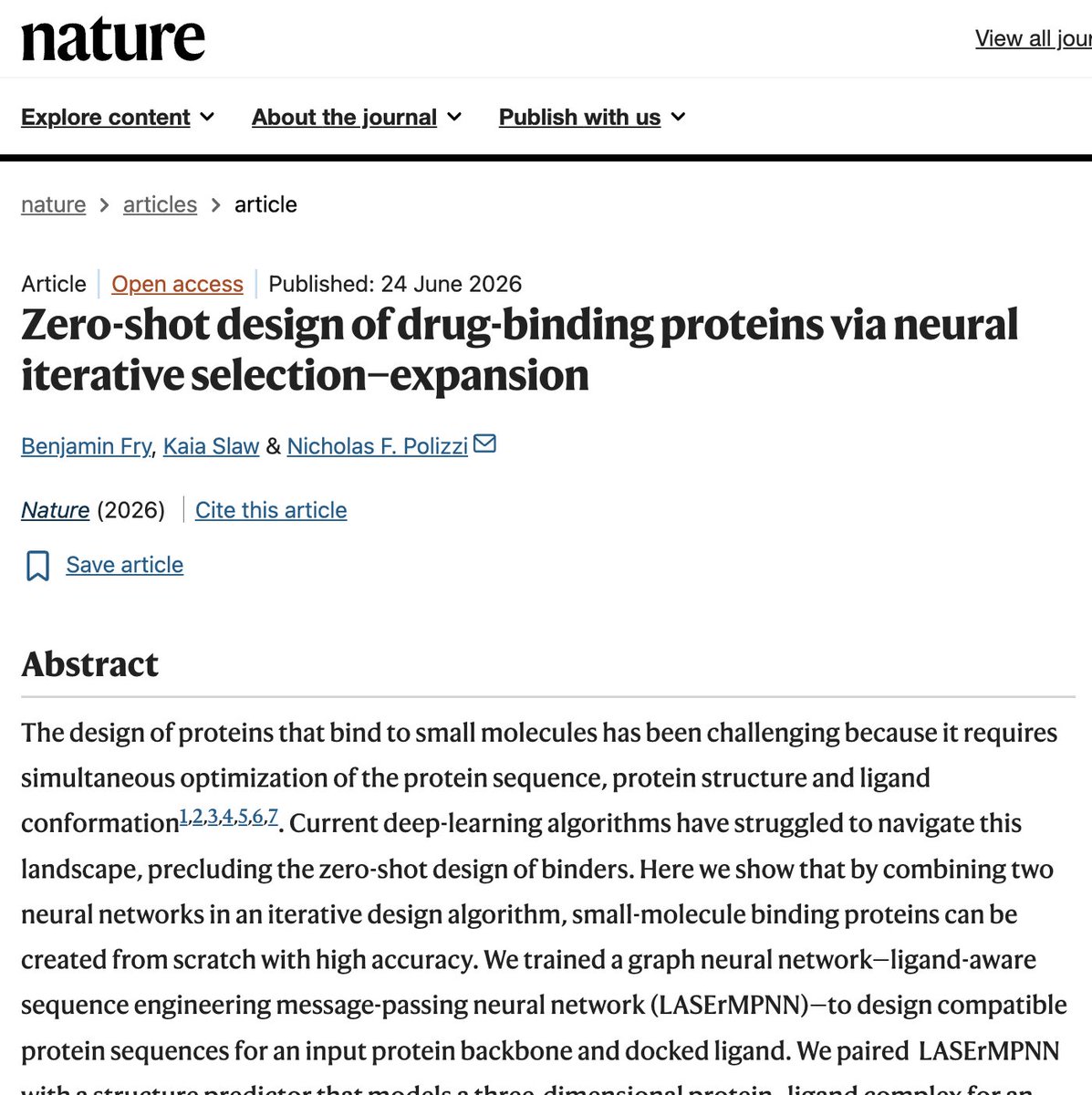
My first-author paper describing our protocol for the zero-shot de novo design of drug-binding proteins is now available as an article in Nature! Here’s what we did and what's new from the preprint posted last year 🧵 (1/10):
Since the 1960s, the genetic code has been used to predict protein sequences from DNA and mRNA sequences. Our @Nature article demonstrates that these predictions miss thousands of protein sequences present in human tissues.
Across >1,000 human samples, we identified numerous abundant proteins whose amino acid sequences differ from those predicted by the genetic code.
These proteins are not rare translation byproducts. They accumulate to thousands of copies per cell. Some are more abundant than the proteins predicted by the genetic code from the same transcripts.
Their abundance reflects a combination of alternate RNA decoding mechanisms — including codon-anticodon mismatches, tRNA abundance, and RNA modifications — and selective stabilization of the resulting proteins. The last factor – protein stability – emerges as a major determinant of protein abundance across proteins, proteoforms and cell types: https://t.co/IzOfAZKnxT
Alternate RNA decoding is pervasive across functional groups of proteins, healthy and diseased tissues. It affects proteins playing key roles in neurodegeneration, and some alternately decoded proteins show strong enrichment in tumors compared to their surrounding tissues.
This discovery has been a long and exhilarating journey with Shira Tsour and the @slavovLab team. It started in 2019 and proceeded through many challenges and thrilling highs. A journey that has opened new perspectives that we long to explore!
1/
Does “writing is thinking” still hold when AI can do most of the writing?
If writing has long been one of the main vehicles of thought, what happens when AI starts carrying much of that cognitive labour?
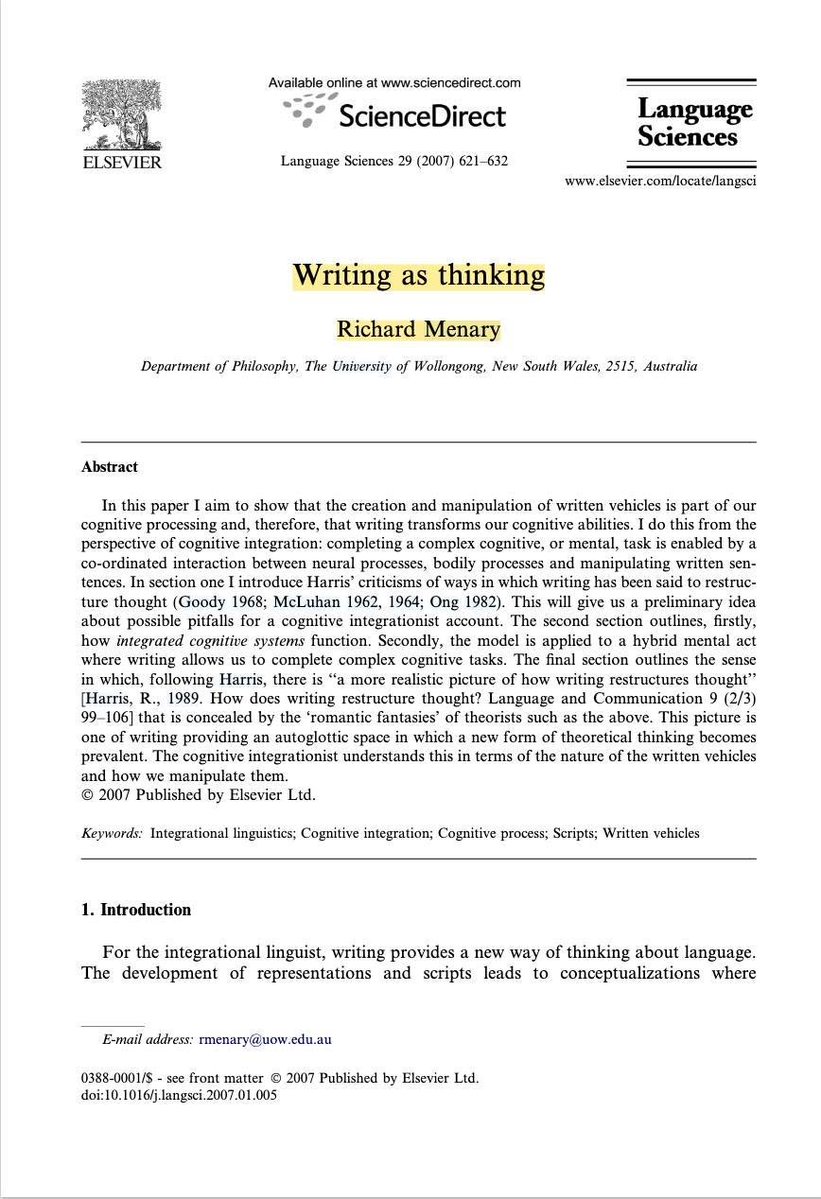
I have been thinking about this after reading Richard Menary’s paper Writing as thinking.
His argument is powerful. Writing is part of thinking. We do not simply think first and write later. We think through the act of writing itself.
Drafting, revising, deleting, moving sentences around, rereading a paragraph, seeing a gap in an argument, finding a clearer way to say something. All of that is cognitive labour.
But generative AI changes the conditions around this argument.
Before AI, writing carried much of the heavy lifting. It was one of the main ways students externalized thought, struggled with ideas, organized meaning, and developed judgement.
Now AI can produce the paragraph, polish the sentence, restructure the argument, summarize the reading, and generate the reflection.
So the question becomes serious: what happens to the thinking that used to happen through writing?
I still believe writing matters deeply. But I also know people, including people close to me, for whom writing creates anxiety. They think better through sketching, diagramming, drawing, speaking, mapping, or building.
So maybe the old mantra “writing is thinking” belonged to an age when writing carried far too much of the burden.
This also explains part of our current assessment problem. For years, education has leaned heavily on the written product as the main evidence of learning.
Generative AI has disrupted that assumption.
A polished text can still tell us something, but it can no longer carry learning assurance by itself. We need process evidence, oral explanation, drafts, diagrams, annotations, design choices, and moments where students show how their thinking developed.
Literacy is a situated practice. Pre-AI literacy and post-AI literacy belong to different conditions. Now what we need to think about is whether our students can think across tools, modes, contexts, and constraints?
Excited to share the first pre-print from our lab!!
Check it out here! https://t.co/N72qCF2V4c
We found that many RNA-binding proteins understood to regulate RNA processing can also function like transcription factors and cofactors to directly regulate transcription.
Finally out in @Cellcellpress!
Proteins with long intrinsically disordered regions (IDRs) are prone to misfolding during protein synthesis.
This is prevented by mRNA 3′UTRs that act as mRNA-based IDR chaperones.
https://t.co/Pa4bWYhOMe
Key takeaway 1: QA is there for unis not merely as a compliance checklist, but to help them to evolve in the backdrop of an ever-evolving socio-tech landscape, to keep the uni relevant
I am at a QA conference and what I'll be doing for the next two days is to list one or two major key takeaways from each speaker I get to listen to (because rn I had to run away 😭 -- artista duties haha)
Exogenous Lactate, the preferred energy substrate. New post in @Glut4Science after 3 years!!
I hope you can enjoy the read of our journey behind ExoLactate and the science behind this potential fuelling solution! 🤓
Thank you very much for reading!
https://t.co/h6lUmJ1wBs
The aerobic vs anaerobic model is not wrong because it’s simple. It’s wrong because it implies a switch where there is only a continuum.
Glycolysis is always active. Lactate is always produced and cleared. Mitochondria are always involved. There is no moment where the body “switches” from one system to another. What changes is the balance between glycolytic flux and mitochondrial capacity and lactate is the best real-time proxy of that balance.
I proposed in 2013 a model based on substrate utilization. Now I propose an update of that model built around four metabolic states. From metabolic equilibrium at Zone 2 all the way to metabolic overload, where the central question is not what fuel you’re burning, but whether the system can sustain balance.
Ultimately, the ceiling of equilibrium matters more than the ceiling of oxygen consumption.
👇
https://t.co/CWkZyRohzT
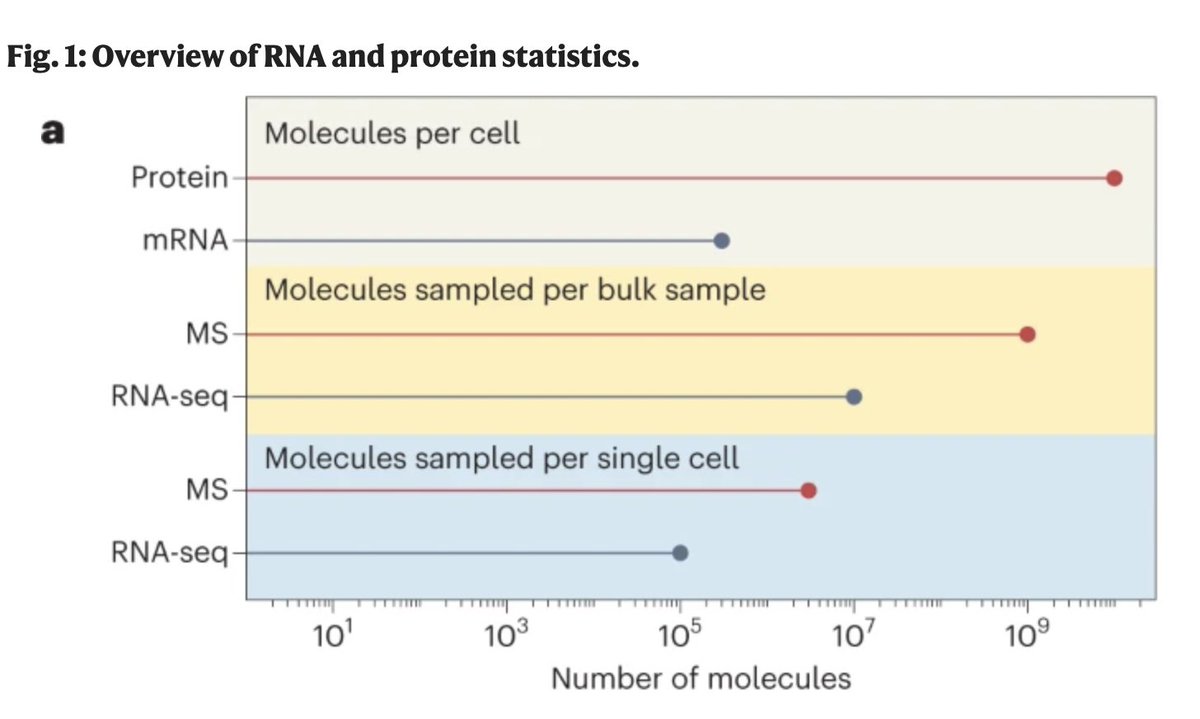
These numbers are key to understanding RNA and protein analysis.
The different counting statistics fundamentally shape technological challenges and opportunities.
https://t.co/UKsQ2AEuro
Las figuras deben ser lo más simples posibles.
Figura 1:
a) Un diagrama demasiado complicado de una inversión en dos genes.
b) Una versión simplificada, combinando los dos primeros pasos y usando menos flechas.
Most academics waste years waiting for the perfect writing conditions.
Sabbatical.
Summer break.
Weekend marathons.
Meanwhile, their drafts pile up.
Here's what productive scholars do instead:
They schedule 30 minutes tomorrow morning and just start.