@thejessezhang interesting take. would have thought that especially with customer support a degree of common sense i.e. general knowledge would benefit the user experience.
You would consume less computer credits (and be able to run more tasks as a result) if you switched to GPT-5.5 as your default orchestrator. This was the number one complaint about Computer (being credits/token hungry). GPT 5.5 is more token-efficient in subagent orchestration.
Over the past two weeks, students researched and prepared stock pitches with Perplexity Computer.
Now the top 5 finalists will present live for $17,500 in prizes to our panel of judges.
Watch today’s live pitches from 9–10:30 AM PST: https://t.co/iqBF209Xms
There has been a long standing debate in Finance AI around "who wins": the foundation labs vs. the finance specific AI platforms (pejoratively, "the wrappers")
The pendulum in asset management has shifted back towards a strong consensus that foundation labs directly are the winners, Claude specifically. "Why work with a wrapper when I can work direct with Claude Enterprise?". And foundation labs building finance RL sandboxes and building big forward deployed engineering teams (and have endless capital) have reinforced that belief "OpenAI is hiring investment bankers, game over..."
My sense is this race isn't over, however.
Imaging you are an asset manager and you hitch your wagon to the Claude Complex:
> Opus 4.6 nerfed in earnings preview season
> Token bill arrives and after the "first hit is free" dynamic abates, your token budget explodes (and once the tool is in investor's hands, it is super hard to control usage). I'm no expert in token economics, but I do know that Uber used to sell $15 rides for $5 and I suspect Claude is selling thousands of dollars of compute for $200/month. This LLM capex burn isn't sustainable forever, and this isn't a sustainable foundation on which to transform your firm's investment process (see same $5 Uber ride now $50).
Perplexity has shown me the future with Perplexity Computer, an agentic multi-model workspace, with access to 19 models that is insanely user friendly. Guess what's not nerfed today? Research context, workflow context & enterprise security are also critical, so not necessarily arguing Perplexity Computer is the winner (they could be), but evidence like this suggests a more thoughtful bet is a multi-model approach that considers the LLM capability cycle (nerfing and leapfrogging) and token economics (using frontier intelligence economically).
The most exciting outputs I am getting from my experimentation in building an AI-native workflow are not the result of prompts or single workflow skills.
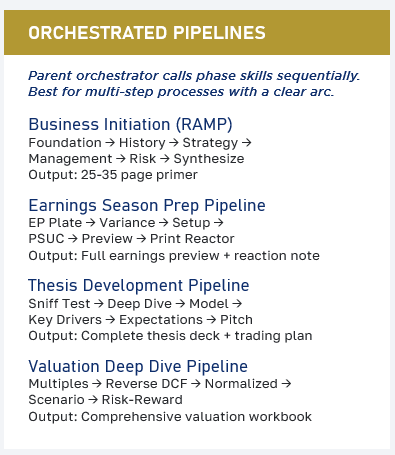
The really exciting outputs are a function of orchestrated pipelines, which are a set of sequentially applied skills. The engineering around the context window on agentic work platforms has been the key unlock (I am building these in Perplexity Computer). Before this ability, I had a prompt library of 306 prompts that I had to remember to apply at various stages of the investment process: this was cumbersome & cognitively demanding (and I had to upload the right data at the right moment which was highly cumbersome).
This is the closest thing I've come to producing work that looks & feels like it was produced by a well-trained analyst.
The really cool part about orchestrated pipelines is that they are also highly user friendly once set up: you literally just press a button. My tools aren't capable, but it seems possible you can also create an agentic verification loop on the backside of these pipelines.
I'll share a bit more about how I'm doing this on our "Up to Speed" webinar on Thursday.