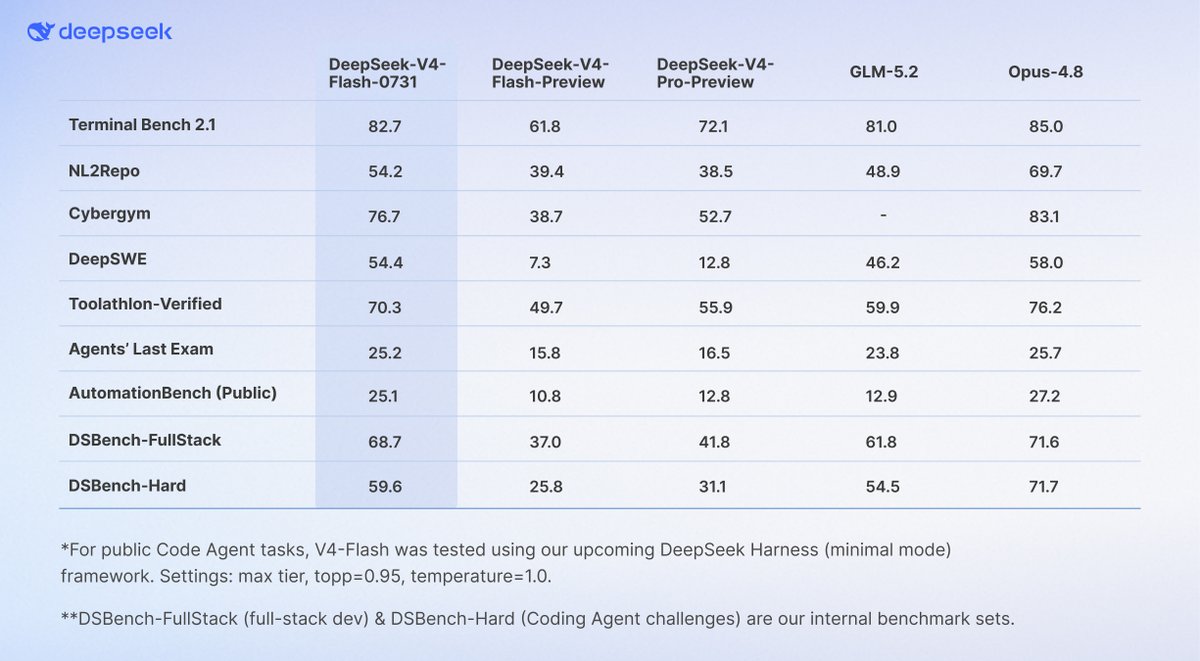
🚀 DeepSeek-V4-Flash Official API is now LIVE in public beta!
🔷 We’ve massively upgraded its Agent capabilities—benchmark scores are now far surpassing the V4-Pro-Preview. Check out the massive performance leap below! 👇
🔷 The official V4-Flash now natively supports the Responses API format and is fully adapted for Codex!
Check out the configuration details in our official API docs: https://t.co/smCwQZMeiq
Model quality is the ceiling. Context quality is the floor.
From what I observe at work: the people getting the most from AI — across ICs, EMs, PMs — are the ones who are most intentional about how they organize their context.
@Michael47313603@ZhihuFrontier@Kimi_Moonshot The translation is not very good. The original post in Chinese is actually a lot more readable. You can try redo the translation yourself.
@yilin_sung Yi Lin, my team at Meta is looking for talents. We’re building foundational multimodal LLM for Ads and beyond. Sent u an email; I’d love to connect. Or feel free to DM.
Can't agree more. Knowledge entertainment tricks us into confusing consumption with growth. True learning demands effort—mental sweat, not passive scrolling. Deliberate practice is the bridge between information and wisdom.
# on shortification of "learning"
There are a lot of videos on YouTube/TikTok etc. that give the appearance of education, but if you look closely they are really just entertainment. This is very convenient for everyone involved : the people watching enjoy thinking they are learning (but actually they are just having fun). The people creating this content also enjoy it because fun has a much larger audience, fame and revenue. But as far as learning goes, this is a trap. This content is an epsilon away from watching the Bachelorette. It's like snacking on those "Garden Veggie Straws", which feel like you're eating healthy vegetables until you look at the ingredients.
Learning is not supposed to be fun. It doesn't have to be actively not fun either, but the primary feeling should be that of effort. It should look a lot less like that "10 minute full body" workout from your local digital media creator and a lot more like a serious session at the gym. You want the mental equivalent of sweating. It's not that the quickie doesn't do anything, it's just that it is wildly suboptimal if you actually care to learn.
I find it helpful to explicitly declare your intent up front as a sharp, binary variable in your mind. If you are consuming content: are you trying to be entertained or are you trying to learn? And if you are creating content: are you trying to entertain or are you trying to teach? You'll go down a different path in each case. Attempts to seek the stuff in between actually clamp to zero.
So for those who actually want to learn. Unless you are trying to learn something narrow and specific, close those tabs with quick blog posts. Close those tabs of "Learn XYZ in 10 minutes". Consider the opportunity cost of snacking and seek the meal - the textbooks, docs, papers, manuals, longform. Allocate a 4 hour window. Don't just read, take notes, re-read, re-phrase, process, manipulate, learn.
And for those actually trying to educate, please consider writing/recording longform, designed for someone to get "sweaty", especially in today's era of quantity over quality. Give someone a real workout. This is what I aspire to in my own educational work too. My audience will decrease. The ones that remain might not even like it. But at least we'll learn something.
We used Mistral OCR with Claude 3.7 to create blog-style overviews for arXiv papers
Generate beautiful research blogs with figures, key insights, and clear explanations from the paper with just one click
Understand papers in minutes - not hours
We used Mistral OCR with Claude 3.7 to create blog-style overviews for arXiv papers
Generate beautiful research blogs with figures, key insights, and clear explanations from the paper with just one click
Understand papers in minutes - not hours
@svpino Great suggestions. I have something similar setup using Filesystem MCP. But it looks like the upcoming Claude feature Harmony is going to provide built-in support for use cases you mentioned.
If you look at most of the models we've received from OpenAI, Anthropic, and Google in the last 18 months you'll hear a lot of "Most of the improvements were in the post-training phase."
Here's a simple analogy for how so many gains can be made on mostly the same base model:
The intuition I've been using to understand the potential of post-training is what I call the elicitation interpretation of post-training, where all we are doing is extracting and amplifying valuable behaviors in the base model.
Consider F1, most of the teams show up to the beginning of the year with a new chassis and engine. Then, they spend all year on aerodynamics and systems changes (ofc a minor over simplification), and can dramatically improve the performance of the car. The best F1 teams improve way more during a season than chassis to chassis.
The same is true for post-training. The best post-training teams extract a ton of performance in a very short time frame. The set of techniques is everything after the end of most of pretraining. It includes "mid-training" like Annealing / high-quality end of pre-training, instruction tuning, RLVR, preference-tuning, etc.
Then, when you look like models such as GPT4.5, you can see this as a way more dynamic and exciting base for OpenAI to build onto. We also know that bigger base models can absorb far more diverse changes than their smaller counterparts.
This is to say -- scaling also allows post-training to move faster. Of course, to do this, you need the infrastructure to train the models. This is why all the biggest companies are still building gigantic clusters.
Still, it is very important to understand how much craft their is to post-training and how these labs are grabbing so much available performance. Improvements have been easier than most people think -- fitting them all together in one model is harder, but we have a lot more to gain still.
@karpathy I pondered a sec for what exactly agency means here, since this is not its typical meaning. But its Chinese translation 能动性 pops up a lot in our Chinese education (probably in some Communism course), which literally means "ability, movement, trait".
Cline v3.2 has a new Plan/Act toggle 🚀 Plan mode turns Cline into an architect that gathers information, asks clarifying questions, and designs a solution for you to review. Switch back to Act mode to let him execute the plan! This gives you a chance to flush out task details before wasting time and tokens going down the wrong direction.
Introducing Gemini 2.0 Flash Thinking, an experimental model that explicitly shows its thoughts.
Built on 2.0 Flash’s speed and performance, this model is trained to use thoughts to strengthen its reasoning.
And we see promising results when we increase inference time computation!
@JinaAI_ Great work and enjoyed your blogs! As embedding models were pre-trained & fine-tuned on natural text, their insensitivity to random shuffles is expected - they're out-of-distribution examples. Fine-tuning is a sounded solution.