$IONQ
Just finished reading IonQ's proxy ahead of its June 16 annual meeting.
The board got my attention.
John Raymond spent his career in the military, finishing as a four-star general and the head of the U.S. Space Force, with a seat on the Joint Chiefs of Staff. He is now a director and special adviser to IonQ.
William Scannell is the President and Chief Customer Officer of Dell, where his job is selling technology to the biggest companies in the world.
William Teuber was the Chief Financial Officer and Vice Chairman of EMC, the company that stored much of corporate America's data before Dell bought it.
Beyond the board, IonQ's top lawyer spent decades at EMC, and its top business executive came up through EMC and then Dell.
Robert Cardillo, who ran one of the country's top intelligence agencies, the National Geospatial-Intelligence Agency, is leaving the board to lead IonQ Federal, the part of the company built to serve the U.S. government, full time.
IonQ is building its board for selling and for Washington.
$IONQ $IBM $GOOG $HON $QBTS $MSFT $AMZN $XNDU $INFQ $RGTI $HQ
The quantum era won't be won by whoever builds the best qubit. It'll be won by whoever owns the entire stack — and almost no one is analyzing the race that way. So I built the analysis that does. "The Quantum Full Stack: Defining the Quantum Tech Era" evaluates the four leading vendors across hardware, cloud, software, fault-tolerance, and networking — every score reproducible, no vendor reviewing a single line.
Why does this matter? Simple: whoever controls the full stack position will control the chess board. And with the quantum tech market maturing faster than expected, this might be critically important to both operators and investors. 120+ pages of primary-sourced analysis on the question the field has been getting wrong. This is the framework the next phase will be measured against.
Read the report: https://t.co/de0iSTqm7i
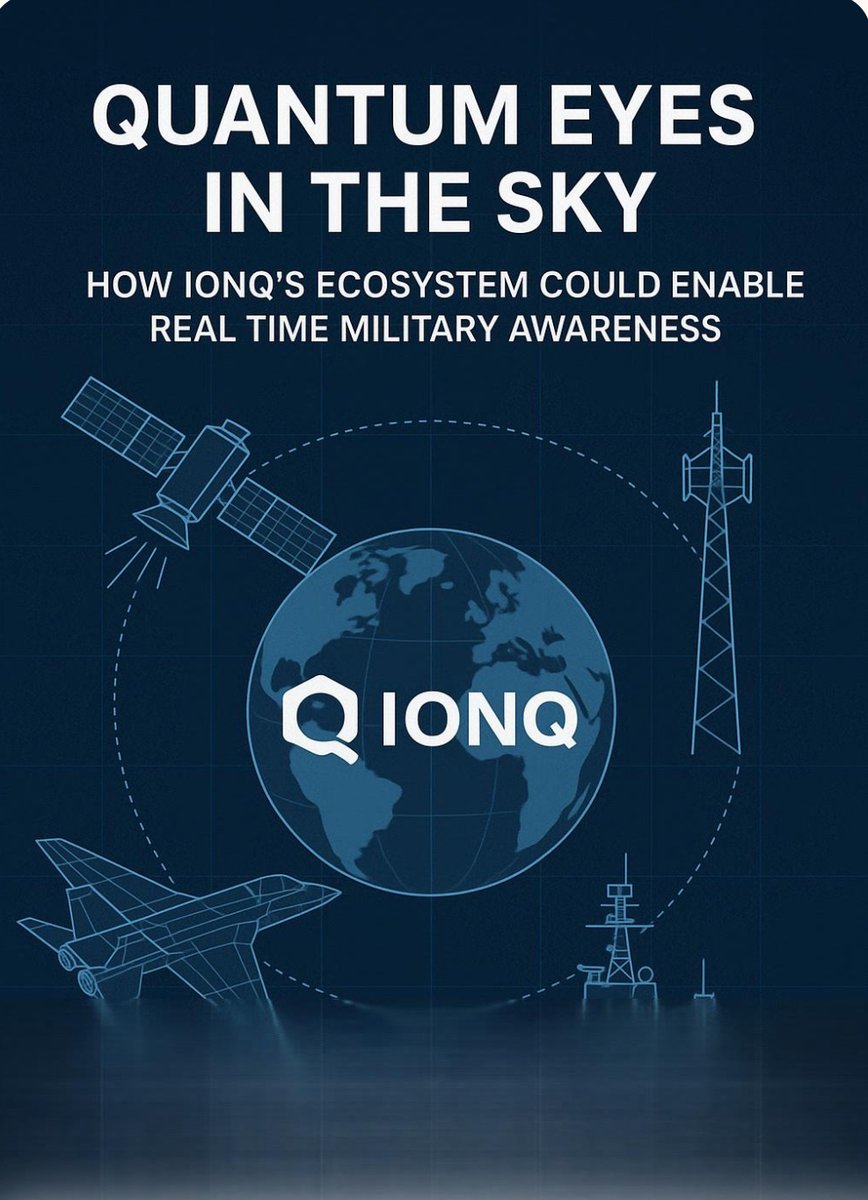
$IonQ Quantum Eyes in the Sky: How IonQ’s Ecosystem Could Enable the DoD’s Real-Time Awareness of Iran’s Nuclear Facility Bombings
For the United States and its allies, national security begins and ends with this very straightforward reality. The DoD doesn’t just need more operational data—it needs better eyes, faster pipelines, and smarter analysis. IonQ is engineering all three.
Today, we see a real-time case as to why quantum networks, created by satellites armed with quantum sensors is critical to the new age of modern warfare, where real-time battleground assessment (BA) is critical.
In an age where information superiority dictates strategic dominance, real-time intelligence on high-value targets—such as Iran’s nuclear facilities—is no longer a luxury but a necessity. IonQ, a U.S.-based quantum computing pioneer, is positioning itself to provide the U.S. Department of Defense (DoD) with an unprecedented advantage in this arena through a rapidly evolving ecosystem of quantum sensors, secure communication infrastructure, and AI-enhanced analysis. Through its recent acquisitions and cross-border partnerships, IonQ is building what amounts to a quantum-powered nervous system for global situational awareness.
Quantum Sensor Constellations: Seeing What Others Can’t
At the heart of IonQ’s strategy is its acquisition of Capella Space, a commercial provider of synthetic aperture radar (SAR) satellites. SAR technology enables sub-meter resolution imaging in any weather or lighting conditions—a crucial advantage for assessing nuclear sites shrouded in secrecy or cloud cover.
When integrated with quantum sensors—including single-photon detectors from ID Quantique—these satellite systems can detect ultra-faint thermal signatures, structural damage, or even radiation anomalies that follow a targeted strike. For the DoD, this means the ability to detect whether centrifuge halls have collapsed, if radiation is leaking, or if defensive decoys are deployed—without boots on the ground.
Quantum Networking & Ultra-Secure Data Links
Damage assessment is only as useful as the speed and security with which that data is delivered. IonQ’s collaboration with Lightsynq, a quantum repeater developer, and Qubitekk, known for battlefield-grade quantum networking solutions, enables entanglement-based communication and quantum key distribution (QKD) across satellite and terrestrial channels.
This guarantees that reconnaissance data—once captured by Capella’s sensors—is relayed securely and instantaneously to command centers without risk of interception or tampering. It's a level of cybersecurity that even the most advanced adversaries cannot crack using conventional or quantum decryption.
The Intellian Factor: On-the-Ground Resilience
IonQ’s recent partnership with Intellian Technologies, a South Korean leader in satellite antenna systems, adds a crucial layer of resilience and deployment agility. Intellian’s rapidly deployable ground terminals enable the DoD to receive quantum-encrypted intelligence at mobile operations centers—whether in forward bases, naval vessels, or airborne command posts.
With Intellian and IonQ’s development centers located just five miles apart in Maryland, rapid hardware-software integration is already underway. These physical synergies matter when response time is measured in seconds, not hours.
AI for Rapid Intelligence Fusion
IonQ’s alliance with General Dynamics Information Technology (GDIT) brings quantum AI into play. GDIT’s military analytics platforms can combine Capella’s SAR data, quantum sensor output, and satellite imagery into a real-time battle damage assessment (BDA) dashboard—flagging anomalies, radiation spikes, or heat signatures that indicate successful strikes or secondary detonations.
This allows analysts and policymakers to confirm the effectiveness of operations at Iranian nuclear sites within minutes, not days—an enormous advantage in managing escalation risks and strategic messaging.
Global Quantum Infrastructure: A Korean Connection
IonQ’s long-term engagement with South Korea, including partnerships with KISTI, SK Telecom, and national universities, is expanding its global reach and ensuring strategic redundancy. With hybrid quantum-classical integration underway in South Korea’s HPC systems, the company is helping build a distributed quantum intelligence network—one that U.S. and allied commanders could tap into for supplementary verification or mission planning in the Indo-Pacific and Middle East regions.
Quantum Superiority at the Tactical Edge
In a scenario where the U.S. needs to verify the results of a strike on Iran’s nuclear program in real time, IonQ’s quantum-powered network becomes a linchpin of modern deterrence. Through sensor fusion, unbreakable communications, and global collaboration, IonQ is not merely advancing technology—it is reshaping the future of military intelligence.
As I shared in my opening sentence, the DoD doesn’t just need more data—it needs better eyes, faster pipelines, and smarter analysis. IonQ is engineering all three. Fortunately, under President Trump's leadership in this area, the right man is at the helm.
One final thought, in reflecting on how swiftly @IonQ_Inc has increased its operations and added all the right pieces with the necessary authorizations, it is clear to me that in the age of modern national defense, IonQ is positioning itself to become a critical infrastructure pillar for the DoD. And that comes down to great leadership who sees the big picture and operates with swift precision.
I served under six presidents -- four Republicans, two Democrats -- only one has failed to serve U.S. national security interests. https://t.co/BiCiIEHsKs via @denverpost
In latest @stltoday op-ed: NGA Dir. Cardillo says, "the future is bright” for NGA, thanks to STEM programs for St. Louis-area students. Read the full op-ed » https://t.co/8GKphIVvu5
🎶 'Fly me to the moon' ... but, even Frank Sinatra would need a map. Check out our latest Mapping Moments to learn how we helped @NASA get to the moon!