The 3 largest IPOs in history (SPCX, ANT, SKHY) all happened in 2026. Great for the companies and the small number of investors who got in when they were private, not so great for average investors who can only buy at IPO prices.
It's time to update accredited investor laws and give the average person the opportunity to get exposure to private markets if they pass a financial literacy test, instead of using a financial means test.
People hold money in thousands of banks, neobanks, and payment platforms in the US, but the value of your dollar doesn’t change depending on where you hold your money. That’s singleness.
Stablecoins don’t have it yet. Converting between one dollar stablecoin to another today typically happens via exchanges, AMMs, or OTC desks. That introduces slippage, a market-driven cost that’s variable and hard to predict, on top of ordinary fees.
In our latest post, our co-founder @AdamZuck13 covers how fiat built singleness, where stablecoins still fall short, and the clearing infrastructure that closes the gap: https://t.co/xUdYDHilKg
Secure wallet operations are an important part of running the TBMC clearinghouse, and we work with best-in-class providers across our stack. Glad to have Utila among them! 💪
Your business holds $USDC, and a vendor invoices you in $RLUSD. Now what?
Today that mismatch sits in the middle of your payment: go to an exchange or OTC desk, sell your USDC, buy RLUSD, eat the slippage and fees, wait for it to settle, maybe bridge chains, and then finally pay the invoice.
All of that to move from a dollar to a dollar.
Together with @notabene_id, we’re removing this complexity. Notabene Flow orchestrates the invoice payment, the TBMC clearinghouse converts between stablecoins with no slippage, 1:1, and with predictable timing. You pay in what you hold, your vendor receives what they want, and you never think about the step in between.
First payment through the integration? Our own invoice. We’re a Notabene customer, so we paid them through Flow with the TBMC clearinghouse handling conversion.
Watch @SamBroner and @na_alice make the payment live:
If you don’t think crypto is the future…
Pay attention to how hard traditional banks are fighting against stablecoins paying yield.
It’s really that simple.
tokenized real estate is one of those ideas i find super interesting
it has everything:
- huge market
- illiquid assets → liquid
- fractionalized ownership
- global access for everyone
but i genuinely dont know if there is real demand for it
this could be a massive paradigm shift in the financialization of attention.
until now, memecoins acted as a crude proxy for quantifying attention. if a topic was hot, someone would spin up a ticker on pumpfun (e.g. $EPSTEINRITUALSACRIFICE”) and attempt to monetize the narrative flow.
but the problem was fragmentation.
the moment a topic trends, 50 identical tickers launch. liquidity gets dispersed. attention gets diluted. insiders and snipers dominate early supply. retail chases shadows. the signal gets lost in noise.
an attention market built natively around prediction mechanisms changes the structure.
instead of fragmented memecoin proxies, you get unified liquidity around a single measurable expression of public interest. less supply-side spam, more demand-side aggregation. cleaner price discovery on cultural momentum.
if polymarket + kaito manage to centralize and standardize that layer, this becomes a new financial primitive like a tradable index of narrative flow.
bullish on both teams.
very curious what the implementation looks like.
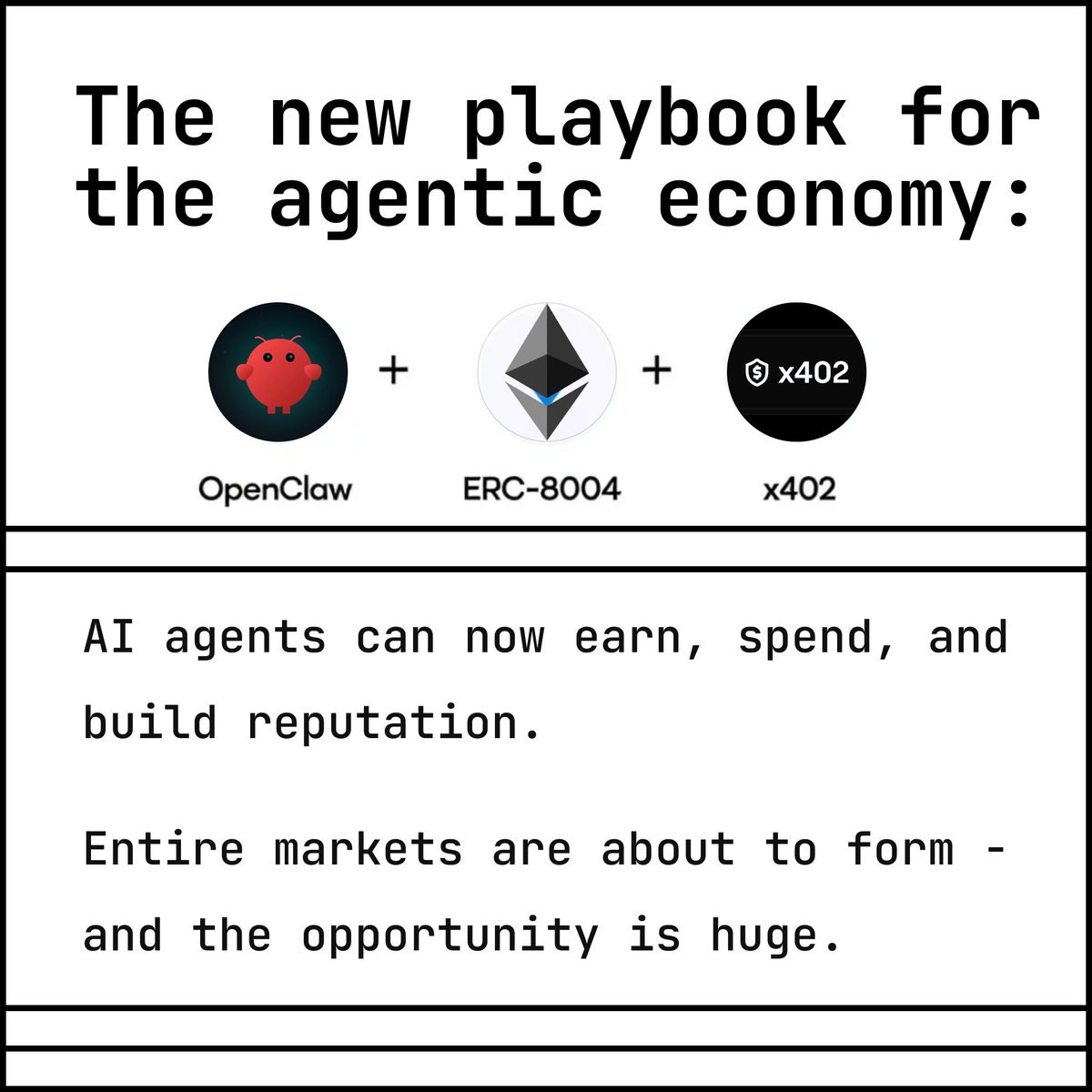
OpenClaw + ERC-8004 + x402 is the new meta
until recently, agents couldn't really build reputation, transact with each other, or prove identity across platforms.
they were trapped in isolated systems, starting from 0 every time.
ethereum's ERC-8004 changes this completely.
pair it together with the rest of the killer-infra-combo, and here're some ideas of what you could build:
- agentic commerce markets (where agents place orders and settle payments across crypto and card rails without humans)
- workflow coordination networks where agents share context, route tasks, and earn reputation scores
- credit lines for agents based on verified onchain activity
- identity verification that travels with the agent everywhere
- decentralized compute feeding live inference into agent decision loops with RWA oracle pricing
and today, ERC-8004 went live on Scroll
agentic txns will need to be fast, cheap, and secure - and Scroll offers all 3:
- super low fees for high-frequency interactions
- ZK proofs for verifiable computation
- full EVM compatibility
this is the birth of the first non-human economy.
agents will soon hire other agents, form companies, build credit histories, compete for contracts.
probably the biggest economic shift since the internet created digital commerce.
don't sleep on it.