As Strategy’s rapidly growing BTC treasury encroaches upon the fixed 21M supply of BTC it should invoke increasing anxiety and the dreaded expectation of fading relevance and momentum for every Bitcoin treasury company except for Strategy.
Once the spot BTC market sells out and there is no more BTC for sale there will no longer be any way to deliver consistent BTC yield.
This will draw the final curtain on all the one-trick-pony companies and their investors that have become monomaniacally enamored by high time preference games like “BTC yield.”
For MSTR shareholders, however, the Bitcoin Terminal Accumulation Point ushers in the dawn of a new chapter, rich with opportunity and rising expectations.
Strategy’s well-established moat, good brand name, strong customer loyalty, top-rated (formally and informally) creditworthiness, and quasi-monopoly status will enable it to serve as the epicenter for the financial system on a Bitcoin Standard.
No name in the financial markets will evoke more trustworthiness and inspire more loyalty than “Strategy.”
“Strat the Standard”
Bitcoin is based on Proof of Work.
The entity that acquires and keeps the most BTC, therefore, has exhibited the most Proof of Work.
Strategy will prove itself as having performed the most Proof of Work soon when it holds the most BTC, even more than Satoshi.
There are few people, if any, who have done as much work for the Bitcoin network as Michael Saylor.
On a daily basis I observe a large volume of criticism from Bitcoin enthusiasts—often self-identified as “plebs,” “maxis,” “cypherpunks,” and “self-sovereign hodlers”—directed toward @Saylor and @Strategy Inc.
You argue that Saylor lacks a true understanding of Bitcoin.
“He’s not one of us.”
“He doesn’t embody the Bitcoin ethos.”
“He doesn’t understand Proof of Work.”
If Saylor doesn’t understand Proof of Work then what does that say about you?
If you believe what Saylor’s doing is so effortless, why not replicate it or another Bitcoin-based billion $ achievement yourself?
What Saylor is accomplishing demands far greater effort and resilience than the average “self-sovereign” pleb’s personal hardware wallets + RaspPi plug-n-play full node setup to manage a relatively small scale BTC balance. (Not that there’s anything wrong with that; it’s actually good.)
Some of these influencers role play as OPSEC-obsessed underground cypherpunks, ever-vigilantly guarding their $10k-$10M of BTC in cold storage against $5 wrench attacks by their affluent neighbors who live in multi-million $ McMansions and would barely dare to run a stop sign.
All too often these individuals start out by proposing some good ideas: secure your BTC in cold storage; run your full node; acquire the necessary equipment. But this quickly devolves into aimless gadgeteering. All of a sudden you’re being pushed into adopting exponentially decreasing marginal improvements in privacy and security while incurring linearly increasing costs (measured in time and money) from the very salesmen who are profiting from all these products and projects, and they will do it all in the name of “ethos”. These distractions draw from your same pool of funds that could otherwise enable you to save/buy more BTC.
Rather than waste time with such performative games, Saylor has positioned himself to serve as a soldier for advancing Bitcoin at the highest possibles stakes. He faces far more intense pressure than any of his critics have ever endured, or likely ever will, from powerful institutional interests eager to dismantle his innovative business model through sophisticated strategies in the media and in the financial markets.
Many others are attempting to achieve even a fraction of his success, and we should applaud them for recognizing a good thing when they see it. Rather than imposing rigid purity tests on fellow Bitcoin advocates, these fellow innovators are mobilizing capital that might otherwise remain idle and directing it toward BTC.
Even those adopting Strategy’s playbook to one degree or another are contributing meaningfully—far more than those who criticize the emergence of aggressive institutional BTC buyers—especially when contrasted with the selling trends among certain Bitcoin maxi “hodlers” who, behind all their big talk, seem to be toting some of the weakest soggy paper hands of all. All of this selling has to be coming from somewhere, and it’s not coming from Strategy.
The recent interview that has garnered undue notoriety, in which Saylor unleashed a tempered degree of righteous anger, serves as a wake-up call for certain factions of the Bitcoin community. It underscores the need to mature and move beyond unprovoked divisive behaviors that hinder our progress.
This is what I perceive to be Saylor’s Strategy. Saylor has proven himself to me as a competent visionary, so I will adapt my own strategy accordingly. By fostering productive collaboration we will accelerate Bitcoin’s rise.
Strategy bought 1229 BTC in a week.
Apparently this represents a mere “speck” unworthy even of being called a “dot” on the chart.
There are only 45 public companies that hold more than that much BTC.
Even to the next largest public Bitcoin Treasury (MARA), such a purchase would increase its BTC Count by 2.3%.
On an annualized basis this addition would amount to a 226% increase per year in BTC Count.
The simple reason other companies aren’t buying this much BTC or anywhere close to it is that they can’t.
Strategy can.
Source: https://t.co/O2hBVH75Wr
Like many of you, I too used to believe MSTR was limited by a 21M BTC market cap.
Then I studied Saylorian Theory and realized I was dead wrong.
The global economy will be:
Built on Bitcoin.
Powered by Bitcoin.
But running on Digital Credit.
Bitcoin is our base, not our ceiling.
🧡 Bright Orange Strategic Future 🧡
Embrace the Saylorian Capital-Currency Framework and escape the TradBit Matrix to see the reality taking shape before your very eyes:
Bitcoin is a hard capital asset that competes with other hard assets.
Credit products compete with other credit products.
Bitcoin is not competing with fiat.
Bitcoin and fiat are natural partners.
Best friends 🟠🤝💸
The world will be powered by digital capital but it will run on digital credit.
Some say USD has insurmountable issues and will spiral to its death.
Let’s say they’re right.
Well, all that means is BTC would need to seek out a new fiat friend to partner with.
What kind of fiat might that be?
One that is more…
Strategic?
Strategy bought 1229 BTC in a week.
Apparently this represents a mere “speck” unworthy even of being called a “dot” on the chart.
There are only 45 public companies that hold more than that much BTC.
Even to the next largest public Bitcoin Treasury (MARA), such a purchase would increase its BTC Count by 2.3%.
On an annualized basis this addition would amount to a 226% increase per year in BTC Count.
The simple reason other companies aren’t buying this much BTC or anywhere close to it is that they can’t.
Strategy can.
Source: https://t.co/O2hBVH75Wr
I think @saylor meant “speck” and not “dot”as all he bought last week was 1,229 BTC for $109 million, funded by selling more $MSTR common. Buying BTC by issuing common isn’t a ‘strategy’
Even the most ardent $MSTR acolyte has to be disappointed with that.
Hyper-fixation on a single variable—BTC Yield—causes investors to miss the forest for the trees.
Things are moving along just fine, all according to Strategy.
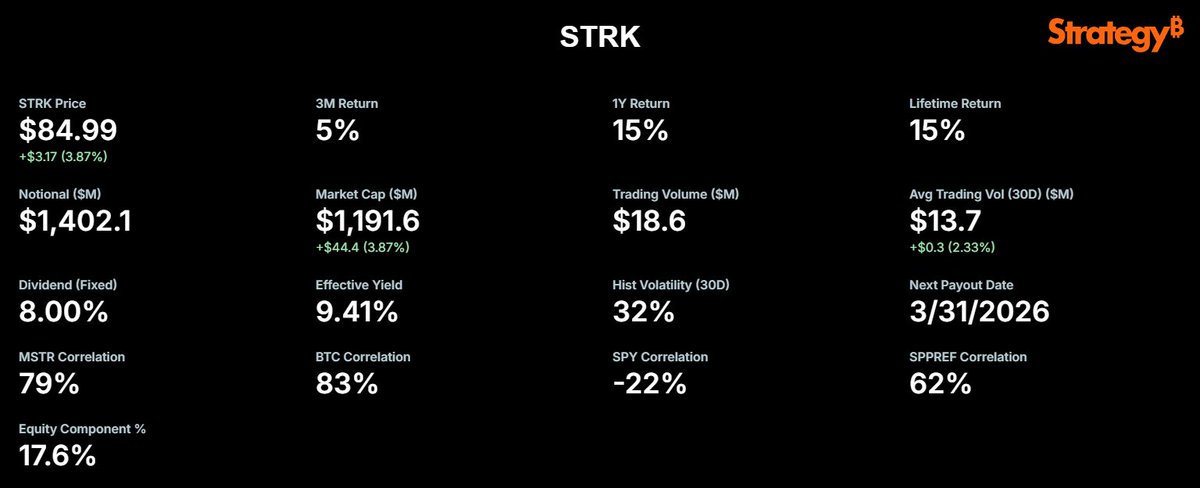
Another week, another round of shareholder value destruction by @Strategy / $MSTR. [1]
• Yield: -0.03%
• MCap/BTCNav: 0.83 (vs 0.86 last week)
Zero leverage/"amplification" from prefs, too.
Truly incredible, buying 1 BTC for 1.2 BTC. 🤡
[1] https://t.co/zzNF4FMTVq






![NitherDither's tweet photo. Another week, another round of shareholder value destruction by @Strategy / $MSTR. [1]
• Yield: -0.03%
• MCap/BTCNav: 0.83 (vs 0.86 last week)
Zero leverage/"amplification" from prefs, too.
Truly incredible, buying 1 BTC for 1.2 BTC. 🤡
[1] https://t.co/zzNF4FMTVq](https://pbs.twimg.com/media/G9VtSaJW4AAfZCF.jpg)


