ICYMI: Canada is an important ally, but an ally should not expect the United States to sacrifice its own industrial base as the price of a trade agreement.
We will always fight for American steel mills, aluminum extruders, and other domestic metals producers.
https://t.co/IYfDCAiqE2
NEWS: According to a report from @TransportTopics, Mexican production of heavy-duty trucks and buses climbed 51.8% year-over-year in July, reaching 14,675 units. Exports increased 66.7% to 13,117 vehicles, with more than 90% of that volume destined for the U.S. market.
Manufacturers making major investments in U.S. workers and facilities should know that American trade policy will reinforce those investments. Strong tariffs on imported commercial vehicles help ensure that the economics favor producing the next truck, expanding the next shift, and building the next plant here in the United States.
https://t.co/zVbiHQwuMS
🚨 NEW REPORT: America now produces just 27% of the medicines it consumes—down from 72% in 2002. Meanwhile, drug shortages are worsening and dependence on China and India continues to grow. CPA’s new report lays out a roadmap to rebuild U.S. generic drug manufacturing before the next crisis hits.
https://t.co/Z78FqHlLAA
New from CPA trade counsel @Charles_Benoit ⮕ America taxes the steel that goes into a food can—but not the imported can full of foreign-grown food. That’s tariff inversion, and it’s helping wipe out U.S. canneries, farms, and jobs. The fix already exists: extend Section 232 to imported canned food.
https://t.co/EOPREdVZCX
.@DefenseOpinion: China’s control over mining and processing of critical minerals for batteries used in U.S. weapons and other gear is especially worrisome. It threatens U.S. national security – a conclusion in a recent report by the Coalition for a Prosperous America (CPA) and the Responsible Battery Coalition (RBC).
The report concludes that the U.S. “loss of control over refining and processing—the midstream stages that transform raw materials into battery-grade inputs— has become a national security threat, enabling China to convert industrial advantages into strategic leverage through gray-zone economic coercion.”
https://t.co/uwffAoyCLY
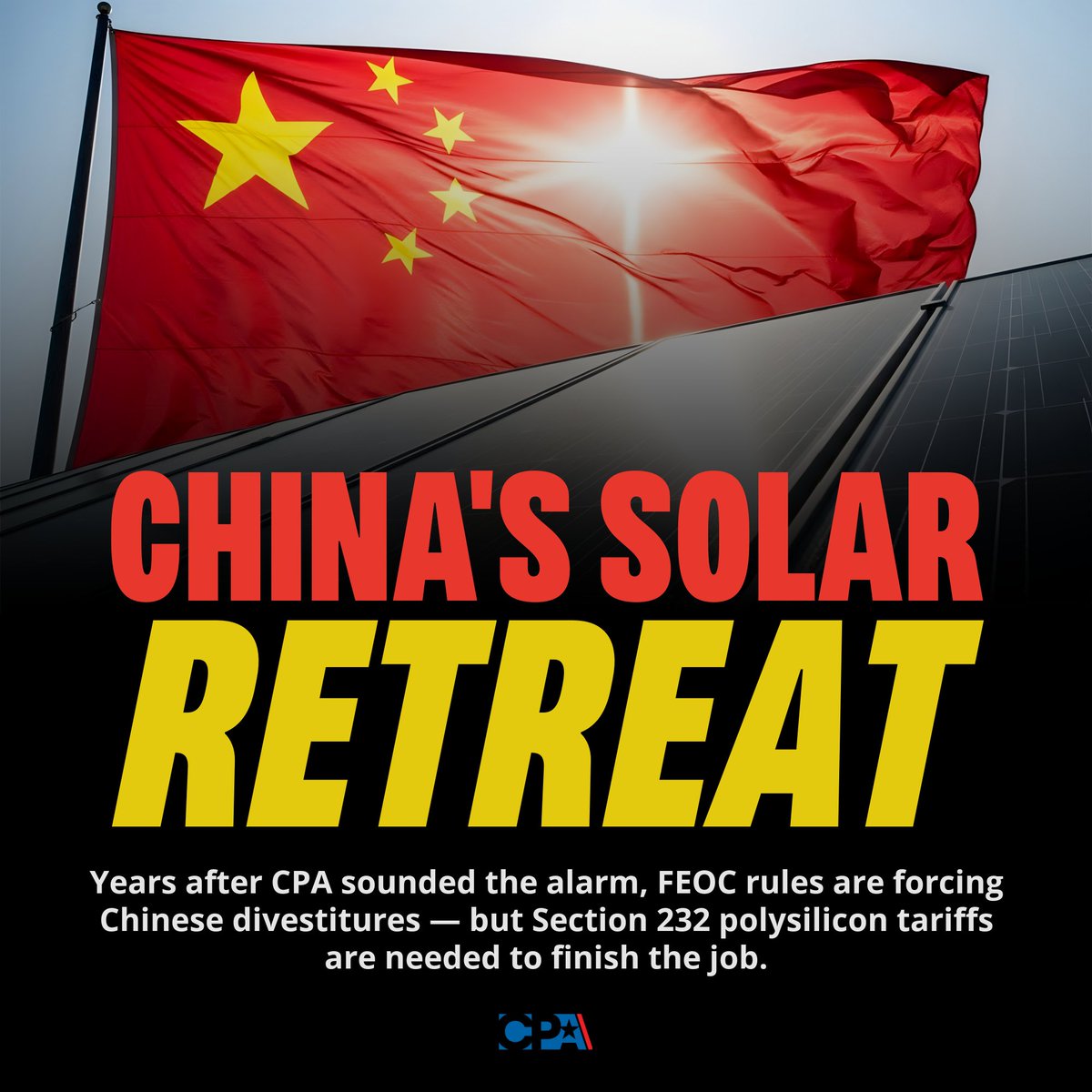
Years ago, CPA warned that China was using American clean-energy tax credits to capture our solar industry, and we led the fight to slam that door shut.
Today, that door is closing. Chinese firms are divesting their U.S. factories at fire-sale prices, and American investors are acquiring the plants, the technology, and the know-how. This is exactly what FEOC was built to do.
https://t.co/uTZaC6bVZe
Read @henryolsenEPPC on Reclaiming American Citizenship, and the linkage of MAGA populism to true citizenship that he identified a decade ago[!].
"...expect Compass’s magnificent articulation of that idea to be cited and drawn upon for years to come." https://t.co/4wBTr7YhTj
Last week, CPA held its 2026 Annual Conference in Washington, DC, bringing together policymakers, industry leaders, and economic experts as America approaches its 250th anniversary.
This year’s theme — “America 250: Back to the Future of Economic Prosperity” — reflected a clear reality: the principles that built this country’s economic strength—tariffs, domestic production, and national industrial policy—are once again central to the future of U.S. prosperity.
Members heard from @SenRickScott, @RepAaronBean, @RepBethVanDuyne, @RepCarolMiller, @RepRonEstes, administration officials from @US_FDA, @CommerceGov, @WHOMB, industry champions and manufacturers and producers from across the country.
Thank you to all who joined us for this premier gathering during a pivotal moment for U.S. trade and industrial policy.
And thanks to our sponsors Charlotte Pipe & Foundry, Sherrill Manufacturing, and Cassidy, Levy, Kent for helping to make it possible!
America can’t rebuild critical supply chains with Fortune 500s alone. @SBAgov is looking to help small businesses scale production of critical minerals, battery components, pharmaceuticals, and other strategic goods—strengthening domestic manufacturing and reducing dependence on China.
U.S.-based battery manufacturers, led by @ClariosGlobal, responded to SBA’s Request for Information from market participants on where to take this initiative, currently in its incubation stage, as members of the @RespBattery Coalition submitted comments on the government's efforts to bring smaller companies into Washington’s reindustrialization efforts.
https://t.co/sdfb3eXgSg
Memorial Day is more than a long weekend. It is a solemn reminder that the freedoms we enjoy were secured by generations of Americans who gave everything in service to their country. Today we honor the fallen, remember their sacrifice, and recommit ourselves to proving worthy of it.
#NeverForget 🇺🇸
AI’s electricity surge shouldn’t fall on ratepayers.
Solar bridges to nuclear, but built with American panels, by American workers. Big Tech pays its own way.
My latest: https://t.co/2F4NRwGwGO
NEW: This week’s episode of #TheBig3 features special guest Rogan Quinn of @rhodium_group, author of "Minerals, Metals and Megawatts: How China’s Power Generation Drives Its Industrial Metals Ecosystem."
Quinn joins CPA economists @CPAMihir and @AndrewRech to explain how China became what he calls an “electrostate” — an industrial power whose dominance in electricity generation, metals processing, and manufacturing mutually reinforce one another.
The conversation breaks down how China’s cheap thermal power, hydroelectric capacity, state-backed credit, and local-government growth incentives helped build the world’s most powerful metals and electrification supply chain. Rather than simply controlling minerals in the ground, China dominates what happens after extraction: refining, smelting, separation, processing, and downstream manufacturing for batteries, EVs, solar panels, electronics, and other electric-current-driven industries.
Quinn also highlights the demand side of China’s system, especially batteries, where falling costs have opened new use cases across vehicles, storage, and heavy-duty trucking. But the system contains major vulnerabilities, including weak cash flows, overcapacity, global demand dependence, and exposure to recession.
The episode closes with lessons from Japan and South Korea, and Quinn’s central takeaway: any country hoping to compete with China’s industrial ecosystem must solve the problem of abundant, cheap power.
🔊 Listen on Apple: https://t.co/EQpYlBNs4f
🔊 Listen on Spotify: https://t.co/zAtsD57prJ
.@CPAMihir: Every U.S. president since Reagan has believed that the right combination of personal chemistry and presidential leverage could pull Beijing toward American interests.
But nothing has worked.
Tactical concessions cannot buy durable cooperation from a regime whose stated objective is to displace the United States by mid-century.
The most consequential outcome @POTUS Trump can achieve is making clear that America is prioritizing its home market.
https://t.co/l7Grvh3Se6
.@RealPNavarro on foreign ownership and influence behind big meatpackers: "It’s not just price gouging and price fixing we have to worry about. It’s also the influence of foreigners on our supply chain."
Johnny has been an extraordinary leader for @ISI, and truly represents the best of American conservatism. I am looking forward to his next chapter, and the success he will undoubtedly achieve with it.
“The deeper measure of Johnny's tenure is that, under his leadership, ISI has remained what it has always been: a civilizational organization, deeply imbued with the spirit of liberal learning.”
—@ISI Chairman, Mark Henrie
(1/6)
This week’s episode of #TheBig3 focused on CPA’s new report on the foreign control of America’s antibiotic supply chain and the collapse of the domestic production base that once supported it.
CPA economists @CPAMihir and @AndrewRech traced the story back to an East Syracuse, New York facility that once produced 70% of America’s penicillin supply, but now produces nothing, symbolizing how the U.S. lost control of a critical industry.
The discussion highlighted how China now supplies roughly 87% of the antibiotic active pharmaceutical ingredients imported by the United States, while India formulates much of those ingredients into the finished drugs Americans consume.
The hosts stressed that this is not just a country-level dependence, but a highly concentrated firm-level chokepoint, with a handful of companies controlling much of the trade. They also underscored that foreign producers are not merely cheaper — in some cases, they are cutting corners on safety, falsifying data, and exposing American patients to greater risk.
Finally, the episode explored how policymakers can begin rebuilding antibiotic sovereignty through a mix of tariff-rate quotas, procurement reform, allied sourcing, and support for the remaining Western footholds in production and the limited final-dose capacity still operating in the United States.
Chapters:
00:00 - Introduction
01:38 - How America Lost its Antibiotic Industrial Base
09:57 - China's API Chokepoint, India's Role, & the Dangers of Concentrated Control
14:22 - Tariffs, Procurement Reform, & the Road Back to Antibiotic Sovereignty
🔊 Listen on Apple: https://t.co/EQpYlBNs4f
🔊 Listen on Spotify: https://t.co/zAtsD57prJ