Imagine walking into McDonald’s and they pay YOU to eat a Big Mac.
That's the global copper market right now.
Welcome to the upside-down world of "Copper's McDonald's Economics.
🔊 Listen on Apple: https://t.co/8tE6xLe29G
📷 Listen on Spotify: https://t.co/kkLneYiVTr
This week on The Big 3, CPA economists @CPAMihir and @AndrewRech sit down with Ben Carlson of @Securing_Energy's (SAFE) Center for Strategic Industrial Materials to examine China’s growing dominance in steel, aluminum, and copper—and what it means for America’s industrial future.
The conversation centers on SAFE’s new report, "Strategic Surpluses: China’s Economic Warfare on Major Metals," which argues that China’s vast production capacity is not simply the result of market forces or planning mistakes. Instead, Carlson explains how Beijing has deliberately cultivated strategic surpluses across key industrial sectors, creating manufacturing capacity that can support economic objectives in peacetime and national security objectives during periods of conflict.
The discussion explores the staggering scale of China’s metal production, the role of state support and industrial subsidies, and the consequences for American manufacturers. Carlson also explains why tariffs, while important, are often insufficient on their own. Through transshipment, tariff inversion, and complex global supply chains, subsidized Chinese inputs can still find their way into the U.S. market through finished products.
Finally, the episode turns to solutions. What would a successful American industrial strategy actually look like? The answer goes beyond tariffs to include energy policy, infrastructure investment, permitting reform, recycling, and stronger rules of origin that align domestic demand with domestic production. For anyone interested in trade, manufacturing, national security, or industrial policy, this is an essential conversation about one of the defining economic challenges of our time.
🔊 Listen on Apple: https://t.co/EQpYlBNs4f
🔊 Listen on Spotify: https://t.co/zAtsD57prJ
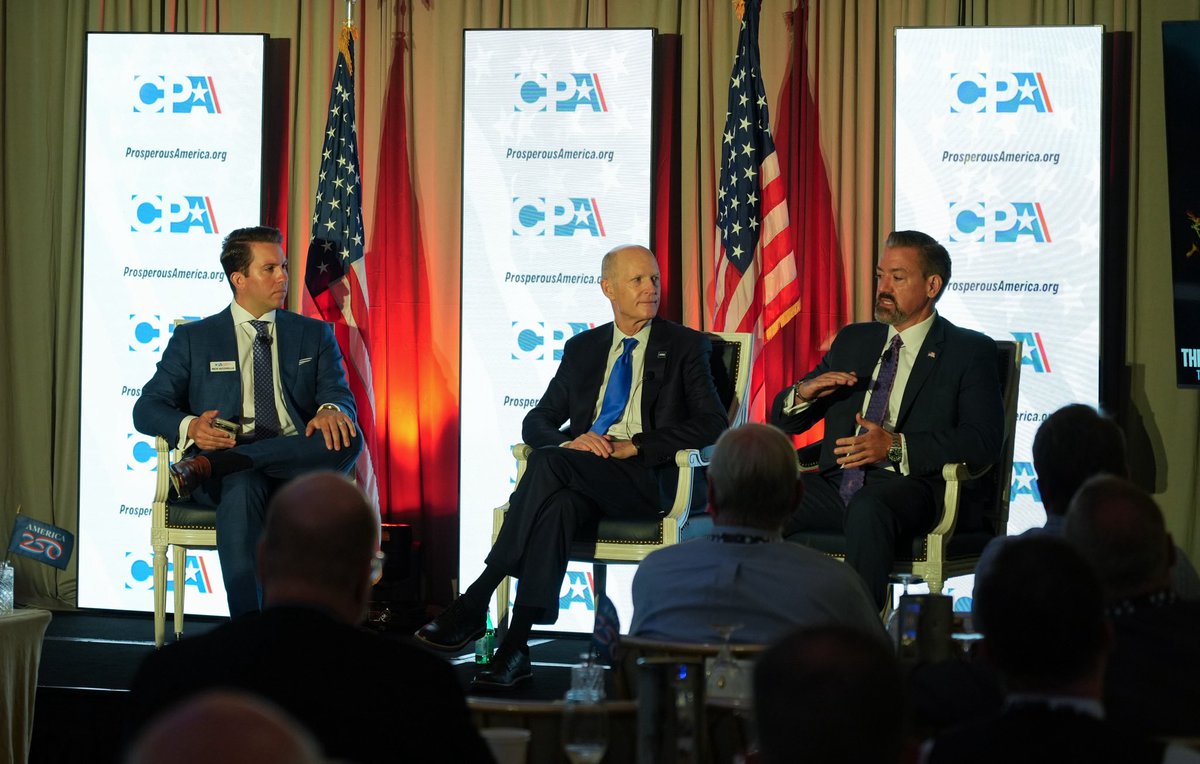
Chairman @SenRickScott joined Dr. Kevin Rhodes of @WHOMB and @cpa_tradereform to talk about the risks of relying on COMMUNIST CHINA for products Americans depend on.
They’re working to bring drug manufacturing back to the U.S so Americans can TRUST what’s in their medicines.
ICYMI: Ahead of last week's China Summit between @POTUS and Xi Jinping, @CPAMihir noted that the most consequential outcome President Trump could achieve was to make clear that America is prioritizing its home market.
The history of U.S.-China relations is littered with American presidents trying to convert engagement with Beijing into leverage and coming up empty-handed.
Tariffs have done more to discipline Chinese trade behavior than three decades of dialogue.
https://t.co/x5DPwBPcSR
NEW: This week’s episode of #TheBig3 features special guest Rogan Quinn of @rhodium_group, author of "Minerals, Metals and Megawatts: How China’s Power Generation Drives Its Industrial Metals Ecosystem."
Quinn joins CPA economists @CPAMihir and @AndrewRech to explain how China became what he calls an “electrostate” — an industrial power whose dominance in electricity generation, metals processing, and manufacturing mutually reinforce one another.
The conversation breaks down how China’s cheap thermal power, hydroelectric capacity, state-backed credit, and local-government growth incentives helped build the world’s most powerful metals and electrification supply chain. Rather than simply controlling minerals in the ground, China dominates what happens after extraction: refining, smelting, separation, processing, and downstream manufacturing for batteries, EVs, solar panels, electronics, and other electric-current-driven industries.
Quinn also highlights the demand side of China’s system, especially batteries, where falling costs have opened new use cases across vehicles, storage, and heavy-duty trucking. But the system contains major vulnerabilities, including weak cash flows, overcapacity, global demand dependence, and exposure to recession.
The episode closes with lessons from Japan and South Korea, and Quinn’s central takeaway: any country hoping to compete with China’s industrial ecosystem must solve the problem of abundant, cheap power.
🔊 Listen on Apple: https://t.co/EQpYlBNs4f
🔊 Listen on Spotify: https://t.co/zAtsD57prJ
.@CPAMihir: Every U.S. president since Reagan has believed that the right combination of personal chemistry and presidential leverage could pull Beijing toward American interests.
But nothing has worked.
Tactical concessions cannot buy durable cooperation from a regime whose stated objective is to displace the United States by mid-century.
The most consequential outcome @POTUS Trump can achieve is making clear that America is prioritizing its home market.
https://t.co/l7Grvh3Se6
📺 WATCH: This week’s episode of #TheBig3 welcomes special guest Beth Baltzan, former senior advisor to U.S. Trade Representative @AmbassadorTai during the Biden Administration and now deputy director of the Coalition for New Trade (@NewTradeCo), for a wide-ranging discussion on how the global trading system broke — and what should replace it.
Baltzan argues that the postwar system originally recognized the danger of unchecked capital mobility and sought to empower workers, but that framework unraveled as floating exchange rates, liberalized capital flows, and free-trade orthodoxy took hold.
The conversation traces how the WTO-era model rewarded capital, weakened labor, and encouraged supply-chain concentration — most visibly through China’s manufacturing dominance and the COVID-era shortages that exposed U.S. vulnerability.
Hosts @CPAMihir and @AndrewRech highlight how import competition and offshoring suppressed wages, hollowed out industrial communities, and shifted economic gains away from workers.
Baltzan makes the case for a new trade framework built around resilience, labor rights, environmental standards, and corrective action — not reflexive free trade agreements.
The episode closes with a discussion of the upcoming USMCA review, rapid-response labor enforcement, digital trade risks, and the need for a bipartisan industrial strategy that rebuilds domestic production while creating a fairer global trading system.
CHAPTERS:
00:00 - Introduction
03:24 - Bretton Woods, Broken Promises, & the Rise of Capital-First Trade
19:35 - China Shock, Supply Fragility, & the Worker Cost of Free Trade
44:42 - USMCA Review, Labor Rights, & the Fight for Resilient Trade
🔊 Listen on Apple: https://t.co/EQpYlBNs4f
🔊 Listen on Spotify: https://t.co/zAtsD57prJ
America's A.I. data center buildout has exposed three distinct failures in U.S. trade and industrial policy, writes senior economist @CPAMihir:
1️⃣ For computing hardware, tariffs and export controls succeeded in moving sourcing away from China but failed to bring production home — the United States still imports virtually all of its servers.
2️⃣ For transformers, tariffs appear to have moved the shipping route rather than the supply chain, with Chinese exports flowing through Vietnam and Thailand on their way to U.S. data centers.
3️⃣ For lithium-ion batteries, tariffs have barely dented China’s dominance, and the upstream cathode materials that determine actual supply chain security have no non-Chinese source at any scale.
The policy tools exist. Production tax credits can make domestic manufacturing competitive. FEOC restrictions can ensure federal dollars flow to genuinely independent supply chains. Anti-circumvention investigations can close the transformer rerouting loophole. The Defense Production Act can designate critical battery materials for strategic stockpiling. Allied investment partnerships can build cathode processing capacity outside China.
Washington proved it can redirect trade flows. It has not yet proved it can rebuild industrial capacity. The data center buildout will determine which matters more.
https://t.co/9VQ7Nf4nYb
This week’s episode of #TheBig3 used @CPAMihir's recent Ohio State debate on whether tariffs are “just” as a springboard to examine three core arguments in the trade debate: affordability, employment, and production.
First, Mihir and @AndrewRech argued that the cost-of-living crisis is being misdiagnosed. While tariffs are often blamed for inflation, they noted that the biggest drivers of household strain are non-tradable essentials like shelter, healthcare, and energy, not tariff-affected manufactured goods.
They pointed to a recent Minneapolis Fed analysis and category-level inflation data to argue that tariffs cannot explain the broader rise in prices.
Second, the discussion turned to employment and inequality. The hosts argued that free trade did not lift all boats, but instead helped drive factory closures, job displacement, wage stagnation, and wider regional decline, while the biggest gains flowed to capital, top earners, and asset holders.
Finally, the team examined whether tariffs are actually driving reshoring. Here, the hosts pointed to rising durable goods orders, stronger manufacturing PMI readings, improved labor productivity, and gains in domestic market share and output in sectors like primary metals and motor vehicles.
Their larger point was that tariffs, done right and sustained over time, can help redirect the economy away from consumption and toward production.
🔊 Listen on Apple: https://t.co/EQpYlBNs4f
🔊 Listen on Spotify: https://t.co/zAtsD57prJ
.@CPAMihir: A single key mineral processing dependency can now disrupt America’s transportation fleets, logistics systems, data centers and military-related infrastructure. That’s because all of these technologies depend on reliable battery systems.
It’s an intolerable situation for the United States to be so beholden to Beijing. That’s why, with global tensions soaring, Congress must get on a wartime footing and start rebuilding domestic U.S. extraction, processing and refining of key minerals.
The clock is ticking, since China has already consolidated its hold over the midstream stages of battery supply chains. Washington must intensify efforts to rebuild domestic critical mineral supply chains.
https://t.co/6y0cwDBIvg
📚 CPA ON CAMPUS: During a recent debate with the @TaxFoundation at @OhioState, senior economist @CPAMihir argued that trade policy should not be judged only by the price tag at checkout, but by whether it supports productive work, stronger communities, and an economy where the gains of growth are broadly shared.
TORSEKAR: “The students in this room are going to inherit the economy that today’s trade policy builds. The Fed’s own survey says your age group – 18 to 29 – reports the lowest financial well-being of any generation. The rewards of this economy are flowing to capital, not to labor.
That is not a natural law. It is the result of choices — and it can be changed. So the question ‘are tariffs just?’ is really a question about what kind of economy you want to live in. One that measures success by the price of consumer goods while wages fall behind the cost of living? Or one that asks whether people have productive work, whether communities can sustain themselves, and whether the gains of growth are broadly shared. I think justice demands the second vision.”
https://t.co/Z0KM8eCVpk
.@CPAMihir: If you walk the floors of @WhirlpoolCorp's manufacturing plants, you will see what 115 years of commitment to domestic production has built.
8,000 manufacturing workers across six Ohio facilities, a company that sources 96% of its steel from American mills, and a $300 million expansion that is adding hundreds of jobs in communities where families have built careers on the factory floor for three generations.
Six Ohio plants, $23 billion in U.S. spending over the past decade, and a new vertically integrated facility in Perrysburg that will drive greater competitiveness.
Whirlpool’s story validates a central premise of the pro-industrialization agenda: companies that invest in America can compete and win when trade policy stops subsidizing offshoring.
For decades, the prevailing economic consensus held that domestic manufacturing was a relic, that American firms could not compete with low-cost Asian production, and that consumers were better served by cheap imports regardless of what they cost in jobs and industrial capacity. Whirlpool Corporation’s continued investment proves the opposite conclusion.
https://t.co/ra7YThiHyl
The pattern is familiar. The United States invents a transformative technology (e.g. solar panels, semiconductors, and lithium-ion batteries) only to see China capture the technology through coordinated state investment, supply-chain integration, and outright theft.
The same has happened with nuclear fusion. Beyond its utility as an energy source, fusion is the foundation of twenty-first-century military capability, AI infrastructure, and industrial competitiveness. China understands this and is investing accordingly.
The race to commercialize nuclear fusion will define the next era of geopolitical power. The United States built the scientific foundations of fusion energy and led the world in research for more than half a century. That lead is eroding, says CPA Senior Economist @CPAMihir.
https://t.co/jybNwqAvib
NEW: A recent @60Minutes segment gave the @CatoInstitute a platform to argue that America’s shipbuilding crisis proves protectionist industrial policy has failed. The opposite is true: the crisis is the product of four decades without an industrial policy.
The segment asked the right question: can American shipbuilding be saved? The answer is yes. The path runs through more industrial policy, not less. Beijing built its shipbuilding dominance through decades of patient state investment. The United States once held the industrial advantage that China holds today. American shipyards, not superior seamanship, decided the outcome of the Pacific war.
The free-market critique offered on 60 Minutes has been tested repeatedly across solar, batteries, rare earths, and steel; in every case, the result was deeper American dependence on China, not the efficient market outcome its proponents promised.
Shipbuilding is too important to run the same experiment again.
https://t.co/raaWL2H4Nj
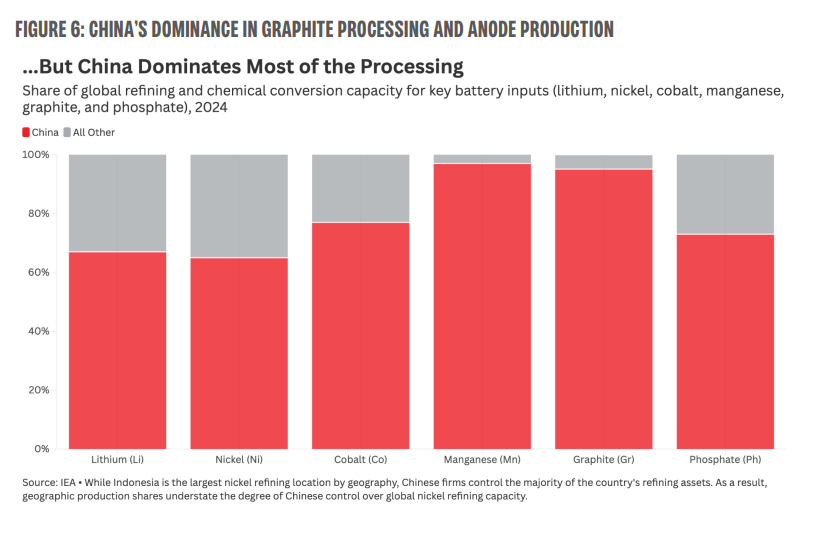
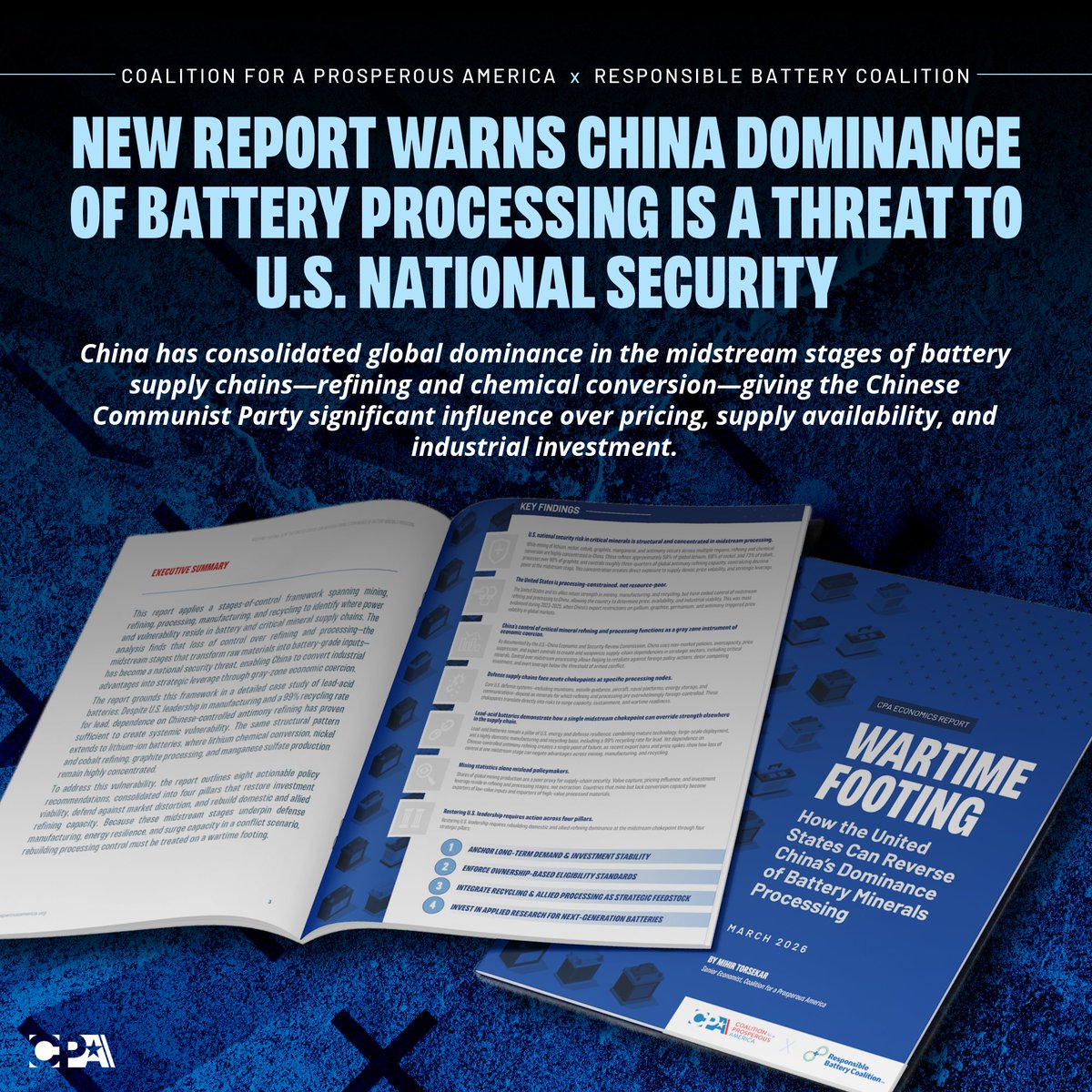
China has consolidated global dominance in the midstream stages of battery supply chains—refining and chemical conversion—giving the Chinese Communist Party significant influence over pricing, supply availability, and industrial investment.
Here's the hard truth: Battery supply chains underpin everything from electric vehicles to military logistics and grid resilience. If the United States does not rebuild control over the refining and processing stages of production, it will remain exposed to supply disruptions and strategic leverage from foreign adversaries.
WATCH the full episode here: https://t.co/AeRFzZdO6e
CPA President Jon Toomey: “America’s healthcare system cannot remain dependent on fragile and subsidized foreign supply chains for generic pharmaceuticals and other critical countermeasures that are fundamental to patient care. @CMSGov has a timely opportunity to use Medicare’s purchasing power to rebuild domestic manufacturing capacity, strengthen supply chain resilience, ensure higher standards of quality and safety for patients, and bolster our national security against such critical industries propped up and heavily subsidized by the Chinese state military apparatus.”
https://t.co/WYqC9SNl5f
NEW: China’s $1.2 trillion goods surplus didn’t happen by accident. New @FederalReserve research finds a clear link between Beijing’s industrial policy and export growth — reinforcing CPA’s years-long warning that overcapacity and state support are warping global trade.
https://t.co/HMVD3zLlW4
🔋 WARTIME FOOTING: This week's episode of #TheBig3 focused on the national security risks of America’s dependence on China for critical minerals processing, especially in the lead-acid battery supply chain.
CPA senior economists @CPAMihir and @AndrewRech were joined by retired Major General Bill Crane and retired Rear Admiral Peter Brown to discuss CPA’s new report with the @RespBattery Coalition on how the United States can reverse China’s dominance in minerals processing.
The conversation explored why lead-acid batteries remain indispensable to the American economy and military readiness, powering everything from trucks and hospitals to telecom systems and defense infrastructure.
The second segment examined the strategic vulnerability created by China’s control over antimony processing, ports, shipping, and industrial inputs, with General Crane and Admiral Brown warning that America has offshored not just production, but surge capacity in the event of conflict.
The final segment turned to policy solutions, including Project Vault, tariffs, domestic stockpiling, maritime capacity, and the importance of extending the 45X tax credit to encourage onshore processing and manufacturing.
The message was clear: Economic security and national security are inseparable, and rebuilding America’s industrial base is essential not only for today’s competitiveness, but for future generations.
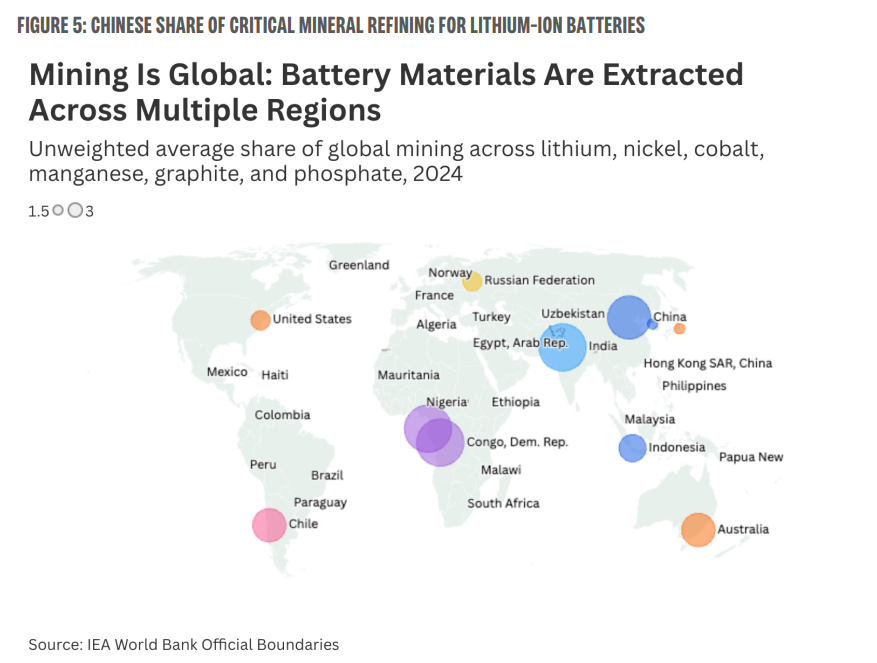
It’s a common myth that the U.S. lacks the raw materials for a battery-powered future.
The reality?
We are processing-constrained, not resource-poor. While mining happens globally, China currently controls the "midstream" chokepoint.
Learn more: https://t.co/C00vG4ylYB
The U.S. isn’t resource-poor. It’s processing-poor.
New CPA and @RespBattery Coalition research warns China’s grip on battery minerals processing gives Beijing dangerous leverage over U.S. manufacturing, logistics, and national security.
@CPAMihir's new report, “Wartime Footing: How the United States Can Reverse China’s Dominance of Battery Minerals Processing,” underscores a hard reality: the United States is dangerously short on the ability to process critical minerals into the materials our economy and military depend on every day.
https://t.co/0KKcT8pAMc