May Allah guide you and us and keep us firm upon Islam. You should have a discussion with knowledgeable people to clear your doubts. I highly suggest the orthodox muslim, and even watching his videos. He addresses lot of things non-muslims and even muslims have questions about. You can email him and you guys can hopefully talk in private.
If you’re sincere in sha Allah, Allah will guide you. But if you have ill intentions when learning about the religion and try to use misconceptions or flawed reasoning to hate on or spread falsehood then don’t expect goodness
@FreeTheDragons@Kruveux@UncYoda It’s the atheists that can’t objectively refute slavery whereas Muslims can refute it because Allah is the authority who alone decides what’s wrong and right. Revelation solves disputes between humans whereas subjective morality only fuels it.
@HannahMakay@LordofCinder24 What would be the issue? No one has ever given a reason for why it’s wrong. They always dodge the question by either insulting or keep asking «hOw»
@AkramKarani@HanbaliRegiment@Haqiqatjou Yeah if he did say the second point then he’s a disbeliever without a doubt but how is the first point kufr? Attacking the kabah is kufr 100% but is it still kufr if it’s other than that?
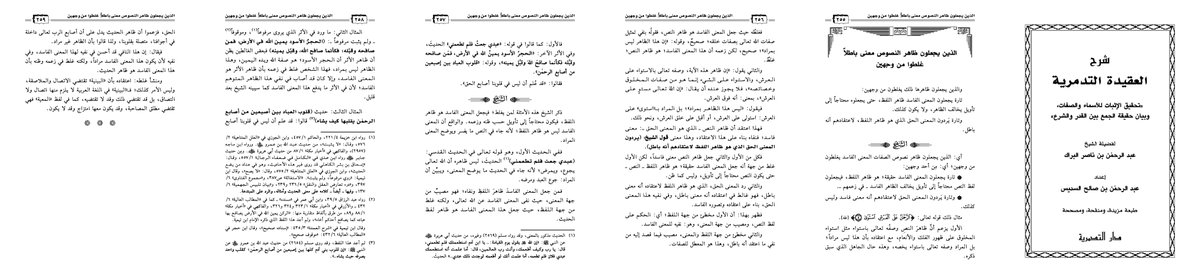
The Meaning of Taking the Apparent Meaning of Allāh's Attributes
Ibn Taymiyyah (d. 728AH) explained that the expression ẓāhir (apparent meaning) is ambiguous because it can refer to more than one meaning. Consequently, when someone claims that the apparent meaning of the texts concerning Allāh's attributes is either intended or not intended, the meaning of the expression must first be established.
The apparent meaning of speech is the meaning that naturally comes to the mind of someone who possesses sound understanding and knowledge of the language.
According to the Salaf, the apparent meaning of the texts concerning Allāh's attributes is the meaning that befits Allāh, not a meaning that resembles the attributes of creation.
Therefore, if someone understands the apparent meaning to be tamthīl (likening Allāh to His creation), such a meaning is certainly not intended.
However, the Salaf never regarded this false understanding as the apparent meaning of the Qurʾān and Sunnah. Nor did they accept that the Speech of Allāh apparently conveys kufr (disbelief) or ḍalāl (misguidance). (Sharḥ al Risālah al Tadmuriyyah, al Barrāk, pp. 251–252).
The Different Understandings of the Apparent Meaning
Shaykh ʿAbd al Raḥmān al Barrāk explained that the disagreement arises because people understand ẓāhir (apparent meaning) differently. There are four positions concerning the texts of Allāh's attributes.
The first position is to affirm that the apparent meaning is intended, understanding it as the affirmation of Allāh's attributes in a manner befitting His Majesty and Perfection. This is the correct position in both wording and meaning, and it is the way of Ahl al Sunnah.
The second position is to affirm that the apparent meaning is intended while understanding it as resemblance between Allāh and His creation. This is the position of the Mushabbihah (those who liken Allāh to creation), and it is false in both wording and meaning.
The third position is to reject the apparent meaning because of the belief that affirming Allāh's attributes necessarily entails tashbīh (likening Allāh to creation). Although rejecting resemblance is correct, denying the attributes themselves is false. This position arises from mistakenly believing that resemblance is the apparent meaning.
The fourth position is to reject the apparent meaning because it is understood to mean resemblance, while nevertheless affirming the attributes in a manner befitting Allāh. This position is correct in rejecting resemblance and affirming the attributes, but incorrect in describing resemblance as their apparent meaning.
Thus, the fundamental error is assuming that the apparent meaning of Allāh's attributes is resemblance to creation. The true apparent meaning is the affirmation of the attributes in a manner befitting Allāh, without tamthīl (likening Him to creation). (Sharḥ al Risālah al Tadmuriyyah, al Barrāk, pp. 252–253).
Why the Apparent Meaning Cannot Be Disbelief or Falsehood
Ibn Taymiyyah rejected the claim that the apparent meaning of the Qurʾān and Sunnah is kufr (disbelief) or ḍalāl (misguidance).
Such a claim would imply that Allāh addressed His servants with words whose apparent meaning is false, while intending something contrary to what they naturally understood. This contradicts the Wisdom of Allāh, the clarity of His Speech, and the fact that He revealed the best speech.
Allāh says:
اللَّهُ نَزَّلَ أَحْسَنَ الْحَدِيثِ
"Allāh has sent down the best statement." (al Zumar 39:23).
It would also imply that Allāh was unable to explain His intended meaning, was unaware of how His words would be understood, or deliberately concealed His intended meaning. Allāh and His Messenger ﷺ are free from all such deficiencies, for Allāh possesses perfect Knowledge and Wisdom, and the Messenger ﷺ conveyed the revelation with complete clarity.
Therefore, it is not permissible to claim that the apparent meaning of Allāh's Speech is false simply because someone has mistakenly understood it to imply resemblance to creation. (Sharḥ al Risālah al Tadmuriyyah, al Barrāk, pp. 253–254; Darʾ Taʿāruḍ al ʿAql wa al Naql, Ibn Taymiyyah, 1/22).
The Two Errors of Those Who Reject the Apparent Meaning
Ibn Taymiyyah explained that those who regard the apparent meaning of the texts concerning Allāh's attributes as false have fallen into two errors.
The first is to assume that a false meaning is the apparent meaning of the wording, and then to claim that the wording requires taʾwīl (interpretation away from that supposed meaning). In reality, the false meaning was never the correct apparent meaning.
The second is to reject the true meaning indicated by the wording because of the mistaken belief that this meaning is false.
Shaykh al Barrāk showed these errors through the statement of Allāh:
الرَّحْمَٰنُ عَلَى الْعَرْشِ اسْتَوَىٰ
"The Most Merciful rose above the Throne." (Ṭā Hā 20:5).
The first person assumes that istiwāʾ (rising above the Throne) means rising in the manner of creation. Such a person correctly rejects resemblance but wrongly assumes that this resemblance is the apparent meaning of the verse.
The second person rejects Allāh's real istiwāʾ above the Throne because of the belief that rising above something is only possible for creation. Consequently, the verse is interpreted to mean that Allāh conquered the Throne or turned towards creating it.
Both positions are incorrect. The first wrongly attributes a false meaning to the wording, while the second rejects the true meaning because of a false understanding.
The correct meaning is that Allāh truly rose above His Throne in a manner befitting Him, without resembling His creation and without interpreting His istiwāʾ as something other than its true meaning. (Sharḥ al Risālah al Tadmuriyyah, al Barrāk, pp. 255–256).
Why Certain Aḥādīth Do Not Justify Rejecting the Apparent Meaning
Ibn Taymiyyah addressed three reports used by those who claimed that the apparent meanings of texts cannot always be accepted.
The Ḥadīth Concerning Allāh's Hunger and Illness
Among the examples was the Ḥadīth Qudsī (a sacred narration from Allāh) concerning Allāh saying, "My servant, I was hungry, and you did not feed Me."
Some claimed that the apparent meaning suggests that Allāh experiences hunger, and therefore the apparent meaning must be rejected.
However, the authentic ḥadīth itself explains the intended meaning. Allāh mentions a servant who was hungry and was not fed, and another servant who was ill and was not visited.
The hunger and illness belong to the servants, not to Allāh. The wording of the ḥadīth itself makes this clear.
Shaykh al Barrāk further explained that the expression concerning the sick servant indicates a special relationship of ʿubūdiyyah (servitude to Allāh). Visiting the sick servant is also connected to Allāh's special qurb (closeness) and maʿiyyah (being with His servant).
Every special closeness entails special maʿiyyah, although special maʿiyyah does not necessarily entail special closeness.
Therefore, the correct meaning is established by the ḥadīth itself, without needing to reject its apparent meaning or introduce an interpretation contrary to its wording. (Ṣaḥīḥ Muslim, 2569; Sharḥ al Risālah al Tadmuriyyah, al Barrāk, pp. 257–258, 260–261).
The Report Concerning the Black Stone
Another example was the report describing the Black Stone as the right hand of Allāh on earth, stating that whoever touches and kisses it is as though he has shaken hands with Allāh and kissed His right hand.
Some mistakenly understood this to mean that the Black Stone is literally an attribute of Allāh. Consequently, they claimed that the apparent meaning must be rejected.
However, the wording itself distinguishes between the Black Stone and Allāh. It describes the Stone as being on earth and uses a comparison, saying that touching and kissing it is as though someone has shaken hands with Allāh.
A comparison does not establish that the two things are identical. Therefore, the report does not mean that the Black Stone is literally Allāh's right hand or that touching it, constitutes touching Allāh.
Shaykh al Barrāk also clarified that this report is known from Ibn ʿAbbās رضي الله عنه, rather than being reliably established as a statement of the Prophet ﷺ.
Thus, the supposed false meaning arises from misunderstanding the wording, rather than from its true apparent meaning. (Sharḥ al Risālah al Tadmuriyyah, al Barrāk, pp. 257–258, 260–261).
The Ḥadīth Concerning the Hearts Between the Fingers of Allāh
The third example was the statement of the Prophet ﷺ that the hearts of the servants are between two fingers of al Raḥmān (the Most Merciful), and that He turns them however He wills.
Some assumed that the apparent meaning requires Allāh's fingers to be inside the bodies of His servants, touching their hearts. Consequently, they rejected this supposed apparent meaning.
Shaykh al Barrāk explained that the expression bayna (between) does not necessarily entail contact or attachment. In Arabic, something may be described as being between other things without touching them, just as the expression maʿa (with) does not always entail contact.
Therefore, the ḥadīth does not indicate that Allāh's fingers are inside the bodies of His servants or physically attached to their hearts.
The false understanding must be rejected, but this does not require rejecting the real attribute affirmed in the ḥadīth.
The correct position is to affirm the attribute of Allāh's Fingers in a manner befitting Him, while rejecting the false assumption that this necessarily entails contact with the hearts of His creation. (Ṣaḥīḥ Muslim, 2654; Sharḥ al Risālah al Tadmuriyyah, al Barrāk, pp. 257–259).
The Correct Principle Concerning the Apparent Meaning
The Salaf affirmed the true meanings of the Qurʾān and Sunnah concerning Allāh's Names and Attributes, without tashbīh (likening Allāh to creation), tamthīl (making Allāh comparable to creation), or taʿṭīl (denying His attributes).
The apparent meaning must be understood according to the Arabic language, the complete wording, its context, and what befits Allāh.
Where the wording itself provides an explanation, that explanation forms part of the apparent meaning. It is therefore incorrect to isolate part of a statement, impose a false meaning upon it, and then claim that the apparent meaning must be rejected.
The source of his error is his belief that al bayniyyah (being between) necessarily involves ittiṣāl (contact) and mulāṣaqah (touching). However, this is not the case. In the Arabic language, al bayniyyah (being between) does not necessarily involve contact or touching.
It may involve these things, or it may not. Similarly, the term maʿiyyah (being with) indicates muṣāḥabah (companionship) in a general sense, which may involve contact or it may occur without it. (Sharḥ al ʿAqīdah al Tadmuriyyah, Shaykh ʿAbd al Raḥmān al Barrāk, p. 259.)
Accordingly, the true apparent meanings of the texts concerning Allāh's attributes are intended, while all meanings involving resemblance to His creation are rejected. This preserves both the reality of Allāh's attributes and His absolute distinction from everything He created