So excited to share that DeepPrep is now online in @naturemethods! 🚀 It’s 10× faster than the SOTA pipeline and more robust in handling clinical cases. We’ve just released v25.1.0 with a concise GUI and support for both Win and Linux. Give it a try! 📷 https://t.co/So57Nvu7JC
Dear colleagues, please circulate, I am looking to fill a PhD position in computational neuroscience - fully funded (3 years). Part of an international collab. (4 labs) to test and develop further computational models of episodic and spatial memory
https://t.co/2Qq6LcahOP
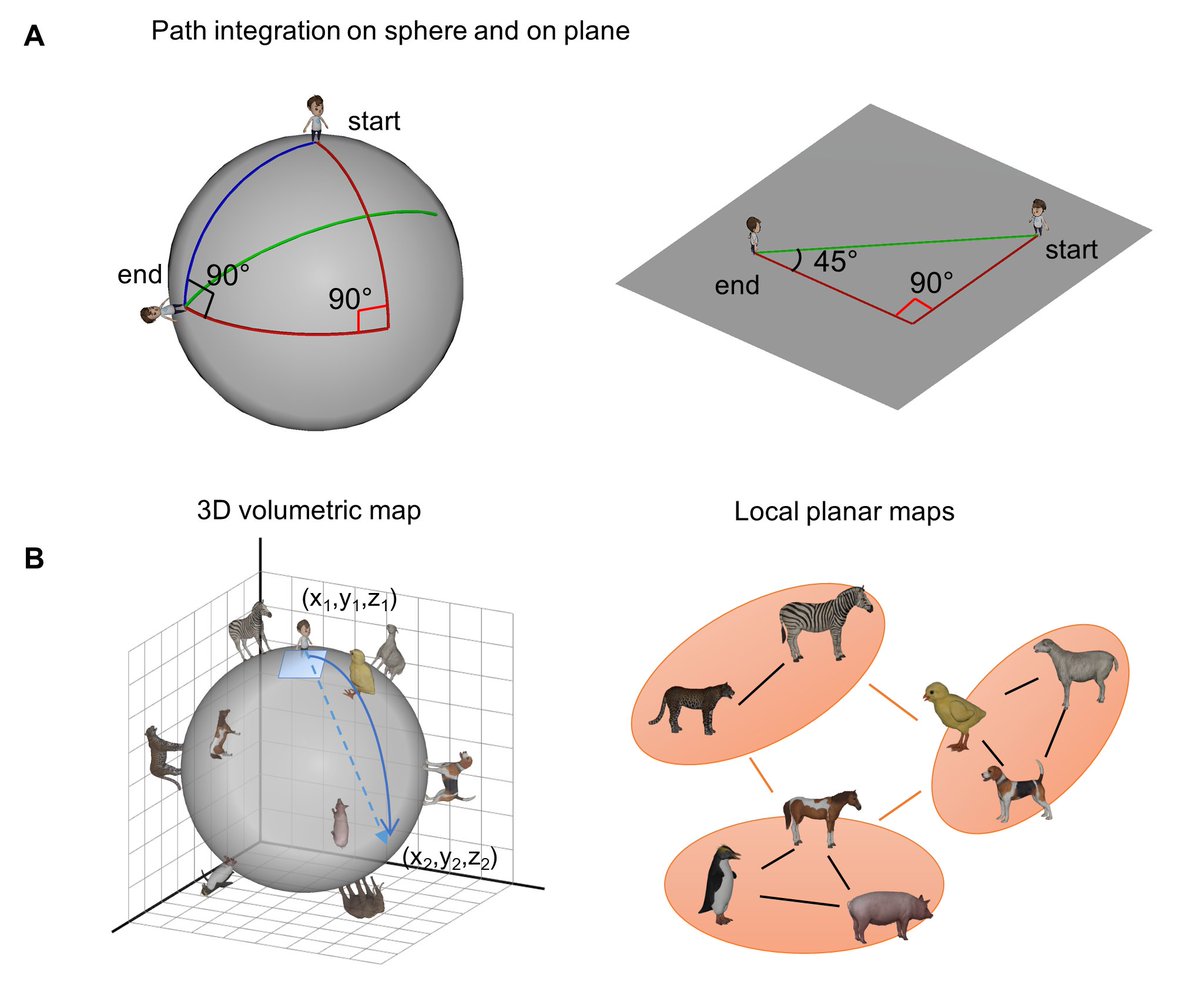
Can human adapt their path integration system for navigating on a sphere (non-Euclidean geometry)? We found a strong Euclidean bias. Multiple local planar maps can be used to solve a complex task. https://t.co/cbRpmtQvnE
Temporal structure of experience etched on firing of human hippocampal-entorhinal neurons to serve memory & prediction. See our study @Nature at @UCLANsgy, great work by lead author @PTacikowski with @GuldamlaKalendr & @DavideCili support @NIH_NINDS.
https://t.co/4wWzb1N4r5
I’m thrilled to share our paper published online today in @ScienceMagazine !
I appreciate my mentor, Dr.Fujisawa, for running through this project with me. We discovered the new type of grid cells that have grid field for future projected locations. https://t.co/xmRgZaQfHE
How can memories persist in the brain when their properties and supporting biological substrates change over time and experiences?
Our latest work newly published in @ScienceMagazine proposes that a balance between memory dynamics and persistence is achieved through the divergent recruitment of multiple memory traces established in parallel upon memory encoding.
https://t.co/j0Swqi1CRG
Welcome to the Multiverse of Memory! A thread. 1/7
Observing the birth of an abstract representation with disentangled variables in human HPC!!
Now published in Nature. Great collaboration with @courellis@JMinxha@amamelak@UeliRutishauser and others
5-year full PhD position at the Berlin Mobile Brain/Body Imaging Labs!
(Please distribute in your network).
We are looking for a highly motivated candidate to work in the field of Neurourbanism using multimodal psychophysiological measurements in stationary and mobile protocols.
Our preprint is online!
We show how the hippocampal-entorhinal cognitive maps could solve the general problem of representing and relating multiple alternative action plans.
Work together with @vigano_s@reznikdan@PatrickHaggard@doellerlab
https://t.co/hrovNueq1k
A simple mathematical model perfectly captures the shape and statistics of hippocampal place fields in mouse, rat, and bat, in one, two, and three dimensions. With @nischmainali and @yoramburak.
https://t.co/aPHk5FUCXu
Truly thankful for being given the chance to pitch our work on human spatial memory in 3D space (w/ @theo_aj_schafer, Misun Kim, Leo Koenig & @doellerlab) at this year’s iNAV in beautiful Meran! What a fantastic experience: brilliant people, gorgeous scenery and many new insights
New lab preprint!
"Human Neural Dynamics of Real-World & Imagined Navigation”
Theta oscillations in the human medial temporal lobe occur in short, critically timed bouts during walking. What about during imagined walking? Find out here:
https://t.co/V8v1d3egYd
🧵
January 1992 in Prague Jan Bureš told me about place cells, and turned me into a scientist. This Perspective reminds us that such neurons don’t respond to stimuli. Network discharge (and knowledge) is internally-organized but interdependent on the world https://t.co/ejJ7XvqbDX
One of my PhD projects is online!
We show that category prototypes correspond to interpolated states in a cognitive map that guide cortical pattern completion during category-based decisions.
w/ Mirko Thalmann, @cpilab, @doellerlab, @ThevesStephanie
https://t.co/GxqIZJcE3O
~75M years ago some nocturnal mammals developed the vision superpower. When dinosaurs went extinct, they invaded the daylight niche; the super power became UberPower shaping the behaviour and brain of our ancient primate cousins, including the Hippocampus. https://t.co/oGpnPngzXm
In this Article, @b_j_griffiths et al. use EEG and iEEG data to identify a complex network of brain regions that track head direction in freely-moving humans. @t_staudigl @LMU_Muenchen@TheCHBH#neuroscience#psychology#navigation
https://t.co/EU127FnedA