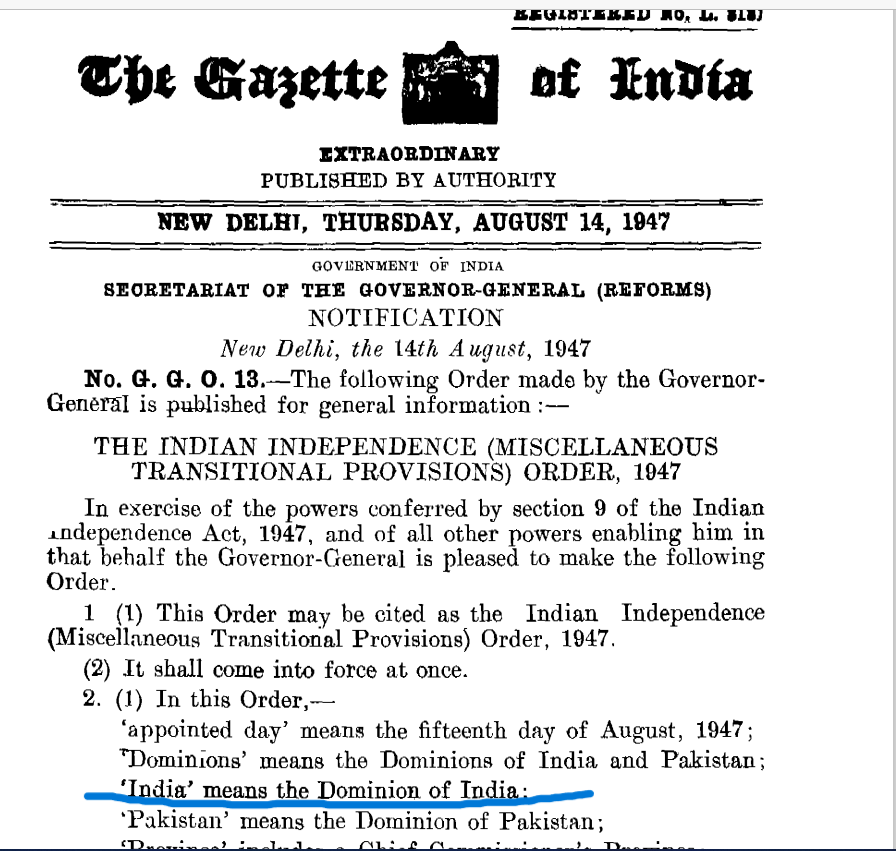
Please remember Dominion & Independence are NOT SAME ! :
1Today we are independent but remember on 15 Aug 47 we became a Dominion with Mountbatten as 1st Gov. Gen. of the Dominion with slogans of Mountbatten ki jai !
Remember Gandhi had opposed Complete Independence amendment at Calcutta session of Congress in 1929 and got his way for Dominion status !
2 Mountbatten took oath in name of King as representative of the Crown !
3 All talk of swadeshi was put in grave by inviting him as GG. Jinah didn't do that !
4 Govt. of India Gazette of 14th Aug 1947 describes India as a Dominion. Issued under Nehru- the PM of Interim Govt.
5 Union Jack didn't go down at Viceregal Residence !
6 Though Pakistan was created Congress let 28 Muslim League Members continue on our Constitute Assembly and they left for Pakistan only in 1950 after signing our Constitution.
7 Commander in Chief was British, Air Force and Naval chiefs too.
8 In 1948, to appoint Rajagopalachari asnext Gov. Gen, Nehru as ministers of the Dominion sought permission from King !
9 The King abdicated the throne of British Indian Empire only on 22 June 1948 as per London Gazette !
10. Most nations celebrate their Independence day on the date they had declared themselves independent. For example America to be one !
Consider the following :
A Our Freedom Struggle started o 10 May 1857 so why not this date?
B Complete Independence was declared in Lahore session of Congress in Dec. 1929 on 31 Dec on banks of Ravi river and 26 January 1930 was the day all over India it was declared .
C Azad Hind Sarkar was established on 21 Oct. 1943 by Netaji Subhas Bose in Singapore and it had all components of a nation's government besides liberating many areas from British.
on 30 Dec Netaji hoisted the Indian flag in Andamans . The Indian flag went up at Mowdok on 18 March 1944 after throwing out British.
D Indian flag hoisted at Moirang on 14 April 1944.
E When so many dates are there to choose one why do we keep celebration the Dominion Day as Independence Day ? Remember there was nothing special about it in history of events in India's Freedom Struggle ! Mount batten had purposely decided 15 Aug as that day he had taken the surrender of Japan but the Azad Hind Sarkar was the only one that did not surrender to British.!
By statements only we can't decolonise the Indian mind, get rid of Brown Sahibs and put an end to Macaulay's system !
If @INCIndia or any hisrorian proves me wrong and I will stop writing on history !
Jai Hind !
@PMOIndia@BJP4India@rajnathsingh@AmitShah@RSSorg please consider !
A simple fact that the much-hyped Transport Minister @nitin_gadkari should have explained to the masses on the hot topic of ethanol, is demonstrated so effectively by @KVishReddy garu, the @BJP4Telangana MP from Chevella Constituency, through this simple video.
This is precisely why younger, qualified and articulate MPs like him should have been inducted into the Cabinet, rather than continuing with old and fatigued faces.
Her car broke on a highway at night in Uttar Pradesh.
She called UP Police, they came and helped her and told her UP Police is here to help you always.
But the way she told this story is absolutely hilarious 😂
"Sitting in a free country, hurling abuses at the PM on mic, uploading those vidoes is proof that democracy is very much alive"- He brilliantly busts the propaganda that PM Modi ji is a dictator.
सभी राष्ट्रवादियों से विनती है कि इस युवा लड़के (अंकित मजूमदार) के इस बेहतरीन रील को ज्यादा से ज्यादा शेयर करें, ताकि यह ज्यादा लोगों तक पहुंचे।
इस वीडियो में यह लड़का बहुत साफ और स्पष्ट तरीके से बता रहा है कि ��ैसे आज की युवा पीढ़ी बिना सोचे-समझे कुछ ह्यूमरस स्टाइल और कंटेंट से प्रभावित हो जाती है।
अंधभक्ति कितनी खतरनाक हो सकती है, किसी भी विरोध या लीडर के पीछे बिना तथ्यों की जांच किए चलने के क्या नतीजे हो सकते हैं…
सब कुछ बहुत अच्छी तरह समझाया है।
जय भारत, जय हिंद, वंदे मातरम! 🇮🇳
Don’t know about Rang De Basanti, but let me tell you what some of us millennials actually grew up watching.
I was in primary school during the 1993 Mumbai bombings -- too young to even understand what terrorism meant. But I distinctly remember my mom repeatedly warning me not to pick up anything lying around while playing outside because, you know, it could be a bomb.
That was childhood.
Then came the seemingly endless procession of attacks: the 1993 Mumbai blasts, Red Fort in 2000, Parliament in 2001, the Mumbai bus bombings and Akshardham in 2002, three separate blasts within eight months in Mumbai in 2003, the 2005 Delhi blasts, the 2007 Hyderabad bombings, and the 2008 Bangalore and Ahmedabad blasts.
In July 2006, I was supposed to be on one of the trains that was bombed near Mahim. I stayed back at the office because of a meeting. A completely mundane change of plans is probably the reason I’m alive to type this instead of being a name on a list of the dead.
I remember that evening far better than I remember any stupid movie. Our office went into lockdown. Phones were jammed. People were crying and frantically trying to reach their families. Nobody knew what was happening, whether there were more bombs, or whether someone they loved was lying dead inside a mangled train compartment.
Two years later came 26/11.
I had the misfortune of watching uncensored footage of the aftermath. One clip showed bodies being piled and stacked inside a makeshift room at CST while someone wheeled in another load on a bloodied wheelbarrow, with blood dripping onto the floor. The sanitised footage shown on television didn't come remotely close to what actually happened inside that station.
So yes, us millennials lived through an era where we went to work knowing that the crime of simply boarding the wrong train, getting on the wrong bus, eating at the wrong restaurant, or standing on the wrong street at the wrong fucking moment could get you blown to pieces or riddled with bullets.
Some of us literally went to work wondering, somewhere at the back of our minds, whether this would be the commute we wouldn't come home from.
So please, spare us millennials this sanctimonious horseshit about Rang De Basanti and what some Bollywood movie supposedly should have taught us about how to vote.
An Indian scientist at Harvard discovered ATP (Adenosine Triphosphate). Then he helped create the first chemotherapy drug and the first tetracycline antibiotic. Harvard still refused him tenure. A bowling alley would not let him bowl. He died at 53, without an obituary.
His medicines save tens of millions of lives every year. Most American doctors who prescribe them have no idea what his name was. His name was Yellapragada Subbarow (Subba Rao).
He was born in 1895 in Bhimavaram, India. His father was a Sanskrit scholar who died from tropical sprue. Tropical sprue is an acquired malabsorptive disorder found in tropical regions, characterized by chronic diarrhea, weight loss, and severe nutritional deficiencies. It is most commonly associated with deficiencies in vitamin B12 and folic acid, resulting in anemia, fatigue, and glossitis. The same disease killed two of his brothers. As a child, Subbarow watched them fade away and decided he would spend his life fighting disease.
He failed his school exams twice. Passed on the third attempt. His future father-in-law paid for his medical school books. Subbarow married his daughter and repaid the debt. In October 1922, he arrived in Boston with borrowed money and broken English. He was 27. He entered Harvard Medical School and joined the biochemistry PhD program.
He began working under a senior researcher named Cyrus Fiske. Long hours. Little pay. But he was at Harvard, and he did not care. In 1925, they developed the Fiske-SubbaRow assay, a method for measuring phosphorus in body fluids. It is still used today in kidney failure testing, vitamin D testing, and prostate cancer work. It became one of the most cited methods in biochemistry history.
Then they found something even bigger in 1926 - ATP - Adenosine triphosphate. The energy molecule that powers every cell in every living thing on Earth. That discovery changed biochemistry. It also proved that the 1922 Nobel laureate had been wrong about how muscles worked. Muscles did not run on glycogen. They ran on ATP.
Subbarow earned his PhD in 1930. He stayed at Harvard for another decade. Paper after paper. Discovery after discovery. And every year, Harvard refused to promote him. The biochemistry department had never given tenure to a foreigner. They were not going to begin with an Indian.
His colleagues took him fishing. Played tennis with him. Came to dinner at his home. Then voted against him year after year. Outside the laboratory, he met the same wall. He bought an airplane and learned to fly because he loved flying. Once, he tried to go bowling. The local alley refused him entry. The sign said it was “open only to the Caucasian race.”
Then Fiske turned against him. The senior researcher began blocking Subbarow’s discoveries out of jealousy. Some of Subbarow’s work had to be rediscovered years later by other scientists because Fiske kept his findings hidden.
May 1940. Harvard denied him tenure for the last time. After 17 years of groundbreaking work, he walked away. Lederle Laboratories in New York hired him as Associate Director of Research. By the end of the year, he was Director. In the next eight years, he changed medicine. He developed diethylcarbamazine, an oral medicine that killed the tropical worms crippling American soldiers in the Pacific. The World Health Organization still uses it.
He isolated folic acid from liver and worked out how to produce it on a large scale. Today, folic acid in pregnancy prevents birth defects in tens of millions of pregnancies every year. The same family of diseases that killed his father and brothers became preventable because of him.
Then Dr. Sidney Farber called from Boston with an idea: maybe a drug that blocked folic acid in cancer cells could kill childhood leukemia. Subbarow’s team created the drug. They called it Aminopterin. In December 1947, Farber gave it to an eight-year-old boy dying from leukemia. Within weeks, the cancer cells began to disappear.
It was the first chemotherapy drug in history. The first time anyone had put cancer into remission using a pill. Subbarow’s team later refined it into Amethopterin, now known as methotrexate. It became a gold standard treatment for leukemia, lymphoma, breast cancer, and lung cancer. Then rheumatoid arthritis, psoriasis, and Crohn’s disease. The World Health Organization lists it as an essential medicine. Tens of millions of people use it every year.
In 1948, his lab produced Aureomycin. The first tetracycline antibiotic - a broad-spectrum one that killed typhus, cholera, pneumonia, and many bacteria that penicillin could not touch. It opened the door to the whole tetracycline family: doxycycline, minocycline, and drugs still used today against plague, malaria, anthrax, and drug-resistant infections.
He was 53 years old. He had created medicines that would save tens of millions of lives. August 8, 1948. Yellapragada Subbarow suffered a heart attack at his home in New York and died. No American newspaper gave him a front-page obituary. No university held a memorial. The Nobel Committee never honoured him. His own colleague George Hitchings later won a 1988 Nobel Prize for work built directly on Subbarow’s foundation. Subbarow was not even nominated.
In 1950, Argosy magazine published a feature about him titled “Miracle Man of the Miracle Drugs.” It began with a line that still hits hard. “You’ve probably never heard of Dr. Yellapragada Subbarow. Yet because he lived, you may be alive and are well today. Because he lived, you may live longer.”
Most Americans had not heard of him in 1950. Most still have not. Harvard has never officially honoured him. American medical schools mostly do not teach his name. The Nobel Committee that honoured Hitchings for work built on his foundation never corrected the record. Every methotrexate prescription written today remains silent about the man behind it.
India remembers. The government issued a postage stamp for his 100th birthday. His childhood home became a museum. Indian medical schools teach his name. But the country that denied him tenure, refused to let him bowl, and allowed him to die unknown - the same country that uses his drugs every day - still mostly does not know him.
Here is the truth. If someone you know has ever taken methotrexate for cancer or an autoimmune disease. If someone you love has taken folic acid during pregnancy. If you have ever been prescribed doxycycline for an infection. That was him. Yellapragada Subbarow. Born 1895. Died 1948. Saved tens of millions of lives, while a country he loved barely knows what it owes him.
Please remember his name and let your near and dear know about this little-known scientific legend born on this soil but never got the true recognition that he deserved. A story you need to know. A story all of us need to know. #Medicine #Unknownlegends @centerofright@KiranKS
I taught JEE physics for years. That paper breaks strong kids in three hours.
This exam is five hours of theory and five hours of lab work, and these five did close to perfect scores on it.
Let me tell you what actually happened.
The International Physics Olympiad is the world championship of school physics. It was the 56th edition. Held in Bucaramanga, Colombia, from July 5 to 12.
381 students. More than 85 countries. Every one of them the best physics student their country could find.
India sent five kids.
All five came back with gold.
Their names are Kanishk Jain from Pune. Riddhesh Anant Bendale from Indore. Rishit Garg from Dwarka in Delhi. Shresth Suraiya from Mumbai. Svarit Joshi from Ahmedabad.
We know a hundred cricketers by their nickname and not one of these boys. :)
That clean sweep put India at joint World Number One. Tied with China, Russia, Kazakhstan, South Korea and Taiwan.
Those are countries that pour serious money and national pride into science education. We are standing level with them.
Now here is what the exam actually was.
Two papers. Each five hours long.
The theory paper had three problems. One on the thermodynamics of paramagnetic cooling. One on the photoionisation of ozone. One on the dynamics of electron positron pairs.
The experimental paper was another five hours in a lab, working through heat transfer and thermodynamic processes in fluids.
That means you get given equipment you have never seen, and you have to design your own experiment, take your own readings, handle the errors, and reach a real answer.
Not multiple choice. No shortcuts. No pattern recognition. You either understand physics or you sit there for five hours.
HBCSE says the Indian students were near perfect on theory and excellent on the practical too.
Now, this was India's 27th appearance at the IPhO.
Across all those years, about 44 percent of Indian students have won gold, 41 percent silver, 10 percent bronze.
In the last ten years, every single Indian student has come home with a medal. 62 percent gold, 38 percent silver.
Not one kid has gone and come back empty handed in a decade.
Five golds in one year has happened only twice. This year, and in 2018.
So who built this.
The programme is run by HBCSE, the Homi Bhabha Centre for Science Education. It sits under TIFR, which sits under the Department of Atomic Energy.
They run the whole funnel. A national exam, then a national olympiad, then a brutal selection and training camp, and out of everyone in the country, five kids get on a plane.
The team was led by Professor Anwesh Mazumdar of HBCSE-TIFR and Dr Leena Joshi from St Xavier's College, Mumbai.
The scientific observers were Professor Ananda Dasgupta from IISER Kolkata and Nisha Kelkar from Gogate-Joglekar College in Ratnagiri.
Yes. Ratnagiri. A college in a small coastal town in Maharashtra.
This is public education doing something the private coaching industry could never do on its own.
The coaching industry is very good at one thing. Teaching you to solve a known problem fast.
That is what JEE and NEET reward, and I say that with love because I was part of that world.
But an olympiad paper does not have a known type. There is no shortcut chapter. There is no formula sheet that saves you. You have to sit with a problem you have never seen and think.
That is a completely different muscle. And a government funded centre has been quietly building it in Indian teenagers for 27 years.
So yes, be proud. Loudly.
HBCSE also shared that around 64 percent of India's olympiad medallists go on to do a PhD.
But only about 32 percent of medallists end up settling in India.
I do not say that to spoil the moment. These kids owe the country nothing. They earned every option they have.
But it should tell us something. We are excellent at finding this talent. We are excellent at training it. We are still not great at giving it somewhere worth staying.
Congratulations Kanishk, Riddhesh, Rishit, Shresth and Svarit. This is one of the best things an Indian did this year and most of the country will never hear about it.
A Gen Z employee’s candid remarks are going viral after she claimed her boss cancelled her leave at the last moment. In a bold response, she said she doesn’t work out of passion for the job, but to earn money to travel and enjoy freedom.
Expressing frustration, she added, “To hell with the company or project. I am going. I will open my laptop only after 10 days. I don’t care.”
Her comments have sparked a wider debate online about work-life balance, corporate culture, and shifting priorities among younger professionals.
#GenZ #WorkLifeBalance #CorporateLife #ViralStatement #OfficeCulture #YouthVoices #Trending
It was a pleasure to speak to you Varun. You are a genuine seeker who does not simply make videos for the sake of creating content and gaining fame. There is real love for Bharat, her ideals, and a rare seva ka bhaav. May your efforts bear fruit. Blessings to you & your family.
From my op-ed: Yunus has sought to appease jihadists, including lifting bans on Islamist groups and releasing terrorists. To Islamist delight, his regime is also rewriting history, including attempting to erase or obscure the founding role of Sheikh Mujib. https://t.co/SjvBxocGBU
सीता सहित अनुज प्रभु आवत॥ अयोध्या में लौटे प्रभु श्रीराम, कर्नाटक में वक़्फ़ का तमाशा और जीत की ओर ट्रंप : देखें “घूमता आईना” पर लोकतंत्र का नृत्य 👇 https://t.co/ajBvsBHl9T
The Sindhi song that this Hindu child in Pakistan is singing is ‘Albelo India’, which goes like this -
‘My Hindu neighbour Albelo is leaving for India. He will board a train this Friday and will never return to Pakistan. My heart aches with pain. If destiny allows, I will join him someday’
💔
Deepawali should be at least a three-day closed holiday festival. Remove Gandhi Jayanti and one more if needed.
There should be at least one occasion in the year when family and relatives can come together, celebrate, and cherish old and new memories.
Having only one day off means not everyone can make it.