Full podcast episode with @rauchg, @maxhodak_, and @bscholl.
40 minutes of unreleased material.
The AI Industrial Revolution
Part 1: Waste Tokens, Save Time
0:00 Three Frontier Founders
1:27 AI Software Factories
4:15 Waste Tokens, Save Time
5:47 Models Instructing Humans
9:29 Is Pure Software Dead?
12:03 You Don't Get Stuck Anymore
Part 2: Vibe Coding Hardware
14:39 Vibe Coding a Turbine Blade
18:07 Open Source Compounds China's Advantage
20:15 You Always Want the Smartest Model
22:44 Software Still Needs Hands
24:43 Humans Are Becoming Verifiers
Part 3: The Regulatory Frontier
27:53 The Regulatory Red Queen Race
32:32 Why There's No Innovation in Healthcare
36:49 We Need a True 50-State Experiment
40:31 China's FDA Is Beating Ours
43:37 Healthcare Is a Communist Society Inside Capitalism
45:57 Sid's Story: N-of-1 Medicine
Part 4: The Autonomous Company
47:49 Autonomous Infrastructure
51:25 Your Job Is to Train the Agent
54:54 The Next Lord of the Rings
59:08 What's Your Definition of Art?
1:05:00 Can AI Have New Ideas?
1:07:03 A Large Number of Small Teams
Banger essay on the Great China-India Divergence.
Basically Mao socially modernized China by autocratically breaking up old kinship clans, feudal beliefs, superstitions, marriage customs, forcing literacy & human capital edu reforms (like Rhee in KR, Meiji in JP, Imperial JP/Chiang in TW, Brits/LKY in SG) - and made China socially ready as human capital to effectively participate in the globalized modern economy & tolerate econ reforms.
India however did not go through the painful social modernization process of destroying old clannish/superstition/feudal/informal caste culture, and in tandem w these cultures holding enough electoral power in a democracy to resist change, makes India socially mired in premodern era, and thus less compatible in human capital terms to accept modern econ reforms and compete in global economy. Henrich's WEIRD book talks about China's nonWEIRD modernization a bit, but this essay extends the analysis to India. No mention of IQ aspect of human capital but a decent essay nonetheless @davideoks
https://t.co/uHPrtD26R1
An incredible bit of sports journalism by The Guardian here. A short summary of the playing style of all 48 World Cup nations and a short profile of all 1248 World Cup players. Bookmark and refer to the resources when watching the obscure matches: https://t.co/tdLGq8en0o
Predictions that the depletion of petroleum stocks around the world could push oil prices to US$150/bbl before the end of June if shipping does not resume through the Strait of Hormuz are exaggerated. The world is still sitting on substantial reserves of crude and refined products that can be drawn down further over the coming months. However, the flipside of this picture is that even if there is a preliminary peace deal in the Gulf that allows oil exports to flow once again, countries will look to rebuild stocks and accumulate even bigger precautionary reserves. Even with plentiful supply, this will place a solid bid under oil prices over the medium term, argues Tom Holland in this video interview.
The selloff in the high moat, compounder names is getting ridiculous. The irrs I get for some of these co's as long as they don't royally shit the bed are pretty attractive. Stuff like $SPGI, $MA, $V, $BR and now add $CME, $CBOE and $ICE with their recent selloff. Steadily adding
Yeah… I think all your upstream semi supply chain companies are going much higher.
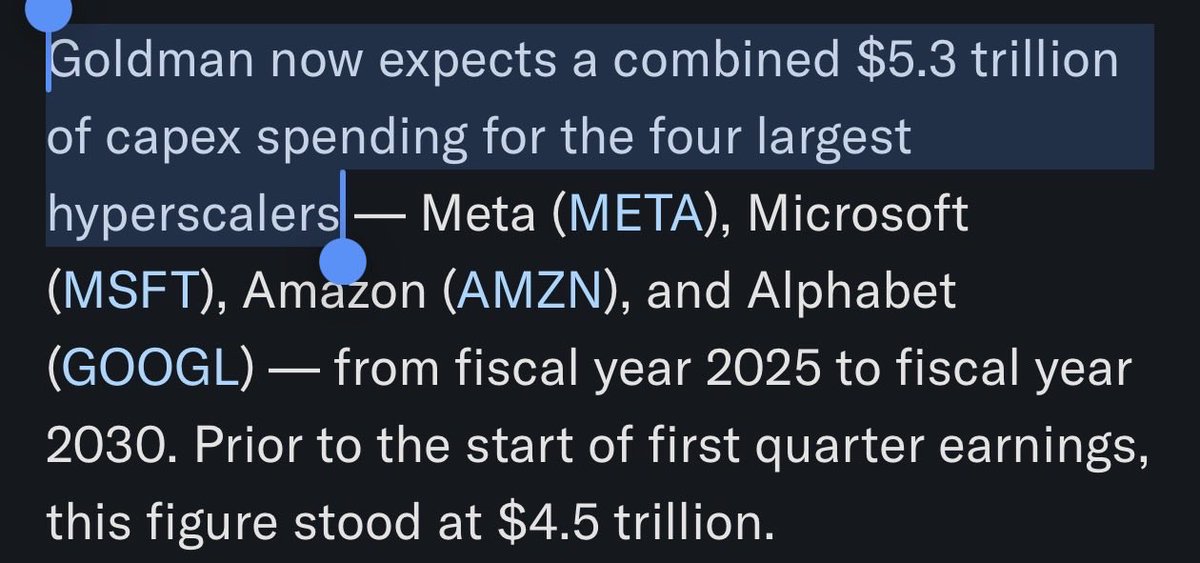
Goldman now expects a combined $5.3 trillion of capex spending for the four largest hyperscalers $GOOGL / $META / MSFT / $AMZN from 2025 to 2030.
Revised up from $4.5T from Q1 earnings.
“Aggregate capex est. $7.6 trillion between 2026 and 2031.”
And it flows upward to these tiny chokepoints like $SIVE for CPO lasers/ $SOI for Silicon Photonics substrates. Leaderdrive/Harmonic for Humanoids components.
And so on…
Ai names don’t move in a straight line up,
but is just the beginning of the next Industrial Revolution as we move from R&D/compute buildout into commercialization from Agents -> Physical AI -> discovery.
There is a graveyard in American tech right now and nobody is walking through it. Companies down 70, 80, 90% from the highs. Still profitable. Still growing. Still the leader in their category. Just unloved. The Trade Desk at 9x earnings. PayPal at 12x with $6 billion in free cash flow. Adobe at 17x and people are talking about it like it’s Kodak. Etsy at 8x EBITDA running a marketplace that two billion people have heard of. Roku trading below its own balance sheet liquidation value if you squint. Match Group, Zoom, Pinterest — each of these would have been a hedge fund’s top pick at this multiple in 2017. Now they’re orphans. Everyone is buying the Mag 7 because the Mag 7 is the trade. The Mag 7 IS already the trade. The trade is over. The next trade is in the rubble pile. You don’t get rich buying what worked. You get rich buying what stopped working for reasons that turn out to be temporary. Every name on that list was a market darling 36 months ago. The fundamentals didn’t fall 80%. The narrative did. Narratives come back. Earnings compound. I’m not buying NVDA at 45x. I’m buying the names CNBC won’t say out loud anymore
Exotic Ferraris have a new financier in a London-based hedge fund. Fasanara Capital has started a platform to finance vintage, racing and classic Ferrari cars https://t.co/2lDg4cGGEz
The $800 billion capex number just doubled (Save this).
Six months ago, the 14 largest publicly traded data center operators had a combined FY2027 capex consensus sitting around $450 billion.
As of February 2026, that number has been revised to $800 billion, nearly doubled in a single consensus cycle, according to the Newmark report that just dropped.
That's the market finally catching up to what demand actually looks like.
And demand is legitimately staggering, Newmark's base case is that AI inference alone could require 250 gigawatts of capacity to serve mainstream adoption.
For reference, the entire US data center fleet was running at roughly 30 GW in 2025.
So the upside scenario isn't 2x or 3x but rather an order of magnitude. The report calls it aggressive but feasible and separately notes that AI training is expected to triple annually through 2030, none of which is included in that 250 GW figure.
Now here's who actually gets paid, Nebius is the cleanest expression of this trade.
It's a full stack AI cloud company, GPU clusters, cloud platform, developer tooling built almost entirely by former Yandex engineers who had to rebuild from scratch after Russia's assets were stripped out in a $5.4 billion separation deal in 2024.
The stock resumed trading on Nasdaq in October 2024 at around $20 per share and today it's trading near $279.
That's roughly a 14x move in under two years for anyone who was paying attention.
The fundamentals justify the move, and then some. Q1 2026 revenue came in at $399 million, 684% growth year over year, 75% quarter over quarter.
This is not a business hunting for customers but rather demand is outrunning capacity.
So Nebius raised the bar it was already clearing.
Capex guidance for 2026 was lifted to $20–25 billion, up from a prior range of $16–20 billion, they signed a $27 billion contract with Meta.
They raised over $6 billion of capital in a single quarter, pushing cash above $9 billion.
The power story makes it even more defensible.
Nebius now has contracted power capacity above 3.5 gigawatts, with a new Pennsylvania site adding 1.2 GW alone and power is the binding constraint in AI infrastructure right now, it's what's stopping everyone else from building faster.
Nebius has the power, they also have the GPU supply relationships and they have the contracts.
That combination is genuinely hard to replicate in any reasonable timeframe.
Milk Road Pro members already know this, NBIS was a featured position in our AI infrastructure coverage well before the Q1 print.
Members who sized it appropriately are sitting on massive gains.
Come join Milk Road Pro and get our full AI infrastructure positioning sheet, the names we're still holding, the ones we trimmed after the Q1 surge, and the exact framework we're using to size into the next leg of this trade as the 250 GW buildout unfolds.
Link down below.
NVIDIA is telling you exactly where to invest with its new 800V DC power architecture.
The old 48V system can't keep up. 800V reduces copper usage by 45%, cuts the power chain from 5 conversion stages to 2, and cuts power delivery losses in half.
These 7 companies are building the power layer underneath it all.
1. $ON - onsemi
SiC and GaN chips for high-voltage power conversion across AI and EVs. AI data center revenue nearly doubled YoY and is expected to double again in 2026. The key number: their content per AI rack scales from $15,000 today to $115,000 in next-gen 800V architectures. A 7.7x increase per rack deployed.
We are short $SIVE.
A retail-driven pump built on speculative hyperscaler links, a fabricated bottleneck narrative, and a rumored volume ramp-up has driven a 1,800%+ rally in $SIVE.ST.
Insiders sold ~29M shares into it. Here's what they're not telling you.👇 Full report: https://t.co/4QEyuXQIQb