🫀 Is a CAC score of zero truly “zero risk”?
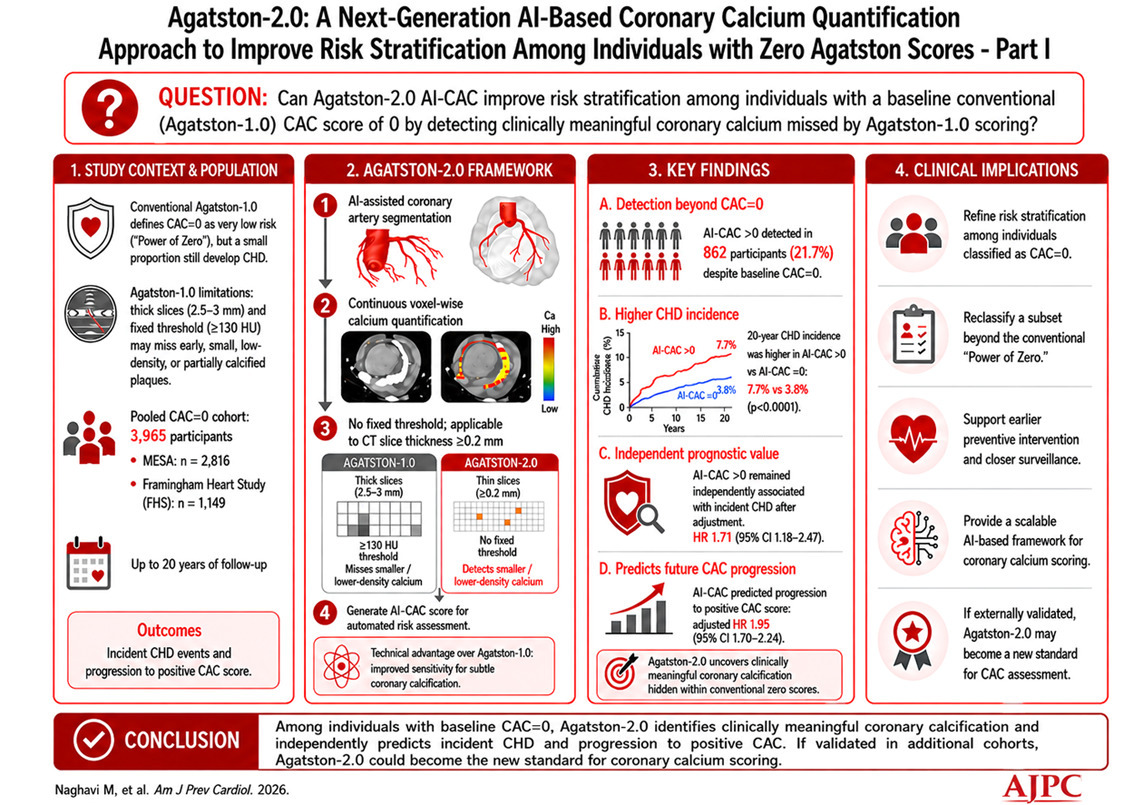
A new study in the American Journal of Preventive Cardiology introduces Agatston-2.0, an AI-based approach to coronary calcium quantification.
Among individuals with CAC=0, AI detected previously unrecognized calcium in ~22%—and those patients had higher long-term coronary risk.
These findings challenge the “power of zero” and highlight how AI may refine risk stratification and personalize prevention.
Read more: https://t.co/9Y3hS2QFiK
#PreventiveCardiology #CAC #ArtificialIntelligence #Cardiology #Atherosclerosis #AJPC @ASPCardio
Can you predict future stroke using the ECG?
New @JACC_journals we introduce ECG2Stroke, a publicly available AI neural network model that estimates 10-year stroke risk with comparable performance to dedicated clinical risk models by encoding markers of atrial cardiomyopathy.
@broad_institute@broad_ml4h@MGHHeartHealth@MGBResearchNews@MACE_Lab_AI
🚨Double-blind RCT (n=1670) in pts w/ prior #ICH
Triple low-dose antihypertensive pill + standard care ⬇️ recurrent #stroke vs placebo (4.6% vs 7.4%; HR 0.61; P=0.02)
Also ⬇️ major CV events & lower SBP (127vs138 mmHg)
🖇️https://t.co/9NBLKQhWnw
@NEJM@escardio@JacopoImberti
New research highlights the heart–liver connection.
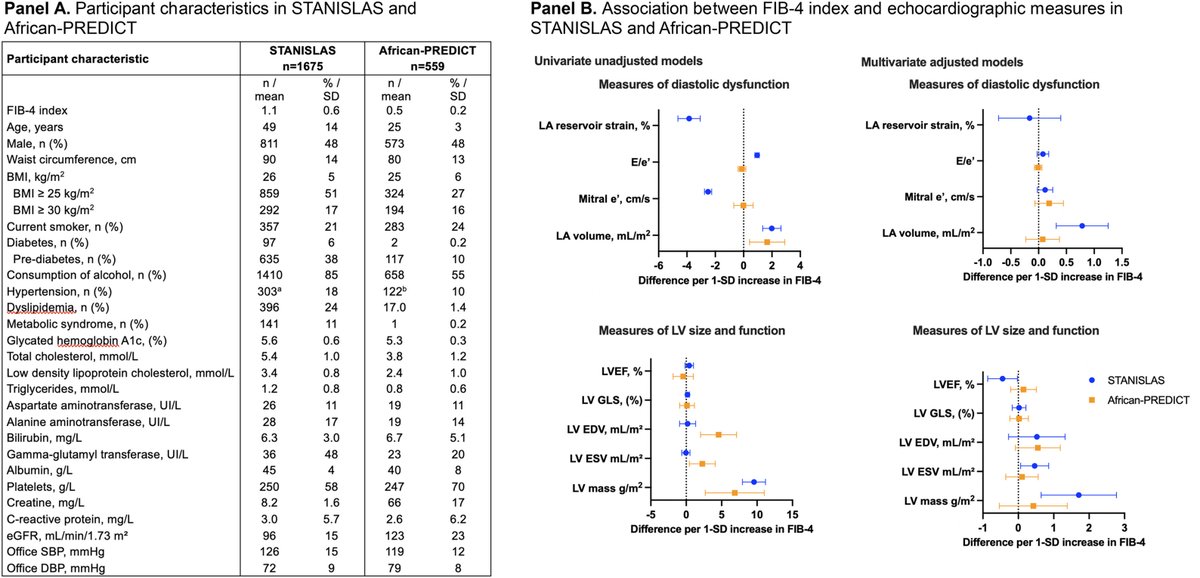
In a study across the STANISLAS and African-PREDICT cohorts, higher Fibrosis-4 (FIB-4) index—traditionally a marker of liver fibrosis—was linked to adverse cardiac remodeling and diastolic dysfunction in the general population.
These findings reinforce the role of FIB-4 as a simple, accessible tool that may help identify early cardiovascular risk beyond the liver.
🔗 Read more: https://t.co/NZSke2gZq7
#Cardiology #LiverHealth #Prevention #Research #PopulationHealth
A lot of BS is being pushed to the scientific community in the form of dressing up inadequate design so that one can pretend to answer a question with inadequate data. Watch out.
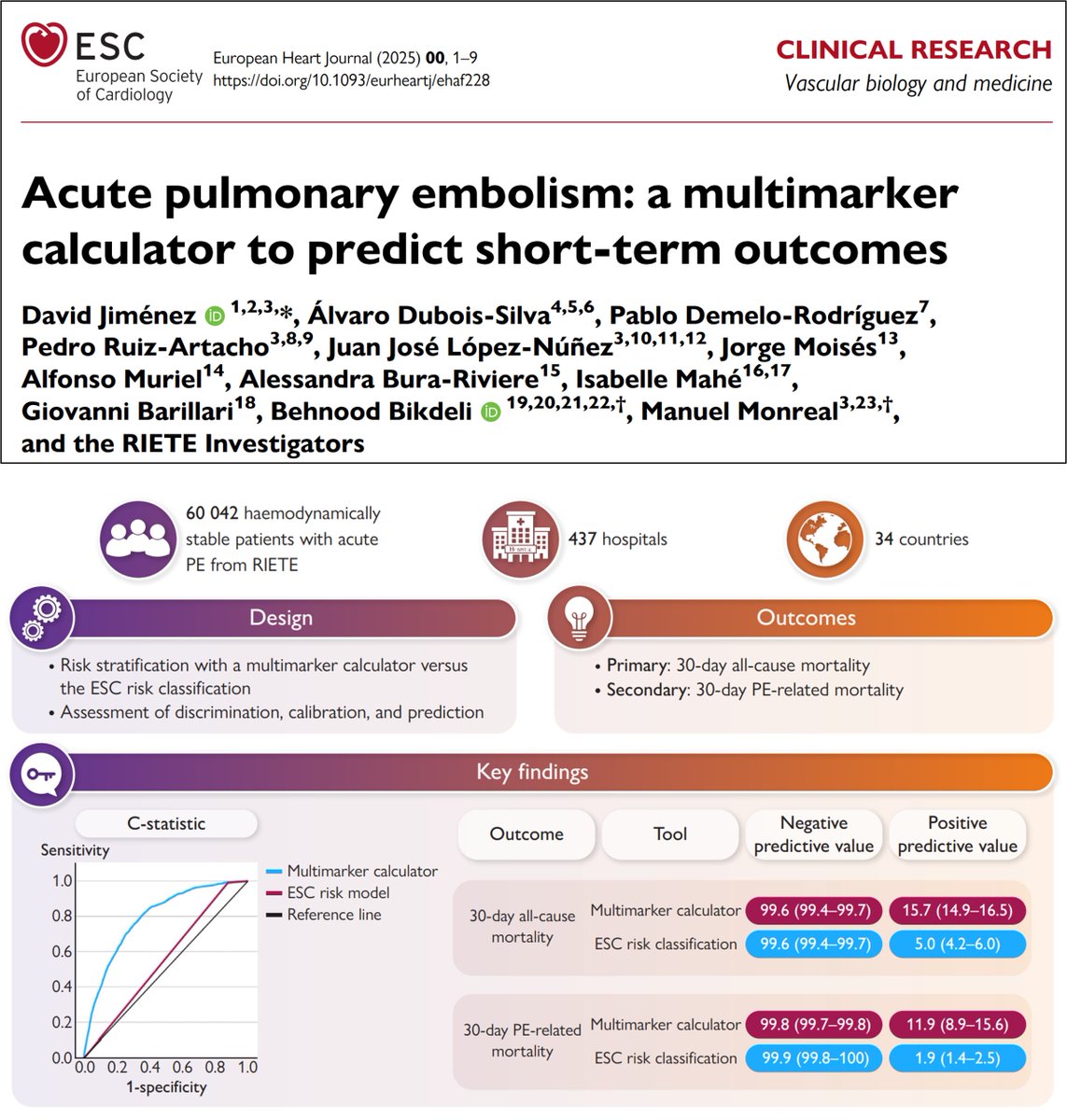
Need to do better for #PE risk stratification, beyond reductionist models. In an @ESC_Journals#EHJ paper we show that a multimarker calculator🌡️outperforms the ESC model. Great work by @DJC6998@mmonrealriete et al #RIETE! Honored to be a part of it 👇:
https://t.co/9oY00u63KL
An excellent paper from my fellow Angelo De La Rosa who published great work on predicting CHF with CAC scans from MESA - https://t.co/Er5Lmtp7t5
continuing work we have been doing for > 20 years.
Are plasma triglycerides an important causal factor and therapeutic target for atherosclerotic cardiovascular disease? Discover Pro & Contra in a Great Debate published in #EHJ 👉 https://t.co/LM6ey6Nnhl
@RoccoMontone@ehj_ed
This Position Statement from Principle Investigator @BudoffMd ended up as dispersed tweets. I've compiled them for clarity 👇
There has been a tremendous amount of interest in our new paper: https://t.co/7W4ac4jl2b
While we appreciate the interest, there have been some comments that are unbecoming of fellow clinicians and academics. Let me clarify key points in this thread 🧵
These lean, metabolically healthy individuals on a #ketodiet exhibited less coronary plaque and lower rates of plaque progression than I would have expected, with the majority exhibiting minimal progression and several exhibiting regression. This is interesting.
However, this does not mean that this population is immune to atherosclerosis — obviously. Like any population, the KETO-CTA participants exhibited a heterogeneous risk profile, and a minority exhibited more rapid progression, as expected.
Importantly —in the population at large (including those with and without CAC at baseline), neither LDL nor ApoB predicted plaque progression, whereas baseline plaque predicted plaque progression. This is novel, a contribution to the literature, and warrants further investigation.
This is the first of a set of papers, with more published data coming soon. I would ask fellow professionals to keep social media dialogue civil and especially that those parties without experience conducting research keep their juvenile attacks to themselves.
Finally, these patients were on no other treatments, anti-hypertensives, statins, or other therapies to slow plaque, so a true natural history study, different from many other drug therapy studies.
@AdrianSotoMota@nicknorwitz@bschermd@realDaveFeldman@khurramn1@JACCJournals
More to come in an interview with @Metabolic_Mind@bschermd
According to that Jordan is near to Iran it might be a good opportunity for Iranians who are interested in this field. For additional information and registration you can use this link. https://t.co/10yojHr25t
*price: 30$ for symposium and 75$ for datathon
Hello everyone. I'd like to introduce a symposium on AI in health care that will be held on 10-12 April (21-23 Farvardin) at the King Hussein Cancer Center in Amman, Jordan, with the participation of prominent figures in this area such as Dr.Leo Anthony Celi.
It's a one-day AI symposium and two-day healthcare datathon that gives you the opportunity to solve real-world healthcare challenges under the supervision of data scientists, AI researchers, and experts in the area.
2025 ACC/AHA/ACEP/NAEMSP/SCAI Guideline for the Management of Patients With Acute Coronary Syndromes: @CircAHA@JACCJournals
🥸Here are class 2A recommendations from the document: @SVRaoMD
😱 Some people were asking what is new in the guidelines? *Some are in 2A
👇👇
Whoa! In @NEJM_AI:
A Multimodal Biomedical Foundation Model Trained from 15 Million Image–Text Pairs… fully open-access foundation model!
https://t.co/ZC00ai1Cr9
🚨 New @JACCJournals: Navigating 2024 ESC Hypertension Guidelines
🔑 Key highlights:
-Lower BP targets (<130 mmHg) for high-risk patients
-Emphasis on home BP monitoring
-Tackling global gap in HTN control
📖 Read more: https://t.co/9vV8Klq9qP
@yuan_lu1 @SpatzErica.
@YaleMed