CTO at @oursky. Father. Programmer who writes js, python, golang. Validator of @likecoin since genesis. Read code, run marathon, sailing and drink whisky.
Aave is my life's work and we're working nonstop to find the best possible outcome for users.
I’m personally contributing 5000 ETH to DeFi United as we continue working together with partners on formalizing more commitments. I’m working to see this resolved and market conditions normalized as soon as possible.
DeFi United.
The Arbitrum Security Council has taken emergency action to freeze the 30,766 ETH being held in the address on Arbitrum One that is connected to the KelpDAO exploit. The Security Council acted with input from law enforcement as to the exploiter’s identity, and, at all times, weighed its commitment to the security and integrity of the Arbitrum community without impacting any Arbitrum users or applications.
After significant technical diligence and deliberation, the Security Council identified and executed a technical approach to move funds to safety without affecting any other chain state or Arbitrum users.
As of April 20 11:26pm ET the funds have been successfully transferred to an intermediary frozen wallet. They are no longer accessible to the address that originally held the funds, and can only be moved by further action by Arbitrum governance, which will be coordinated with relevant parties.
aave will repay if it is a bank. If it doesn't, or it can't, will EF repay? If yes, then EF will be the state.
Welcome onchain replicate to the human political system.(?
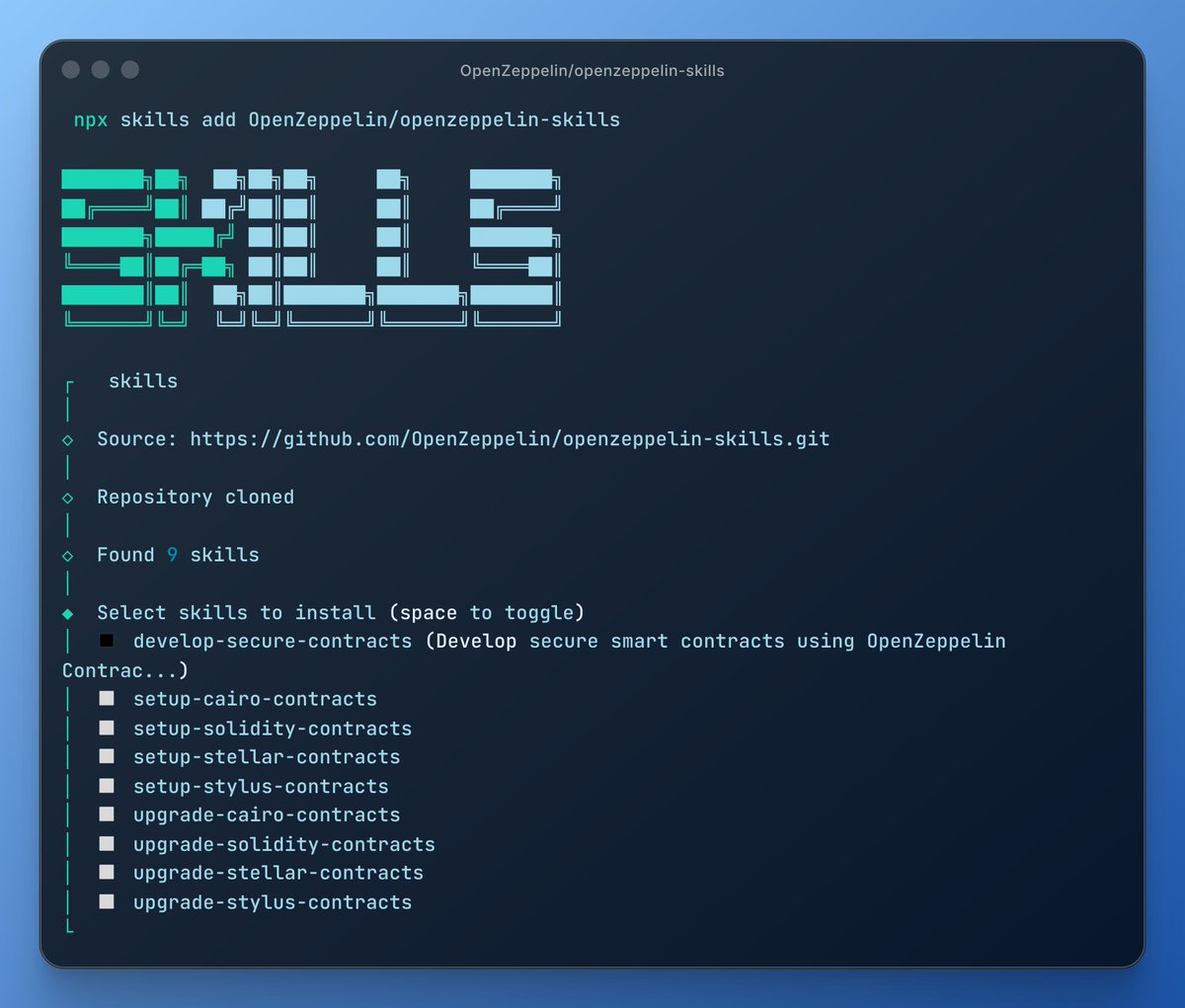
Introducing OpenZeppelin Skills 🤖
In the first of a series of releases, we're dropping 9 skills to give AI agents authoritative, up-to-date knowledge of OpenZeppelin Contracts libraries for secure smart contract development, setup, and safe upgrades.
https://t.co/kS0eTJxPJ1
Increasing bandwidth is safer than reducing latency
With PeerDAS and ZKPs, we know how to scale, and potentially we can scale thousands of times compared to the status quo. The numbers become far more favorable than before (eg. see analysis here, pre and post-sharding https://t.co/2gR8V6hxJe ). There is no law of physics that prevents combining extreme scale with decentralization.
Reducing latency is not like this. We are fundamentally constrained by speed of light, and on top of that we are also constrained by:
* Need to support nodes (especially attesters) in rural environments, worldwide, and in home or commercial environments outside of data centers.
* Need to support censorship-resistance and anonymity for nodes (especially proposers and attesters).
* The fact that running a node in a non-super-concentrated location must be not only possible, but also economically viable. If staking outside NYC drops your revenues by 10%, over time more and more people will stake in NYC.
Ethereum itself must pass the walkaway test, and so we cannot build a blockchain that depends on constant social re-juggling to ensure decentralization. Economics cannot handle the entire load, but it must handle most.
Now, we can decrease latency quite a bit from the present-day situation without making tradeoffs. In particular:
* P2P improvements (esp erasure coding) can decrease message propagation times without requiring individual nodes to have lower bandwidth
* An available chain with a smaller node count per slot (eg. 512 instead of 30,000) can remove the need for an aggregation step, allowing the entire hot path to happen in one subnet
This plausibly buys us 3-6x. Hence, I think moderate latency decreases, to a 2-4s level, are very much in the realm of possibility.
But Ethereum is NOT the world video game server, it is the world heartbeat.
If you need to build applications that are faster than the heartbeat, they will need to have offchain components. This is a big part of why L2s will continue to have a role even in a greatly scaled Ethereum (there are other reasons too, around VM customization, and around applications that need _even more scale_).
Ultimately, AI will necessitate applications that go faster than the heartbeat no matter what we do. If an AI can think 1000x faster than humans, then to the AI, the "subjective speed of light" is only 300 km/s. Hence, it can talk near-instantly within the scope of a city, but not further. As a result, there will inevitably be AI-focused applications that will need "city chains", potentially even chains localized to a single building. These will have to be L2s.
And on the flipside, it would be too much of a cost to make it viable to run a staking node on Mars. Even Bitcoin does not strive for this. Ultimately, Ethereum belongs to Terra, and its L2s will serve both hyper-localized needs in its cities, and hyper-scaled needs planet-wide, and users on other worlds.
Milady.