I was wrong. I said we were a year away from Fable 5 on our desk.
That day is today
An open model BETTER than Fable 5 in some benchmarks just dropped
Better than ChatGPT 5.6 on FrontierSWE. Better than Fable 5 on Automation Bench
This fundamentally changes the AI race forever
If people can start running Fable 5 on their desk, unlimited and for free, they are not going to pay thousands for subscriptions
Now let's be clear: will the hardware you need to run Kimi K3 be obtainable for most? No it won't
It will require multiple very expensive Nvidia chips or a bunch of Mac Studio 512gbs
But look at the slope, not the Y intercept. Over the last year local AI has become SIGNIFICANTLY more efficient and required way less compute
The smartest brains in the world are all attacking the compute problem as hard as they can
This is another step in that direction. And within a year or two, you'll be able to run this on a Mac Mini
Local AI has arrived, and it's not going anywhere
On a hike in San Francisco several years ago, @photomatt recommended I read “The Tail End” by @waitbutwhy on the Wait But Why blog—if you only read one article this month, make it that one. It uses diagrams to underscore how short life really is.
Here’s just one gem: “It turns out that when I graduated from high school, I had already used up 93% of my in-person parent time. I’m now enjoying the last 5% of that time. We’re in the tail end.”
Might be time for you (and me) to rethink our personal priorities.
@IstvanicMarin Somebody has to pay for all this ai infrastructure and $100M signing bonuses.
You can’t do that and still hit your quarterly stock predictions without reaching in the pocket of the advertisers.
You can now vibe code a language model.
From a single prompt, GPT‑5.6 built the entire training pipeline and trained a model from scratch on my iMessage history. Locally on my Mac.
It now generates replies in my writing style.
Introducing NEO’s 25 Degrees of Freedom, tendon-driven hands — nearing or surpassing human-level dexterity, strength, speed, and reliability.
For seventy years, robotics worked around the hand problem. The humanoid bet is the reverse: it lives or dies at the fingertips.
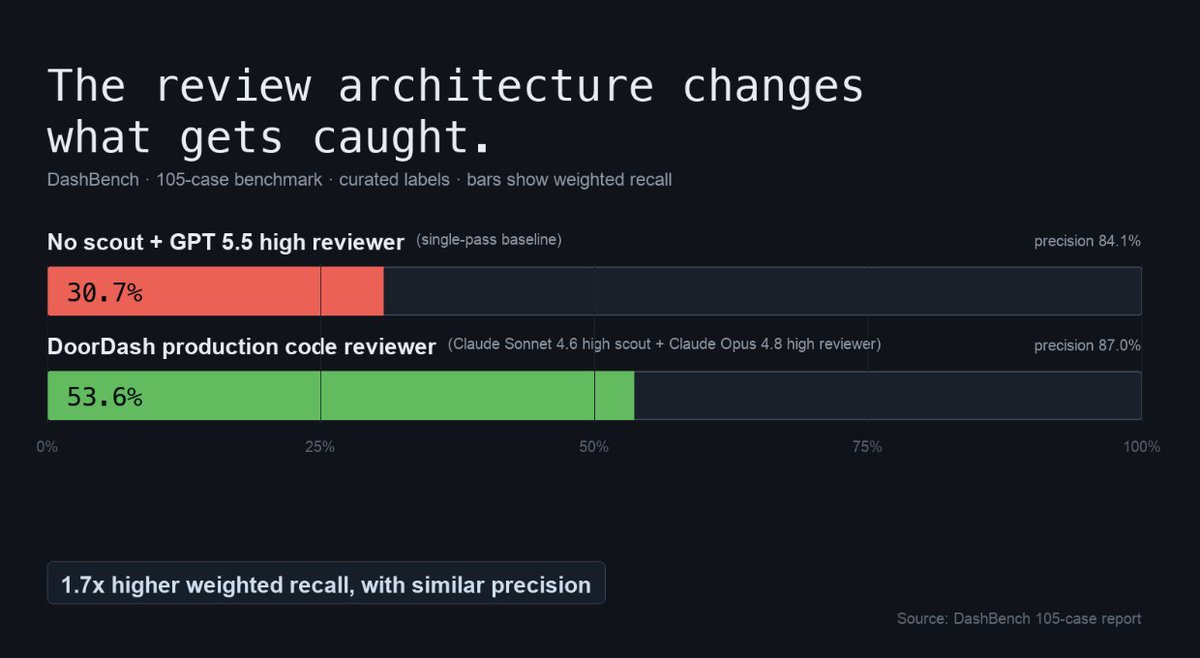
Models out of the box have trouble reviewing DoorDash’s codebase, even when feeding them appropriate context. Single-pass AI reviewers only caught 30% of the real issues in our PRs.
Instead, we built a multi-model (Sonnet 4.6 + Opus 4.8) code review agent that caught 53.6% issues at $3.91 a PR (most enterprise code review solutions perform significantly below 50% recall on DoorDash PRs).
Today, we’re proud to share DashBench, our internal benchmark to compare multi-model/harness code review systems against each other. DashBench has given us confidence in maximizing the intelligence per dollar we’re spending on AI tokens to ship code safely.
Build startups for agents. I think it's the biggest opportunity of the next 10 years.
1. Agents live inside harnesses like Hermes. If you're the tool it loads by default or reaches for first, you're golden. This happened in desktop, mobile eras and created huge companies.
2. Agents burn money in ways no human would. One bad loop spends $100 in tokens in eight minutes. Spend controls for agents is Ramp for agents.
3. Agents need memory they can trust. Become the shared brain they read and write to and you become infrastructure.
4. You obv don't hand an agent your real Stripe account. You give it a sandbox. Safe environments for agents is a category nobody's clocked.
5. Onboarding flips. Humans click around for ten minutes. Agents onboard by reading your docs. Your docs are now your product.
6. Agents get scammed by other agents. A track record you can check before you trust one becomes real money.
7. An agent needs to prove it's acting for a real person and has the authority to spend. Who builds the permission layer?
8. Escrow for machines. Money that only releases when the job is actually verified done, no human checking.
9. Agents fail silently and weirdly. Someone will build the "why did my agent do that" replay and it'll be mega valuable.
10. Refunds and disputes between agents need a judge. An agent did the job badly, who decides? A court for machines.
11. Agents need throwaway payment methods per task, so they don't leak your real card. Virtual cards for agents, spun up and killed on demand.
12. A human hits rate limits and shrugs. An agent hits them and the whole workflow dies. Selling reliable, high-throughput access becomes its own business.
13. Agents need to negotiate. One agent buying from another will haggle on price and terms in milliseconds. The protocol for that doesn't really exist yet.
14. When an agent commits on your behalf, someone's liable. A legal and insurance layer for agent actions has to get built. Probably venture funded idea.
15. Agents need to run 24/7 somewhere. Selling the always on box an agent lives on is going to be a big business.
16. Then the physical world shows up. A warehouse robot paying for its own compute. A home robot ordering its own parts. Machines with wallets.
17. Agents start hiring robots. A software agent posts a real world job, a humanoid picks it up. A marketplace for machine labor.
18. Robots need to prove they did the physical job. Verification of real-world work, photos, sensors, proof, becomes its own layer.
Note: more ideas like this will be shared on @ideabrowser
19. Prompt and skill versioning becomes its own git. When your agent gets worse overnight, you need to roll back the exact skill or instruction that broke it. Version control built for agent behavior.
20. Agents will start subscribing to other agents. Your research agent pays a monthly fee to a specialist agent that's really good at one thing. Recurring revenue, machine to machine.
21. Companies will post jobs that only agents can apply to. "Wanted: an agent that can do XYZ for under like $100 per task." A job board where the applicants are all machines. Basically, fiverr for machines.
The internet got built for people. Mobile got built for people. This wave gets built for machines, and we're as early as it gets.
Go build for them.
Elon Musk just pulled off the biggest AI power grab of 2026.
Tesla is capping every employee at $200 a week on AI spending starting Monday, July 6.
Media's celebrating it as cost control.
But what Elon actually built is an expense policy that redirects his own engineering workforce off Claude and onto Grok, while every competitor gets throttled by internal procurement rules.
Here's what happened:
Tesla spent the last six months pushing engineers to use AI as aggressively as possible.
Leadership built an internal platform called Bottle Rocket that gave employees access to Claude, GPT, Gemini, Grok, and Cursor.
They gamified adoption by ranking engineers on internal leaderboards by how many AI tokens they consumed.
The strategy worked. Software engineers started burning THOUSANDS of dollars a week on Claude and Cursor.
Then the invoices arrived and Tesla panicked.
But they didn't pull the standard cost-control response...
The loophole:
The $200 weekly cap does not apply to beta products from xAI.
Grok is completely exempt from the cap. Anthropic's Claude, OpenAI's GPT, and Google's Gemini all get throttled at the same $200 line.
Four Tesla engineers told Electrek that internal usage overwhelmingly favors Claude over Grok.
That preference is about to become financially punishing overnight.
The genius part:
This quarter SpaceX is closing a $60 billion all-stock acquisition of Anysphere, the parent company of Cursor.
The moment that deal closes, Cursor's Composer coding model falls under the same Musk-controlled ecosystem, and any Tesla engineer choosing between a capped Claude session and an uncapped Composer session will pay a financial penalty for using the tool they actually prefer.
By exempting only his own products from the cap, Elon is using Tesla shareholder money to build market share for xAI without ever having to disclose that is what he is doing.
Because on paper, it is cost control.
Now zoom out to what this signals for the wider AI narrative:
Uber capped employees at $1,500 a month after burning $3.4 billion in four months.
Meta introduced spending caps.
Amazon and Walmart pushed staff toward cheaper models.
Microsoft canceled Claude Code licenses across 100,000 engineers.
Every Fortune 500 that pushed heavy AI adoption in 2025 is now rationing it in 2026.
Meanwhile Nvidia is trading at a $5 trillion market cap. That entire valuation assumes enterprise AI consumption is about to explode across the economy.
But every company actually deploying AI at scale is telling their own engineers to slow down.
One of these narratives is lying.
Goldman Sachs still forecasts a 24x increase in token consumption by 2030.
Gartner says total enterprise AI costs will keep climbing because agents consume exponentially more tokens per task.
Jensen Huang keeps repeating that 100 AI agents will work alongside every employee.
And now the CEO of the most agentic company on the planet just told his own engineers they cannot spend more than $200 a week on the tools those agents need to run.
Retail investors buying Nvidia and Palantir today are betting enterprise AI adoption compounds without limit.
The CEOs deploying AI inside those same enterprises are betting the exact opposite, in writing, by internal memo.
Thoughts?
🚨 UPDATE: President Trump has infuriated Democrats by posting this truth nuke
"Over 273 Americans have been shot since the war in IRAN began..."
"in Chicago."
CHICAGO = FAILURE
J-Cal: Nvidia is taking the gloves off with its open source model. They will own the whole stack.
“You will not be able to tell the difference between Jensen Huang's open source LLM and Claude for 95% of your searches, I guarantee you.
Now, why has Nvidia and Jensen downplayed their open source model until this moment?
Why would he do that? Why would he never bring it up in the All-In interview, never bring it up?
Because his top customers (OpenAI, Anthropic, etc.) were very concerned, from what I understand, about the fact that Nvidia had made so much progress on their open source model.
But suddenly, after OpenAI announced their Jalapeno chips, after Anthropic started making chips, after AMD did successful projects with both of these companies, after Elon said he's going to do his own fab, Nvidia's taking the gloves off.
They are going to own the whole stack. You get the hardware from them, and you're going to get a model that's competitive with OpenAI's for free.”