At all ages observed, more women are childless than in the recent past. Conditional on having one child by a given age, except for teen moms, women are just as likely to have a 2nd - same for going from 2 to 3
(@MarcGoldwein I changed your wording to be very precise) -
The Vera Rubin observatory, in Chile, has already found 11K new asteroids--and it hasn't yet officially opened. Plus it found 80K previously known asteroids, many of them not initially observed long enough to ID their orbits, so they were lost till now. https://t.co/HJP2ILDatw
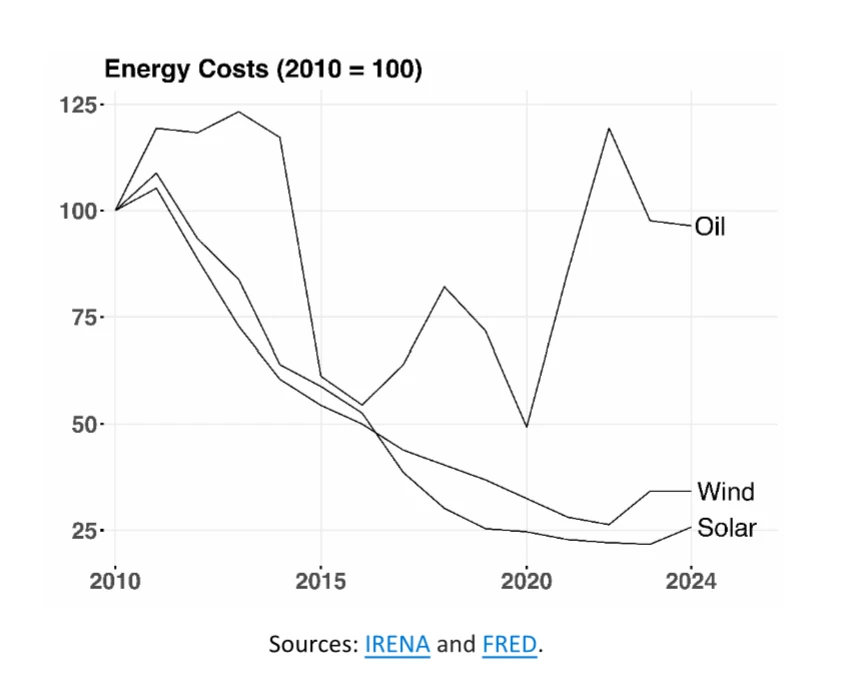
An economist friend passes along this graph of energy costs. He says, "Given this history, it is more than a little ironic that renewable energy is derided by fossil-fuel proponents as 'unreliable.'”
If I had the time to flesh this all out, I'd do a book on how American cities manage virtually everything at the wrong scale, and this accounts for about 80% of our routine issues. Policy wonks want to policy wonk everything; designers like me see everything as a design problem. But what I've become convinced of is we have a basic management problem.
I find this to be really difficult to communicate, so bear with me (which would be the point of writing something out, right?)
Smaller cities and towns have their limitations, but their local governments are intimately familiar with issues in town, know their constituents closely and are generally very accessible.
As cities grow larger, the population of districts also grows. Sometimes to very large numbers. My district in my city has over 80,000 people in it - represented essentially by 2 people. Bear in mind there are entire towns of half that size with a City Council of 5-12 people. So there's that aspect - the political side.
Then there's the day to day management side. As cities grow, they grow like corporations used to grow - vertically and siloed. It becomes harder and harder for lay people to know who to call, who does what, etc etc. I've seen a number of workarounds tried, with good managers and not so good ones. But fundamentally I see a systems problem - people just get farther and farther away from constituents and needs.
One result is many very localized issues just don't get dealt with well at all. Everyone in the process seems to default to solving problems at the scale of the whole city, when in fact most issues are hyper-local. That hyper-local scale gets problem-solvers in the form of BIDs, CIDs, Place-management organizations, like mine. And these groups often do a great job - because again they operate at a fine scale and are accessible.
But parts of the community without those groups, just generally don't get their issues solved.
This is but one part of a much longer thought train, but over and over again I've seen how we have countless issues because of lack of management at the right scale - a more localized one. And those issues then metastasize and become much bigger fights.
Much of this is rooted in the very 20th century idea that consolidation of governments and annexations would lead to management efficiencies. Because that was the mentality of much of society at the time. Might've sounded good in a textbook or a seminar, but it just hasn't worked.
My gut tells me so much of cities would work 1000% better if we had smaller-scale, localized governance and management. I feel like people instinctively know this or sense it, but we can't figure out how to communicate it well or solve for it.
Nous voulons la légalisation de la norme EN 81, car :
1. Les ascenseurs au Canada et aux États-Unis coûtent trois fois plus cher qu'en Europe;
2. Le coût d'entretien des ascenseurs nord-américains fait grimper le budget d'entretien de nos logements publics et privés.
3. La cherté des ascenseurs nord-américains mène à des immeubles multi-résidentiels de trois étages SANS ascenseurs, ce qui n'est pas bon pour les aînés.
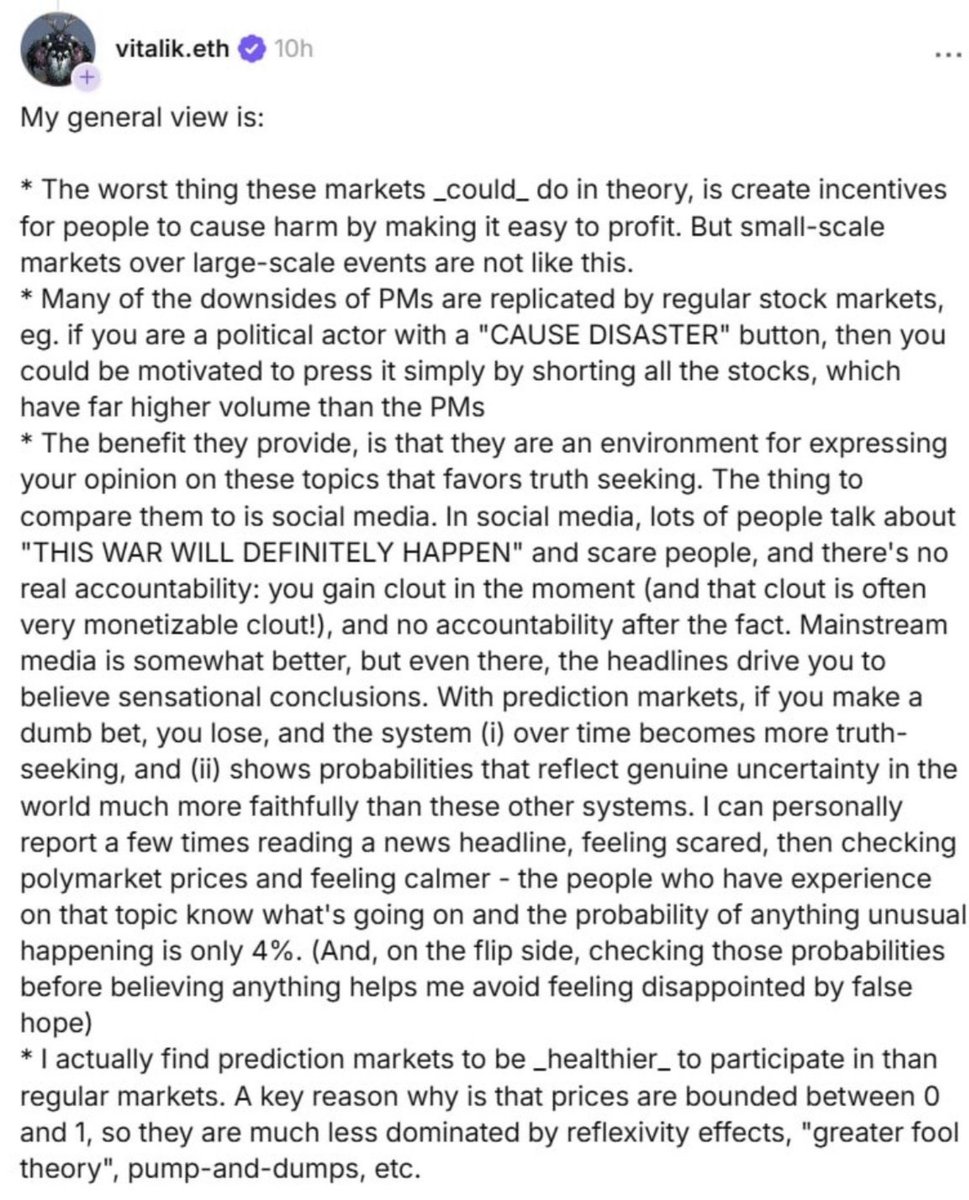
this is one of the clearest explanations of why prediction markets matter that I’ve seen.
Vitalik is basically saying:
> prediction markets aren’t about gambling, they’re about forcing accountability into beliefs.
> on social media, people get rewarded for being loud, extreme, and wrong.
whereas on prediction markets, you get punished for being wrong and that flips incentives completely.
> what’s powerful here is the idea that markets discipline narratives.
you can scream "this will definitely happen" on X and get likes, but the moment you have to put money behind it, uncertainty suddenly matters.
that’s why prediction markets feel healthier than most info ecosystems:
> lies are costly
> confidence has a price
> reality settles arguments
they don’t eliminate misinformation, but they price and that alone makes them one of the most honest coordination tools we’ve ever built.
I was involved in government (California) when this switch happened. I vouch for this thread’s explanation.
It was a hippie mistake, a notion that took hold. No one spoke up for asylums. It’s past time to reinvent them.
A fungus from the Amazon rainforest can break down polyurethane plastic without oxygen. It's the first organism discovered with this capability, and it can survive using plastic as its only food source.
Most plastic waste ends up deep in landfills where oxygen doesn't reach, precisely where this fungus thrives. Polyurethane persists for centuries in these environments. It's everywhere: mattresses, insulation foam, shoe soles, adhesives, car parts. Annual global plastic production exceeds 400 million tons. Less than 10% gets recycled.
Pestalotiopsis microspora was discovered in 2011 in Ecuador's Yasuní National Forest, isolated from plant stems. The endophytic fungus lives inside plant tissues without harming its host. Laboratory testing revealed its remarkable ability: it degrades plastic equally well with or without oxygen present.
The fungus secretes an enzyme that breaks apart the chemical bonds holding polyurethane together. In laboratory tests, concentrated enzyme extracts can completely break down polyurethane polymer in under an hour. The fungus also produces a second enzyme that degrades PET plastic, splitting it into simpler compounds the fungus then consumes as food.
What makes this significant? Other plastic-degrading organisms need oxygen to function. When tested without oxygen, fungi like Lasiodiplodia and Pleosporales slowed down or stopped working. P. microspora maintained the same performance. This ability to work without oxygen directly addresses the actual problem—plastic buried in oxygen-depleted landfill depths.
The enzyme production is adaptive. When the fungus grows in a basic environment with only plastic available, it ramps up enzyme output. These enzymes spread through the surrounding material, breaking down plastic well beyond where the fungus itself is growing. The enzyme breakdown converts long-lasting polymer into simple compounds the fungus uses as food.
This fungus offers a biological solution that works precisely where the problem exists, in oxygen-depleted landfills where an ever-increasing amount our plastic waste collects.
Systems thinking promises to give us a toolkit to design complex systems that work from the ground up. It fails because it ignores an important fact: systems fight back.
https://t.co/DBzcxYGC0C
What happens when a team turns a failure into a dramatic success? Sometimes, their hard work and courage earn them a GAO nastygram. That's because the Government Accountability Office holds them accountable to the operating model that caused the problem in the first place. 👇
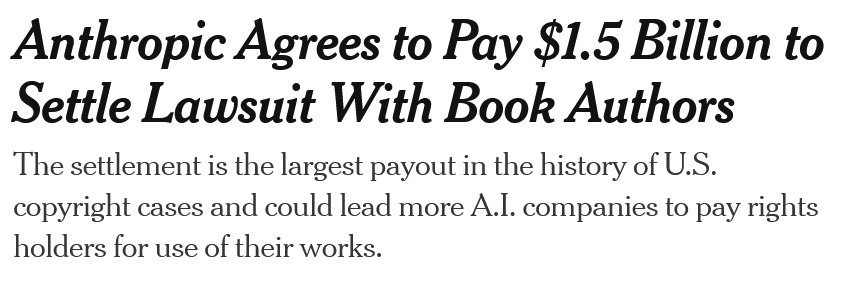
Fine wrap-up on the $1.5B settlement for Anthropic's use of pirated books.
Apparent lessons:
1) Using books to train AIs is OK, as it's transformative as per copyright law;
2) But you gotta *buy* the books--you can't download a database of pirate books like Anthropic;
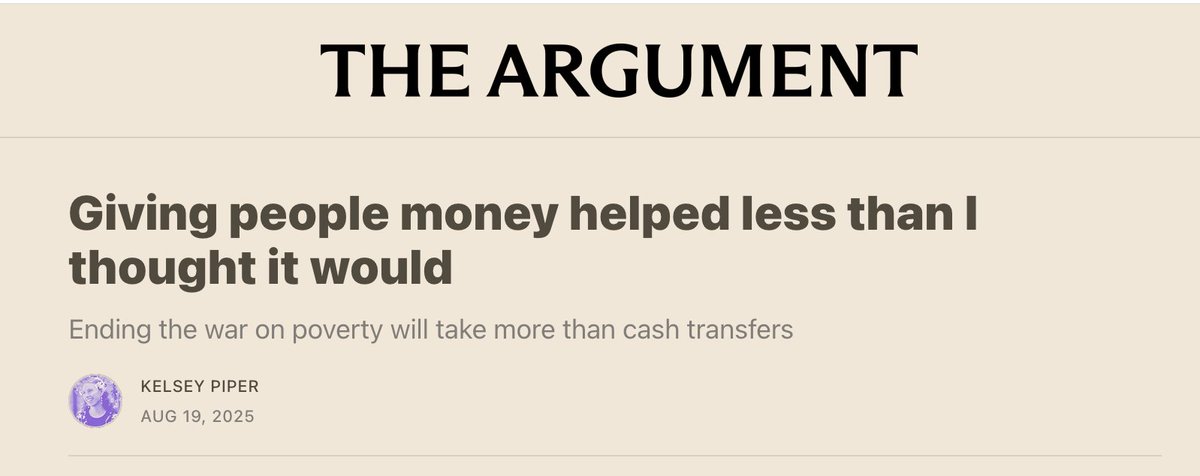
It's a bit painful for me to share this, but I respect @KelseyTuoc (and @evavivalt) a lot, and I think they're basically right: the most rigorous recent studies on basic income and cash transfers (in rich countries) have yielded pretty disappointing results.
Further proof, if any were needed, that there is only one political ideology in the US, and it is subscribed to by roughly 75% of US politicians, and even more Americans, and its name is NIMBY. Our failure to build high-voltage electricity lines, Part 593. https://t.co/qYZCa9hi7x
Superb piece by Paul Friesen. Tolerance is a virtue but should not be extended to tolerating violent intolerance. In particular, why does the liberal West give a free pass to the intolerant medieval bigotry of Islamism? Please read the whole article.
https://t.co/rCao3Aam51
@JeffSpeckFAICP "Bike projects also create 2x more jobs than road projects."
Are bike projects more expensive? If not, are the jobs lower pay or material costs lower?
Why do bike projects create more jobs?
“Just build more and prices will go down.”
It’s the theory dominating housing policy.
Simple supply and demand. Deregulate, upzone, speed up permits—and affordability will follow.
But here’s the question no one wants to ask:
What happens when prices actually fall?
This is nuts.
In 1990 healthcare wasn’t the top employer in any state
In 2024 it’s the top employer in 39 states
We are the united states of healthcare