Today's my first day in a new role: Head of Editorial at Latent Space (@latentspacepod).
From ReadWriteWeb to The New Stack, I've always loved being at the cutting edge of tech x media. So I'm thrilled to join @swyx & his team. We have big plans! https://t.co/Uh9VMvLqOK
sorry for the tech issues yesterday but omg @lydiahallie posted her makeup talk last night and it already got 200k views in 13 hours - highest day 0 count in the history of AIE!!
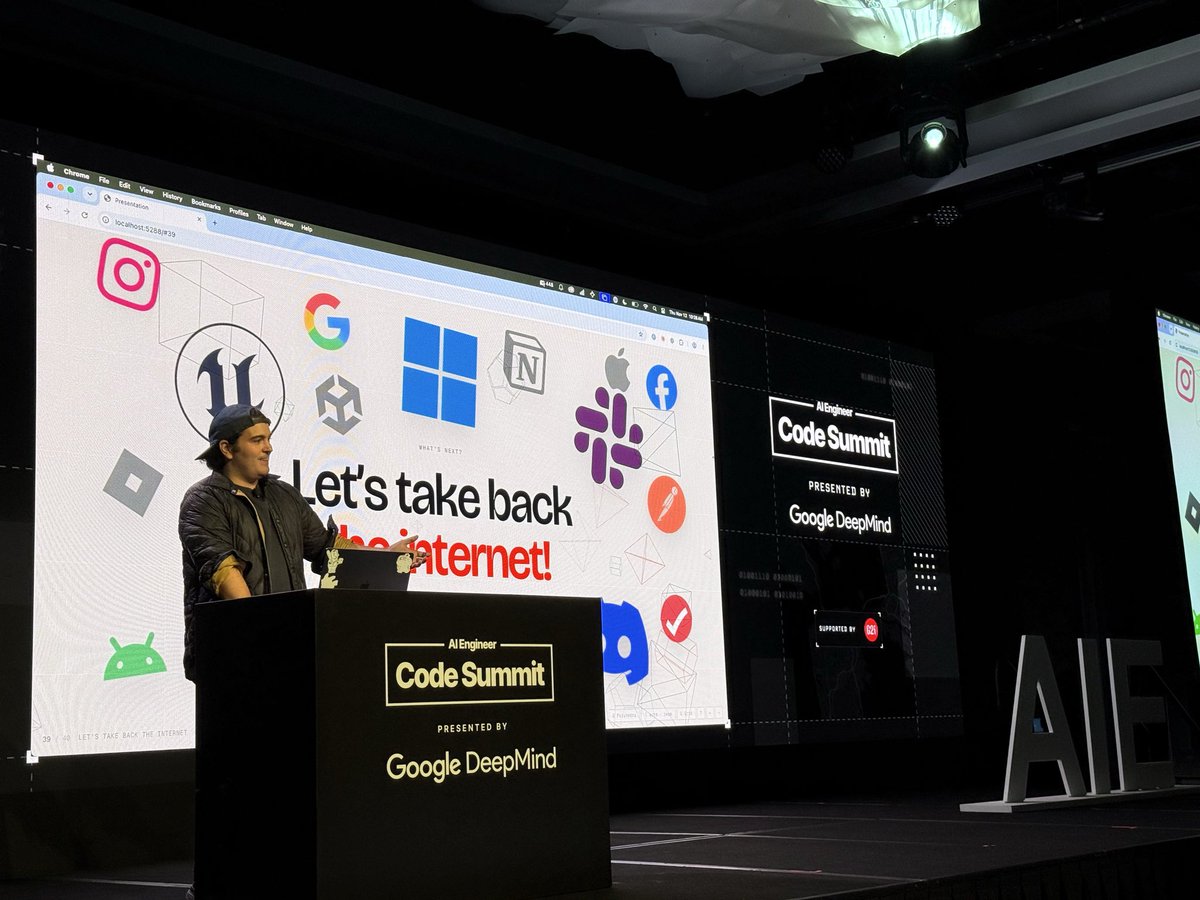
My writeup from @aiDotEngineer Code Summit today, where the theme was System One models. Not only was there an inspirational, Jobsian presentation by @CompleteSkeptic, but we also saw how companies like @glean are using Jev. https://t.co/Vf82fLXT8n
“Software is gonna be so fucking back.”
.@CompleteSkeptic is full of bangers and you will have to listen to his full talk at @aiDotEngineer, but for now, here is our top-10 of his pearls:
1“We’ve been announcing AGI three months away for two years now.” Meanwhile, go outside San Francisco and a lot of the world looks unchanged. Where the fuck is all the automation?
2“You get Einstein 95% of the time, but Mr. Bean 5% of the time.” And if you can’t tell which is which, how are you supposed to automate anything?
3“I do believe RLHF is part of the problem.” His complaint: we optimized models for assistance, with a human checking the result, and then expected them to reliably do work on their own.
4“The bitterest lesson is doing the right task.” Diogo thinks that compute matters more than algorithms, data matters more than compute, and choosing the right task matters most. You get what you optimize for.
5“I think the world still has LLM Stockholm Syndrome.” We keep designing around the limitations of today’s models. Why is the best we can come up with still the same software, cheaper to write, with a chatbot on the side?
6“What if we can program with common sense, with intention, with human understanding?” Very passionate talk! He suggests: put intelligence into the software’s inner loop. What could we build if understanding intent became a building block we could actually rely on?
7“Real fucking engineering by people who care a lot about the end result.” Break tasks down, build stages you can verify, and actually manage state. Why should every agent rediscover the same codebase patterns over and over?
8“There’s an asymmetric advantage for people who are, like, bad actors and don’t give a shit.” That’s his explanation for slop: unreliable output is much easier to tolerate when everyone else pays the cost of reading, checking, and filtering it.
9“I call this software research. That’s not a joke.” Explore what software could become, including weird things with no obvious business case. Build something because you can. Maybe one percent of those ideas leads to something awesome.
There is going to be SaaSopalooza! (I don’t know how to write this word but you got me)
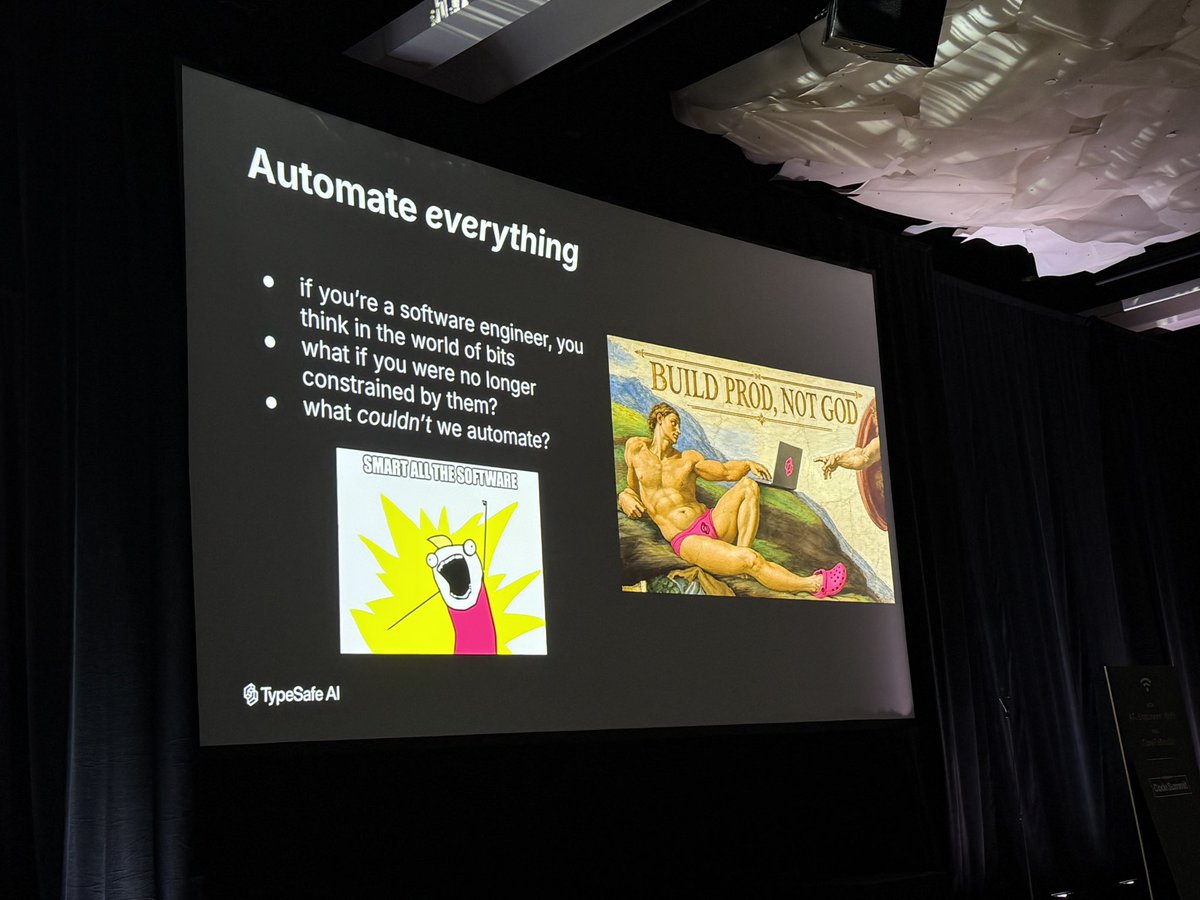
10“Software is gonna be so fucking back.” The future he wants is one where “can we automate this?” becomes “how much work will it take?”
At @aiDotEngineer Code Summit today, @charlierguo & @dkundel from @OpenAI showed all the new ways of working with Codex — including on cloud, via voice, and with dots. My writeup of their workshop: https://t.co/T8qLhMZM1Q
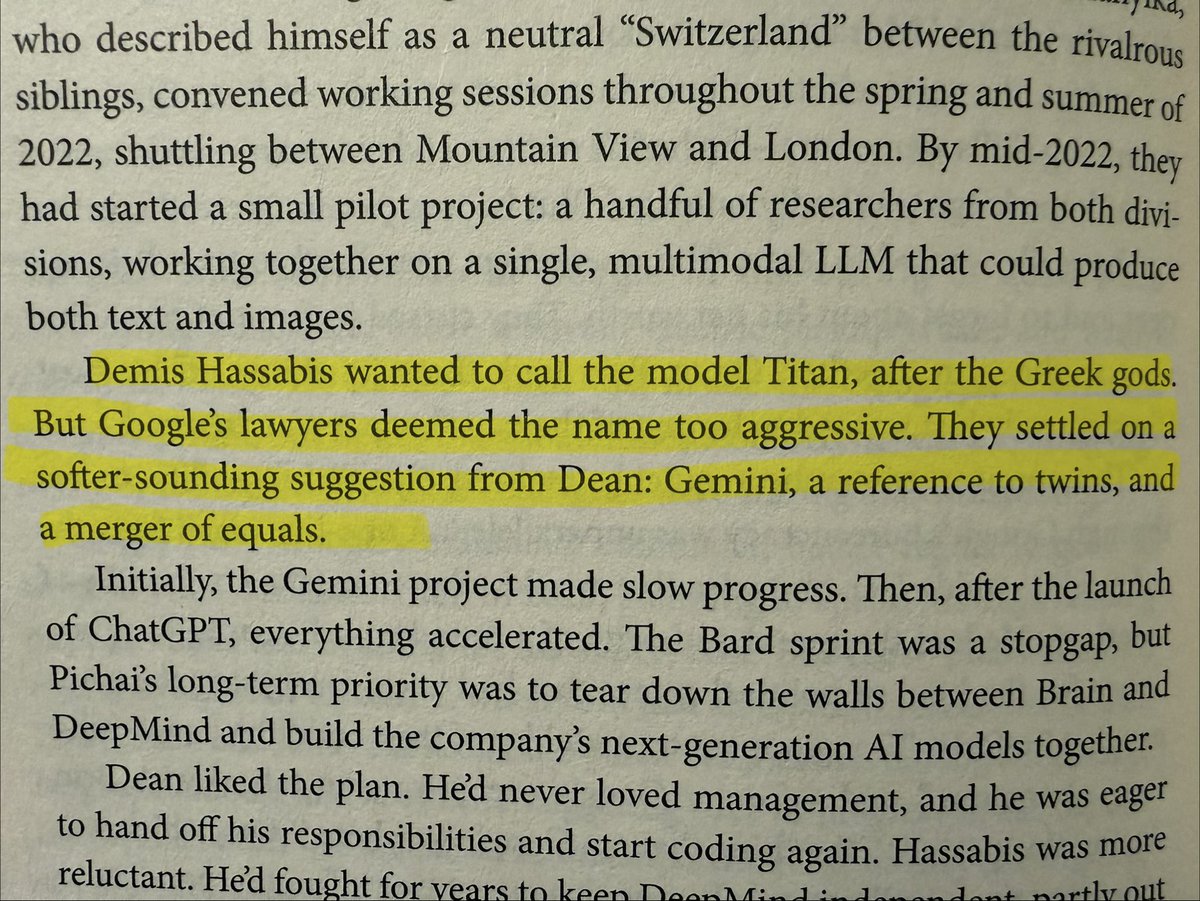
Love this detail from The AGI Chronicles book. Titan would’ve been a cool name, especially compared to the space and story metaphors of OpenAI and Anthropic (“I’m going to summon Titan now!”). But Gemini does neatly sum up the merger of DeepMind & Google Brain.
AIE 2026 Shanghai is over. I walked away feeling inspired and encouraged by the talks.
My personal favorite was @ryolu_ 's . It made me think about the relationship between myself and my craft.
As a developer, though, I connected more with the @Ronny_MiniMax 's talk — it’s closer to what I’m actually working on right now. It pushed me to rethink the relationship between developers, the actual development tasks, AI agents, and the product.
I’ve published the recordings from both days on this site: https://t.co/WVYz95P1v4
You can listen to them with subtitles, or just talk to your agent about the topics you care about. There’s also an MCP server built in, so your agent can help surface what’s most relevant to you.
Really nice to meet so many of you offline. What a wonderful two days.
the AI industry is getting a little too excited about the idea of agents doing everything for us imo
i don’t want an AI to book my vacation. i want it to find the incredible little hotel i’d never discover on my own
i don’t need it to buy my groceries. i want it to fill my cart with everything i usually order so i can review it and check out
the people building agents seem strangely obsessed with removing the human from the equation when there’s still so much opportunity to make the human better at what they actually want to do
Memory is what allows Claude to learn from experience. In a new Engineering Blog post, we share how “dreaming” helps Claude organize what it’s learned, correct its mistakes, and find what it needs more easily the next time. https://t.co/uUEN4bNkr9
how we’re building decision models at @liquidai
(aka: “how we reverse-engineered Jev”)
谢谢 @aiDotEngineer shanghai for having me.
here is the thread version of my talk 🧵
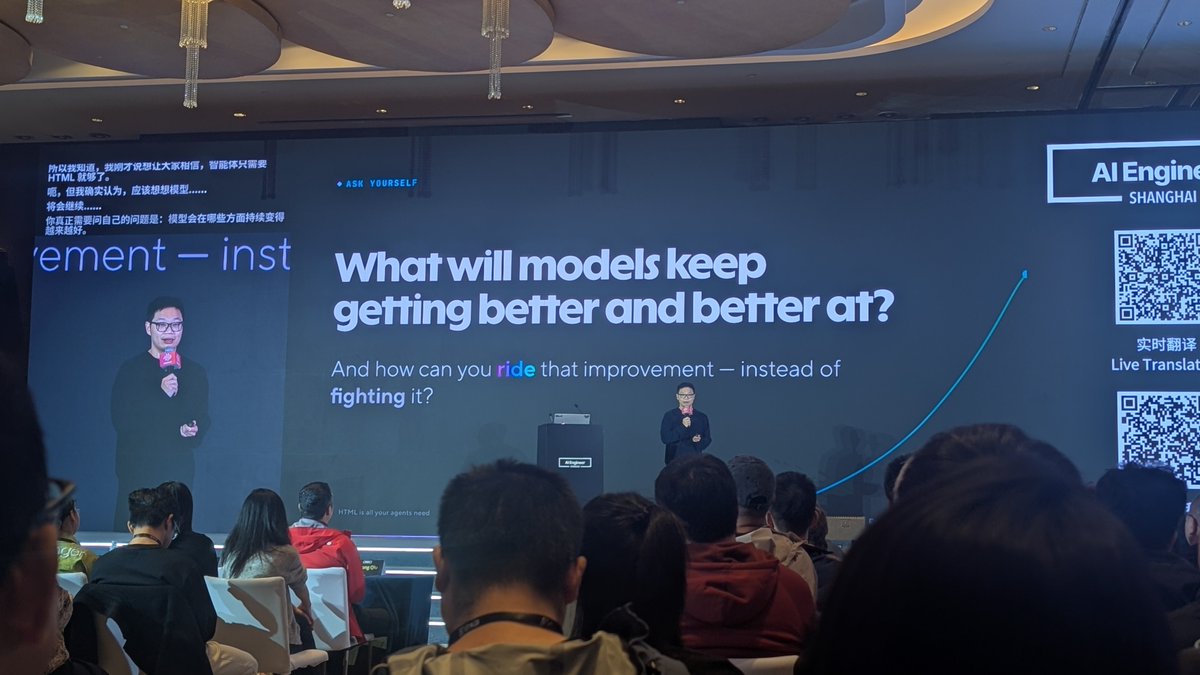
@liu8in of @HyperFrames_ gave an amazing talk at @aiDotEngineer today, and I enjoyed followup discussions with Bin, @WaterrrMiao and @wenbozhu0328
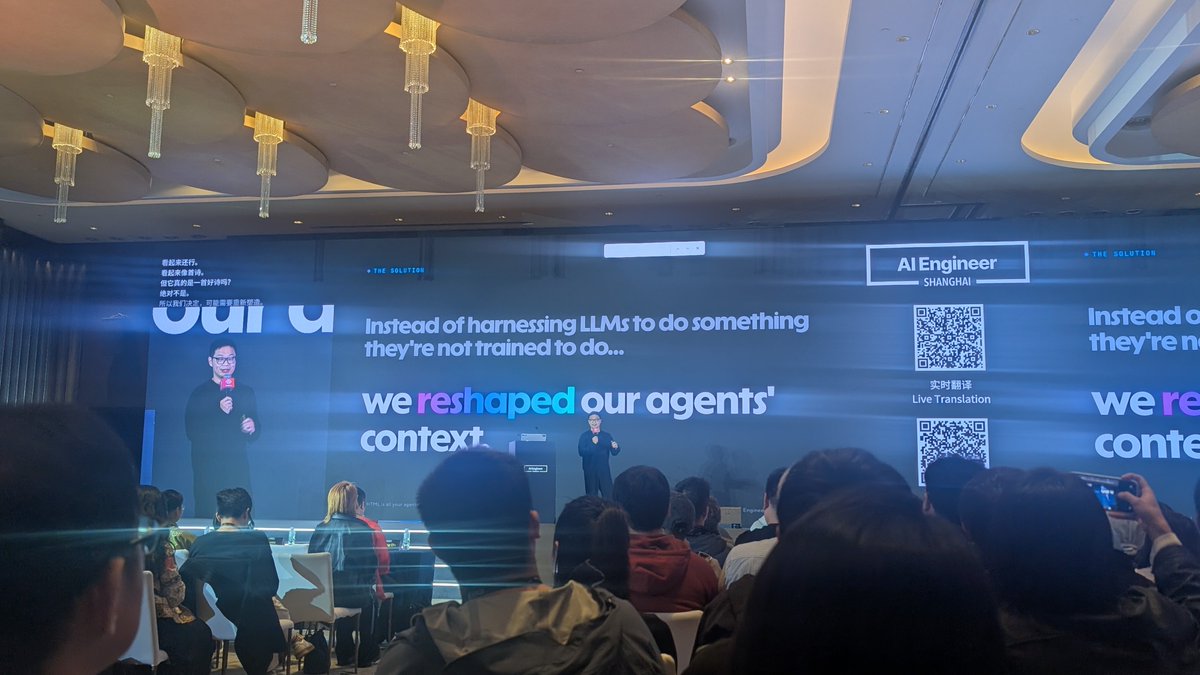
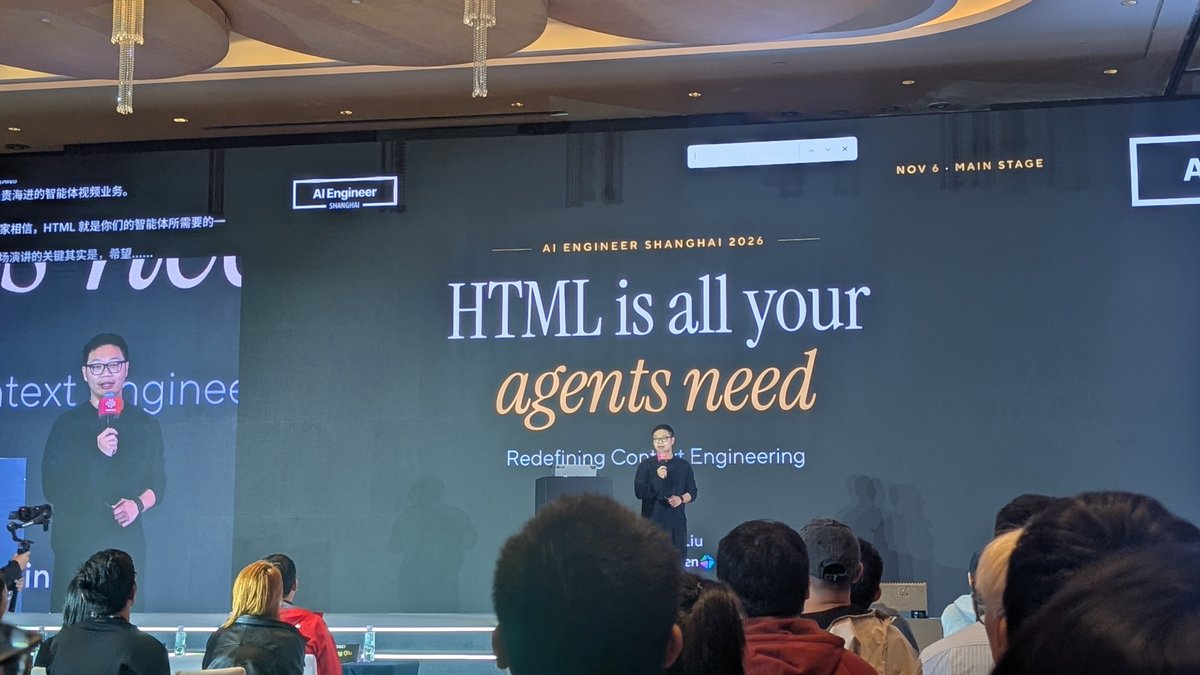
Bin's talk: HTML is all your agents need.
Quick highlights:
1. Exploit what the model is good at
The team used to ask agents to produce custom JSON to do video editing, but performance wasn't good. Instead of harnessing the LLM to write JSON with higher accuracy, they switched to HTML, which the agents are really good at writing.
2. Exploit what models will get better at
Hyperframes rode the wave of the popularity of Opus 5.5. As Opus 5.5 got better at video editing, even more people started to use Hyperframes, as it serves as the "infrastructure" piece.
It's a perfect example of "building a product for the model capability of 3 months into the future" that Boris talks about
3. Use videos more
Use videos as a way of expression & communication, as they have a much higher information density than pure text.
rich personal websites possibly with your first & last name domain or even with an identity like signull will matter a lot more because when personal agents browse the internet for a variety of use cases, that context will be highly ranked.
first & last name domains + a rich website will be the new facebook profile. imagine a match maker agent finding you because you’re single, or a job search agent because you’re looking for a gig, or an agent that finds you ppl to play tennis with, etc.
discoverability for agents will be huge & networks like insta & linkedin will have not have huge incentives to open this up for other agents than their own, so it’ll matter again a lot more.
gave a talk at @aiDotEngineer shanghai about about a question i keep coming back to: when we can make anything, do we still know what we want?
i want tools that help us find our own answers, not skip the process of forming them. not just more output, but more room to think, care, and make together.
will share more soon!
So here it is — @ryolu_ 's talk at @aiDotEngineer 2026 Shanghai.
I shot it handheld on a Xiaomi 15 Ultra, so there's some shake; I fixed as much of it as I could in CapCut. Handheld footage just isn't going to be sharp or steady.
Still, it's the best talk I saw on day 1 of AIE — which is why I'm not posting a text summary. Watch for yourself.
I missed the first minute or so. Ryo opens with the excitement of what AI makes possible, and how seeing what others are building can quickly turn that excitement into anxiety about falling behind.
Cloud is still a mess on both ChatGPT and Claude. I started a new chat today to create an intranet site for work, and for some reason the chat started in the cloud. But I had a few of these kinds of responses, so had to switch back to desktop (where it worked first time!)