I talk about commodities and equities. Sometimes I'm right, sometimes I'm...not. 🤷♂️ My tweets are just my thoughts, not financial gospel. 🙏 Don't sue me. 😅
FX depreciation absolutely affects inflation. India imports crude oil, electronics, machinery, fertilizers, and industrial inputs. When INR weakens, these become costlier, which raises domestic prices indirectly.
Purchasing power is not just local. Even if domestic inflation is moderate, INR depreciation reduces Indians’ ability to afford foreign education, travel, imported goods, overseas assets, and global investments.
“Savings beat inflation if you are smart” is not true for most people. A large share of Indians keep money in FDs/savings/gold, where post-tax real returns often barely beat inflation - sometimes not even that.
A falling currency reflects deeper macro realities. Persistent depreciation usually signals inflation differentials, trade deficits, weaker productivity growth, or lower capital attractiveness relative to stronger economies.
The mistake is treating FX and inflation as unrelated. Inflation may matter more for daily life, but FX depreciation feeds into inflation over time through fuel, logistics, imports, and supply chains. They are connected, not separate worlds.
Race between #Crudeoil and #Exitpolls - both factors moving in opposite directions for #Nifty.
If there is even a whiff of relaxation in conflict, #Nifty can have an even better day tomorrow.
@quantian1 Elegant formula, but Jäckel's "Let's Be Rational" (2015) already hits machine precision in ~1µs and runs on every trading desk. Root search hasn't been the bottleneck for a decade.
The White House saw Shehbaz's ceasefire text that says #Lebanon is part of the deal. He can't do it on his own. FT reports trump was pushing the Pakistanis to sell his ceasefire to Iran. #Iran won't buy assurances from #Pakistan (which is an American ally). That's why Ishaq Dar went to Beijing on March 31. Iranian officials say, per NYT, China pressed Tehran to accept the ceasefire (We don't know what did they offer in return). So Pakistan's job was to present the American proposal to Iran and get China to nudge Tehran to accept the deal so that trump can get out of the mess he has put himself in. Iran accepted the deal based on the 10-point proposal--which clearly says ceasefire on all fronts, control over Hormuz and it has the right to enrich. But for ceasefire to take hold in Lebanon, netanyahu should stop his killing machine. he accelerated it instead--because he, angry with the deal, saw an opportunity to torpedo it. So twelve hours later, the White House, unable to rein him in, says Lebanon is not part of the deal, throwing Shehbaz under the bus. Iran tightens the grip on Hormuz.
That's where we are standing now. There is no largescale American-Israeli attack on Iran or Iranian retaliation, but the Strait remains closed; Lebanon is being pounded; US says the 10 points it agreed to are different; Tehran says ceasefire at this point is "unreasonable" (but it hasn't quit it).
This is some steeply backwardated #WTI curve with front-loaded tightness. The convexity suggests short-term supply constraints, while longer maturities reflect expectations of normalization. The structure implies strong positive roll yield for long positions. #Crudeoil
I don't know why market expected Trump to be de-escalatory in tonight's address to the nation. How can you expect US to withdraw in the middle of the campaign when Iran is having an upper hand in the middle east? If the war were to wind up tonight, the whole regional balance of the ME shifts to the detriment of GCC countries. US and it's allies don't want that. This war will go on till the time IRGC themselves start giving feelers for peace deal. #WTI #Crudeoil
#WTI#crudeoil continues to favor a “buy on dips” approach. Any assurances from non-IRGC-affiliated sources - whether from the U.S. or Iran - are likely to be short-lived and may present tactical buying opportunities.
A sustained move below $100 for several hours would be required to signal a potential breakdown; until then, the broader bias remains bullish.
Even after so much geopolitical news flying around, between Mar 20 and Mar 23, the #WTI vol surface experienced a front-end volatility shock, steepening the backwardated term structure, while long-dated expectations remained unchanged.
@AnilSinghvi_ looting retailers since 2018 @ZeeBusiness
He gave call today morning to buy stocks related to Aluminum and these stocks are down more than 5% already.
The 3rd #Gulf#War - yes, we're saying it - may have just begun in the #Strait of #Hormuz.
The 12-order cascade that follows a zero-flow closure is the most important systems analysis you'll read today. I've added an infographic breaking down how it unfolds.
Spoiler: it reaches your server rack, your supermarket, and your government's solvency.
🧵 Hormuz closes, who quietly wins in India?
1. LNG disrupted → gas power plants starved of fuel
2. Essential Commodities Act already invoked → govt's four-tier framework puts power plants explicitly below households & CNG in gas priority. They can cut supply to plants legally, overnight.
3. #NTPC, #JSW Energy run on domestic coal/renewables - they don't care about Hormuz
4. 2nd order: LPG getting expensive → induction cooktops, electric geysers, EV two-wheelers flying off shelves → more grid demand, less gas demand
The electricity just has to go somewhere.
Not a buy call. Both stocks have baggage. But the policy wind shifted - worth watching.
DYOR 🙏
The last time global supply chains broke our business went from $12M to $60M a year. The U.S. imports $115 million a day in specialty chemicals. Among them: tolyltriazole and benzotriazole, the corrosion inhibitors protecting military equipment. Most of that comes from China. Same story with the orthophosphates that keep lead out of our drinking water. When COVID hit, companies that had ignored supply chain risk were exposed. They needed a domestic supplier. We make specialty chemicals from corn sugar, not oil. Our plants sit next to the customer. The lesson: build where the points of failure are. Find the products where one black swan event flips the entire market.
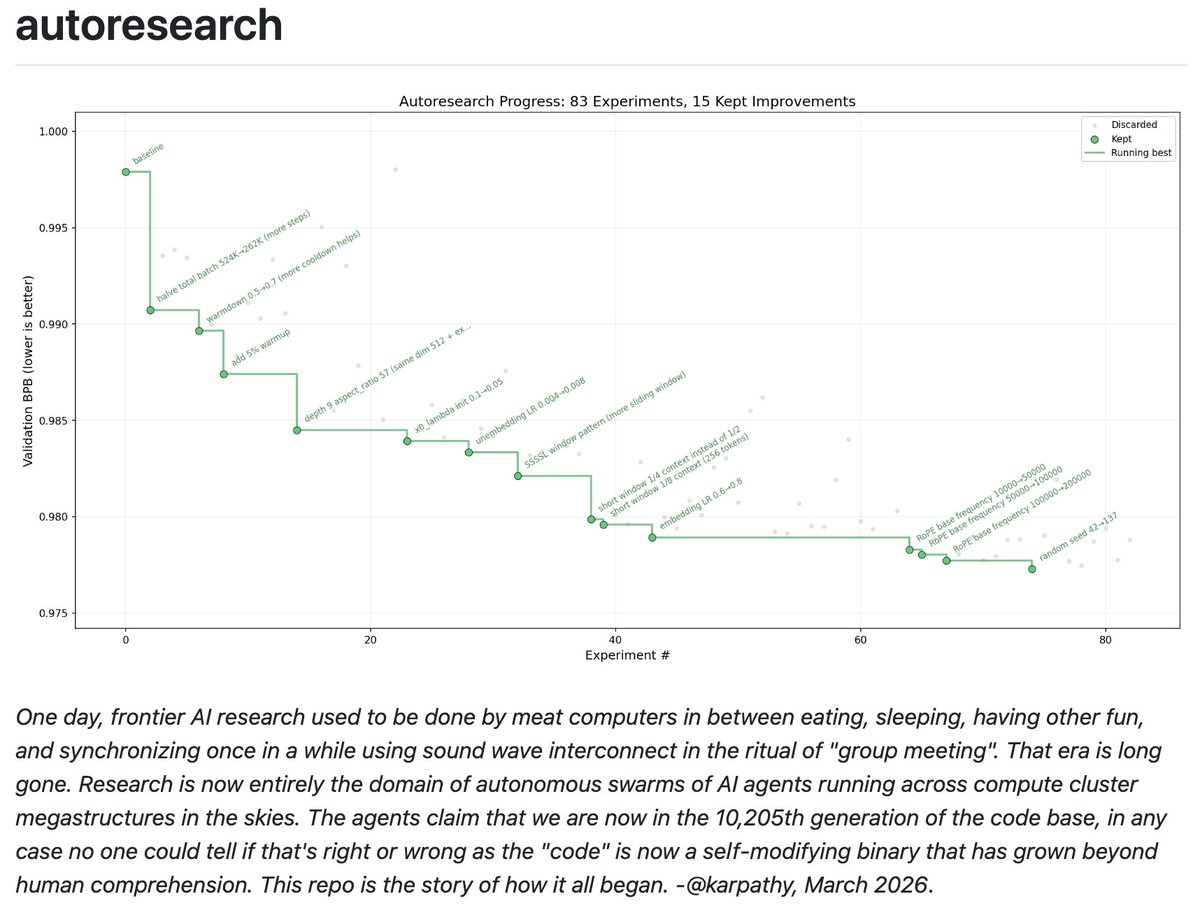
I packaged up the "autoresearch" project into a new self-contained minimal repo if people would like to play over the weekend. It's basically nanochat LLM training core stripped down to a single-GPU, one file version of ~630 lines of code, then:
- the human iterates on the prompt (.md)
- the AI agent iterates on the training code (.py)
The goal is to engineer your agents to make the fastest research progress indefinitely and without any of your own involvement. In the image, every dot is a complete LLM training run that lasts exactly 5 minutes. The agent works in an autonomous loop on a git feature branch and accumulates git commits to the training script as it finds better settings (of lower validation loss by the end) of the neural network architecture, the optimizer, all the hyperparameters, etc. You can imagine comparing the research progress of different prompts, different agents, etc.
https://t.co/YCvOwwjOzF
Part code, part sci-fi, and a pinch of psychosis :)
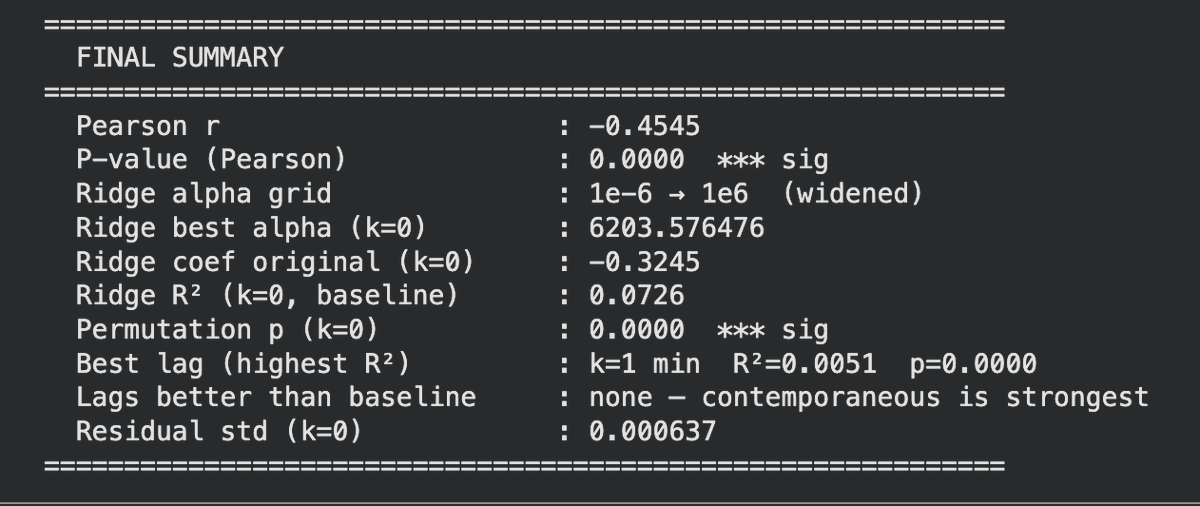
Out of curiosity, I modeled the #USDJPY's effect on #Nifty and was shocked to see that a 1% weakness in JPY causes an instant (in the same minute) decline of 0.3% in #Nifty50. The fact that no lag beats the contemporaneous relationship tells you this is information efficiency at work - both markets are absorbing the same global macro shock simultaneously, within the same 1-minute bar. USDJPY alone explains ~7.3% of Nifty's 1-minute variance. For a single forex variable at 1-min frequency, this is actually quite respectable!
Is the Indian market really done selling? 🤔
#Nifty is only about ~3% down this week, and we’ve already seen a few green shoots of recovery. Yet Gift Nifty is up - which honestly doesn’t make much sense.
Feels unexplained… and very likely a trap for eager buyers.