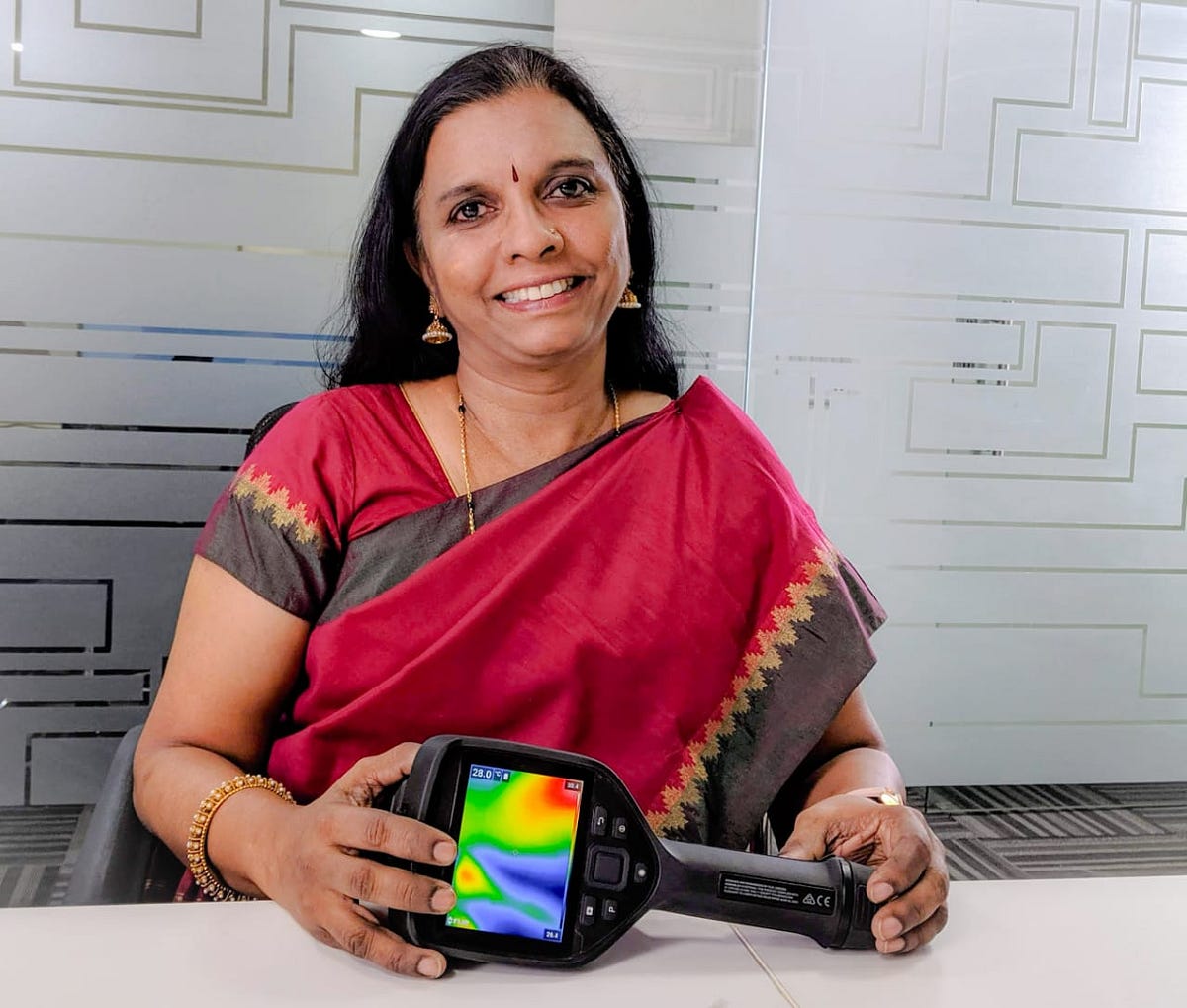
In 2016, Dr. Geetha Manjunath was heading AI research at Xerox's Bengaluru lab, a role that followed a PhD from IISc, a stint as Principal Scientist at HP Labs, and over two decades building enterprise AI systems. Then her cousin, in her early forties, was diagnosed with breast cancer at a stage too advanced to treat.
"The mammogram had missed her cancer earlier," Geetha would later say. She quit her job soon after.
Mammography, the global standard for breast cancer screening, has real limits. It uses ionising radiation, is often painful enough that women actively avoid it, and is known to be less reliable in younger women and in the dense breast tissue common across Indian women. In India, where breast cancer accounts for over a quarter of all cancer diagnoses and the five-year survival rate trails far behind the United States and Australia, late detection is not a statistic. It is the difference between a cure and a funeral.
Geetha had spent years working with thermal imaging on unrelated projects. She wondered if temperature variation in breast tissue could reveal what mammograms missed, and built the science to test it. The result, Thermalytix, requires no radiation, no incisions, and no physical contact: a woman sits before a thermal sensor for a few minutes, and an AI model trained on clinical data analyses the image.
Niramai Health Analytix, the company Geetha founded and now leads as CEO and CTO, has since screened over 300,000 women across more than 20 countries, built on 39 patents and validated in 55+ peer-reviewed clinical studies. Geetha herself has been named to Forbes India's Top 20 Self-Made Women and inducted as a Fellow of the Indian National Academy of Engineering.
For India, where cost and discomfort keep millions of women away from regular screening, a radiation-free test that can be deployed in a primary clinic is not a convenience. It is a chance to catch what would otherwise be caught too late.
Introducing Universal Manipulation Exoskeleton (UME)
A low-cost exoskeleton with real-time haptic torque feedback for learning autonomous policies that perform highly force-mediated, tightly space-constrained, visually occluded, whole-body, and long-horizon mobile manipulation tasks.
Using UME, the teleoperator can unsheathe a heavy metal sword completely blindfolded.
https://t.co/W3PHmYRm4q
🧵1/N
This is what responsible use of resources means to us.
No industrial-scale compute.
No massive in-house proprietary data.
Just open-source data, an academic compute cluster, and a team with a lot of passion 🤩
Still achieved industrial level performance!
I’m excited for the next stage: scaling the data, while keeping the model efficiently small and the representation meaningful.
People replace their phones every ~4 yrs. This means there are hundreds of millions of old phones discarded each year that are still perfectly usable as computing devices. @Google in collabration with @UCSD is exploring how to turn these old phones into cloud-computing “phone clusters”. Putting phones back in service in this way can directly reduce the environmental footprint of computing by avoiding the need for further raw material extraction, and taking advantage of the embodied carbon already incurred from manufacturing these devices, and modern phones actually are already quite powerful computers. Read more in the blog below ⬇️
How much time should robots spend thinking?
Vision-Language Models are increasingly used as high-level planners for robots, and the prevailing strategy has been to scale test-time compute to boost capability. But more reasoning steps, bigger models, and longer memory all come with increased latency, tokens, and FLOPs—often with diminishing and uneven returns.
So when, and where, is test-time compute actually worth its cost? 🧐
We study three dominant scaling axes and find that each unlocks a distinct capability, showing that test-time compute is not a uniform lever:
- Chain-of-thought depth helps with tasks involving implicit semantic, physical, or spatial constraints, but its additional latency is not always necessary (on VLABench, a non-CoT model matches a CoT model on 44% of tasks).
- Model size governs the breadth of skills a planner can reliably draw upon, but its benefits appear only when those additional skills are actually required.
- Memory history improves performance on long-horizon, history-dependent tasks, but can actively hurt performance elsewhere.
Across all three axes, a consistent pattern emerges: the gap between cheap and expensive configurations is large, but highly non-uniform and task-dependent.
DIRECT (Dynamic Inference Router for Embodied Compute Tradeoffs) is a lightweight router that reads scene + instruction context and sends each task to the cheapest planner that can still solve it, allocating compute per task rather than committing to one fixed model.
👉 Takeaway: smart allocation of test-time compute can recover frontier-level planning at a fraction of the cost.
📄 Paper: https://t.co/H11V7q4zGj
🔗 Website: https://t.co/Es9RJaXE0o
Work led by @_jadelynn@milanganai
With an outstanding team of collaborators: @ajaysridhar0@Mozhgan_nasr@katielulula Clark Barrett @jiajunwu_cs@chelseabfinn
#Robotics #VLM #EmbodiedAI #MachineLearning #TestTimeCompute
I’ve been capturing 3D human motion for 30 years and today is maybe the biggest day in that history. We are presenting MAMMA at CVPR (oral session 2A). MAMMA is a markerless multi-camera system that has accuracy similar to marker-based systems.
Tired of 1B+ parameter VLMs that require massive GPUs and take 1s+ to process an image? Do you miss live demos?
Come to the CVPR Meta booth Friday + Saturday 10am-12pm, I'll be giving a new live demo running on a LAPTOP of our egocentric 3DBB demo of our latest work, Boxer
(1/3) I am happy to share our work on Triangle Splatting SLAM!
We show the first RGB-D SLAM to use differentiable triangles as a 3D map representation.
Our method enables online mesh-based deformations and collision checking via on-the-fly Delaunay triangulation.
Recovery from Long COVID isn’t one big moment.
It’s hundreds of tiny impossible things becoming possible again.
The science is coming. The hope is real.
Helix-02 running simultaneously on 2 robots, fully onboard, doing a full bedroom reset from pixels-to-actions.
To be clear, there's no explicit messaging between these robots, they coordinate their actions fully visually, e.g. head nods.
1x speed, fully autonomous, no teleop.
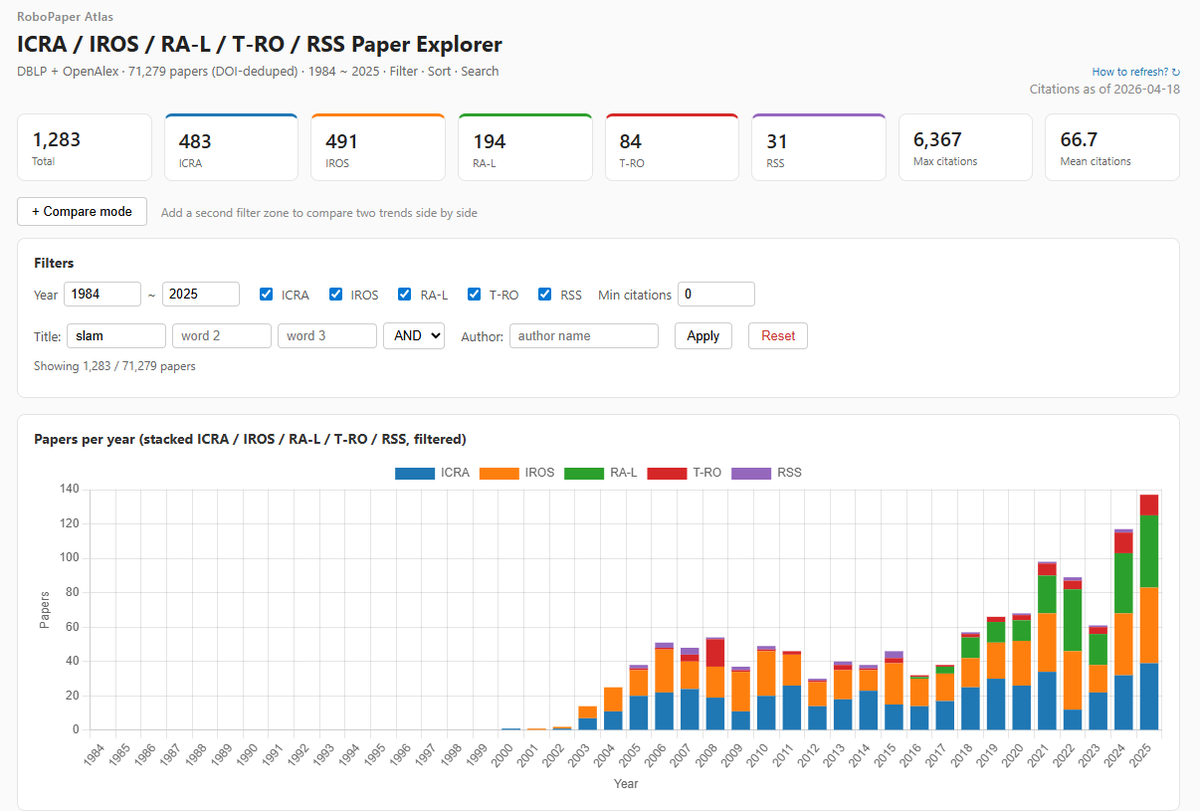
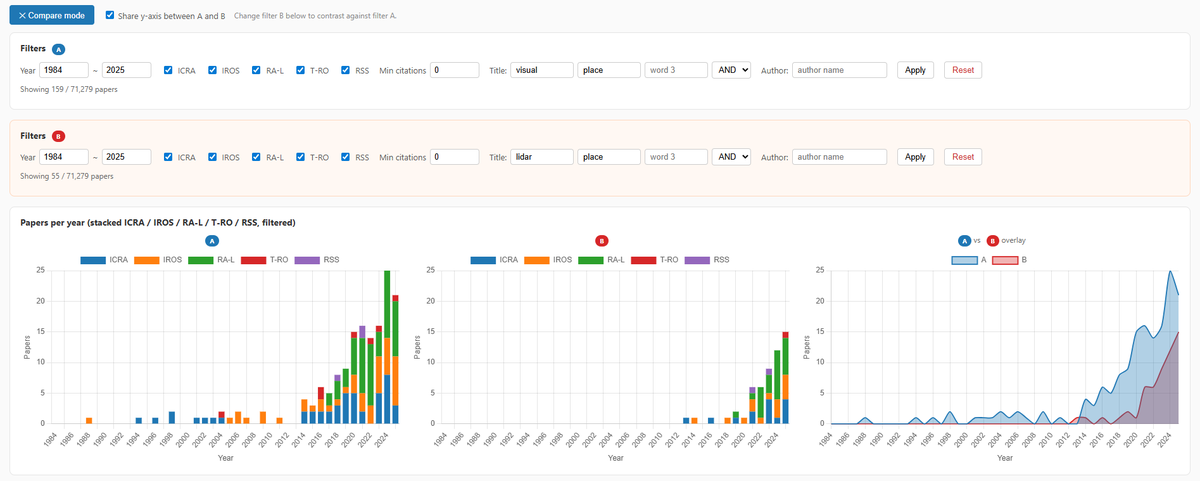
When did "SLAM" show up, and where is it now? 🔍
I vibely built RoboPaper Atlas to see the field evolve.
71,000+ robotics papers from ICRA, IROS, RA-L, T-RO, and RSS (1984 ~ 2025), turned into live visualizations
Link: https://t.co/SxyW3W4Y0p
We are publishing our second deep dive today as a follow-up post on SLAM and VIO in egocentric tracking. We go deep into the sensor tradeoffs b/w global shutter and rolling shutter and their implications on SLAM / VIO - specifically how the way the camera reads each frame can introduce significant tracking errors before our SLAM pipeline even starts processing.
We break down why global shutter is the obvious fix but the wrong default, the physics of why rolling shutter dominates every consumer device, and where the fundamental limits lie.
I think a lot of people's attitude to AI doing autonomous science will come down to whether they think the point of science is understanding or the point is getting the right answer.
We just OCR'd 27,000 arxiv papers into Markdown using an open 5B model, 16 parallel HF Jobs on L40S GPUs, and a mounted bucket.
Total cost: $850 Total time: ~29 hours Jobs that crashed: 0
This now powers "Chat with your paper" on https://t.co/G2mDae0uv9
Introducing EgoVerse: an ecosystem for robot learning from egocentric human data.
Built and tested by 4 research labs + 3 industry partners, EgoVerse enables both science and scaling
1300+ hrs, 240 scenes, 2000+ tasks, and growing
Dataset design, findings, and ecosystem 🧵