$TSLA IPO’d at a $1.68B valuation. $SPCX is eyeing $2 trillion.
Lesson: The biggest gains in investing nowadays happen in pre-IPO rounds, not after the public listing.
Wild fact: Since the 2012 JOBS Act, more Americans can access private market deals than ever before ⬇️for more
If the trend is bullish, only look for longs.
If the trend is bearish, only look for shorts.
If the trend isn't clear, turn off your f*cking PC.
That's how simple trading actually is.
I am taking a massive bet on Cerebras Systems $CBRS . Retail is completely overreacting to the recent Culper Research short report. That stock selloff was mechanically engineered by insider unlocks, and I am aggressively buying this manufactured dip. 🧵
We're living in an economy where a guy with a master's degree is delivering groceries to a 22-year-old who made $4 million filming himself screaming at video games. And we're still telling kids to study hard.
THE BEAR CASE AGAINST $CBRS: DECONSTRUCTING A DEEPLY FLAWED SHORT REPORT
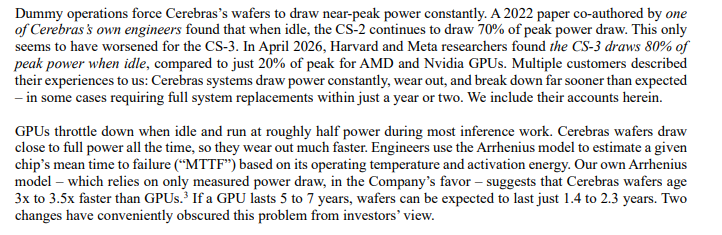
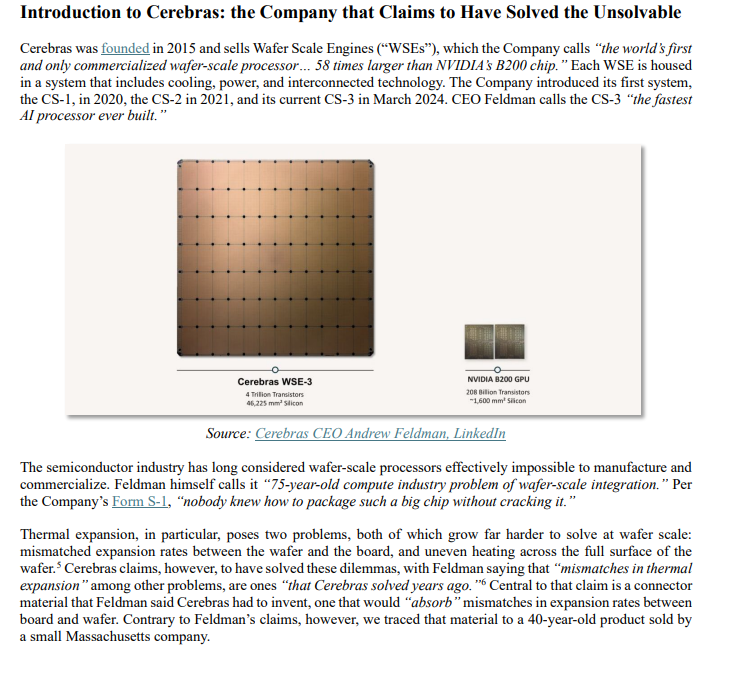
Culper Research has released a short report targeting $CBRS. Framed as an "investigation into engineering breakthroughs," the report instead relies on the sensationalized use of technical jargon. Culper claims that Cerebras’s wafer-scale chips suffer from catastrophic physical defects, asserting that the necessity of employing thermal management workarounds will cause the chips to fail within approximately two years. I find the foundation of their report to be fundamentally flawed: it cherry-picks information regarding engineering trade-offs, deliberately misrepresents the workload characteristics of data centers, and exploits a classic speculative window—the period just before a scheduled lock-up expiration—in an attempt to trigger panic selling.
The following points outline why Culper’s arguments fall apart across three dimensions: engineering reality, operational history, and market fundamentals.
1. Culper’s primary line of attack is that Cerebras maintains a constant operating temperature for its wafers by running background instructions. They claim this results in the chips consuming 80% of their peak power even while idle, thereby accelerating the degradation of the silicon. In reality, within the field of modern semiconductor packaging—particularly concerning massive, multi-reticle, wafer-scale integrated systems—the primary driver of physical failure is thermal cycling, not "sustained thermal equilibrium." Repeated heating and cooling cycles create significant differentials in thermal expansion between the silicon, the packaging substrate, and the cooling plate, which leads to the formation of micro-cracks and fatigue failure in solder balls. "Active thermal smoothing"—maintaining a stable thermal gradient across the entire compute substrate—is a proven engineering technique, widely utilized in high-reliability sectors such as aerospace, defense, and high-performance computing. To mischaracterize this deliberate design choice—intended to ensure thermomechanical stability—as a cover-up for an inferior product suggests either a fundamental lack of understanding regarding packaging mechanics or a calculated attempt to mislead non-technical retail and institutional investors. 2. Culper cites a comparative study—contrasting the idle power consumption of the CS-3 with that of commercially available GPUs from $NVDA and $AMD—to argue that keeping a wafer-scale engine active accelerates its degradation. This line of reasoning fundamentally ignores how commercial AI infrastructure actually operates. $CBRS systems are not desktop accelerators or consumer-grade servers sitting idle in a corporate basement; they are dedicated, multi-rack supercomputing engines designed to support high-density training and continuous inference tasks that demand high token-generation speeds. In production environments—such as the massive Condor Galaxy supercomputing clusters that power national-scale and enterprise-level AI workloads—utilization rates remain consistently near saturation. Evaluating a wafer-scale engine with thousands of cores based on its idle power consumption is akin to judging an industrial turbine based on a vehicle’s fuel consumption while it sits stalled in a traffic jam.
3. The claim that $CBRS wafers fail after approximately two years is refuted by real-world operational records. At national laboratories and research institutions, $CBRS deployed its first-generation CS-1 systems as early as 2020—at the Pittsburgh Supercomputing Center and Argonne National Laboratory—followed by widespread deployments of CS-2 systems between 2021 and 2022. These machines have remained operational for four to five years, consistently supporting scientific breakthroughs, cancer research simulations, and the development of physical models—far exceeding the "two-year lifespan" limit speculated by Culper. Furthermore, regarding large-scale production clusters: if the hardware required replacement on an unsustainable 24-month cycle, commercial clients—who operate hundreds of CS-2 and CS-3 units—would certainly not continue to place follow-on orders, which have now reached a cumulative value in the tens of billions of dollars.
4. If Cerebras hardware suffered from catastrophic failure rates, this would inevitably be reflected in the balance sheets of enterprise clients and the financial disclosures of hyperscale partners—manifesting as a surge in warranty reserves, asset impairments, and customer churn. Actual financial disclosures paint a starkly different picture: RPO (Remaining Performance Obligations) stand at $25.4 billion, confirming substantial, legally binding, multi-year demand from global cloud operators and enterprise consortia. Triple-digit revenue growth: In the most recent quarter, core revenue surged 103% year-over-year to nearly $210 million. Meanwhile, the company holds over $8.6 billion in cash—more than enough to fund ongoing operations and the tape-out of next-generation nodes. Wall Street sees significant upside: Analysts from 11 major research firms have set an average price target exceeding $280—representing an upside of over 130% from current levels—driven by upward revisions to earnings per share forecasts and the company’s unrivaled memory bandwidth advantage, which is critical for real-time inference.
5. The report released by Culper coincided with the expiration of the IPO lock-up period, scheduled for October 28. In late October, short positions in $CBRS surged by over 40%; speculators sought to use this as a catalyst to drive down the share price, thereby forcing more shares into the circulating market.
Manufacturing panic around the complex physics of semiconductors during a lock-up expiration is a common manipulative tactic. Once this technical noise subsides—and following the release of third-quarter operational metrics on November 12—fundamentals will inevitably reassert themselves: wafer-scale processing architecture remains one of the few structural approaches capable of breaking through the "memory wall" in the field of cutting-edge artificial intelligence.
In my view, the current short-selling data is largely misleading—a classic case of price mispricing. This discrepancy stems from a short thesis that not only violates the laws of thermodynamics but also contradicts the proven performance record of Cerebras hardware in real-world applications.
If you find my article helpful, please like+save it!