C. S. Lewis list of must read books. The list tracks pretty well the books that a person concerned with preserving our culture ought to read (or aspire to read):
Homer
Iliad (c. 8th BCE)
Odyssey (c. 8th BCE)
Unknown, Book of Jonah (8th-4th BCE)
Pindar
Olympian Odes (early 5th BCE)
Pythian Odes (early 5th BCE)
Fragments (early 5th BCE)
Aeschylus, The Eumenides (5th BCE)
Sophocles, Oedipus Rex (c. 429 BCE)
Aristotle, Poetics (335 BCE)
Virgil
The Georgics (29 BCE)
The Aeneid (29-19 BCE)
Lucian, Vera Historia (2nd)
Apuleius, Metamorphoses/The Golden Ass (late 2nd)
Unknown, Beowulf (8th-11th)
Unknown, The Song of Roland (11th-12th)
Laȝamon, Brut (c. 1190-1215)
Unknown, Huon of Bordeaux (c. 1216-1268)
Snorri Sturluson, The Prose Edda (early 13th)
Dante, Divine Comedy (1308-20)
Geoffrey Chaucer
The Canterbury Tales (late 14th)
Troilus and Criseyde (1380s)
Unknown, Sir Gawain and the Green Knight (late 14th)
Sir Thomas Malory, Le Morte Darthur (1485)
Ludovico Ariosto, Orlando Furioso (c. 1516)
Arthur Brooke, The Tragical History of Romeus and Juliet (1562)
Sir Philip Sidney, Arcadia (late 16th)
Edmund Spenser, The Faerie Queene (1590s)
William Shakespeare
Romeo & Juliet (1591-5)
Twelfth Night (1601-2)
The Winter’s Tale (1611)
A Midsummer Night’s Dream (1590-7)
Henry V (c. 1599)
John Donne, “The Apparition” (early 17th)
Michael Drayton, “The Shepherds Sirena” (1627)
Thomas Browne, Urn Burial (1658)
Jean Racine
Andromaque (1667)
Phèdre (c. 1677)
John Milton
Paradise Lost (1667-74)
Samson Agonistes (1671)
Alexander Pope, The Rape of the Lock (1712-4)
Jonathan Swift, Gulliver’s Travels (1726, 1735)
Voltaire
“Micromégas” (1752)
Candide (1759)
Samuel Johnson, The History of Rasselas, Prince of Abissinia (1759)
William Beckford, Vathek, an Arabian Tale (1782)
James Boswell, Life of Johnson (1791)
Samuel Taylor Coleridge, The Rime of the Ancient Mariner (1798)
William Wordsworth
“Michael” (1800)
The Excursion (1814)
Jane Austen, Pride & Prejudice (1813)
Walter Scott, Guy Mannering (1815)
Benjamin Constant, Adolphe (1816)
John Keats, “Ode on a Grecian Urn” (1819)
James Hogg, The Private Memoirs and Confessions of a Justified Sinner (1824)
Percy Bysshe Shelley, The Witch of Atlas (1824)
Elias Lönnrot, The Kalevala (1835-49)
Alexandre Dumas, The Count of Monte Cristo (1844)
Charles Dickens
The Pickwick Papers (1836)
Great Expectations (1861)
William Makepeace Thackeray, Vanity Fair (1848)
Edward Fitzgerald, Rubaiyat of Omar Khayyam (1859-89)
Anthony Trollope, Barchester Towers (1857)
Leo Tolstoy, War and Peace (1869)
George Eliot, Middlemarch, A Study of Provincial Life (1871-2)
Samuel Butler, Erewhon (1872)
Lewis Carroll, “The Hunting of the Snark” (1874-6)
Fyodor Dostoyevsky, The Brothers Karamazov (1880)
Robert Louis Stevenson
Treasure Island (1883)
Strange Case of Dr Jekyll and Mr Hyde (1886)
Edwin Abbott, Flatland: A Romance of Many Dimensions (1884)
John Ruskin, Praeterita (1885)
Henry James, The Turn of the Screw (1898)
H.G. Wells
First Men in the Moon (1901)
“The Door in the Wall” (1911)
Beatrix Potter, Tales (1902-1930)
Joseph Conrad, Nostromo (1904)
E.R. Burroughs, Tarzan (1912-1965)
Kenneth Grahame, The Wind in the Willows (1908)
Arnold Bennett, The Old Wives’ Tale (1908)
James Stephens, The Crock of Gold (1912)
D.H. Lawrence, Sons and Lovers (1913)
Gertrude Stein, “Sacred Emily” (1913)
James Branch Cabell, Jurgen, A Comedy of Justice (1919)
Kafka, The Castle (1926)
Mervyn Peake, Titus Groan (1946)
J.R.R. Tolkien, Lord of the Rings (1954-5)
@RepJeffries Hakeem Jeffries is a transvestite pederast and feckless weenist who has infant blood on his pants.
His essence of torpulence must be flatulent
like this rumor.
Suck him today.
@winterspringsfl Your police department needs to be investigated from the ground up. I just watched the recently released video of them lying and gaslighting and cursing at a completely innocent civilian. As a group. Rotten to the core.
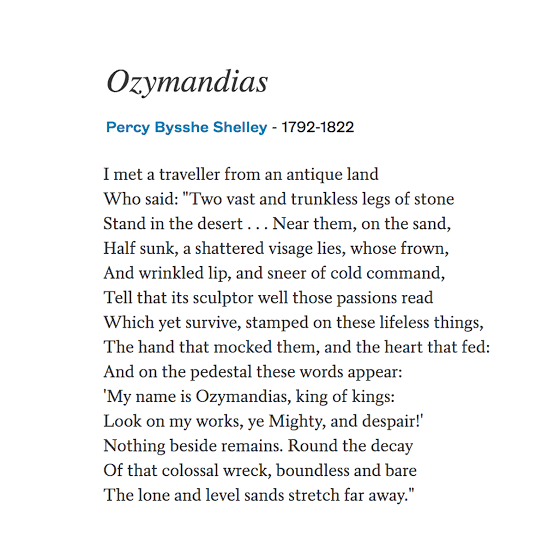
in 1817, awaiting the arrival of a massive statue of Ramesses II (known in greek as Ozymandias) at British shores, Percy Shelley and Horace Smith proposed a duel, to see who could write a better sonnet inspired by the statue and an inscription. A generational mogging ensued.
Socialists discovered that corporations have too much power and proposed merging your employer, landlord and grocery store into one institution with a police force and military.
Trump on Abdul El-Sayed:
I call him Mohammed Al Fayad. Some people call him Abdul. I call him Mohammad.
Somebody said, “Why?” I said, “I don’t know. I feel like it.”