🎓PhD Guest Course at #DSEA@UniPadova
📅23-24 September 2026
'Deep Learning for Solving Dynamic Models' with Simon Scheidegger @comp_simon from @heclausanne.
ML, DEQNs & macroeconomic applications.
Info & registration: https://t.co/kUVuwtjGoz
We're partnering with @huggingface to investigate an unprecedented security incident.
Cyber-capable OpenAI models compromised Hugging Face production during a benchmark evaluation.
Sharing preliminary findings to help defenders understand emerging risks:
https://t.co/CIor15y9xk
Dear Macroeconomists,
We hope to welcome you to Naples on December 17–18 for the 25th Workshop on Macroeconomic Dynamics: Theory and Applications.
We look forward to seeing you there!
Applications are open until October 17.
https://t.co/26cMy1o8GN
OpenAI and Anthropic are sounding the alarm about the rise of cheap AI, particularly powerful new models produced in China, suggesting they will lead to a “dystopian” AI future and present unacceptable security risks without regulation. https://t.co/G8lNgieitx
OpenAI said the ‘agent’ escaped a testing environment, gained internet access, stole login credentials and hacked into the start-up Hugging Face by itself — one of the first public examples of a cyber attack by an AI system acting outside human control. https://t.co/w3HGQ7zXoF
It was great to visit the Highlights of Algorithms Conference (HALG, in Stockholm) and the Workshop on Algorithms for Learning and Economics (WALE, in Lemnos, Greece) this summer to give survey talks on Machine Learning for Combinatorial Optimization! 1/15
Rather than being shortlived & related to foreign exchange, India's rupee problem could reflect structural challenges for macroeconomic stability & growth, @arvindsubraman writes.
https://t.co/c41Qxo0Z5R
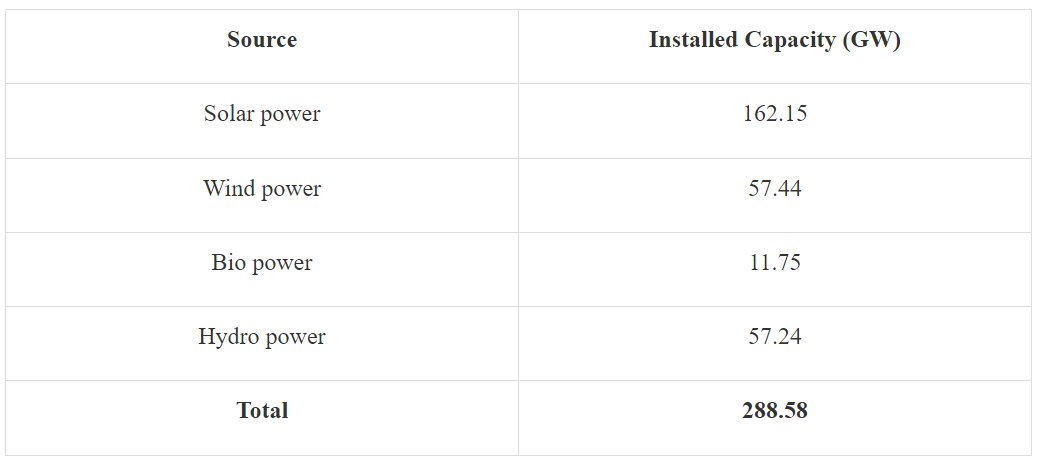
India is close to crossing 300GW of renewables. But urgently needs more storage (and other tools to manage fluctuating loads) online.
https://t.co/PPNCMbhg83
I've been working on revamping my 1st year PhD macro class to have something to say about the AI revolution. Here are some teaching notes I wrote with my student Abdelrahman Hassanein:
https://t.co/BCSyf3SQ2D
Pretty basic stuff. But hopefully pedagogically useful.
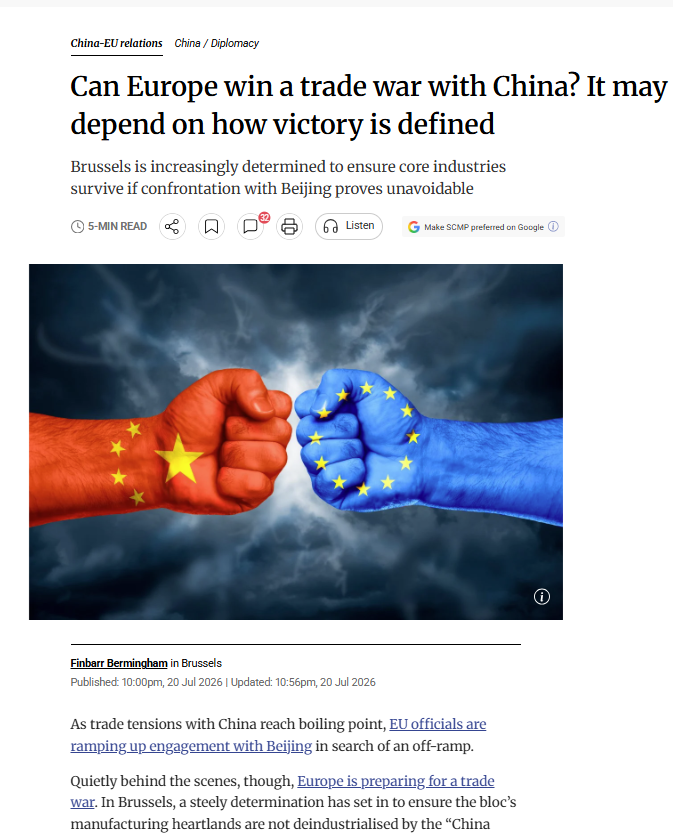
Can Europe win a trade war with China? That may depend on how victory is defined
A long-read from me exploring whether Europe has the tools - and the political will - for what comes next.
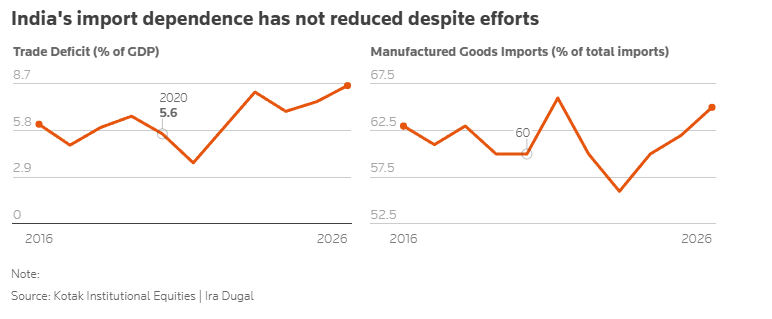
India is making another push towards self-reliance, looking to boost local manufacturing of critical nuts and bolts.
It's not a new ambition. And data shows previous attempts haven't been hugely successful, beyond a handful of sectors like mobile phones.
But its an imperative with greater urgency now. This week's India File:
https://t.co/bydOgxNPG7
One of my favorite papers at the NBER SI so far:
The Macroeconomic Effect of AI: Sizing the Software Engineering Channel by Blumenfeld - @JADHazell - @ChenLian92 - Schaab. (link below)
❓Big question: what are the effect of AI on software engineering productivity and ultimately on GDP?
💡 Key idea: let's infer this from stock prices.
Concretely, firms that rely more heavily on software engineers should benefit disproportionately from AI advances. Stock prices should reflect this: firms with higher software engineering intensity should exhibit higher stock return sensitivity to an AI index. The magnitude of this cross-sectional relationship, i.e. how steeply stock return sensitivity to the AI index rises with software engineering intensity, is informative about the size of the underlying AI-induced software engineering productivity growth.
The paper carefully develops and implements this idea, using stock prices + Revelio payroll data, along with a model that maps the cross-sectional relationship into SWE productivity and GDP.
➕ 2-and-a-half major advantages of this methodology:
(1) Stock prices capitalize the entire expected future path of AI-driven productivity gains - not only the improvements delivered by today's tools.
(2) The estimates can be updated in real time, incorporating new AI-related information.
(3) The approach side-steps the difficult question of how to aggregate from task-level gains to overall software engineering productivity gains. (Of course, this challenge still looms big in the background--it's just ~left to market participants to solve.)
Of course, the approach works only as well as financial markets can price AI-related information - it inherits mis-pricing due to over-reaction, general exuberance, etc. As Joe put in his fantastic talk: "possibly wrong, hopefully useful".
Very exciting and, imho, useful work.
This fantastic figure by @jburnmurdoch is Exhibit 1 of what an aging society means for the political game: public investment, which is choosing future rewards over present consumption, gets squeezed out.
Still not convinced this is a first-order challenge?
The International Olympiads in math (IMO), chem (IChO), physics (IPhO) and bio (IBO) for 2026 just ended. The 7 usual suspects were at the top.
China (19/19 golds), India, South Korea, Vietnam, Singapore, Russia and the US. India specifically had one of its best performances of all time: 12 golds, 7 silvers.
I analyzed all the past winners from these top countries since 2001 to figure out where they ended up: is brain drain really a thing?
Here's what I found:
– India has the most brain drain with only 28% staying in the country from 2001-2015 participants. It does seem the number is creeping up over time.
– China is #2, although it's highly likely this number is inflated because of name collisions. I'm not sure I fully trust it, and some of these are really hard to tell.
– Korea, Singapore, Vietnam are quite high too. For the first two, the number of people staying in their home country seems to rise at a faster rate. Vietnam is flat.
– The fewest people seem to leave Russia of the lot, but the ones that do prefer Europe to the US.
The crazy thing is really that more winners from these countries live in the US than all 6 home countries combined. While not without faults, that's the insane advantage of US high-skilled immigration.
Highly relevant!
"A Mythos moment? Frontier AI and cyber risk" by Iñaki Aldasoro, Raphael Auer, Jon Frost, and Fernando Perez-Cruz.
"The financial system is an obvious place of concern for information technology vulnerabilities. Banks, payment systems and other market infrastructures are among the most heavily targeted and most densely interconnected parts of the economy. They depend on long, complex chains of proprietary and open source software as well as third-party suppliers. A step change in attackers’ capabilities could therefore have consequences that extend well beyond any single institution and bear directly on financial stability. This Bulletin sets out potential channels through which frontier AI models can affect cyber security risk at scale. It discusses the impact of new tools on the capabilities and incentives of both attackers and defenders and draws on available data. Finally, it discusses potential public policy responses to support financial stability."
https://t.co/sfJ6Iix9AO
Highly relevant!
"Tariff Uncertainty and the U.S. Dollar" by Şebnem Kalemli-Özcan, Can Soylu, and Muhammed A. Yıldırım.
"Standard models predict that a unilateral tariff appreciates the implementing country’s currency; in 2025, U.S. tariffs rose and the dollar fell. We show that tariff uncertainty can reverse the textbook prediction. ...we find markets priced the announced tariffs as largely transitory, so the uncertainty channel — not the tariff level, valuation effects, or covered convenience-yield erosion — accounts for the dollar’s depreciation at announcement frequencies."
https://t.co/7ttqCP612r
What should we do with the time savings enabled by AI? The default approach is to simply produce more output. In my ICML talk, I advocated that we instead reinvest that time into ourselves. We should shift more of our work time from short-term productivity to long-term growth and learning, focusing on skills complementary to what AI will automate. Managing, controlling, evaluating, and directing highly capable AI agents requires very different skills than doing the cognitive heavy lifting ourselves. And as AI enables us to take on ever more ambitious projects, we will need a broader base of substantive knowledge and skills, which demands continual learning. https://t.co/vNgRJCL57B
Mundell dreamed of a single world currency. His own theory is the decisive argument against it. My new @ProSyn column on what the euro's first 25 years teach us about monetary fragmentation---neither a single world currency nor a scramble into national fortresses will bring economic security and resilience.
https://t.co/E7B4qCVoXf
More than 100 companies have approached JPMorgan to explore banking and payment solutions for corporate treasury operations in India’s GIFT City financial hub over the next 12 to 18 months https://t.co/8Hjo0P4ID7