@RadioGenoa Ethiopian food is indeed very tasty. Imagine being so racist that you first judge people by how they look, and then move on to judging their food too.
Open access link for "Inferring Consciousness in Phylogenetically Distant Organisms":
https://t.co/4hplcRcCRN
From a very good NIH conference organized by @BiyuHe. 2/
Cognition isn't abstract—it's embodied. Sensory-motor adaptations are intrinsic to cognitive evolution, not confounding variables that just rank species by human-like traits.
#ComparativePsychology#EmbodiedCognition ##AnimalCognition
https://t.co/tvvVvsLSEW
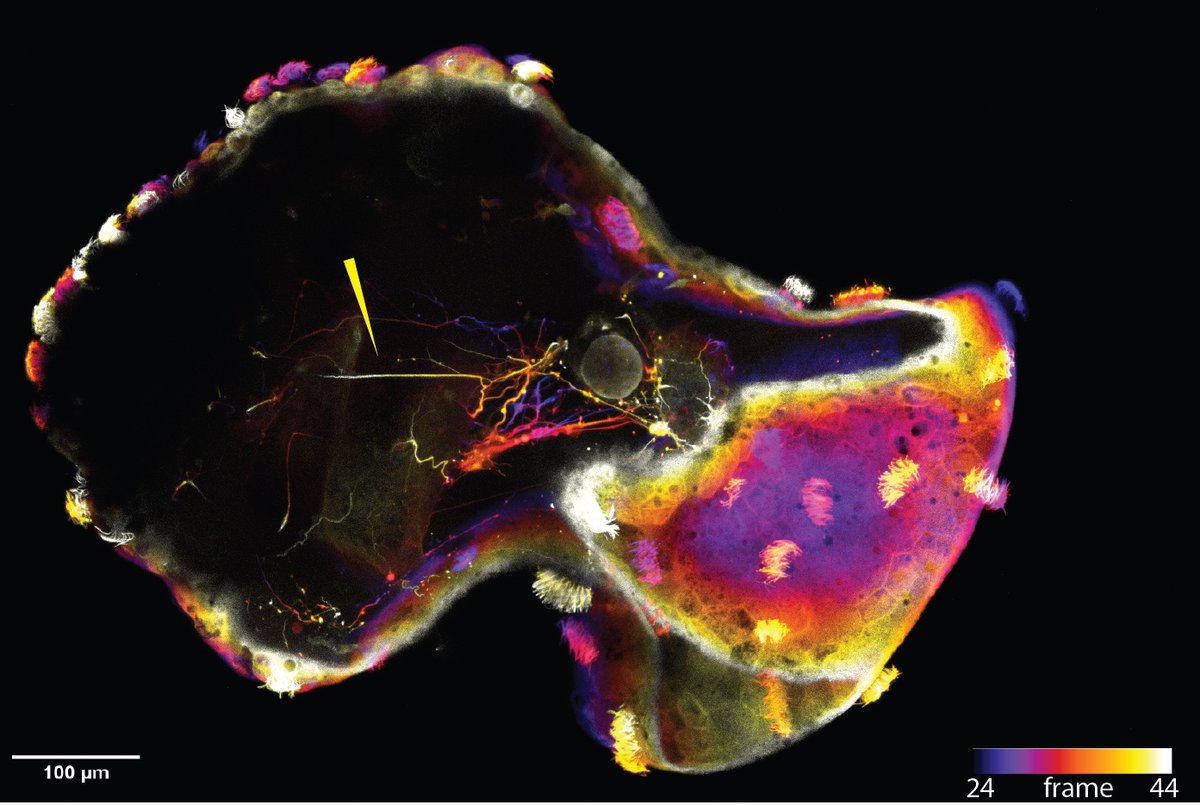
Ever wonder what the architecture of a neural network would look like, in a novel organism that had not been through selection for specific structure and function of an embodied nervous system? Here's our #preprint with morphological, behavioral, electrophysiological, and transcriptomic analysis of a new kind of Xenobot with a nervous system:
https://t.co/CJLl8DR2JA - the hard work of @halehf@LaurieONeill99@mmsperry and @LPiolopez
Abstract: "A great deal is known about the formation and architecture of biological neural networks in animal models, which have arrived at their current structure-function relationship through evolution by natural selection. Little is known about the development of such structure-function relationships in a scenario where neurons are allowed to grow within evolutionarily-novel, motile bodies. Previous work showed that when a piece of ectodermal tissue is excised from Xenopus embryos and allowed to develop ex vivo, it will develop into a three-dimensional (3D) mucociliary organoid, and exhibits behaviors different from those observed in tadpoles of the same age. These 'biological robots' or 'biobots' are autonomous, self-powered, and able to move through aqueous environments. Here we report a novel type of biobot that is composed of ciliated epidermis and additionally incorporates neural tissue (neurobots). We show that neural precursor cells implanted within the Xenopus skin constructs develop into mature neurons and extend processes towards the outer surface of the bot as well as among each other. These self-organized neurobots show distinct external morphology, generate more complex patterns of spontaneous movements, and are differentially affected by neuroactive drugs compared to their non-neuronal counterparts. Calcium imaging experiments show that neurons within neurobots are indeed active. Transcriptomics analysis of the neurobots reveals increased variability of transcript profiles, expression of a plethora of genes relating to nervous system development and function, a shift toward more ancient genes, and up-regulation of neuronal genes implicated in visual perception."
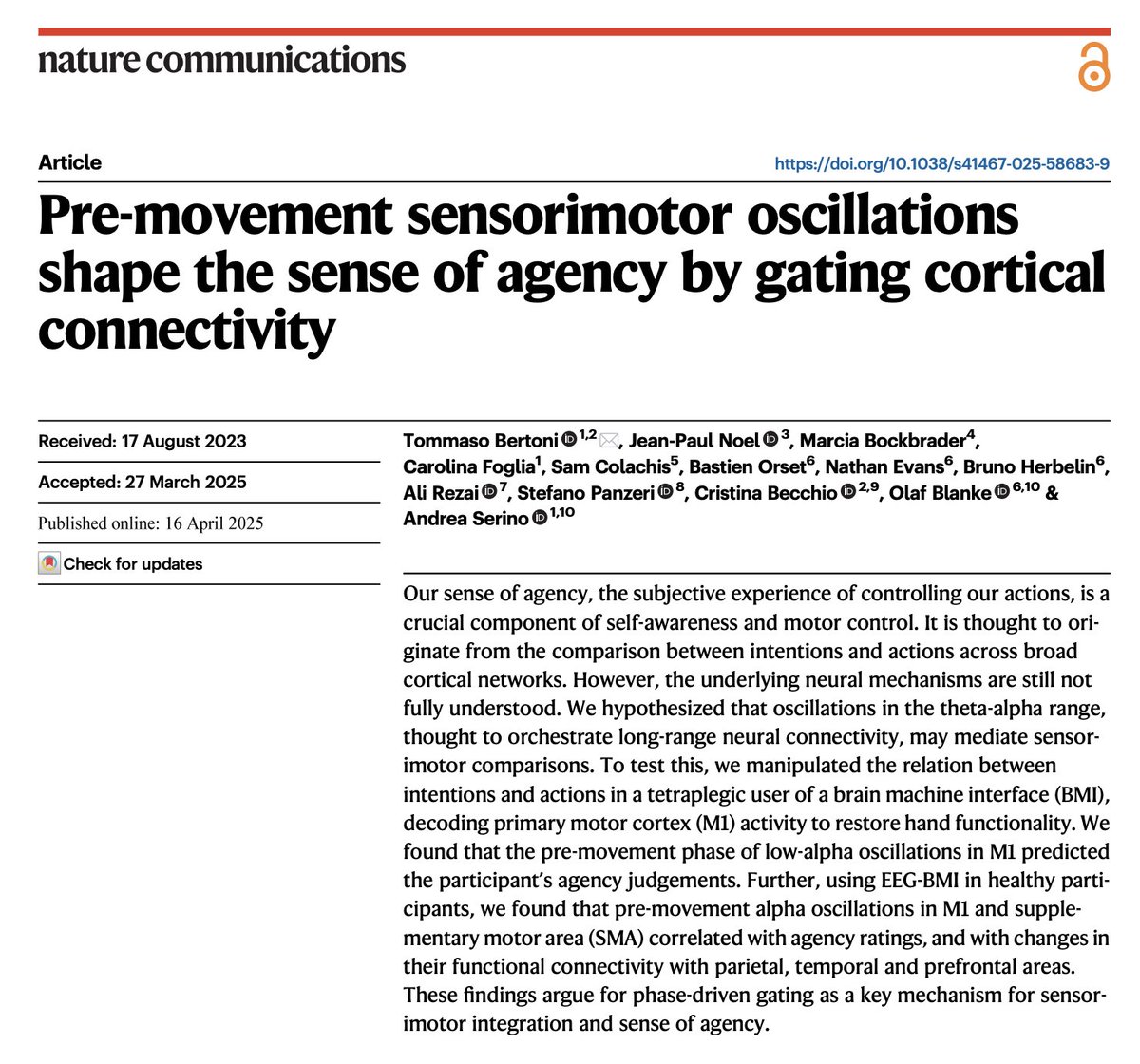
The brain decides if a movement belongs to you before you even make it. Fascinating @NatureComms study reveals that pre-movement alpha rhythms in motor cortex are not just preparatory, they’re the foundation of subjective control and sense of agency.
New paper! @BeneHartl and @AndreasZoettl
https://t.co/UOaCSE9B9d
"Neuroevolution of decentralized decision-
making in N-bead swimmers leads to
scalable and robust collective locomotion"
"Many microorganisms swim by performing larger non-reciprocal shape deformations that are initiated locally by molecular motors. However, it remains unclear how decentralized shape control determines the movement of the entire organism. Here, we investigate how efficient locomotion emerges from coordinated yet simple and decentralized decision-making of the body parts using neuroevolution techniques. Our approach allows us to investigate optimal locomotion policies for increasingly large microswimmer bodies, with emerging long-wavelength body shape deformations corresponding to surprisingly efficient swimming gaits. The obtained decentralized policies are robust and tolerant concerning morphological changes or defects and can be applied to artificial microswimmers for cargo transport or drug delivery applications without further optimization “out of the box”. Our work is of relevance to understanding and developing robust navigation strategies of biological and artificial microswimmers and, in a broader context, for understanding emergent levels of individuality and the role of collective intelligence in Artificial Life."
New paper - AI from a diverse intelligence perspective:
https://t.co/aybgfjwSrZ
Abstract: "Recent discussions and debate around artificial intelligence (AI) and its status are notably incomplete, missing the implications of highly relevant aspects of the emerging fields of diverse intelligence (DI) and synthetic morphology, as well as of basic facts of developmental biology. Herein, it is argued that human flourishing is impossible without an appreciation of the space of possible beings and of the ways in which today's intelligent machine debates are about universal existential questions facing biological beings, not just AI. The inevitable arrival of a wide set of unconventional bodies and minds as humans modify and create new forms will disrupt untenable old narratives of what people are and how to recognize their sentient allies in unfamiliar guises. Herein, the issues engendered by the advent of AI from the perspective of the field of DI and the evolutionary history of the bodies and minds are discussed."
.@drmichaellevin on how re-thinking cognition in cells has "huge implications for medicine."
"I don't think neuroscience is about neurons in any case. If you don't think that's the case, you will never try these crazy things..you're not going to find the new biology."