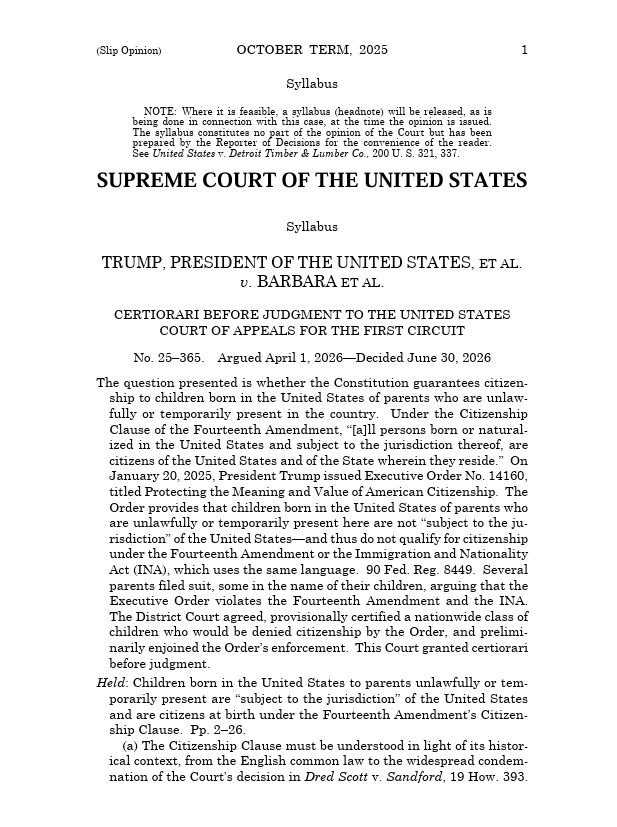
🚨 The Supreme Court ruled that the Fourteenth Amendment guarantees birthright citizenship to children born in the United States, including those whose parents are in the country unlawfully or only temporarily, striking down President Trump's executive order.
The moral calculus here is simple.
For decades there was bipartisan congressional agreement to fund lifesaving programs. 80% of Americans agree with providing food and medical supplies to the worlds poorest people.
Elon was neither elected nor confirmed. He illegally and gleefully destroyed USAID, which did not save any money - in many cases he just disrupted distribution of supplies already purchased - but he did kill many children.
The closest analogy would be burning down a food bank causing people to die of starvation. It was an illegal act that was wasteful and caused harm. You can’t defend it by saying “what obligation do we have to fund food banks?”
.@elonmusk says that no one can name a person who died from his aid cuts. In fact, I've met the kids who are dying, and I've talked to the families who lost children. In my columns, I've cited many, many names of people who have died because of Musk's aid cuts. A few examples:
*Yamah Freeman was a 23-year-old woman who died in childbirth because Musk cut funding for the diesel for ambulances in her part of Liberia. She couldn't get to a hospital and died as people were carrying her there. I talked to her parents and sister in their village.
*Gbessey Kiadu, age 1, died of malaria because of his cuts to malaria medication in Liberia. I talked to his mom in her village.
*Ibrahim Koroma, an infant, died of AIDS in Sierra Leone after he interrupted HIV supplies. I talked to health workers who cared for him.
*Achol Deng was an 8-year-old girl with HIV in South Sudan who died when Musk cut funding for the health care worker who provided her medicines. I talked to the healthcare workers.
I could go on and on. In almost every village you go to in South Sudan, Uganda, Liberia, Sierra Leone or other countries I reported in, you find people dying because of aid cuts. I challenge Musk: Come with me on a reporting trip, and we'll talk to these moms and dads, and you'll see the dying children themselves. I think if you see the kids whose lives are at stake, maybe you'll change your mind.
The average life expectancy of a new Russian recruit—from arrival at a training ground to death in a combat zone—lies somewhere between 10 days and three weeks. Once sent onto the battlefield, they survive an average of 20 to 35 minutes. @peterfrankopan https://t.co/W3UhBerdH0
1. Elon's counterfactual impact on the USAID-related deaths is large, likely hundreds of thousands of people. This is very bad.
2. On this scale, i.e. the broad counterfactual impacts of US policies, this isn't a uniquely large mistake.
The counterfactual deaths from coal pollution due to nuclear bans, for example, number in the tens of millions. The inventor of leaded gasoline is responsible for millions of deaths and disabilities. Slow FDA approvals have killed millions. DDT bans and slow-rolling gene-drives have arguably caused millions of malaria deaths. Not to mention all of the compounding effects of unnecessary taxes or tariffs or regulations that have delayed economic growth and invention long enough to kill millions. Norman bourlag saved a billion lives and his enemies might have killed them.
These are all also really bad mistakes. It's important to count, condemn, and avoid them. But ultimately, it's not that hard to make a decision that hurts millions of people when you're setting the policy of the US government.
3. We don't usually use the language of murder and moral outrage when analyzing these decisions. I think that's a good thing because although we can think about the counterfactual impact as akin to murder, the decision-making process is nothing like murder and being "against murder" doesn't help improve these decisions at all.
4. There may also a question of moral responsibility beyond causality. It's clear that Elon's decisions led to hundreds of thousands of deaths (this is extremely bad), but a necessary piece in the causal chain is also the crumbling and corrupt African institutions who cannot otherwise provide the basic services needed to prevent these deaths.
If you see some institutions as having particular responsibilities to certain people, rather than the more utilitarian obligation to all people equally, then more blame rests on these institutions than on decisions made in the US govt.
BREAKING: OpenAI is now "leaning toward" pushing its IPO until 2027, per NYT.
Details include:
1. "Choppy" markets in recent weeks have led OpenAI to reconsider the timeline of the IPO
2. The company is worried it may not find much enthusiasm from retail investors
3. Advisors are recommending OpenAI either wait until 2027 to IPO at $1 trillion or lower the valuation for a quicker IPO
Recent volatility in tech stocks has raised concerns around OpenAI's IPO.
The GenAI economy has generated $110 billion in sales over the past 12 months. It is growing fast. On an annualized basis, the revenue run rate exceeds $175 billion.
These numbers took us several months to construct, and as far as we know, it’s the first bottom-up, deduplicated measure of consumer and enterprise AI spending across the full stack.
We are releasing this research today in our first The State of the AI Economy report.
https://t.co/cJwZb0T99C
This is a fascinating and important set of data which shows us where things are going, using OpenAI as a canary in the coal mine.
The chatbot era is over, and agentic systems are coming to tasks beyond engineering. And skills show promise as a way to standardize AI use in firms.
The new Claude Tag feature seems extremely useful, but at the same time, a dangerous bargain for enterprises because of the pricing model and the risk of lock-in. The four big changes together mean that you interact with Claude as a coworker instead of a tool (the same Claude instance for everyone instead of each worker; soaks up tacit knowledge without your telling it; acts on its own; and does so asynchronously). All clearly very useful, but completely flips the interaction paradigm. https://t.co/iWpePXGiL8
Let’s talk about lock-in. As far as I can tell, Claude maintains its own memories in this new way of working; the human team members can’t see and edit them. (System administrators presumably can, but they have other things to do!) Tacit knowledge thus goes from a weakness of AI agents to a major strength — it seems inevitable that as teams and orgs start to use Claude this way, it will become the main queryable repository of all their tacit knowledge, creating dependence and stickiness. Effectively, Claude is a coworker that you can’t fire without *every* team losing workflows and know-how.
By the way, it also seems to introduce a new and pervasive security risk, since Claude can be integrated into private channels as well, and can be given access to repositories and tools even if the users in that channel don’t have access to them. Anthropic has introduced an interesting but complicated access control model to handle all this: https://t.co/l4oB5SVk9r But I’m not sure I trust people to understand and implement it correctly, nor the LLMs to be sufficiently robust against threats like prompt injection.
What about pricing? Claude is not like regular coworkers, because it bills for every token it produces. And it can do an unbounded amount of work, asynchronously and without being asked. In the current model, when AI is a tool, enterprises set per-user budgets, which creates accountability and keeps cost somewhat manageable. When everyone shares a Claude, it will be much harder to track and control spending. Of course you can set a token budget, but turning off Claude for the month for everybody when the budget is hit risks bringing work to a screeching halt.
When AI companies talk about the next stage of AI being a “drop-in replacement” for human workers, it should be understood not as a technical innovation but a business model innovation, enabling more value capture and rent extraction. AI companies are no longer competing for a share of enterprises’ IT budgets but rather a share of their entire labor spend, which is orders of magnitude bigger. Claude Tag is a big milestone in this evolution. This shift is very good for AI companies, but it is unclear if it is good for their customers.
BREAKING: Iran says the Strait of Hormuz will now remain fully closed even if the US fulfills all remaining MOU commitments, including the $300 billion reconstruction fund, frozen funds release, naval blockade removal and oil sanctions waivers, unless Israel fully and permanently withdraws from southern Lebanon and permanently stops all attacks in any form, per Tasnim.
Iran’s FM Araghchi and Parliament Speaker Ghalibaf have stated that the first clause requires Israel’s full withdrawal from Lebanese territory, with Iran emphasizing that opening Hormuz in exchange for merely lifting the naval blockade would be a “strategic mistake.”
This comes as Netanyahu has said Israel will remain in the Lebanese security zone “for as long as necessary,” and won’t withdraw, with Iran warning any further negligence will have “severe damaging consequences.”
I'm very bullish on AI over 20 years.
But now I'm confident that AI is most likely going to be a boom/bust cycle in the shorter term. Probably within a few years. The issue:
1. Most AI end user spend is just on coding. **Coding is where the money is actually coming from to pay for today's extreme capex**.
2. Compute costs will keep dropping a lot because hardware keeps improving rapidly. Even if the volume of capex doesn't keep going up (and it is today), the cost of software development will keep going down as the hardware gets better. Software developement isn't that hard a problem and it's easy to how **AI is going to drive development costs very low long term**.
3. **Back in 2020, it made sense for software companies to continuously improve their products because the cost of developing software was going to be roughly flat long term**. Thus, money invested into development was a moat because it would cost a competitor way too much to ever catch up. The bet was that each niche piece of software would be winner takes all and it would never make sense for anyone to catch up.
4. But now because of 2, 3 is no longer the case. If you assume software will cost 99% less to develop in 10 years (I do), software's moat sucks. You keep investing into something, where the future cost of that thing is going to be lower.
At some point the market will realize all of this. And then software companies will stop making this poor investment. And then AI capex will overshoot almost for sure vs the short term demand. And then AI companies are going to drop hard / we have a bear market.
Longer term, I expect companies to spend big on compute on things besides software. But this dominating variable is key today.
3 years ago I wrote that $NVDA would become the most valuable company in the world on the back of AI. Today, I'm nearly as confidently calling a short term boom/bust cycle, unless companies quickly find something else to spend huge on AI.
In 2002, after his stock fell 90%, the CEO of Sun Microsystems said the most honest thing a CEO has ever said about a valuation.
At 10 times revenue, to pay you back in ten years, I'd have to give you 100% of revenue as a dividend. Every year. For a decade.
Zero cost of goods. Zero expenses. Zero taxes. Zero R&D. Just hand you every dollar that comes in.
"Do you realize how ridiculous those assumptions are? What were you thinking?"
That was one company. A cautionary tale everyone nodded at and promptly forgot.
Today, 51% of the S&P 500 trades above 10 times revenue.
Different decade. Same math.
The past couple months we may be witnessing what the Applied AI layer will look like at scale. Despite some of the initial critique that this would just be a thin layer on the LLM, it’s turning out that actually driving agentic workflows in an enterprise is far more complex. And anywhere there’s complexity you generally gain a moat and value over time.
Here are a few of the components that appear to make up the playbook based on the examples we’re collectively seeing in coding, legal, healthcare, customer support, financial services and other fields:
* Build the features that bridge the gap between the intelligence and the workflow. Some workflows can be automated by simply going to a general purpose interface, but others need tuned interfaces and features tied to the work they’re augmenting or automating. They need features that are specific to capturing the kind of data that’s needed as context for the agent. And they need a variety of bespoke tools for the agent to use, and unique interfaces for the human-in-the-loop UX. Going far deeper than just presenting the output tokens is clearly critical, and the more depth there is here definitionally the more sustaining value.
* Act as the model router balancing frontier intelligence with cheaper models. A natural advantage that any model neutral platform has is that it can naturally (in a business model-aligned way) leverage whatever level of intelligence is necessary for the workflows they’re automating to get done. There are plenty of scenarios where you need GPT-5.5 or Fable level capability, and also lots of workloads where a more efficient closed or open weights do the trick. Only the companies that have deep evals on specific tasks across all models, and the ability business model wise to leverage them, are in a great position.
* Drive the actual implementation and change management via FDE or equivalent. A big reason the applied layer works at scale is that most enterprises need some degree of help and support with change management in implementing agents for their workflows. Data has to be cleaned up and moved to modern systems, processes have to be re-engineered and documented, workflows have to be evaled, SLAs have to get achieved, and so on. All of this is going to be unique for every type of process that gets implemented, which means the companies that have expertise in a given domain and come with all the relevant best practices will be in a strong position.
* Implement domain specific GTM that creates expertise in that field. Beyond FDEs the companies that can build sales and GTM motions aligned to their domains also have a natural advantage. Most IT and line of business leaders have too many things to do in any given day; so if you’re not on their agenda, likely someone else is. Depending on the industry, there are entirely different sets of language you use, ways of working through security and compliance, regulatory controls you have to support, industry events that companies convene at, different system integrator and consulting partners you need to work with, and so on. The more generalized this gets the less you can speak the customers language, which is where the applied layer has a leg up.
A final note. There remains a view that a lot of this is all mitigated by model intelligence alone, and the bitter lesson solves all of this in the limit. That’s possibly true, but enterprises need help changing *today*. And many aspects of how to bring intelligence to real world work don’t only depend on the axis of the pure capability of the model, so most of what you’re doing now to win ends up being important no matter how good the models get.
BREAKING: The US has released the full text of its 14-point "Memorandum of Understanding" with Iran.
Key terms include:
1. The US, Iran, and their allies agree to immediately and permanently end military operations on all fronts, including in Lebanon
2. The US and Iran agree to respect each other's sovereignty and territorial integrity and not interfere in each other's internal affairs
3. The US and Iran commit to negotiating and reaching a final deal within 60 days, unless mutually extended
4. The US will begin removing its naval blockade immediately and fully end the blockade within 30 days
5. Iran will use its best efforts to ensure safe passage for commercial vessels through the Strait of Hormuz for 60 days with no charge
6. The US and regional partners will develop a mutually agreed plan of at least $300 billion for Iran's reconstruction and economic development
7. The US will work toward terminating all types of sanctions against Iran, including UN, IAEA, primary, and secondary sanctions
8. Iran reaffirms that it will not procure or develop nuclear weapons and agrees to address its enriched material stockpile under IAEA supervision
9. Until a final deal is reached, Iran will maintain the current status quo of its nuclear program, while the US will impose no new sanctions and deploy no additional forces
10. The US Treasury will issue waivers for Iranian crude oil, petroleum products, derivatives, and associated banking, insurance, and transportation services
11. The US will make frozen or restricted Iranian funds and assets fully available for use
12. The US and Iran will establish an executive mechanism to monitor implementation of the MOU and future compliance with the final deal
13. After signing the MOU and implementing key ceasefire, blockade, shipping, oil waiver, and asset-release provisions, the US and Iran will begin final deal negotiations
14. The final deal will be endorsed by a binding UN Security Council resolution
The memorandum will trigger a 60-day window to negotiate a final deal.
Trump on the Iran War MOU: "I didn't want to see economic catastrophe. If you kept this going, that could have happened."
It's honestly a surreal minute to watch: