CBC recently ran a “miracle” story about surgeons operating on a baby inside his mother’s womb at 26 weeks.
The groundbreaking surgery put baby Theo’s intestines back inside his body. He’s now five months old and thriving. Thank God.
Then the @CBC edited the piece to replace “unborn baby” with “fetus” and called Theo an “it.”
New headline: “Fetus has pioneering surgery inside the womb.”
Subheadline: “Operation was to treat fetus that had intestines growing outside of its body.”
I wish this were a joke. The CBC is so desperate to defend abortion ideology that it cannot even use the word “baby” while telling a story about a life being saved in the womb.
It even issued a correction for calling Theo a baby:
“This story has been edited to refer to a fetus rather than an unborn baby.”
The real story is a newsroom so captured by wokism and radical feminist abortion politics that it cannot describe a child being saved without first stripping him of his humanity.
The ideology became the story. The fact that they had to “correct” the word baby tells you everything.
Photo: Baby Theo/BBC
@Phil_Johnson_ And if he lived in the church-sphere of Lawson, Buice, etc. he would also have been held accountable for sleeping with a congregant. The only reason he still has a “ministry” is because he is surrounded by yes-men and does not accept accountability.
@SoCalchrisR@sola_chad Then they asked “so what you’re saying is we can just make stuff up that the apostles never taught and call it tradition and it will have as much authority as what is written?”
Paul:
There are numerous reasons why the faithful Bible interpreter must interpret Ezekiel 40–48 typologically and symbolically not literally.
The difficulty of interpretating Ezekiel 40-48 literally is that you must interpret the period as the eternal state, not a thousand year millennium as many interpreters do, because the prophecy says explicitly that this state will continue “forever” (43:7, 9). So if you are interpreting the block strictly literally this violates the interpretation that it is an earthly millennium before the eternal state since the text says “forever” and not 1,000 years. Clearly this is a clue that this entire block is in referent to what the NT describes in Revelation 21 and 22, the New Heavens and the New Earth.
Moreover, we understand that Jesus defeats sin and death at his second coming (1 Cor 15:20–28; 50–58; Rev 21:4), yet sin and death remain in this vision and even endure “forever” (42:13; 44:27; 43:18; 44:25; etc.). Therefore, we are given another clue that this is symbolic and not literal language, since sin and death are defeated at Christ’s return. And no biblical interpreter can legitimately assert that sin and death will continue “forever.”
But perhaps the greatest clue is the mention of sacrifices of atonement and sin offerings. Understanding the NT, we know that Christ’s sacrifice has put an end to all sacrifices of atonement (Heb 7:27; 9:12, 26; 10:12). There will never be a need for any form of blood atonement. Just as we assert that it is blasphemous to think of the mass as an atonement, so it would be blasphemous to offer an animal for an atonement in the New Covenant, even in memorial fashion.
Yet, Ezekiel asserts three times that animals are sacrificed for “atonement for sins” (Ezek 43:26; 45:17; 45:20). Literalist interpreters assert that these are “memorial sacrifices.” But following their own hermeneutic that is nowhere mentioned in the text. The literal hermeneutic demands that we understand these sacrifices as literal sacrifices of atonement. The faithful student of the New Covenant infers that these sacrifices must be therefore interpreted typologically, not literally, to depict the lasting and forever atonement of Jesus Christ (John 1:29).
So stepping back, we look at these clues and understand that the entire section depicts the glories of the “forever” world to come in the New Heavens and the New Earth, and depicts them in Old Covenant symbolism, that is ultimately fulfilled in Christ.
Interpreting Old Testament Kingdom Prophecy is difficult, but the NT helps shed light and meaning on the realities that are depicted. When interpreting Old Testament Kingdom Prophecy, it is important to always interpret them with the light of the New Testament. With Jesus and the apostles as our guides, the realities of Old Testament Kingdom Prophecy begin to make sense, and we can interpret the symbols using the keys that are given to us in the New Testament.
More to come. Several of these insights come from my friend Dean Davis.
I saw a pastor say that his church has started invoking curses as part of their worship service. “Each week we are praying for God to curse, oppose, and destroy someone in particular.” That is, by name.
This is what you arrive at when you flatten redemptive history to make it one big mono-covenant. You take what was appropriate at one time and in one land, and apply it at all times in all places.
Recall how Jesus greeted the imprecation of the disciples. “Lord, do you want us to tell fire to come down from heaven and consume them?” But he turned and rebuked them.
Could Paul be any clearer? “Bless those who persecute you; bless and do not curse them.”
Or how might we understand cursing some in light of 2 Tim 2:24-26?
“And the Lord's servant must not be quarrelsome but kind to everyone, able to teach, patiently enduring evil, correcting his opponents with gentleness. God may perhaps grant them repentance leading to a knowledge of the truth, and they may come to their senses and escape from the snare of the devil, after being captured by him to do his will.”
“Oh, we're not cursing, we're asking God to.” Such a defense is vacuous. Paul says our warfare is not against flesh and blood—people. So when you curse someone by name, you stand opposed to apostolic truth.
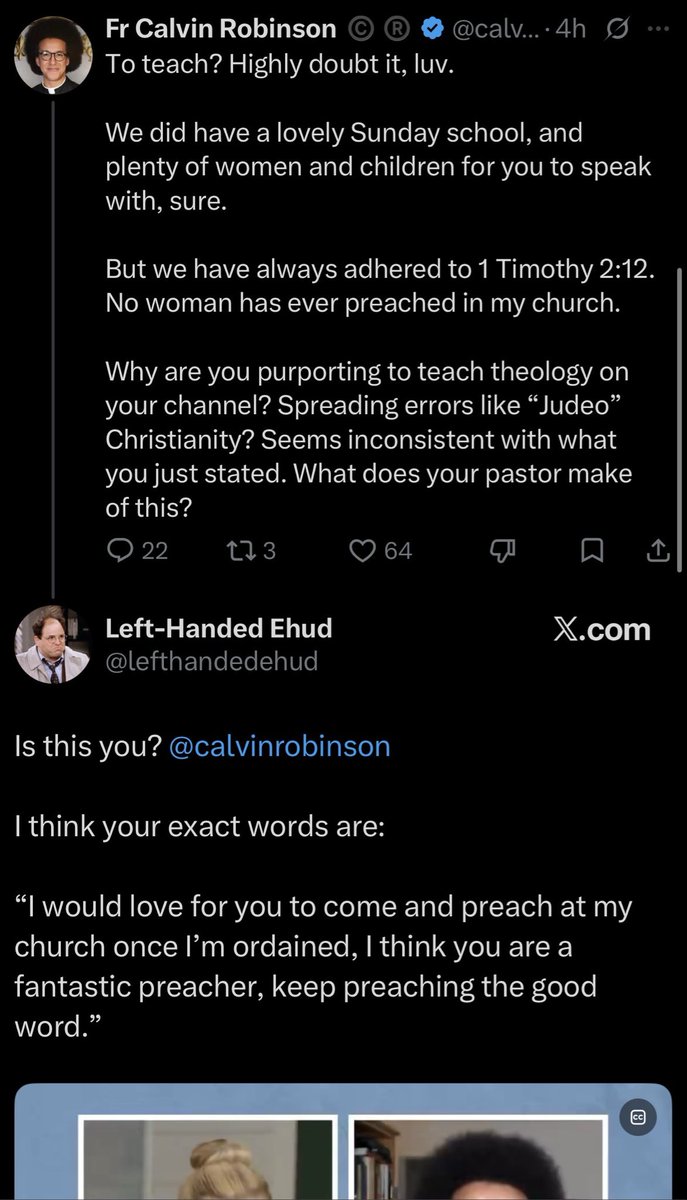
Here you are singing the praises of a female pastor and prosperity preacher, Paula White. Did you pay the $1,000 she was asking for in exchange for a “special Passover blessing?” Just wondering!
I get it - a podcaster affirming that Jesus was Jewish and that all people, Jew and Gentile, must go to Him for salvation is just too far for you.
You’re a shapeshifter, Calvin. Unmoored and unreliable. The faithful deserve better from their clergy.
Hi John! You’re right, that passage doesn’t fit neatly into the cessationist framework. Textual criticism debate on that passage aside, Cess’t would say those gifts were apostolic in nature (see mark 16:20, 2 Cor 12:12, & heb 2:3-4) and may have been more common in the early church, but since these were sign gifts to confirm the apostolic message, they also ceased with the passing of the apostles. Jesus is just telling the apostles what *they can expect to see in their lifetime. This passage does not say the gifts ceased, but it also does not say these gifts will never cease.
In fact, even later in Paul’s ministry we see people being sick and not receiving healing.
End of the day there are verses that don’t fit perfectly into the cessationist framework and there are verses that don’t fit perfectly into a continuationist framework, which is why it is important people in both camps maintain a level of respect and humility for each other and each side does their best to present their view through a biblical framework and not just simply a subjective “I know it’s true because I’ve seen it (or not seen it)” mindset!
@KatKanada_TM@Cult_Film_Fan@MikeWingerii It’s important to remember that cessationists do believe in miraculous healing and that God still can and does heal. They just believe that no individual person has the actual “gift” of healing today.