Today, @editframe emerges from stealth. Agents need video.
Editframe Agent Skills:
npm create @editframe@latest
Just prompt Claude Code, Cursor, or Codex and get a working video or a full interactive GUI.
This video was created just by prompting 👇
Fred Wilson is one of the greatest VCs of all time. He is also my new partner at @USV and I'm lucky to say that. We've known each other for years, but becoming partners felt like a reason to get to know him even better.
So a few weeks ago, we walked around Union Square and caught up about what @fredwilson has learned over nearly 40 years of VC, how AI may be making the profession obsolete, how to build an investment thesis, why he believes the Knicks will win the NBA title this year, and a few of his long held grudges.
Here's a video of that conversation, set at Union Square, Madman Espresso, the USV office, and Leon's on Broadway.
Chapters:
3:22 - That time Fred wrecked Mike on Twitter
6:01 - Pre-Internet VC in NYC
9:50 - Early Internet Investing and Raising for Flatiron Partners
11:59 - The Dot-com Crash Killed Fred’s First Firm
14:28 - Fred’s Grudge Against Coffee Shop
16:35 - How to Pick the Right Team at Right Time
18:28 - AVC blog, Gawker’s Nick Denton, https://t.co/UTWtducKEc
20:44 - Jim Kramer invented Tweeting
21:46 - Why Fred Bet on Twitter Early
23:39 - Building Agents on Claude Code and Tasklet
26:20 - Claude Mythos and Doomerism
27:27 - The Original USV Thesis
29:19 - Network Effects and Brad’s Thesis
31:29 - Coinbase: Thesis, Investment, Outcome
33:18 - Investing in Decentralized AI
34:59 - Open Source AI
36:55 - AI Kill Zone: Legal AI is Dead, Energy Investments
42:37 - USV Agents Will Replace Its Partners
47:00 - Are VC’s building themselves out of a job?
48:30 - Leon’s, NYC’s New Tech Watering Hole
50:52 - Generative Art
53:18 - SOLIENNE: AI Artist trained by Kristi Coronado
54:25 - What About AI Scares Fred
55:40 - Societal Backlash to AI
58:10 - Advice to Early Career VCs: There’s More Risk in Not Doing Deals
1:00:48 - Fred’s Biggest Regrets: Saying No Because of Price
1:04:17 - Fred’s Bold Prediction for the Knicks and the Mets
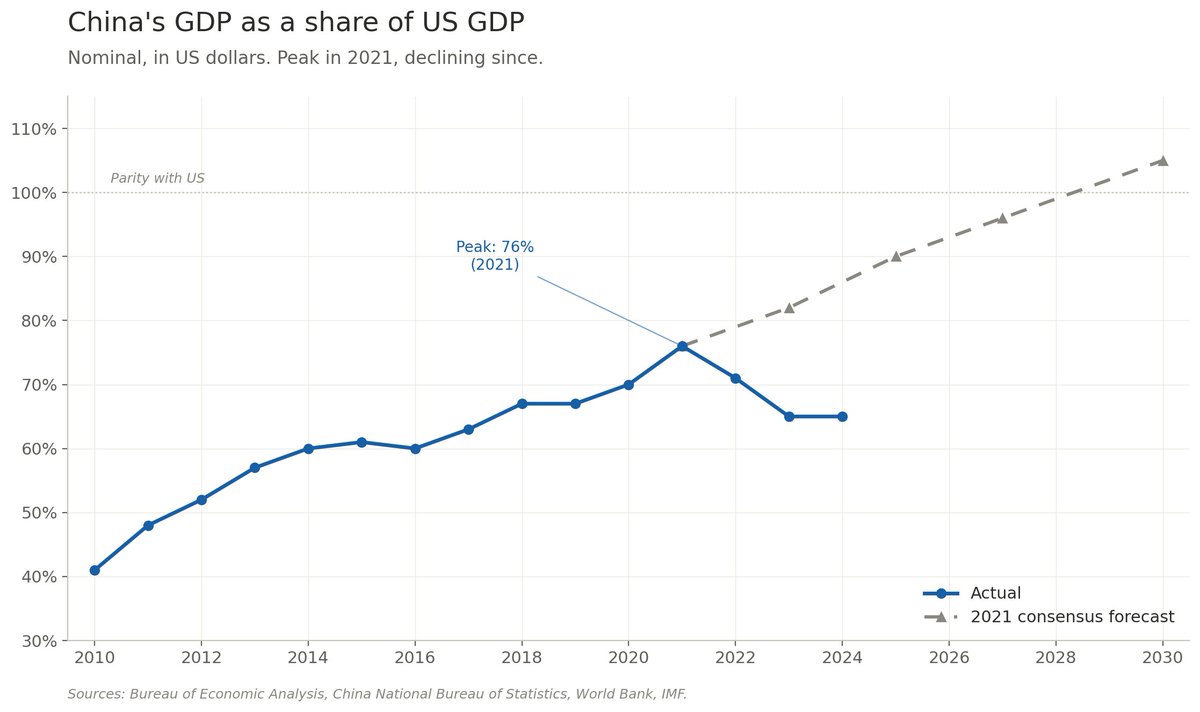
The United States has a habit of watching its rivals shrink. The Soviet Union collapsed. Japan, which was supposed to own America in the 1980s, is now a far smaller economy. China looks set to follow.
In 2021 China's GDP reached 76 percent of American GDP, and the consensus was that it would pass the US before 2030. That consensus has collapsed. By 2024 the US economy was 29.2 trillion dollars against China's 18.9 trillion, a gap that has widened for three straight years. China's working-age population is shrinking. Its fertility rate has fallen to roughly 1.0, half of replacement. There is no immigration to compensate.
Yet America benefits from believing it faces a formidable rival. The belief is what keeps it competing.
the economy is splitting. AI is the fault line.
on Ramp, Nov 2022 to Nov 2025, annualized revenue growth by AI intensity:
- heavy AI users: +27%
- moderate AI: +18%
- no AI spend: +3% (≈ US nominal GDP)
over 20 points a year between top and bottom. this compounds.
Reminder that the United States could have been the world leader in 5G technology instead of China if we had just given *one guy* a green card when he needed one.
Excited to announce that @hbarra , @alcor and I are joining Meta Superintelligence Labs with the entire @Dreamer team today.
The last few months have been extraordinary: we built Dreamer, put the beta in the world just a month ago, and saw magic come to life for real people. Since then, thousands of people have used Dreamer to build personal, intelligent software with our Sidekick in the world’s newest and most popular programming language: English!
They're building and sharing agents to manage email, calendar, and to-do’s, create learning tools for their kids, learn new languages, plan trips with friends, become better cooks, help them with work, achieve their health goals, or simply to creatively express themselves—all sorts of surprising and uniquely personal needs. These are agents as unique as the people building them, because they're built exactly the way each person wants them to be. We’ve captured some of our favorites at https://t.co/G6nrHTsN5i.
What matters most here isn’t the early momentum; it’s what Dreamer has enabled people to do. People are building things they’ve wanted for years. They’re solving real, important problems no traditional software company would ever prioritize, because they’re too niche, too bespoke, too personal. What company would ever build for an “n of 1”?
Our bet from the beginning has been that software should be personal, malleable, and shaped by the person using it. The constraint was never people’s imagination. It was the fact that building software is out of reach for most people. This early chapter gives us conviction that the idea resonates, the need is real, and the moment is now.
@alexandr_wang was helpful to us from the very beginning, and when we showed Dreamer to Mark Zuckerberg and @natfriedman earlier this year, it was clear right away that we share the same vision of the future: one where billions of people have the power to create software that makes their lives better. We’re thrilled to accelerate this mission by joining Meta Superintelligence Labs and licensing our technology to Meta. Read more at https://t.co/KvmdoPJVbU.
Deeply grateful to our investors @jillchase124 and @ninaachadjian for supporting our vision for a more personal, creative, and intelligent future for software. Thank you for the trust, the thought partnership, and for being in our corner at every step.
To everyone in our community who built with us: thank you. You've taught us what's possible, and you're the proof this works. We're so grateful, and we're just getting started!
"Go all the way until it hurts. If you're doing something and it's easy, it's not valuable." - @travisk
"If anyone says a strategic thing was easy, I'm like, 'You messed up. You could have gone way further. More competitive advantage. More differentiation. Get it together.'"
Today, we're launching Ramp Agent Cards.
There's been no safe way for agents to spend money, until now. Ramp Agent Cards give agents the ability to spend, governed with real spend limits, merchant controls, and full visibility into every transaction.
Had the genuine pleasure of being back at @Stripe last week for their Friday Fireside with @patrickcollison and @collision .
I demo'd @dreamer, and it was amazing to see how quickly people "got it" and the specificity of what they wanted to build:
- a project management agent that auto-generates gantt charts
- a Stripe wave visual tool
- an emoji mood mixer
- a SaaS integration guide generator…
…and of course, the Stripe llamas (iykyk - linked in thread)
The best thing about this moment is that you don't need a team of engineers to build any of these. You can describe the problem, and it just works. That's what Dreamer is for.
We've got a lot of Stripes using Dreamer now, and I'm so excited to see what they build!
My information consumption is now 1/4 X, 1/4 podcast interviews of the smartest practitioners, 1/4 talking to the leading AI models, and 1/4 reading old books. The opportunity cost of anything else is far too high, and rising daily.
EXCLUSIVE: Department of War AI Chief On How The Anthropic Deal Collapsed
When Emil Michael (@USWREMichael) took over the Department of War’s AI portfolio last August, he discovered the Biden admin had been “asleep at the wheel” when it came to top military contracts.
“I was like, ‘Holy cow,’” Michael said of Anthropic’s contract, “There’s 25 pages of terms and conditions of things I can’t do.”
For example: as written, the contract would not allow Anthropic to plan any kinetic strikes, generally considered a central activity of war.
“This is a contract that should be made with GEICO Insurance, not with the Department of War,” he told us.
A renegotiation ensued. What followed, in Michael’s words, were “three months of knockdown, drag-out negotiations” which involved Michael imagining every possible future wartime scenario that would require a carveout in Anthropic’s terms of service, and asking them for approval.
Anthropic was also quite slow: “It’s not like mano a mano negotiation, me and Dario,” Michael says. “It’s like every time we discuss something, he has to take it back to his politburo of co-founders and their ethics panel.”
Then, after an Anthropic exec reached out to Palantir to ask for classified info about how Claude was used to capture Nicolás Maduro — allegedly implying they could pull the plug on a military raid if they disagreed with how AI was used (which Anthropic denies) — Michael and the DOW concluded the company was a supply-chain risk.
Many speculated that the Pentagon was punishing Anthropic for ideological differences. But Michael feared that certain ideological differences could, in fact, harm or undermine the performance of DOW products, potentially threatening soldiers’ safety.
“I can’t have a gun not work because they decide they don’t like guns,” Michael says. That’s “putting real lives at risk. It’s no joke, right?”
Anthropic’s unreliable behavior led Michael to believe they may have never really wanted to reach a deal. Still: he’s open to renegotiating if Anthropic can prove they’re acting in good faith.
“I have a responsibility to the Department of War, and if there was a way to ensure that we had the best technology, I have no ego about it.” he said.
“I mean, look, I’m a deal guy.”
Full story in Pirate Wires 👇
Jobs called computers "bicycles for the mind" -- tools we could shape to our will.
But they never were. Until now.
Every morning an agent preps me for my day -- calendar, news, last 24hrs of Slack -- in a personal podcast. I made it by asking. Same for hundreds of other things.
Launching @dreamer in beta today.
That 🧠 bicycle, finally.
https://t.co/Ma0KBkEI3F
We're launching Monaco today.
Monaco automates customer acquisition and revenue growth for startups.
The platform disrupting sales with AI has finally arrived.
Boil the Oceans
You know the phrase: “don’t boil the ocean.” Everyone’s said it in some overly ambitious meeting. It’s good advice in normal times. It keeps teams focused. It prevents scope creep. But we are no longer in normal times, and I think it’s time to retire saying it.
Artificial Superintelligence means it’s time to boil the ocean. We’ll start with a few lakes first.
I was recently with a university endowment’s head of private investing who told me their engineers were terrified for their jobs after seeing what Claude Code could do. And I get it — that’s the natural first reaction. But it’s the wrong one. It’s a zero-sum reaction to a positive-sum moment.
Instead of worrying about doing the same thing we’ve been doing for cheaper, why not focus on doing the thing we never even dreamed of doing? Why can’t that endowment achieve 50% net IRR instead of 10%? Why can’t a startup deliver a service that is 100x better than the incumbent? Why can’t we have fusion energy? Why can’t we talk to every single user and have a perfect understanding of every bug in our product?
These aren’t rhetorical questions anymore. They’re engineering problems with paths to solutions.
Here is what I think is actually going on with the fear: our fear of the future is directly proportional to how small our ambitions are. If your plan is to keep doing exactly what you’re doing, then yes, a machine that can do it faster and cheaper is terrifying. But if your plan is to do something dramatically bigger, then the machine is the best news you’ve ever gotten.
If you’re a worker — someone who trades labor for a living — this is the moment to become a builder. Start a business. And if you’re already management or capital, it’s time to go 10x more hardcore on what your aspirations could be. Not eking out 5% efficiency gains. Not increasing profit margins 2% by lowering cost and firing people. Those are the old games. The new question is: what would it look like to build a product or service so good that people would happily pay 10x what they pay now?
The net result of this is more jobs, not fewer. As Ryan Petersen likes to say, the human desire for more things is absolutely limitless. We can actually fulfill that desire now — if we have the agency to prompt it for ourselves.
Buckminster Fuller coined the term “ephemeralization” in 1938: doing more and more with less and less until eventually you can do everything with nothing. His entire vision of progress was about technology enabling radical expansion of human capability through dematerialization. He traced this from stone bridges to iron trusses to steel cables — each iteration stronger, longer, lighter, cheaper. He wasn’t describing job destruction. He was describing civilization getting better at being civilization.
This is Jevons Paradox for everything. When you make a resource dramatically more efficient, you don’t use less of it — you use vastly more. Steam engines didn’t reduce coal consumption. They made coal so useful that demand exploded. The same thing is about to happen with intelligence, with labor, with every service and product we can imagine.
But Jevons Paradox doesn’t activate on its own. It requires capital and management to actually raise their ambitions — to boil lakes and oceans instead of drowning them in committee
That’s what startups have always been good at: moving fast in the face of radical uncertainty, building for the 10x future while everyone else is optimizing for the 1.05x present.
Time to start.
A bit of perspective.
@hdubugras has just turned 30. @pedroh96 turns 30 in a few months.
At that age, I was only just getting started on Airwallex…. still early, still learning, still figuring things out.
Henrique is already onto his next chapter, starting Orca. And I have no doubt Pedro will go on to build more companies in the years ahead.
Both are exceptional founders. And on a personal note, Henrique has given me some of the best advice of my entrepreneurial journey.
This is still very early in their story as they are true entrepreneurs at heart ❤️
Today is a day I’ll never forget.
I grew up in Cupertino.
My dad was a tech founder in the 80s/90s.
I was in YC S07.
LiveKit is my 5th company.
The first 4 didn’t work out.
I’ve had a lot of advantages — it still took 20 years to get here.
Founders: keep taking shots.
universities are about to realize that they had been selling the wrong product for the 150 years. they thought they sold knowledge, then information became free. they pivoted to selling credentials but now credentials are just proxies. in the post-ai era the universities who survive will realize they were always selling 3 things: network, status signaling, and a 4 years of protected time to become an adult.