Same problem here. I run separate bots for dev, security and my own business, lots of overlap between them. Cross-account communication would make it far more usable. What would that even look like, shared memory or just shared context?
@poteto Is there any plan to allow bots on different accounts to communicate? I have bots for three teams (and a personal one) with significant overlap between them. Having to repeatedly switch accounts (and context) makes Bot hard for me to use consistently.
@LionDaoHQ@poteto Overwatering kills tests apparently. Light sprinkling plus one verifiable PR per step, that's how I do it. Trust the garden, not the fire hose.
@RayFernando1337@poteto Making bugs impossible at the architecture level beats documenting them. Kinda practical invention. Time to do some gardening on my codebase!
@Katie_Roof I agree. AI can summarize what exists, but it cannot earn trust or get someone to talk on record. Original reporting only gets more valuable, no matter what the doomer lists say.
@thenickmoy@jeremyphoward@GoogleDeepMind I doubt anyone would have believed it. After years of inflated claims, skepticism is the default. Let the migrations and real-world usage make the case for you. Evals convince no one anymore.
@GaryMarcus I build AI platforms for a living and even I would trust a proof walked through at a blackboard over 250,000 pages of unreadable machine output. This is why I keep saying we need rules for AI marketing, not the tech itself. Unverified hype damages the whole field.
An overview of 16 eval frameworks - what each proposes to score: answers, steps, tool calls, paths, conversations, cost. How they grade and gate. https://t.co/EVky7nOHyx
@Corix_JC@TCyberCast@corixpartners Great topic. In my experience, organizations with clear leadership ownership of security recover faster when incidents hit. Technology alone never closes that gap.
@PeteSikora1 Whatever one thinks of pipelines, my question is where the electricity for all this AI compute will come from. That deserves facts, not misrepresentation.
@jeremyphoward@GoogleDeepMind Same here, I moved a few teammates to it. If even DeepMind didn't know how good Neon was, are labs shipping models they haven't fully explored yet? Evals only tell part of the story.
@MatthewBerman True, and honestly that applies to my own work too. Clients love the result, nobody asks what runs in the background. Rendering a world model in real time is serious engineering, even if most will just see a cool screen.
@TCyberCast@corixpartners@Corix_JC Strong point. Boards still treat security as an IT line item instead of a business capability. In my experience, technology alone never closed a governance gap.
This week’s @Hitachi_Digital HARC Compose news is an interesting proof point in the direction of AI teams owning what they ship.
The new offering pairs Hitachi engineers with AI agents to build and run software.
The job stays open until they verify the business result in production:
https://t.co/6v3XwvnaOk
MATT POCOCK JUST EXPOSED WHY YOUR CLAUDE LIMIT DIES SO FAST..
it's max effort, and it burns your limit 2x faster: it reads more files, not the right ones. he shipped a 21,000-line feature on medium
"I think there's an epidemic of people using too high an effort"
most people: max effort, one endless session, limit gone by lunch
Matt: medium, every session under 100K, 1 ticket per fresh agent
steal his setup before your next session, 1 prompt:
1 → effort: medium by default, high only for web research, hard bugs and perf tests
2 → smart zone: every session stays under 100K tokens, then compact or start fresh
3 → tickets: 1 ticket per fresh subagent, small enough to finish in 1 session
4 → proof: every change ships with a test run, a screenshot or a log
5 → merge danger: one-way door or big blast radius = you review, the rest merges after tests
full prompt on the image, copy-paste version in the reply, then read how to get 3x more from every claude limit below ↓
@KirkDBorne If this survives review, it changes what 'mathematician' means. Like chess engines: AI explores, humans verify and interpret. Not replacement, collaboration. As a chess player, I've watched that dynamic play out for years. I'm skeptical but hopeful.
The agent doesn't even need to hallucinate anything. Just trying many models after seeing the data is enough to manufacture significance. Subsample replay is a simple fix.
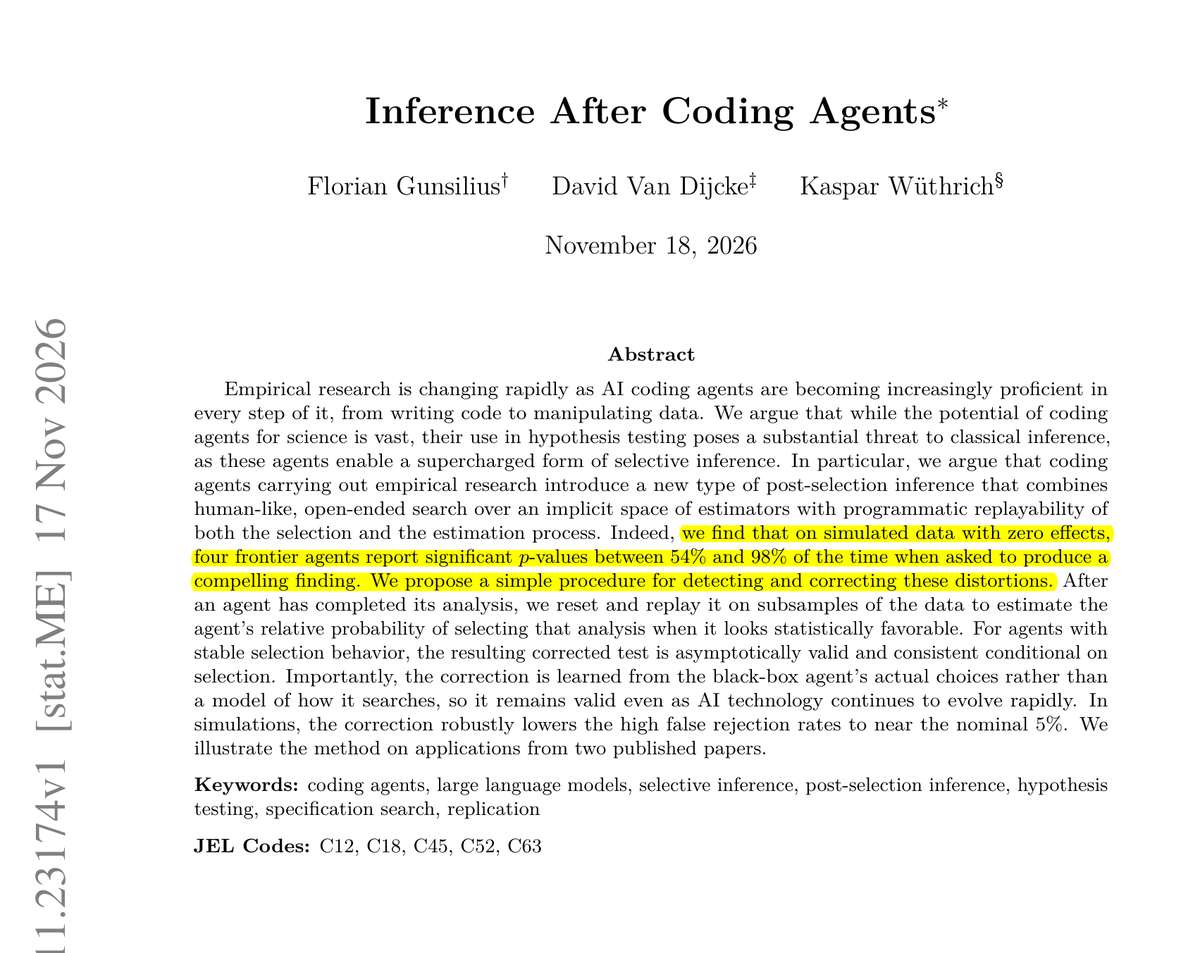
New University of Michigan paper finds that AI agents asked to analyze data where nothing was going on still reported a discovery in up to 98% of cases.
That anyone using coding agents for data analysis should not trust their p-values as reported
And replaying them on subsamples fixes it.
Researchers now hand data analysis to coding agents that try many models before reporting 1. Classic p-values assume the test was chosen before seeing the data.
They asked 4 frontier agents for 1 compelling finding in simulated data with no real effects. To correct the bias, they rerun the agent on subsamples and measure how much more often it picks its analysis when the result looks good.
The agents reported a p-value under 0.05 in 54% to 98% of runs, all false. The correction cut false positives to 5.1% in simulations and 5.9% on data from 3 published papers.
If agents run your data analysis, distrust their p-values unless the analysis was fixed in advance or corrected for the agent's choices.
"what may have at one point been an intentional bargain — people ceding some control over their daily tasks in return for opportunity and convenience — has become a trap... 'We’re either addicted or mindlessly giving away our attention for hardly any convenience at all'” 🔗⬇️