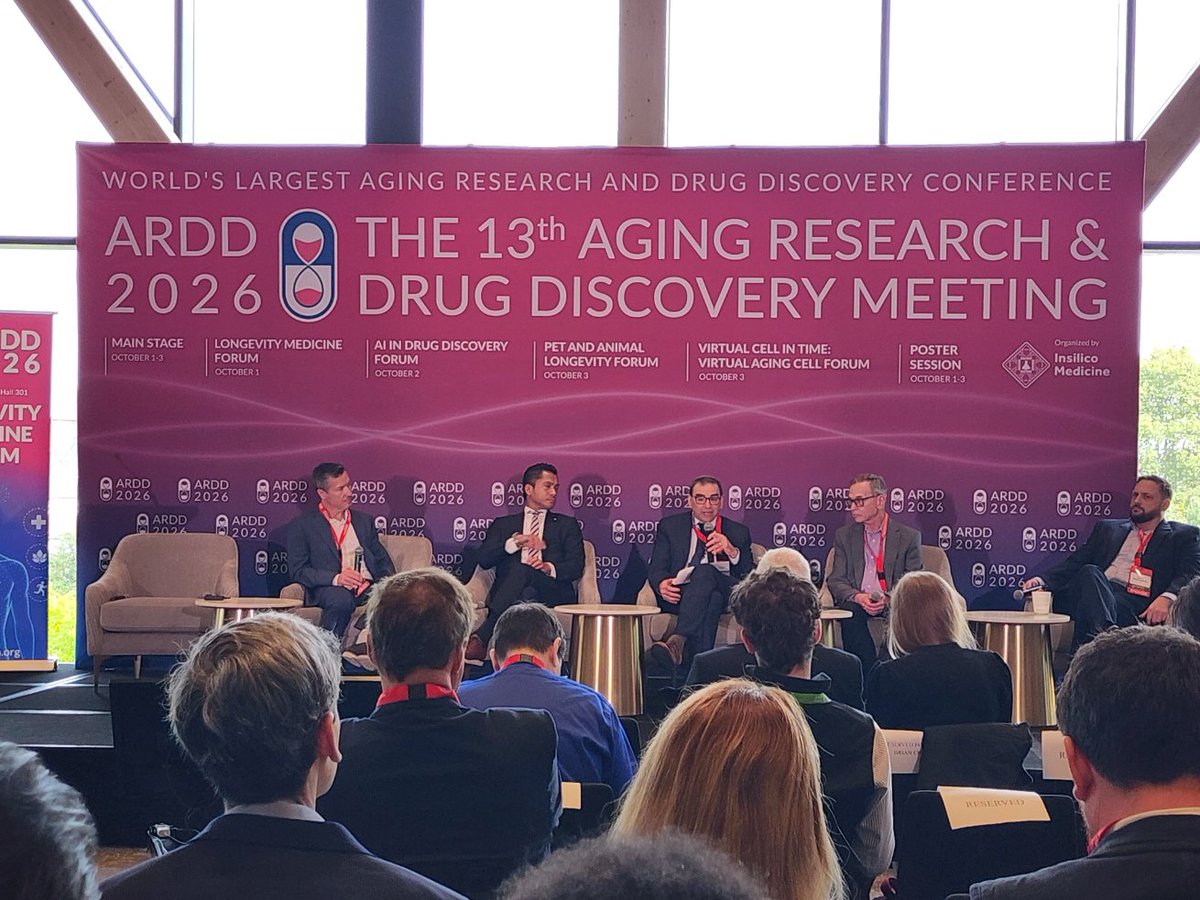
It’s notable that aging/longevity has become a stated priority area for FDA, including that it will be included as part of FDA’s new Focus Areas of Regulatory Science (FARS) report next year
Within CDER, the Office of Cardiology, Hematology, Endrocrinology and Nephrology (OCHEN) appears to be emerging as the home for INDs and applications tackling aging as an indication
Encouraging signals from Lowell Zeta (FDA Chief of Staff), Justin Penzenstadler (Associate Director OCHEN), Steven Kozlowski (FDA Chief Scientist), Jeffrey Siegel (Director of Drug Evaluation Sciences), and Andrew Brack (ARPA-H)
Onward!
Highly positive panel on longevity trials at ARDD:
Lowell Zeta (chief of staff) says longevity is a priority for the current FDA.
There's now a point person for longevity trial design: Justin Penzenstadler (reviewer on GLP1s).
Steven Kozlowski (chief scientist) working on guidance and tech specs, to be released first half of next year.
Justin recommends the field forma precompetitive consortium for which biomarkers, how to include in trials. And to talk to regulators regularly.
Tomorrow, the @HouseCommerce Subcommittee on Health will examine how the @US_FDA can maintain America's leadership in biomedical innovation and strengthen U.S. drug development. Modernizing the regulatory framework is essential if we want to accelerate innovation, maintain our competitive edge in the biomedical sector, and ensure patients have access to the next generation of treatments.
A4LI has submitted a letter for the hearing record urging Congress to consider our Multi-Disease Therapeutic Designation (MDTD) proposal: a regulatory pathway designed to better support therapies that target the underlying biology of aging and reduce the burden of multiple chronic diseases.
📄 Read our MDTD proposal here: https://t.co/g8MSWFeabT
We are thrilled to see Congress continuing this important conversation about the future of biomedical innovation, and we look forward to hearing expert perspectives on how the FDA can help foster this next generation of medical breakthroughs.
▶️ The full hearing can be livestreamed here: https://t.co/7gNm1VmMd1
I'm hiring a CMC Regulatory Lead to drive CMC Regulatory strategy and execution at Retro. This is an opportunity to join a fast-rising, early-stage biotech backed by Sam Altman that is developing therapeutics that target the fundamental drivers of aging to treat and prevent multiple downstream age-related diseases.
Our pipeline is unusually broad for a company at our stage: cell and gene therapies, small molecules, and AI-designed protein therapeutics. For someone who loves the craft of CMC regulatory work, this is a chance to work at real technical depth across multiple therapeutic modalities and help build something important.
https://t.co/FblQoAOZqZ
really enjoyed being a part of this conversation - with therapies now starting to target the upstream cause (aging) of multiple downstream serious diseases, there is so much opportunity for us to unlock over the next decade
some things worth considering:
non-legislative
- an FDA center of excellence for healthspan products
- application of accelerated approval to therapies targeting age-related diseases and multimorbidity
legislative
- Multi-Disease Therapeutic Designation to enable cross-division communication with FDA for multimorbidity registrational plans
- THRIVE Act tiered-approval approach for healthspan products
How does a regulatory agency built for treating disease adapt to a field focused on preventing it? Our panel on FDA Strategies is digging into the pathways, the precedents, and the policy shifts needed for longevity biotech to thrive.
Moderator: Eric Morgen
Panelists: David M. Fox, Lowell Zeta, @roborszulak
super important initiative - for much of the biopharma industry, the first impulse for phase 1 trials is to look outside the US.
it’s exciting to think of a time in the not so distant future where that is reversed.
Today, HHS launched a department-wide effort to restore U.S. leadership in clinical trials by reducing unnecessary barriers, accelerating research, expanding patient access to studies, and strengthening America’s biomedical innovation ecosystem.
From FDA and NIH to ARPA-H and ONC, HHS is working to help bring more clinical research, investment, and medical breakthroughs back to the United States.
Read More:
https://t.co/1HPNxBYRWj
Awesome, thank you! The definitive requirements for when a trial must be posted to https://t.co/BI1wqXekGz are described in 42 CFR 11.22(b)(2):
“Applicable drug clinical trial. A clinical trial with one or more arms that meets the following conditions is an applicable drug clinical trial:
(i) Study Type is interventional;
(ii) Study Phase is other than phase 1;
(iii) The clinical trial Studies a U.S. FDA-regulated Drug Product; and
(iv) One or more of the following applies:
(A) At least one Facility Location for the clinical trial is within the United States or one of its territories,
B) A drug product (including a biological product) under investigation is a Product Manufactured in and Exported from the U.S. or one of its territories for study in another country, or
(C) The clinical trial has a U.S. Food and Drug Administration IND Number.”
Some journals also have as part of their publishing requirements for the trial to be posted in a WHO-recognized trial registry before the first participant is enrolled, and https://t.co/BI1wqXekGz and ANZCTR are both recognized.
Lastly, any NIH-funded trial has to be posted in https://t.co/BI1wqXekGz as part of NIH’s polices.
And sometimes Sponsors may voluntarily add to https://t.co/BI1wqXekGz even if not required.
Hope that helps!
Autophagy-enhancing drug candidate enters Phase 1 trial as longevity focused biotech eyes Alzheimer’s as a potential first indication.
https://t.co/SqswMB8AwY
#longevity#biotech#autophagy#Alzheimers#healthspan
Retro has reached an important inflection point: we are now a clinical-stage company, with our first investigational therapy dosed in humans. Grateful to have been part of the team advancing our Autophagy Program in Alzheimer’s Disease into the clinic. This is an important step, the first of many we are working towards.
Here’s a quote from the article about what makes this program unique:
“ ‘They are targeting a pathway that is upstream of the current therapies,’ said Colin Masters, a professor at the University of Melbourne and one of the world’s leading experts on Alzheimer’s. ‘In other words, they are going after the primary cause of Alzheimer’s Disease.’ Masters helped discover the Aβ amyloid protein years ago and is now working with Retro to shape its clinical trial.”