🚨
Local dependence → manifold hypothesis
Distant independence → Markov random fields
New preprint: the latter works in conjunction first, massivly improves data efficiency, and can be exploited by DNNs https://t.co/OjSqzT6bvc
With
@itsrainingdata
https://t.co/7jAhhLIJIv
🎉I'm happy to announce that our paper "Breaking the curse of dimensionality in structured density estimation" was accepted to NeurIPS 2024. 🎉
with:
Wai Ming Tai (Nanyang Tech. Uni. - https://t.co/7jAhhLIJIv )
and
@itsrainingdata (U Chicago)
-Preprint forthcoming-
NeurIPS preprint: https://t.co/VZ3r992sxo
Standard models for spatial, sequential, hierarchal, etc data result in drastically reduced effective dimension for density estimation. This effective dimension is orthogonal to other approaches such as sparsity or manifold hypothesis.
Just noticed that Tsybakov (author of one of my favorite textbooks: Intro. to Nonparametric Estimation) wrote a nice extension of my 2021 NeurIPS paper "Beyond Smoothness: Incorporating Low-Rank Analysis into Nonparametric Density Estimation."
Exciting!
https://t.co/tEMtjioa1p
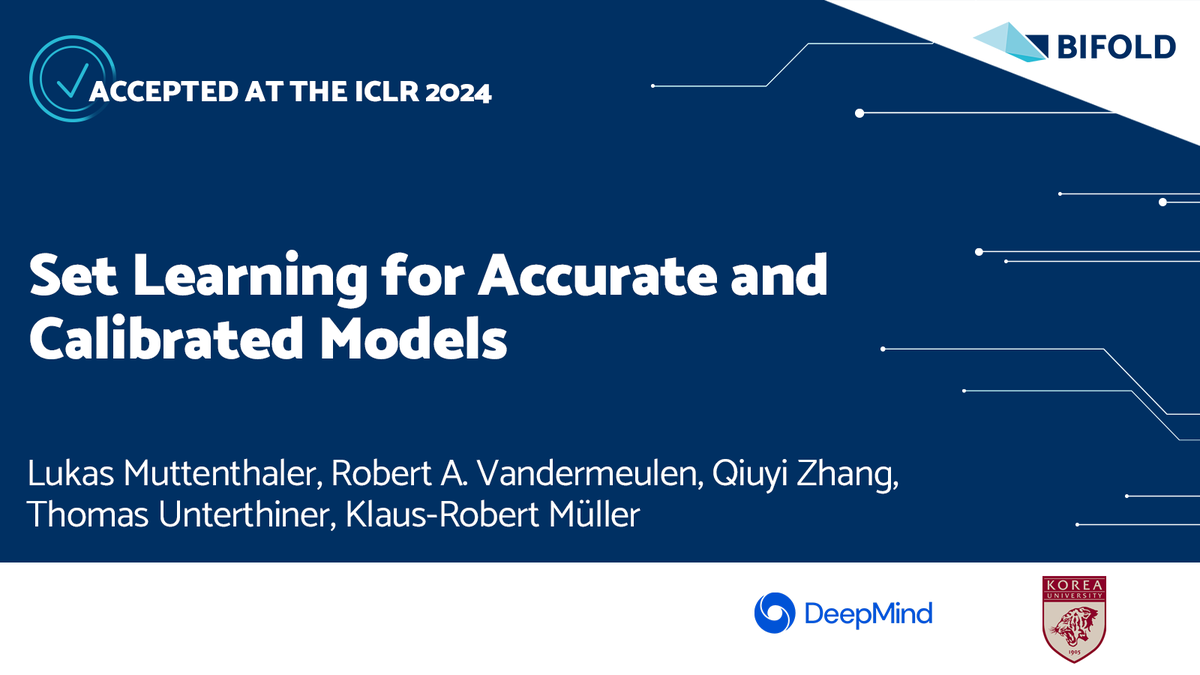
Congratulations: The paper “Set Learning for Accurate and Calibrated Models” is accepted at the #ICLR2024. Authors: @lukas_mut, @robvdm, Q. Zhang, T. Unterthiner, K.-R. Müller.
Preprint: https://t.co/qyTosdxsKS
Wrap up: https://t.co/K87IhVb9pk
@GoogleDeepMind@ml_tuberlin
OKO got accepted to #ICLR2024🎉🥳 OKO is very simple to use: Just change your sampling from single data point sampling to set sampling and compute cross-entropy for the sum of set data point logits rather than for single data point logits. You will get much better calibration! 🔥
🔥The CfP for Re-Align is up 🔥
If you are broadly interested in the alignment of two or more representation spaces, consider submitting to our workshop at #ICLR2024 and join us in beautiful Vienna!
At the poster for @lukas_mut's paper "Improving neural network representations using human similarity judgments"
https://t.co/buOFxnac8v
Wed 13 Dec 10:45 a.m. CST — 12:45 p.m. CST
Great Hall & Hall B1+B2 (level 1) #300
https://t.co/4KJj4BGQxC
It seems like all math tests for LLMs involve just the direct application of various rules, like a bunch of trig or calc rules, to solve the problem. How about getting a LLM to prove the intermediate value theorem or some other proof that requires a clever construction?