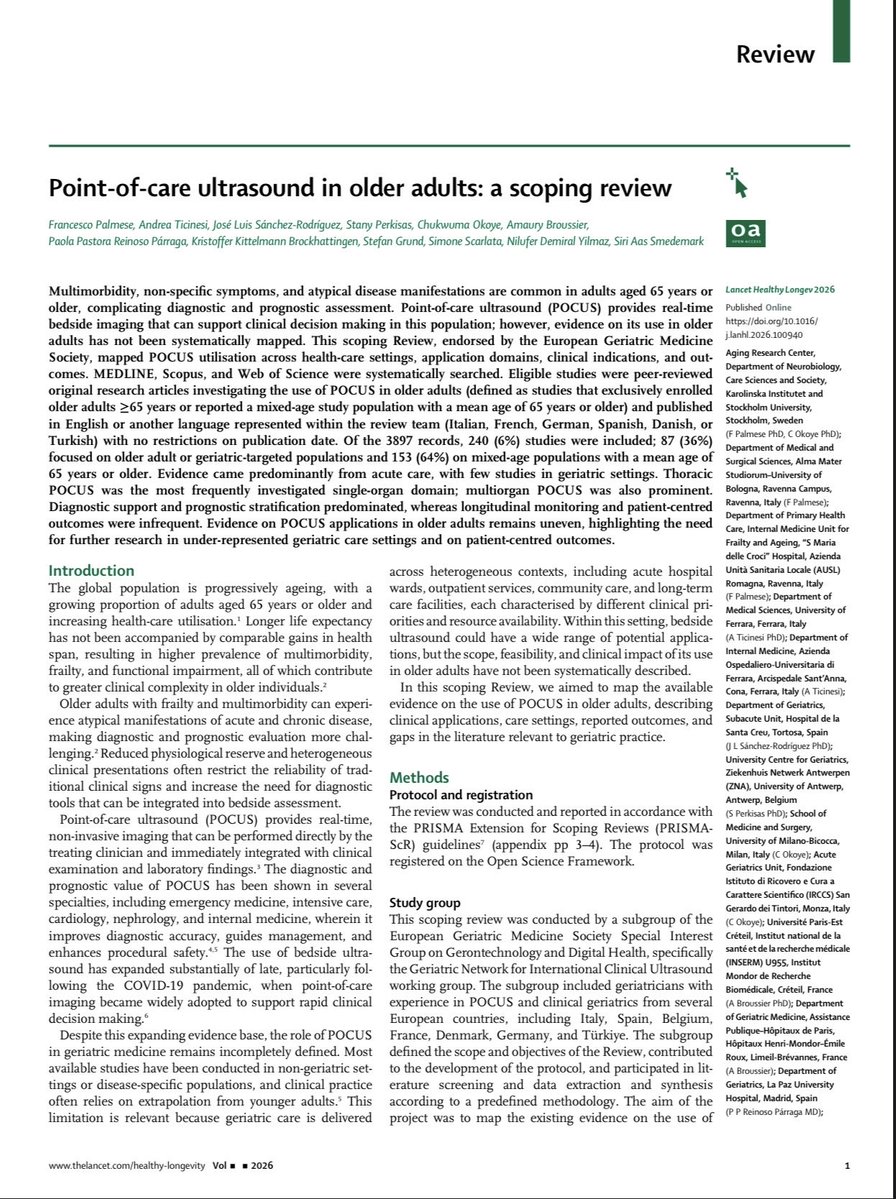
Acabamos de publicar en The Lancet Healthy Longevity una revisión de 240 estudios sobre ecografía clínica a pie de cama (#POCUS) en personas mayores.
Una colaboración internacional que aporta a la geriatría una visión de conjunto de la evidencia.
https://t.co/uQg7D9ouNz
🎙️ ESTRENO en #SEC26
Por primera vez, en nuestro congreso, abrimos un espacio pensado para contar la ciencia de otra manera:
🎙️ Learning Talks 🎙️
de Learning Hub SEC.
Charlas de 15 minutos en formato TED,
sin diapositivas infinitas, que dejan atrás el «más de lo mismo».
Cada una trata un tema de actualidad con una mirada que va más allá del dato científico: historias, ideas y preguntas que te llevarás de vuelta a tu hospital.
Es un formato nuevo, moderno y cercano, con ponentes de lujo:
🔥 @GarciaQuintanaA · Inflamación cardiovascular: el fuego que no duele… pero que mata 🎬 @PabloJ ·
Guardia en la coronaria: lo que el cine nunca muestra 🔍 @dr_pavia ·
Ver lo invisible: mi apuesta personal por la amiloidosis cardiaca ♀️ @R_Campuzano_R · Hormonas, cromosomas y arterias: por qué el corazón femenino enferma diferente 🫀 @davidcalle1390 ·
Prevenir la insuficiencia cardiaca: lo que la evidencia dice y no hacemos 🧩 @Carol_O_C ·
¿Un solo tratamiento para todos? La trampa de la ICFEp ⚗️ @anguita_m ·
Aldosterona: la hormona que no supimos controlar… hasta ahora 💧 @rdelaespriella ·
Congestión: los 10 mandamientos 📏 @yulnunezvill ·
Cuando el corazón pequeño es un problema grande 🔗 @MartaCoboMarcos ·
Tratar el todo, no las partes: el síndrome cardiorrenometabólico 🧭 @SantasEnrique ·
Lípidos: la mejor guía eres tú ⏱️ María Rosa Fernández Olmo · Adelantarse al primer infarto 💊 @Guillermo4ldama ·
Menos pastillas, más vida: 3 recetas en 1 🩺 @docvivas ·
Del bloqueo a la inhibición: el futuro de la HTA ⚡ @adrianarchav ·
Protección inteligente frente a la muerte súbita 🤖 @domingomarzal ·
IA: no es el fin del cardiólogo, es el nacimiento de uno mejor 📊 @rafaelglezm ·
Las trampas de la estadística ✍️ @S_Raposeiras ·
Las claves para que te publiquen un artículo científico 🔬 #JavierBermejo ·
No hay cardiología de futuro sin cardiólogos que investiguen 🚀 @almucastro01 ·
¿Hemos tocado techo en la investigación cardiovascular?
Sé de los primeros en vivirlo. No te defraudaremos 😉
📍 Espacio Learning Talks · FIBES Sevilla
🗓️ Jueves 29 y viernes 30 de octubre
👇🏽Programa y horarios 👇🏽
🧠 Acute ischemic stroke in 2026: the treatment window is becoming a tissue window
The management of acute ischemic stroke has changed dramatically.
This useful 2026 review brings together the evolving evidence for thrombolysis, thrombectomy and early antithrombotic therapy.
Thrombolysis: tenecteplase is changing practice
Alteplase established IV thrombolysis as standard therapy, but tenecteplase has important practical and pharmacological advantages: greater fibrin specificity, a longer half-life and, importantly in emergency stroke workflows, administration as a single IV bolus.
The reviewed evidence supports tenecteplase 0.25 mg/kg, maximum 25 mg, and a 2024 meta-analysis found a higher likelihood of excellent functional outcome and less disability at 90 days compared with alteplase. Tenecteplase was FDA-approved for acute ischemic stroke in 2025.
But perhaps the bigger conceptual change is that 4.5 hours is no longer an absolute biological boundary.
MRI DWI-FLAIR mismatch and CT/MR perfusion can identify selected patients with potentially salvageable tissue beyond conventional time windows. WAKE-UP and EXTEND established this principle, while more recent studies have continued exploring thrombolysis as far as 24 hours in carefully selected patients.
Thrombectomy: even a large core does not necessarily mean “too late”
Mechanical thrombectomy transformed large-vessel-occlusion stroke, and DAWN and DEFUSE 3 subsequently demonstrated that carefully selected patients can benefit 6-24 hours after onset.
Now another boundary is disappearing: the large ischemic core.
Multiple randomized trials have demonstrated benefit from thrombectomy in patients previously considered to have too much established infarction. Across these studies, thrombectomy plus medical therapy was associated with better 90-day functional outcomes, with a combined OR of 1.57 (95% CI 1.40-1.76). The review highlights current consideration of thrombectomy for proximal MCA/ICA occlusion with ASPECTS 3-5 and, in selected patients, even ASPECTS 0-2.
Posterior circulation treatment has also evolved. For basilar artery occlusion with moderate-to-severe deficits, thrombectomy can be considered up to 24 hours. In contrast, the role of thrombectomy for medium and distal vessel occlusion remains unsettled, with recent trials producing conflicting signals.
And reperfusion is only the beginning
Recurrent ischemic events cluster early after stroke.
Aspirin initiated within 48 hours reduces recurrence and produces a small mortality benefit. For minor ischemic stroke or high-risk TIA, appropriately selected patients benefit from early, short-term dual antiplatelet therapy, rather than simply continuing aspirin alone.
Time is brain...
Reference 📚
Leon Guerrero CR. 2026. Thrombolysis, Thrombectomy, and Antithrombotic Therapy for Acute Ischemic Stroke. Continuum (Minneap Minn). 32(3):775–790.
DOI: 10.1212/cont.0000000000001701
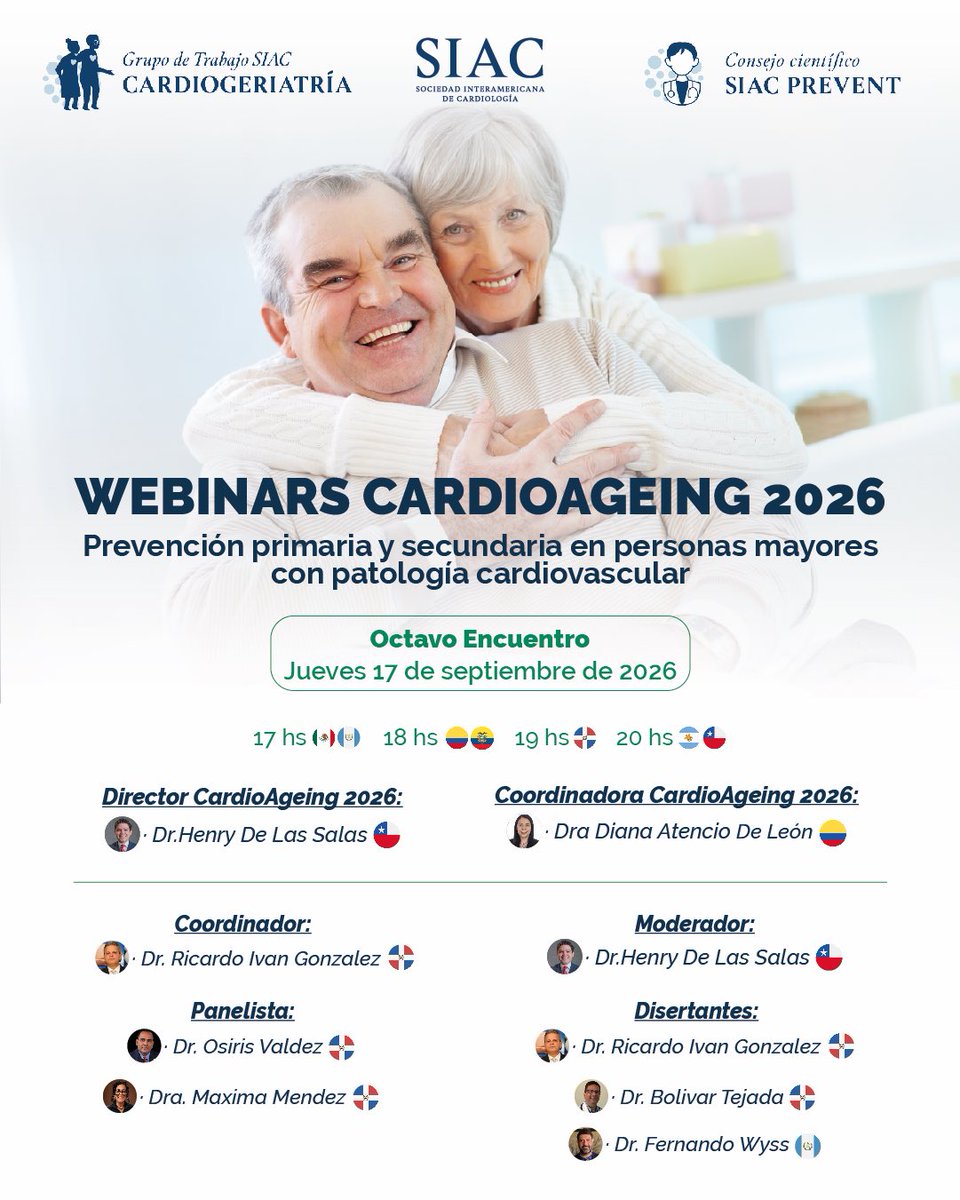
🌎Mes a mes seguimos construyendo la CardioGeriatría de las Américas By @SIAC_cardio
📍 Prevención primaria y secundaria en mayores con patología cardiovascular
🌎 País invitado: República Dominicana 🇩🇴
📅 Jueves 17 sep
#CardioGeriatría
Link: https://t.co/66ZuoxlleA
🥸 1️⃣ When @MichaelGNanna, @ParagGoyalMD, @DrAROrkaby, @Ajar_Kochar, @FrailtyMD, @DEF_gericard@cardskrish @JDodsonMD and many others (who are not on twitter), spoke about #cardiovascular#aging research, the literature was sparse and scattered.
Together, we built a body of evidence in different study cohorts: coronary disease, HF, prevention, structural heart, revascularization, and many others.
Here is a reading list for #cardiovascular #aging. One paper per tweet, each with a link from the American Heart Association (@AHAScience) and American College of Cardiology @ACCinTouch Scientific Statements to the trials that set the current knowledge in #Aging research
👇👇👇
🔥Just published 🔥
Infective Endocarditis: Diagnosis, Antibiotic Therapy, and Management: A Scientific Statement From the American Heart Association #idxposts#IEWiki
https://t.co/0yXAfs4X6X
Thanks @Inox94
🔥 Hot off the press: We identified how and where AF begins.
I am excited to share this work.
Since the discovery of PV triggers more than 25 years ago, AF ablation has evolved into an empiric therapy centered on PVI. Yet, we have never been able to identify the arrhythmogenic substrate that determines why a premature beat initiates AF at one site and not another.
We believe this study changes that.
In this mechanistic study, we found that AF initiation arose predominantly through reentry originating from a small number of spatially discrete regions with steep repolarization gradients. Their distribution was unique to each patient, and they accounted for more than 92% of AF initiation episodes.
Importantly, the arrhythmogenic substrate was not defined by low voltage, and while conduction abnormalities were often present, they appeared to play a secondary role.
Its patient-specific distribution may help explain the controversy surrounding posterior wall isolation: the posterior wall harbored the substrate in only approximately 30% of patients. Importantly, in redo patients with durable PVI, right-atrial substrate (which is often beyond standard mapping strategies) was identified in 30%.
Most encouragingly, in an exploratory cohort of 24 patients with recurrent AF and durable PVI (50% PerAF), targeted elimination of these sites achieved 87.5% single-procedure freedom from any atrial tachyarrhythmia over a median of 489 days, without antiarrhythmic drugs.
The thoughtful accompanying editorial by Jon Kalman highlights the significance of this discovery and its central translational challenge of bringing it into real-world clinical practice.
But stay tuned! Technology is under development to transform this discovery into a rapid, automated functional mapping.
Current electroanatomic mapping relies largely on voltage amplitude and activation timing. We need to move beyond these measures and map how tissue actually functions - how it conducts, repolarizes, and responds to premature stimulation. This can add the critical dimension that has long been missing from substrate mapping and may reveal what truly makes cardiac tissue arrhythmogenic.
To me, this is the beauty of physiology: there are no black boxes. We can identify the sites that reproducibly initiate the arrhythmia, define their EP properties, eliminate them with ablation, and confirm that arrhythmia can no longer be initiated.
The next steps are prospective multicenter validation and technological development. Together, they may move AF ablation beyond empiric therapy toward truly individualized, mechanism-guided therapy.
📄 Paper in @JACCJournals:
https://t.co/izIR8HbNYk
📝 Editorial:
https://t.co/mYIilXkjJ7
#JACCCEP #AtrialFibrillation #CardiacElectrophysiology #CatheterAblation #EPeeps
⬇️ The 2026 Guidelines for the early management of patients with acute ischemic stroke: An updated guideline from AHA/ASA
Must read
https://t.co/kNJh4LAPGK
How to decongest a DECOMPENSATED HEART FAILURE (ESC 2026)
🎯Loop➡️Acetazolamide➡️ Thiazide.
🎯L/F Urine Na & Urine O/P to asses response.
🎯VEXUS 🔁 to decide end points.
The STEMI vs NSTEMI paradigm may be missing the real target.
Occlusion Myocardial Infarction (OMI) refers to an acute myocardial infarction caused by a culprit coronary artery that is completely or nearly completely occluded, resulting in critically reduced blood flow to the myocardium. In simple terms, OMI identifies the patients who need urgent reperfusion because an artery is blocked, regardless of whether the ECG fulfills STEMI criteria.
A 2024 study of 334 ACS patients found that 40% of OMI patients did NOT meet STEMI criteria. Despite having an acutely occluded coronary artery, these patients were often classified as NSTEMI and experienced major delays in treatment.
Among STEMI-negative OMI patients, only 11% underwent PCI within the first 12 hours, compared with 77% of STEMI-positive OMI patients.
The concerning part is that both groups had remarkably similar disease severity:
🔺 Similar rates of PCI
🔺 Similar rates of mechanical complications
🔺 Similar rates of electrical complications
🔺 Similar angiographic evidence of acute coronary occlusion
In other words, many patients without classic ST-elevation had the same dangerous pathology that traditionally prompts emergency cath lab activation.
The authors argue that focusing solely on STEMI criteria can cause clinicians to miss a substantial number of patients with acute coronary occlusion. Instead, ECG interpretation should focus on identifying OMI patterns, including hyperacute T waves, de Winter pattern, posterior MI, reciprocal changes, modified Sgarbossa criteria, and other STEMI equivalents.
The artery does not care whether the ECG meets STEMI criteria.
Time is myocardium. The goal is not simply to find ST elevation. The goal is to identify acute coronary occlusion and restore blood flow before irreversible myocardial injury occurs.
Perhaps it is time to shift the conversation from STEMI vs NSTEMI to what truly matters: OMI vs NOMI.
Managing Bleeding Risk in Older Adults: @Sciencedirect
🥸 This was published in Clinics in Geriatric Medicine - thanks to Drs @DrAROrkaby and @JSpitz_MD
😱 Very proud of Francisco Alexandrino for putting this together: @MichaelGNanna
👇👇👇
In Alzheimer’s imaging, there are some things you just can’t forget!
New Alzheimer’s treatments are changing the way we look at these scans!
Removal of amyloid beta proteins from vessel walls by anti-amyloid antibodies leads increased vascular permeability.
This can cause edema or hemorrhage, called ARIA (Amyloid Related Imaging Abnormalities)
Grading of the degree of ARIA is important bc it can change management. Asymptomatic ARIA is usually treated by pausing treatment if it’s moderate to severe
For ARIA-E (edema) or ARIA-H (microhemorrhage), if the edema measure > 5 cm or number of microhemorrhages are >5, it is moderate
For superficial siderosis, 2 regions is considered moderate.
Remember it by this little rhyme:
--If ARIA findings are great than 5, then the medication deprive
--Or if siderosis is 2, then medication break for you!
Hopefully, now the grading of ARIA will stay in your memory!!
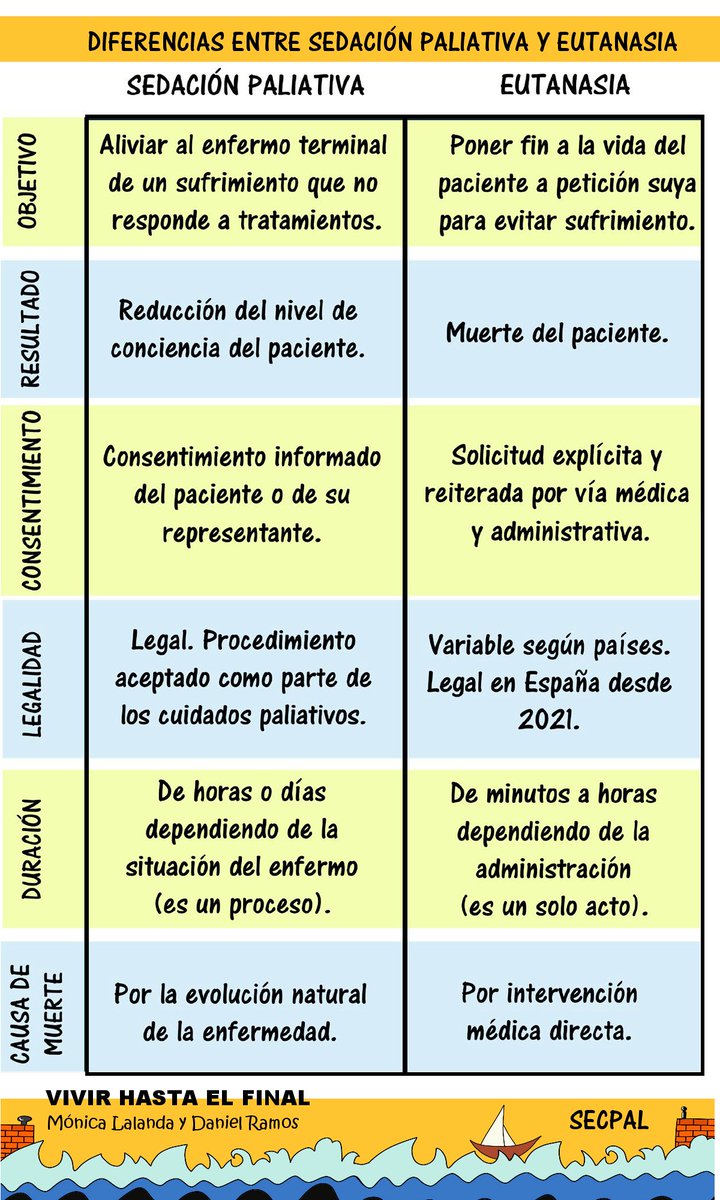
Entiendes que la sedación terminal y la eutanasia son diferentes?
Estos dos conceptos (que parecen similares, pero no lo son) siguen causando confusión y sufrimiento a familiares y profesionales
Te lo explicamos en esta página de Vivir hasta el final
cc @PaliativosTeam@secpal_