The territorial integrity norm - states are immortal, borders are grandfathered in - is a plausible cause of the Long Peace, the decline of interstate war since 1946. Norms are maintained by common knowledge (they exist to the extent everyone thinks everyone else thinks they exist, the topic of my next book) and can be threatened by public doubts. This is why loose talk around Greenland & Panama is dangerous. Francis Fukuyama agrees: https://t.co/b5vZ3ocyDh
@pontific8 Indeed, a great question. @rogan_m and I raised it (and proposed some conjectures) with regard to organizational relationships in our 2014 Annual Review of Sociology piece.
https://t.co/7dbWvI63Zj
Participation in corp social impact projects lowers men's promotion chances but improves retention of employees who participate. Firms benefit but many employees do not.
Retention findings in prev study here - https://t.co/PQdo9uyUQU
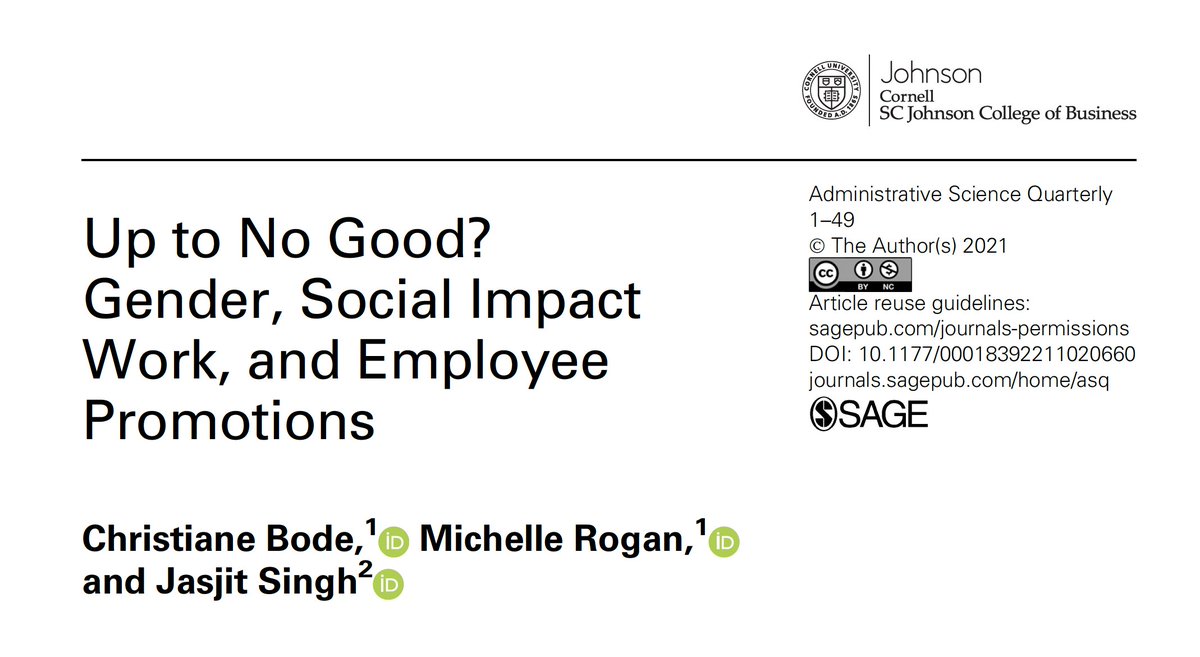
New @SAGEManagement @ASQJournal article! Christiane Bode, @rogan_m from @ImperialBiz and @sjasjit from @INSEAD expose a connection between employees' gender, participation in social impact work, and promotion chances. https://t.co/rLPWJPJKZO
Is doing social good also good for your career? It depends on your gender. Christiane Bode and Jasjit Singh @sjasjit and I find that men who take part in corporate social impact projects are less likely to be promoted https://t.co/1KeYEOG6qn
Anne ter Wal and Michelle Rogan of Imperial College Business School explain why taking your foot off the pedal isn’t such a bad thing, especially during Covid times.
@ImperialBiz
read more here:
https://t.co/gZikJc6Uac
Congratulations to WMBA 2019 @ImperialBiz for delivering +4500hrs of free consulting while working day jobs & attending weekend classes during a pandemic! Truly proud of the value they have created for others @PerkmannM#thenewweekendwarriors#WMBA2019rocks
Teams are under pressure to move fast under COVID-19. Beware if you have lots of money and people..it can slow you down:
1. Team size research & Apple: Use small teams and designate a DRI (directly responsible individual)
2. Adding more people to a late project makes it later
I asked an infectious disease expert I know when things will be completely back to normal, as in flying on planes without masks back to normal.
His answer: 2024.
If someone writes an article you disagree with, here is an option that a lot of you seem to have forgotten: read it, then have some thoughts about it. Then have some thoughts about your thoughts. Critically assess your intuitive reaction. Then see if there's any elements of the
One problem with saying that we should only listen to experts is that new ideas often come from outsiders.
Where an idea came from is one predictor of its validity, but no more than that. And in some fields it's a rather bad predictor.
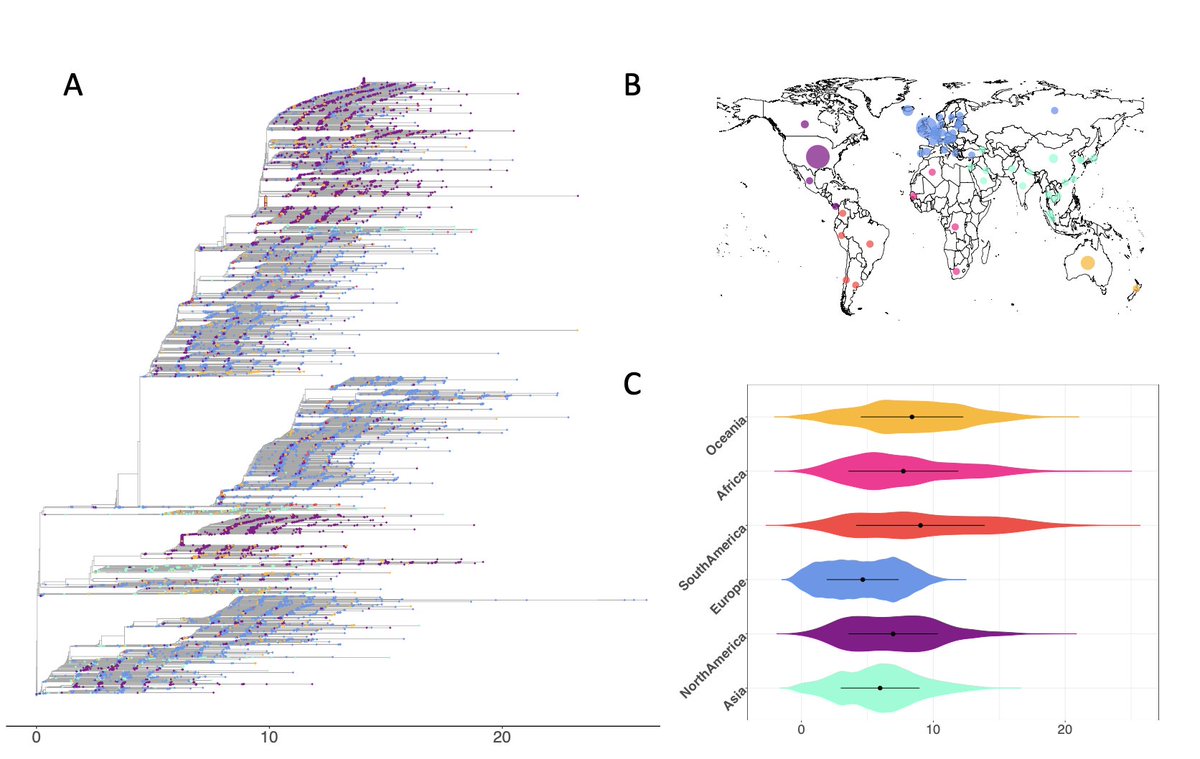
There have been claims that #COVID19 has acquired mutations leading to more transmissible strains. We formally tested whether this was the case using 15,000 #SARSCoV2 genomes from all over the world:
... and the answer is no, not at all!
(1/5)
https://t.co/NxIlUcFDE9
This is quite concerning. Asymmetric impacts by gender on research productivity - suggests that the burdens of, eg, child care in lockdown being (surprise, surprise) unequally shared. What can/should universities do, beyond tenure-clock extensions?
Investors: Any startup that gets started during the next few months is disproportionately likely to succeed. Success depends most of all on determination, and imagine how determined you have to be to start a startup in the middle of a global pandemic.
It occured to me that part of what's exhausting about all this on Zoom-ing is seeing myself & being constantly conscious about what my face is doing, where I'm looking etc. Once I realized that, I googled & figured out you don't *have* to see yourself even if your video is on.