NASA has announced the four astronauts selected for Artemis III, expected to launch in 2027. Meet the crew and learn more about the mission and next step toward a base on the moon: https://t.co/Fc4iSvFMaO
Introducing Artemis III.
Four astronauts. Three launches. Two dockings. One splashdown.
In 2027, the Artemis III mission will practice docking the Orion spacecraft with two lunar landers in low Earth orbit — the capability we need to return humanity to the Moon’s surface.
A new image showcases a dazzling celestial object — a star, paired with another, in the throes of dying that resembles a crystal ball. Scientists captured the image of NGC 1514, nicknamed the Crystal Ball Nebula, with the Gemini Multi-Object Spectrograph. The instrument is mounted on the Gemini North telescope, which is located on Maunakea, a dormant volcano in Hawaii. https://t.co/b6sWmK7rkO
Tomorrow, we're announcing the astronauts flying aboard Artemis III, the mission that will test rendezvous and docking capabilities with commercial lunar landers in low Earth orbit.
If you could ask the Artemis III astronauts any question, what would you ask them?
Earth Seen from the International Space Station
From the International Space Station, Earth appears as a breathtaking blue world floating in the darkness of space. Oceans, clouds, mountains, and city lights become part of one incredible view seen from orbit.
Traveling high above the planet, astronauts aboard the ISS witness sunrises, storms, and glowing atmospheric layers unlike anything visible from the ground.
From space, borders disappear and Earth
looks peaceful, reminding us that this small planet is home to everyone.
One planet... seen from humanity's orbiting home in space.
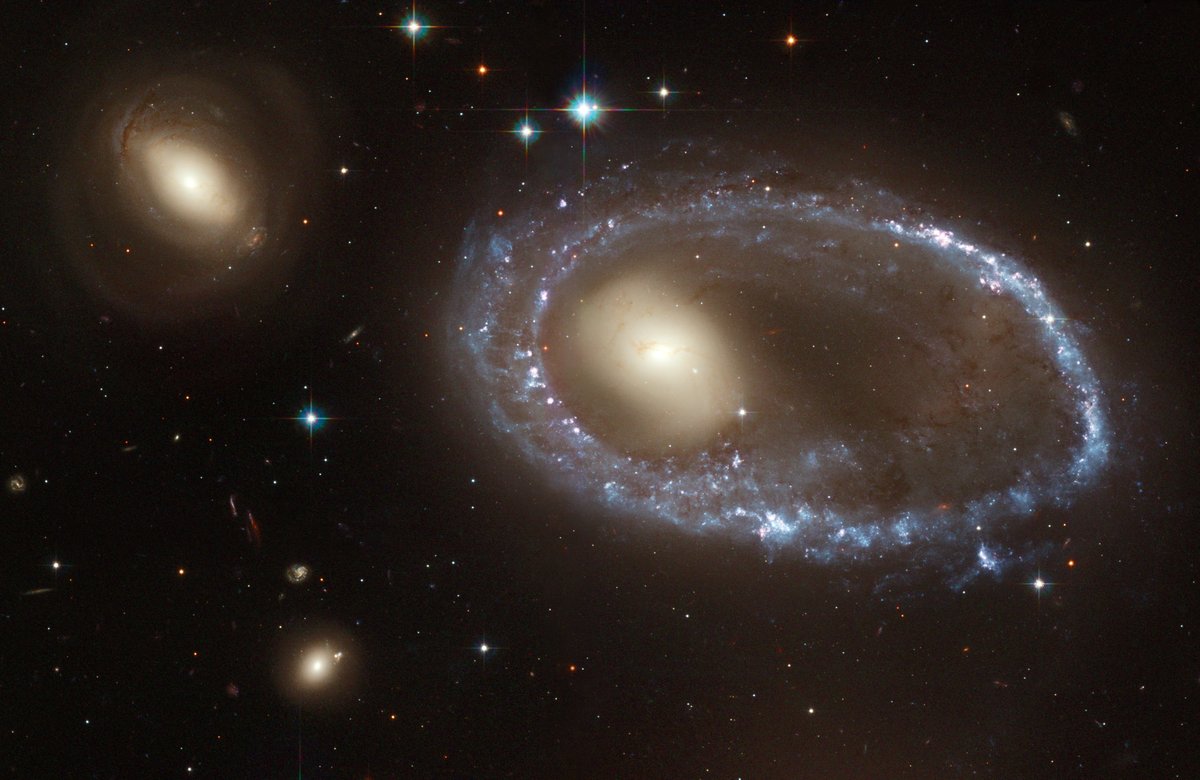
A cosmic marvel, AM 0644-741 displays a glowing blue ring 150,000 light-years wide—vastly larger than the Milky Way.
(Credit: NASA, ESA, and The Hubble Heritage Team - AURA/STScI)
The effects of climate change are displayed through two views of Opal Reef on Australia’s Great Barrier Reef. Following periods of unusually high ocean temperatures in 2016 and 2017, many corals that once filled the reef with color had become gray and skeletal.
The ocean reminds us that people are bound together.
It shapes the climate, sustains ecosystems & economies, and feeds billions of people around the world.
The ocean can no longer be treated as limitless. We all have to do our part to #SaveOurOcean.
#WorldOceansDay2026
The world’s largest electronic blast at Caval Ridge Mine.
2,194 tonnes of explosives, 3,899 holes, and 4.7 million cubic metres of rock moved in a single shot.
EL VÍDEO OFICIAL DEL GOBIERNO DE EE.UU. QUE DEBERÍA HABER CAMBIADO EL MUNDO… Y SIN EMBARGO ESTÁ ENTERRADO🛸
Uno de los vídeos liberados por el Pentágono muestra un objeto que desafía todas las leyes de la física conocidas.
Movimientos imposibles, aceleraciones instantáneas, sin alas, sin escape visible… pura anomalía flotando en el cielo.
Independientemente de si se trata de tecnología extraterrestre o de un proyecto humano negro ultra-secreto, la realidad es la misma: esto no es un globo, ni un dron comercial, ni un error de cámara.
Es algo que debería estar en la portada de todos los periódicos del planeta, abriendo todos los noticieros y generando debates en el Congreso.
Pero no.
Silencio absoluto. Censura suave.
Medios que miran hacia otro lado. Gente que prefiere hablar de cualquier otra cosa antes que enfrentar lo que este vídeo implica.
Mientras tanto, el archivo sigue ahí… disponible para quien tenga el valor de verlo.
El mundo sigue girando como si nada hubiera pasado.
Pero algunos ya sabemos que sí pasó…
🚨 PHYSICISTS HAVE DIRECTLY VISUALIZED A QUANTUM EVENT THAT WAS ONCE THOUGHT TO BE UNOBSERVABLE.
Researchers captured evidence of "quantum phase slips" rare events where a quantum system tunnels between different states without crossing the energy barrier in the classical sense.
In simple terms:
The system appears to pass through a wall it shouldn't be able to cross.
The discovery helps scientists understand superconductors, quantum devices, and some of the strangest behaviors predicted by quantum mechanics.
Reality doesn't always follow the rules of common sense.
Sometimes particles simply find another way.
🚨 WHAT IF THE UNIVERSE COULD EXPOSE A REGION WHERE PHYSICS COMPLETELY BREAKS DOWN?
Physicists have found new mathematical evidence that "naked singularities" can form in higher-dimensional spacetime.
A singularity is a point where spacetime curvature becomes infinite and our known laws of physics stop working.
Normally, physicists expect these regions to be hidden behind the event horizon of a black hole.
But this new research suggests that under certain conditions, spacetime may be able to create singularities that remain exposed.
The team discovered strange self-similar "ripple" patterns in higher-dimensional gravity that can evolve into naked singularities and microscopic black holes.
Why this matters:
• It challenges one of the most important ideas in gravitational physics: the cosmic censorship conjecture
• It suggests there may be situations where the deepest breakdowns of relativity are not hidden from the universe
• It reveals new mathematical structures that emerge in extreme spacetime conditions
• It may help physicists understand where Einstein's theory ultimately reaches its limits
The unsettling implication is this:
If naked singularities can exist, there may be places where the universe openly reveals regions that current physics cannot describe.
For now, this remains a theoretical result in higher-dimensional models.
But it brings scientists one step closer to understanding what lies beyond the edge of known spacetime.
Follow for more frontier physics and reality-bending discoveries.
🚨 SCIENTISTS MAY HAVE DISCOVERED A HIDDEN CHEMICAL LINK TO HOW EARTH GOT ITS OXYGEN.
Using advanced computer simulations, researchers have predicted the existence of a previously unknown manganese-bearing compound that could be stable deep in Earth’s lower mantle under extreme pressure and temperature.
This mineral doesn’t directly produce oxygen. Instead, it may have played an indirect but important role in the deep-Earth chemical processes that influenced the oxidation state of the planet over billions of years processes that eventually helped enable the rise of oxygen in the atmosphere.
Why this matters:
• Earth’s early atmosphere had almost no free oxygen for the first two billion years of its history
• The Great Oxidation Event (when oxygen levels rose dramatically) was driven by both biological and geological factors
• Understanding the deep mantle’s chemistry helps explain how Earth’s interior may have contributed to making the surface habitable
• This discovery suggests the lower mantle may contain more complex and reactive minerals than previously thought
The deeper implication:
We often think of Earth’s oxygen as something that came almost entirely from early life (cyanobacteria). But this kind of research highlights that the deep Earth itself through slow, high-pressure chemical reactions may have helped set the stage for oxygen to accumulate in the atmosphere.
In other words, the conditions that allowed complex life to eventually emerge may have been shaped not just at the surface, but by chemistry happening thousands of kilometers beneath our feet.
Follow for more frontier Earth science and research exploring how our planet became habitable.