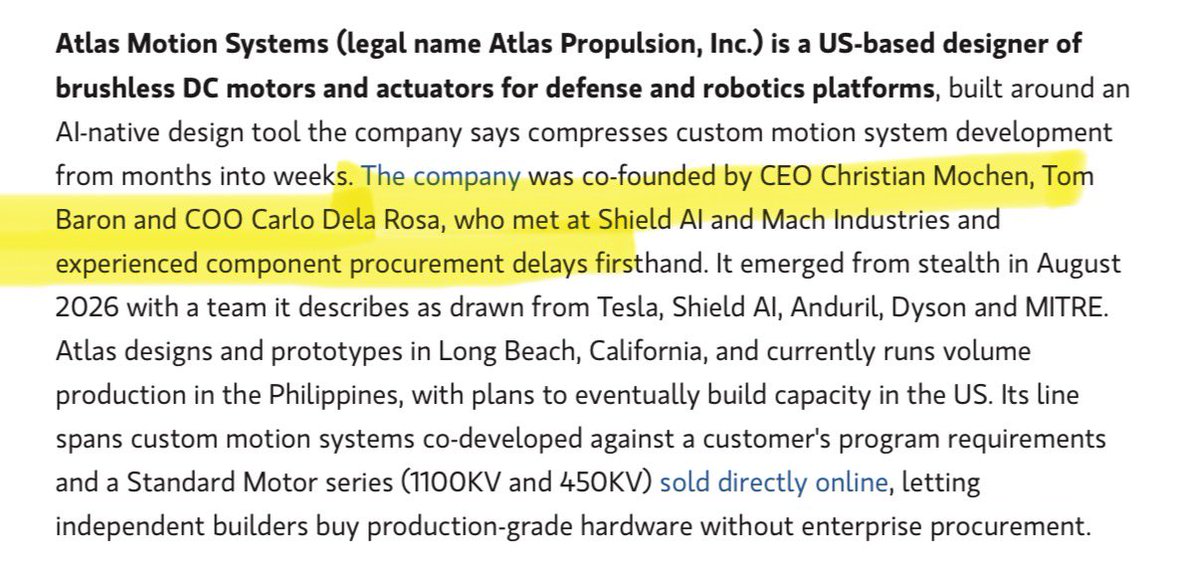
My closet is turning into a micro data center. I will soon need watercooling and power generators. Not sure how I ended up here, but it made sense at that time.
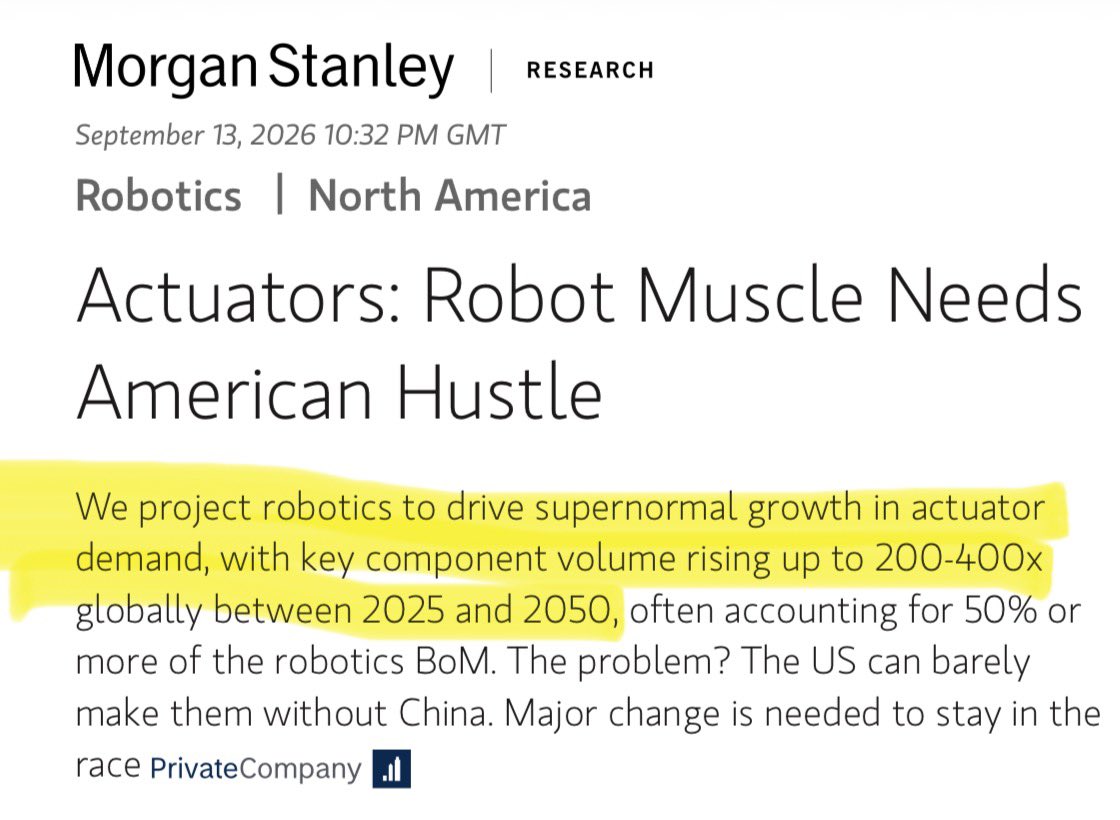
The fellas at @MorganStanley are officially actuator pilled:
“To give investors a sense of scale for the opportunity (globally here, not just
the US), we proxy the actuator opportunity as motors + bearings + reducers, sizing the 2030 global TAM at $94bn in our base case...”
Solar panels now sell for around $0.12 per watt, down from $5–$6 at the turn of the millennium, according to the FT.
Ember’s Dave Jones calls them “offensively cheap.” From 2030 onward, energy could become the most significant bottleneck in data center expansion. Solar power is one of the best and most cost-effective energy sources.
As long as fusion energy is not yet a viable option, solar power should be expanded on a massive scale. This is because the prices for energy storage are also falling rapidly.
Secretary Lutnick visited Lehigh Heavy Forge in Bethlehem, Pennsylvania, where American workers manufacture massive steel components for submarines, naval ships, and the nuclear industry.
American manufacturing at its strongest.
Vice President JD Vance is exactly right.
Data centers:
- Create tons of jobs
- Are "the gasoline of the technology revolution" that America needs to win
- Should work with local communities to ensure everybody benefits--and President Trump's Ratepayer Protection Pledge ensures they will
@joanwalsh@thenation@VP The WaPo columnist was fired for posting a fabricated statement to stoke racial violence and hatred. She FALSELY added “Black women” to a QUOTED statement from Charlie Kirk. He did not say “Black women.” What a sham The Nation has become.
@RampCapitalLLC They took billons in CHIPS funding already and couldn’t turn it around - technically the gov is already a creditor. I consider this a restructuring/recapitalization with an existing creditor - for a critical company.
Nice - my AI startup school talk is now up! Chapters:
0:00 Imo fair to say that software is changing quite fundamentally again. LLMs are a new kind of computer, and you program them *in English*. Hence I think they are well deserving of a major version upgrade in terms of software.
6:06 LLMs have properties of utilities, of fabs, and of operating systems => New LLM OS, fabbed by labs, and distributed like utilities (for now). Many historical analogies apply - imo we are computing circa ~1960s.
14:39 LLM psychology: LLMs = "people spirits", stochastic simulations of people, where the simulator is an autoregressive Transformer. Since they are trained on human data, they have a kind of emergent psychology, and are simultaneously superhuman in some ways, but also fallible in many others. Given this, how do we productively work with them hand in hand?
Switching gears to opportunities...
18:16 LLMs are "people spirits" => can build partially autonomous products.
29:05 LLMs are programmed in English => make software highly accessible! (yes, vibe coding)
33:36 LLMs are new primary consumer/manipulator of digital information (adding to GUIs/humans and APIs/programs) => Build for agents!
Thank you again for the invite @ycombinator and congrats again on an awesome events! I'll post some links/references in the reply.
Later tonight, Palantir CTO @ssankar will be commissioned as a lieutenant colonel in the Army Reserve’s newly formed Detachment 201: Executive Innovation Corps 🪖 🇺🇸
Read his op ed ⬇️
Introducing PCCL, the Prime Collective Communications Library — a low-level communication library built for decentralized training over the public internet, with fault tolerance as a core design principle.
In testing, PCCL achieves up to 45 Gbit/s of bandwidth across datacenters in Europe and 25 GBit/s training intercontinental across North America and Europe.
Yet another massive breakthrough (the last one?)
This is probably getting annoying at this point, but I must report that a new discovery led to yet another 10x-20x speedups, and more.
This time, it came from noticing that certain parameter was affecting the interaction count. My intuition said it shouldn't. I spent 4 days thinking about this and making experiments. This led me to change key parts of the algorithm, and it worked. The result of this is: we're now able to search by increasing pattern-match complexity! This makes ALL functions be found *much* quicker.
Examples:
- 'inc' is down from 1500k to 51k interactions (20x)
- 'eq' is down from 580k to 94k interactions (6x)
- 'draw' is down from 800k to 100k interactions (8x)
Moreover, this new shape *allows us to search non-linear terms*. Functions like `mul`, which were previously unreachable (for not being linear), can now be synthesized perfectly fine (!!!). Technically, non-bizarre sorting functions like mergesort and quicksort should be synthesizable now. I wanna try it next!
Yes, before this update, we were searching with an unlimited pattern-match depth. Similar tools like Myth have a fixed bound. Now, NeoGen is still unlimited, but is capable of searching by increasing pattern-match complexity, which is only possible because optimal evaluation let us fully scan a given depth in finite time. This makes everything much faster, while remaining expressive.
Now I have a strong feeling this was the last breakthrough. The algorithm looks and feels like it is in the "optimal shape" and what's forward is a lot of engineering to micro-optimize, deploy, and explore. I really wanted this to work, and it does. Now is time to ask the next big question: what the hell do I do with that? 😅
So it seems that "real CS" people got quite a huge result: anything that can be done in O(f(n)) compute can be done in O(sqrt(f(n))) memory. Wow.
https://t.co/PhSbvBA1o5