Neuroligin-2 is ubiquitinated by Nedd4l to control developmental #astrocyte#morphogenesis, say Kristina Sakers, Cagla Eroglu @c_eroglu and colleagues: https://t.co/bjW572uuQZ
From Cellular #Neurobiology 2026: https://t.co/UJJflB4CIM
#SfN26
🧂 🍌 You put your sodium in,
you take your potassium out:
that is the hokey pokey of the nervous system!
Neurons do this to fire.
First, Na+ channels open and Na+ rushes in,
sending the voltage from rest (-70 mV) to about +28 mV.
Then K+ channels open and K+ leaves,
and the voltage returns to rest or slightly below it.
The whole routine takes about 1 millisecond.
A message from your big toe needs more than one neuron.
Along the classic touch and pain pathways, three neurons stand in a row.
When the first finishes its routine, its axon (the long cable leaving the cell body) releases chemical messengers,
and those open input channels on the second neuron.
Inputs that arrive close together add up past threshold (about -60 mV),
so the second neuron starts its own routine at full height,
and then the third does the same.
Nobody passes along a faded copy of the voltage pulse.
Each neuron fires an action potential from scratch.
The 10 second video follows one whole neuron,
with a zoom into a patch of membrane,
with each channel type in its own color.
Time is slowed,
the ion counts are not to scale,
and the trace comes from a standard sodium and potassium channel model
set to rest at -70 mV.
🎶 You do the action potentials,
and you make your spikes abound,
that's what it's all about! 🎵
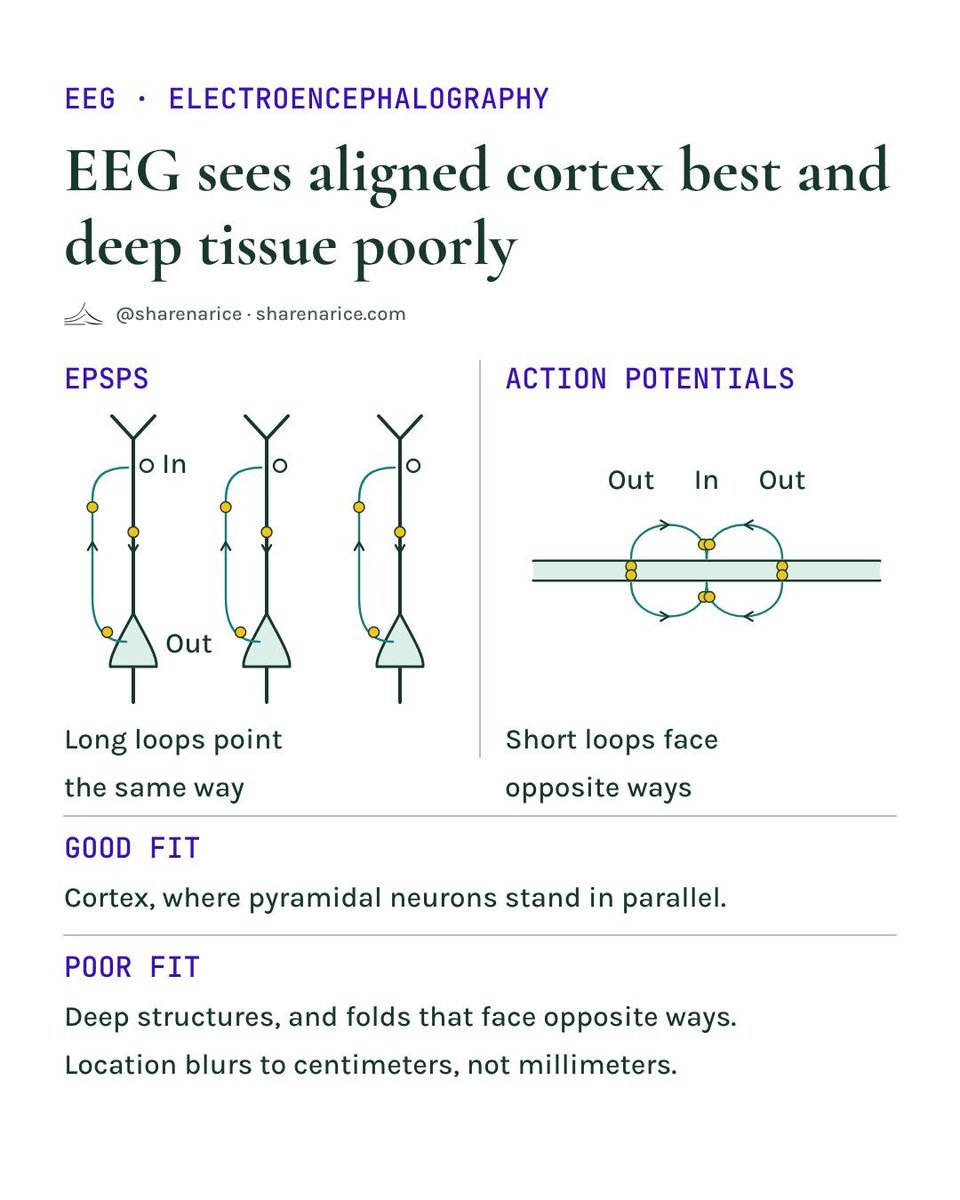
EEG picks up some small electrical events in neurons, yet mostly misses the largest.
Why is this true?
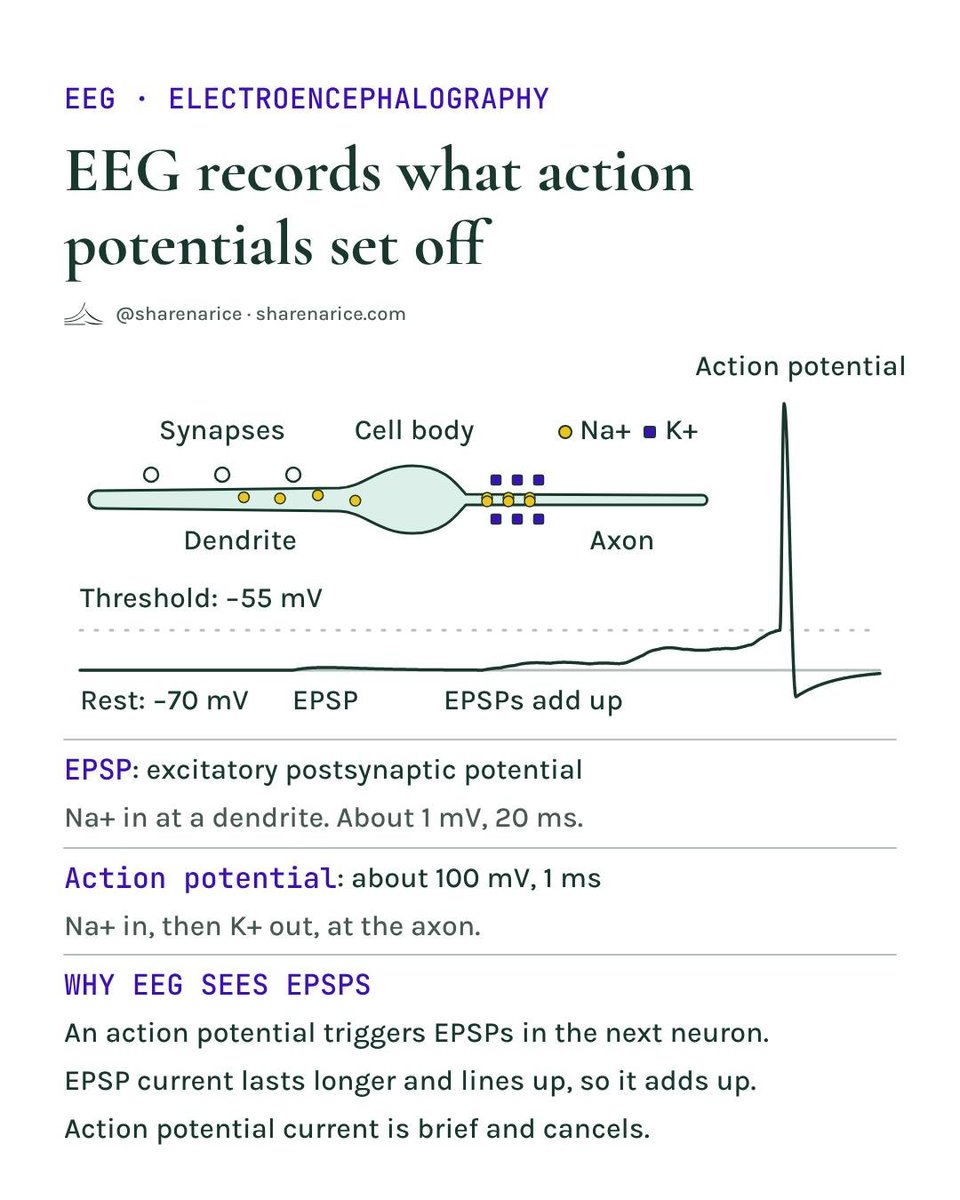
An action potential is the largest electrical event a single neuron can produce.
It swings a neuron’s voltage by about 100 millivolts
in roughly a millisecond.
A single excitatory postsynaptic potential (EPSP, the small step a neuron receives from one synapse) moves the neuron’s voltage by about 1 millivolt,
often less,
over about 20 milliseconds.
The two are linked, because an action potential in one neuron triggers EPSPs in the next.
Yet a scalp recording is built mostly from those synaptic currents,
with EPSPs as the textbook case.
Two things make the difference.
1. The currents themselves differ:
sodium in, then potassium out, along the axon for an action potential,
positive ions in at a dendrite for an EPSP.
The timings of action potentials vs EPSPs differ.
EPSPs last about 20 times longer than action potentials, so they overlap and sum,
and in parallel pyramidal neurons
they run the full length from dendrite to cell body.
Thus, EPSP fields line up!
2. Action potential currents run short loops that oppose each other
and cancel before they reach the scalp.
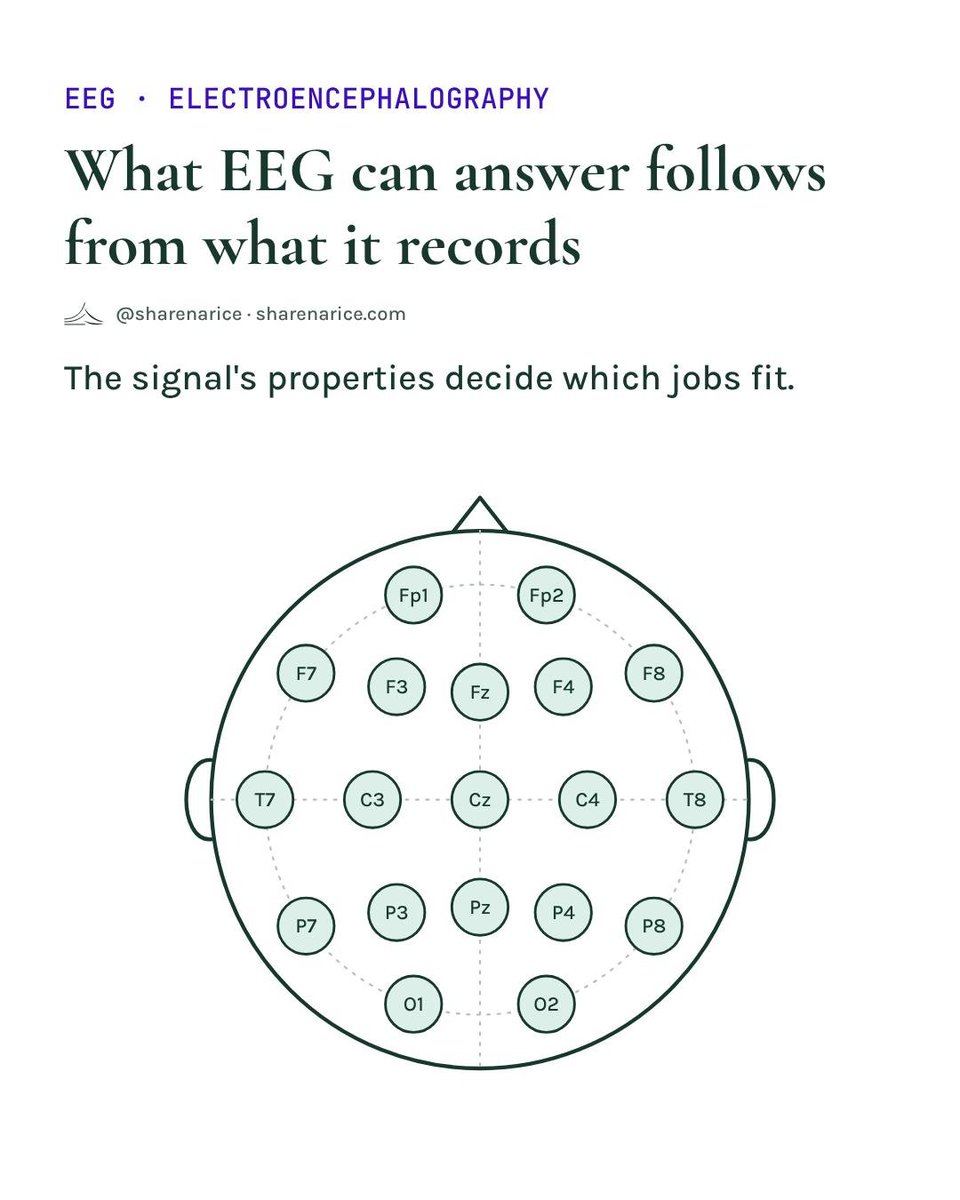
Whether we are talking about EPSPs or action potentials, either current needs a large patch of cortex acting in sync to be picked up by an electrode on the outside of the head.
That is why alpha,
about 10 hertz
and strongest when a person’s eyes are closed,
shows up so clearly:
it is what synchronous synaptic input looks like from the outside.
I made six images
to show what EEG is a good and a poor fit for,
with the voltages drawn to their true proportions.
EPSPs are small in the neuron,
yet dominant at the scalp!
What if the brain's electrical connections are much smarter than we thought? Electrical synapses are specialized connections that allow brain cells to communicate directly through tiny channels called gap junctions. Unlike chemical synapses, which rely on neurotransmitters to carry messages between neurons, electrical synapses permit rapid communication through the direct flow of electrical current. Alberto Pereda and Adam Miller describe in a new review in Nature Reviews Neuroscience why we may need to rethink what an electrical synapse actually is, and how it works.
Key points:
- Electrical synapses are not simply passive channels connecting neurons. They are dynamic structures capable of changing the strength of communication between brain cells.
- Gap junctions are supported by a complex network of proteins, including connexins, scaffolding proteins and regulatory molecules that control how electrical signals are transmitted.
- Neurotransmitters such as dopamine, synaptic activity and molecular processes can modify electrical coupling, suggesting that electrical synapses may play a much more sophisticated role in brain plasticity and network function than previously appreciated.
My take: This review resonates w/ me because it challenges a fundamental assumption about how the brain communicates. For decades, we have frequently thought about electrical synapses as relatively simple connections and chemical synapses as the more adaptable and sophisticated partners. That distinction may be misleading. Electrical synapses can change, adapt and interact w/ chemical signaling systems. As someone who spends much of my time thinking about Parkinson's disease, dopamine and deep brain stimulation (DBS), I find this particularly fascinating. We frequently focus on which brain circuits are firing abnormally and how stimulation can alter their activity. However, could we also be missing an important part of the story by not paying enough attention to how neurons are electrically connected and how those connections change? This is a basic neuroscience review, not evidence that manipulating electrical synapses will improve DBS outcomes, however it opens important questions for future research.
Here are 5 points that resonated w/ me:
1- Electrical synapses are not fixed electrical wires. Their strength can change depending on brain activity and the molecular environment.
2- Dopamine may influence more than chemical signaling. It can also regulate electrical communication between neurons, a fascinating concept when thinking about Parkinson's disease.
3- The proteins surrounding gap junctions may be just as important as the channels themselves. The machinery supporting a connection can influence how that connection functions.
4- Electrical and chemical synapses do not operate in isolation. Their interactions may help explain how brain circuits adapt, synchronize and process information.
5- Could understanding electrical synapse plasticity eventually help us develop smarter neuromodulation approaches, including more personalized DBS? We do not yet know, however this is an exciting direction worth exploring.
https://t.co/MQL4BJBeuv
New Research: Correction: Automated ROI detection allows rapid quantification of synaptic activity across tens of thousands of synapses in cell culture https://t.co/R2aN9HWyIU #FrontiersIn#SynapticNeuroscience
Dendrites aren’t uniform cables. A new study identifies nanoscale dendritic shaft constrictions in mouse and human neurons that increase axial resistance, creating electrical compartments that enhance local depolarization and NMDA receptor recruitment. https://t.co/lokPDvaO72
An emerging body of work shows that glial cells act as leading architects of the neural extracellular matrix, which serves as a critical signaling hub for nerve synapses and neuronal circuits, according to a new Focus in @SciSignal. https://t.co/jY3vIDmEP0
A series of high-energy particle collision experiments tests a decades-old hypothesis about the proton’s baryon number—a conserved quantum property that distinguishes matter from antimatter.
The findings in Science offer support for the idea that baryons are likely carried by a Y-shaped gluonic structure known as a baryon junction, and offer insights into the origin of the proton’s identity and how matter is organized throughout the Universe.
📄: https://t.co/OiRBcx9UjX
#SciencePerspective: https://t.co/mKYTS0auFp
Electric fields generated by neural activity aren't just a side effect. They actively expand the dimensionality of population activity and improve decoding.
Ephaptic coupling improves the neural population code
https://t.co/exo15AgwuK
#neuroscience
An artificial neural network built into a computer memory chip reconstructs the human cortex with high accuracy in real time.
Learn more in a new #SciencePerspective: https://t.co/zE4TiBEHc7
Can superconductivity and magnetism coexist? New research from @theNAEng member Pradeep Sharma and colleagues offers a framework that explains this seemingly paradoxical behavior and other unconventional properties of quantum materials. In @PNASNexus: https://t.co/EXCRNrP4fy
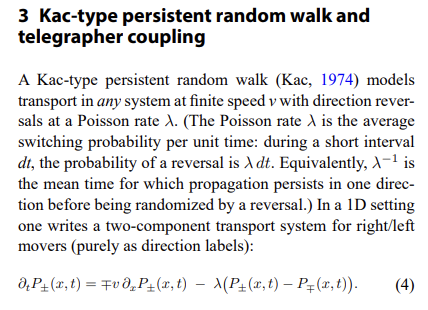
@dimitrispp I found it particularly interesting to see how the proposed framework approaches the connection between classical stochastic neural dynamics and quantum-like descriptions, and how this connection could be explored experimentally through neural signal propagation.