Agree 💯 Tyler. There are those in various Ai camps including Pope Leo calling for a pluralistic common ground that allows us to all to pursue human flourishing and the common good. This positive vision can build on philosophy, broader shared humanities, and sciences as epistemological bridges between secular and religious anthropologies.
The encyclical is being framed as anti-AI. It's not. It's revealing that a small group of people are using a powerful technology to shape our attention for their business models, reform our values, displace our relationships, and concentrate power and wealth into their hands.
It asks the rest of us whether we'll passively accept their narrative or write a new story where we get to build and use technologies that benefit all of us, not just a powerful few.
As evidenced by the unbridled promotion and implementation of technology at the expense of human dignity, we are truly experiencing an eclipse of the sense of what it means to be human. It is imperative to recover an understanding of the true meaning and grandeur of humanity as intended by God. It is in this sense that the challenge we currently face is not technological, but anthropological, and it is my hope that the Encyclical Letter to be published within a few days will contribute to answering this challenge.
@tristanharris recommends an Intelligence Dividend per @luke_drago_@LRudL_. I put forward econ & political justifications for this type of approach in this 2021 @AmericanAffrs essay written pre-GenAi boom but even more relevant. @deanwball@JuliusKrein https://t.co/FG6jg0Ra6z
📁 Tristan Harris, co-founder of the Center for Humane Technology, says the AI race is no longer about augmenting human work but replacing it at planetary scale.
Once GDP depends more on data centers than people, governments stop investing in humans because humans no longer drive growth.
That is how an intelligence economy quietly becomes anti-human without anyone explicitly choosing it.
NEW: The House counterpart to Sens. Hawley & Blumenthal's GUARD Act has been introduced by @ValerieFoushee and @RepBlakeMoore following the Senate version’s unanimous passage in committee today. The bill would hold Big Tech liable for AI chatbots that exploit minors.
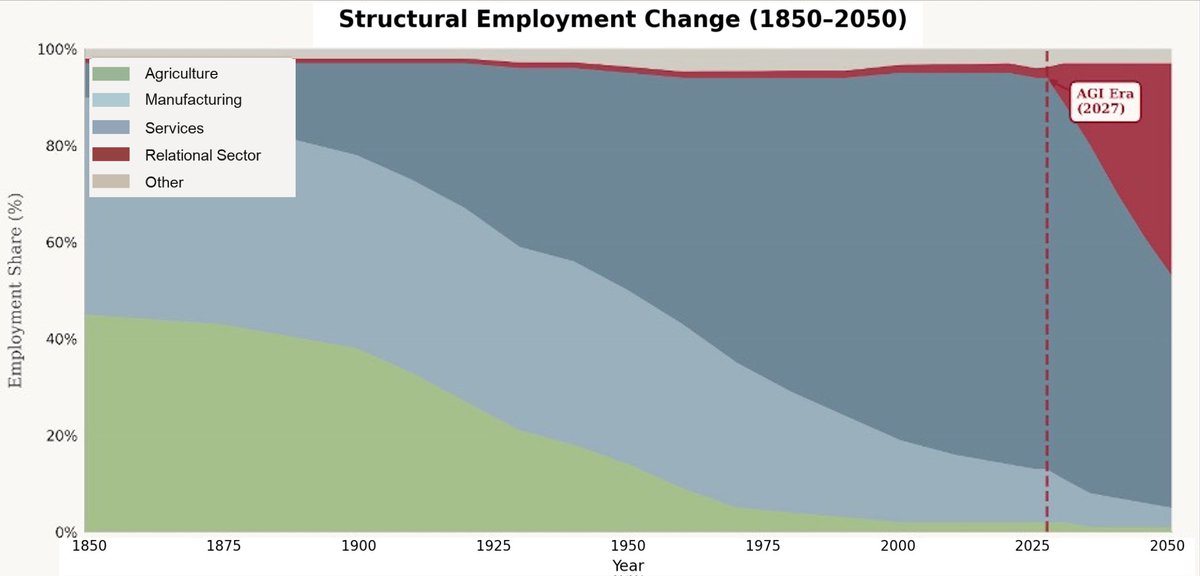
New essay on the economics of structural change and the post-commodity future of work.
1. Almost any question about the impact of advanced AI on the economy needs to start at the same place: what is still scarce? Answer that, and the analysis becomes pretty straightforward. This essay explores what becomes scarce if AI really can replicate most of what humans do in production, and what this mean for the future of jobs.
2. My conjecture, working through the economics: labor reallocates across sectors, and the sector it reallocates to has properties that keep labor a meaningful share of the economy. Ultimately this is about the structure of demand itself. For this, we have to go back to Girard, Augustine and Rousseau: once people's base needs are met, their preferences shift to comparative motives (e.g., status, exclusivity, social desirability). This motive is inherently non-satiated.
4. The key paper is Comin, Lashkari, and Mestieri (Econometrica 2021). As people get richer, they don't buy proportionally more of everything. They shift spending toward sectors with higher income elasticity. They estimate income effects account for 75%+ of observed structural change.
5. The ironic consequence: the sector that gets automated becomes a smaller share of the economy, not a larger one. Agriculture got massively more productive and its share of employment collapsed. Manufacturing too. The "stagnant" sectors absorb the spending and the jobs.
6. So the question is: which sectors have high income elasticity in a post-AGI world? I argue it's what I call the relational sector. Categories where the human isn't just an input into production, it is part of the value.
7. Why does the relational sector have high income elasticity? Because human desire has a mimetic, relational dimension. We don't just want things for their intrinsic properties. We want what others want, and we want it more when others can't have it. Girard, Rousseau, Augustine, and Hobbes all saw this.
8. In work with Kristóf Madarász, we showed this experimentally: WTP roughly doubles when a random subset of others is excluded from the good. And in new work with Graelin Mandel, AI involvement kills the premium. Human-made art gains 44% from exclusivity; AI-made art only 21%.
9. This all comes together for the core argument. The sector that absorbs spending as AI makes commodity production cheap is one where human provenance is part of the value, and demand for it grows faster than income. Exactly the profile that keeps labor meaningful.
10. To be clear about the claim: I'm NOT saying aggregate labor share must rise. It may fall. The claim is about sectoral composition, i.e., where expenditure and employment go once commodities get cheap, and the fact that the sector that will absorb reallocated labor maps to a substantial component of human preferences and desire.
11. If you're interested in the formal model, a linked companion technical note works out all the economics.
Read the essay here: https://t.co/NcjVgn2o8g
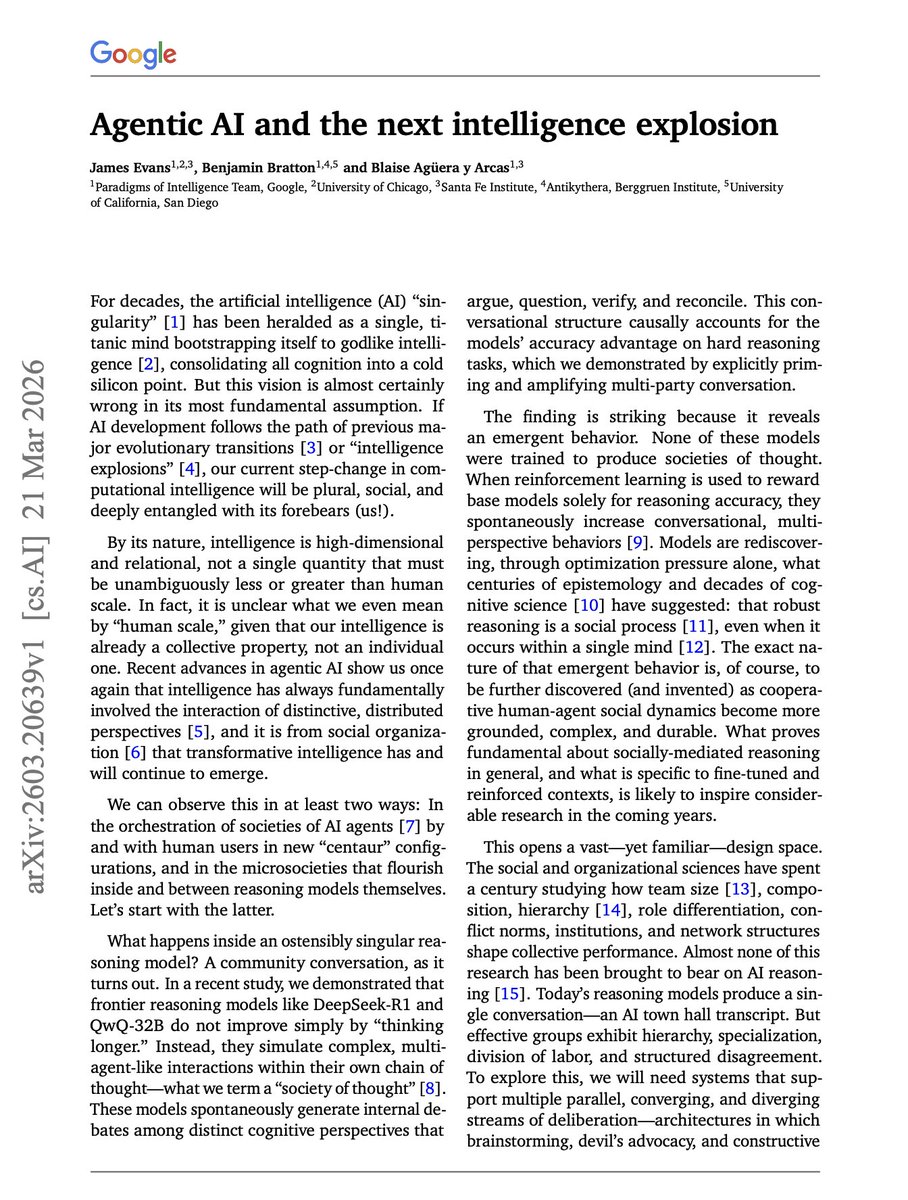
NEW AI report from Google.
Every prior intelligence explosion in human history was social, not individual.
These authors make the case that the AI "singularity" framed as a single superintelligent mind bootstrapping to godlike intelligence is fundamentally wrong.
This is directly relevant to anyone designing multi-agent systems.
They observe that frontier reasoning models like DeepSeek-R1 spontaneously develop internal "societies of thought," multi-agent debates among cognitive perspectives, through RL alone.
The path forward is human-AI configurations and agent institutions, not bigger monolithic oracles.
This reframes AI scaling strategy from "build bigger models" to "compose richer social systems."
It argues governance of AI agents should follow institutional design principles, checks and balances, role protocols, rather than individual alignment.
Paper: https://t.co/bfwrnbkY2y
Learn to build effective AI agents in our academy: https://t.co/1e8RZKs4uX
Check out this new interview of @deanwball Senior Fellow at the @JoinFAI from the Cambridge Gen AI and Youth Policy Workshop hosted by @noesiscollab & @LeverhulmeCFI. Dean's been a key thinker and strategist behind the US AI Action Plan. https://t.co/4VFmns4DuK
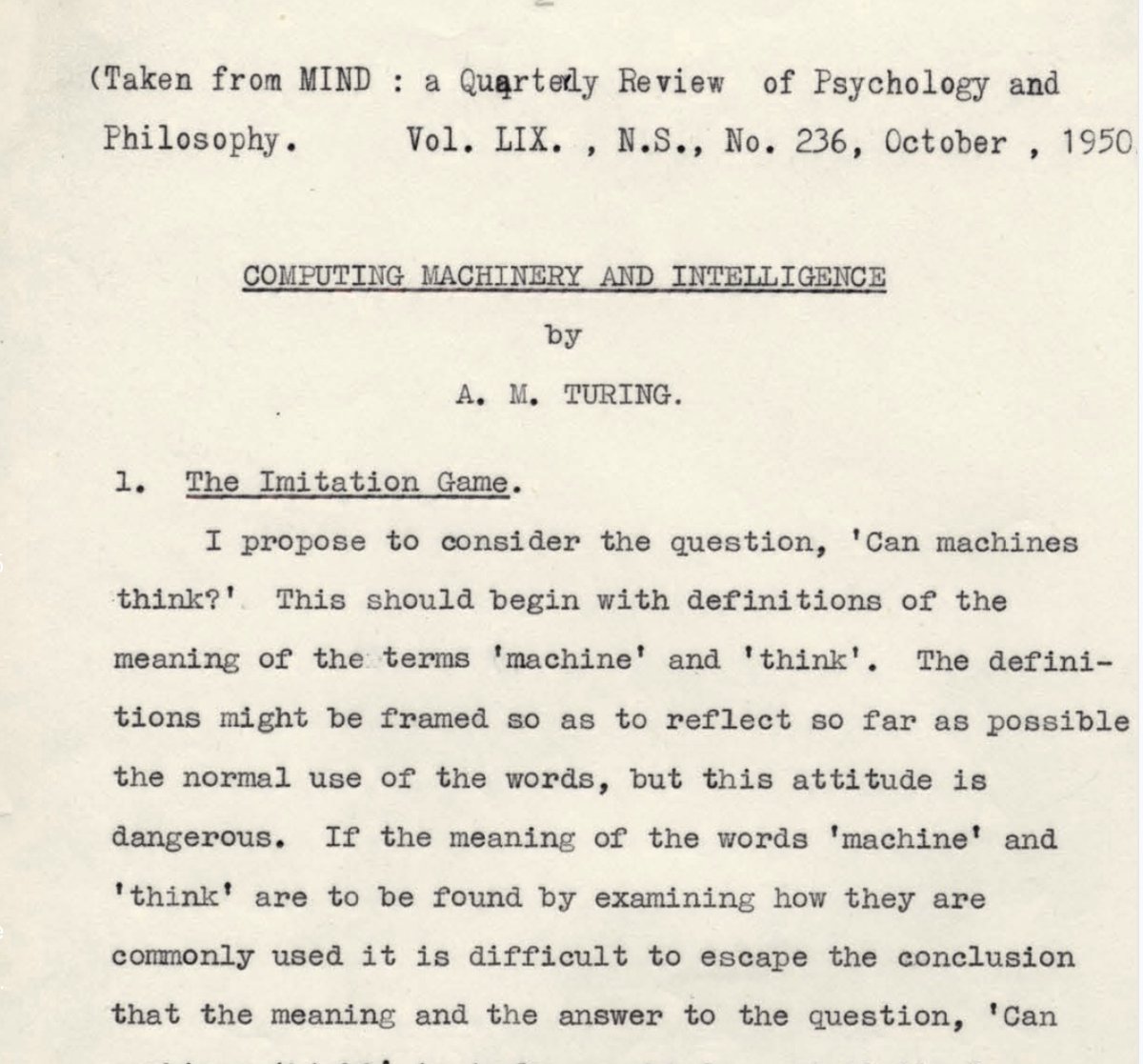
75 years ago, Alan Turing published the article, Computing Machinery and Intelligence, introducing the test that shaped how we think about machine intelligence. In 2025, AI chatbots now exhibit conversational behaviors that some argue meet the spirit of the Turing Test.
At the heart of our workshop was one urgent question for policymakers:
How might we design public policies for AI chatbots that advance youth wellbeing?
Will AI strengthen human agency, wisdom, and relationships? Or will it quietly erode them?
That question led us to start Noēsis Collaborative.
We’re working on it with builders, leaders, and policymakers.
https://t.co/SW5I9LgzeT
Two conversations this weekend make me think that there's a vibe shift afoot in Silicon Valley around what one should work on and what is worthwhile.
Culturally, it feels like the moment is ripe for new frameworks:
• Davos expert morality is stale and discredited.
• It's also apparent that the "just be super based" Counter-Enlightenment is not really an answer. (Yes, woke went too far, but simply inverting it doesn't work.)
• EA is no longer the automatic default for smart people.
• There's increasing skepticism of slot and slop machine dynamics.
Overall, "what is worthy and valuable?" feels like it's becoming more central.
If you identify and mitigate negative externalities of a new technology super early, you might be able to fend off future imprecise regulation or public backlash. You might even accelerate that very technology’s progress.
@deanwball Living in France, your prognosis seems right...yet our (US) stagnation is of the opposite kind...our tax, labor and financial policy dials send all of the blood to the brains & none to the heart of our economy. Hoarding is a drag on productivity growth: https://t.co/FG6jg0RHW7