Introducing Claude Managed Agents: everything you need to build and deploy agents at scale.
It pairs an agent harness tuned for performance with production infrastructure, so you can go from prototype to launch in days.
Now in public beta on the Claude Platform.
Google's Stitch just introduced the Ideate Agent, a creative AI assistant designed for the start of a project.
It gathers web context, analyzes design styles from other sites, and explores multiple directions all in parallel.
@blakeaburge for me it was lifting weights 3 times a week, no matter what. Traveling, overworked, social commitments, fractured toe, sick - mood or motivation was never the criteria. And now when i stand in front of the mirror i want to continue being the person that i see
this. For me, it was lifting weights 3 times a week - no matter what. Traveling, overworked, fractured toe, sick - mood or motivation were never the criteria. It changed me, and when I look in the mirror, I want to continue being the person I have become.
Underrated life hack: Build a “no matter what” habit. One thing you do every day regardless of mood, chaos, or excuses. Ten minutes of writing. A short walk. A chapter read. These become your anchors. The habit isn’t the point; who you become by keeping it is.
Useful rule of thumb for solving problems: Assume the problem is a side problem. The main problem is how you're viewing the problem. If you solve the main problem, the solution for the side problem often reveals itself.
Today we're launching Tasklet — an AI agent for automating your business.
Unlike ChatGPT, @TaskletAI actually does the work for you: connecting to your tools, triggering automatically, and handling tasks while you sleep.
To do this:
-Instead of creating specialist silos, we hire versatile generalists who can solve problems across domains.
-Traditional companies separate "thinkers" from "doers." Rather than hiring pure managers, we find player-coaches who both lead and execute.
Why this matters
The premium on just being someone that stays insanely current on what’s going on in AI is so high right now. The space is changing so fast that you will stand out by being more AI-native and caught up than everyone else. Huge opportunity for the next generation workforce.
Products with extensive/rich UIs lots of sliders, switches, menus, with no scripting support, and built on opaque, custom, binary formats are ngmi in the era of heavy human+AI collaboration.
If an LLM can't read the underlying representations and manipulate them and all of the related settings via scripting, then it also can't co-pilot your product with existing professionals and it doesn't allow vibe coding for the 100X more aspiring prosumers.
Example high risk (binary objects/artifacts, no text DSL): every Adobe product, DAWs, CAD/3D
Example medium-high risk (already partially text scriptable): Blender, Unity
Example medium-low risk (mostly but not entirely text already, some automation/plugins ecosystem): Excel
Example low risk (already just all text, lucky!): IDEs like VS Code, Figma, Jupyter, Obsidian, ...
AIs will get better and better at human UIUX (Operator and friends), but I suspect the products that attempt to exclusively wait for this future without trying to meet the technology halfway where it is today are not going to have a good time.
The best guide on using AI coding at work just dropped.
It comes from Anthropic's internal use of Claude Code and their best practices (for both technical and nontechnical teams). Worth saving for later.
Everyone wants to use AI to code at work. Few talk about how best to do it.
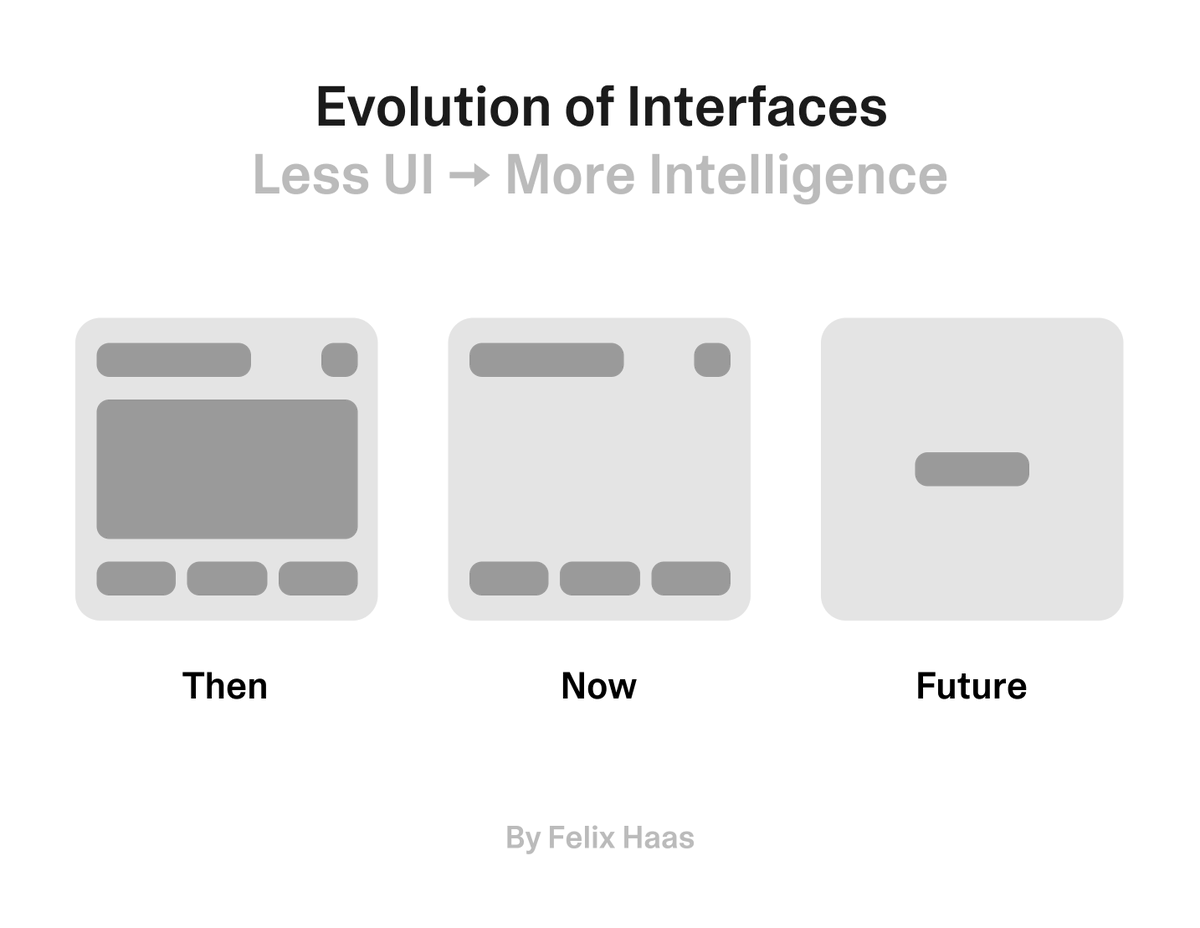
𝗣𝗿𝗲𝗱𝗶𝗰𝘁𝗶𝗼𝗻: 𝗜𝗻𝘁𝗲𝗿𝗳𝗮𝗰𝗲𝘀 𝘄𝗶𝗹𝗹 𝗳𝘂𝗻𝗱𝗮𝗺𝗲𝗻𝘁𝗮𝗹𝗹𝘆 𝘀𝗵𝗿𝗶𝗻𝗸
I see a lot of founders still building apps the same way they did before we had AI.
But if they don’t adapt, they will miss out.
Here’s why:
The way we interact with computers is fundamentally changing.
Historically, interfaces helped us communicate with computers because they couldn’t understand us. So we needed buttons, screens, and structured flows to tell them what to do and what we wanted.
But in the age of AI, that’s no longer relevant. We need to fundamentally rethink human-computer interaction.
AI is getting incredibly good at understanding intent. It can predict what we want before we even say it. It’s faster than any human, and with the right context, it can behave almost exactly like you would.
This has massive implications for interfaces and how we design products.
Take food delivery apps as an example.
Ordering food today takes 10+ clicks. You scroll, filter, customize, enter details, pick a payment method. Way too much effort for such a simple task.
Now, imagine an AI-powered flow.
The AI already knows your preferences and dietary restrictions.
Payment is set.
It suggests the best meal for you, right now.
You hit one button or just say "Go" and the job’s done.
Sure, the final step still needs your approval (for now), but everything else just happens.
The UI of food delivery apps and most service-based experiences will become obsolete.
Once AI knows who you are and how you think, you won’t need a traditional interface to get things done. At least not the way we think about UI today.
We’re moving from apps with 10 screens to apps with one.
From cluttered interfaces to minimal triggers.
The smarter the system, the less UI you need.
Eventually, the best UI might be no UI at all.
And the sooner you prepare for that, the better.
Spotify is already on this path. The more I use it, the less I search. The UI is still there, but I barely need it. It’s optional.
So think about this when designing interfaces.
What are the most essential elements I truly need?
And what can I reduce to the absolute minimum?
The less, the better. That’s never been more important than it is today.
Interfaces aren’t going away.
They’re just becoming invisible.
What's your take on this?