#Stroke Neurologist @Clinicaalemana, Head of Physical Medicine and Rehabilitation Service @alemanatemuco. Deputy Director of Postgraduate & Research @medufro.
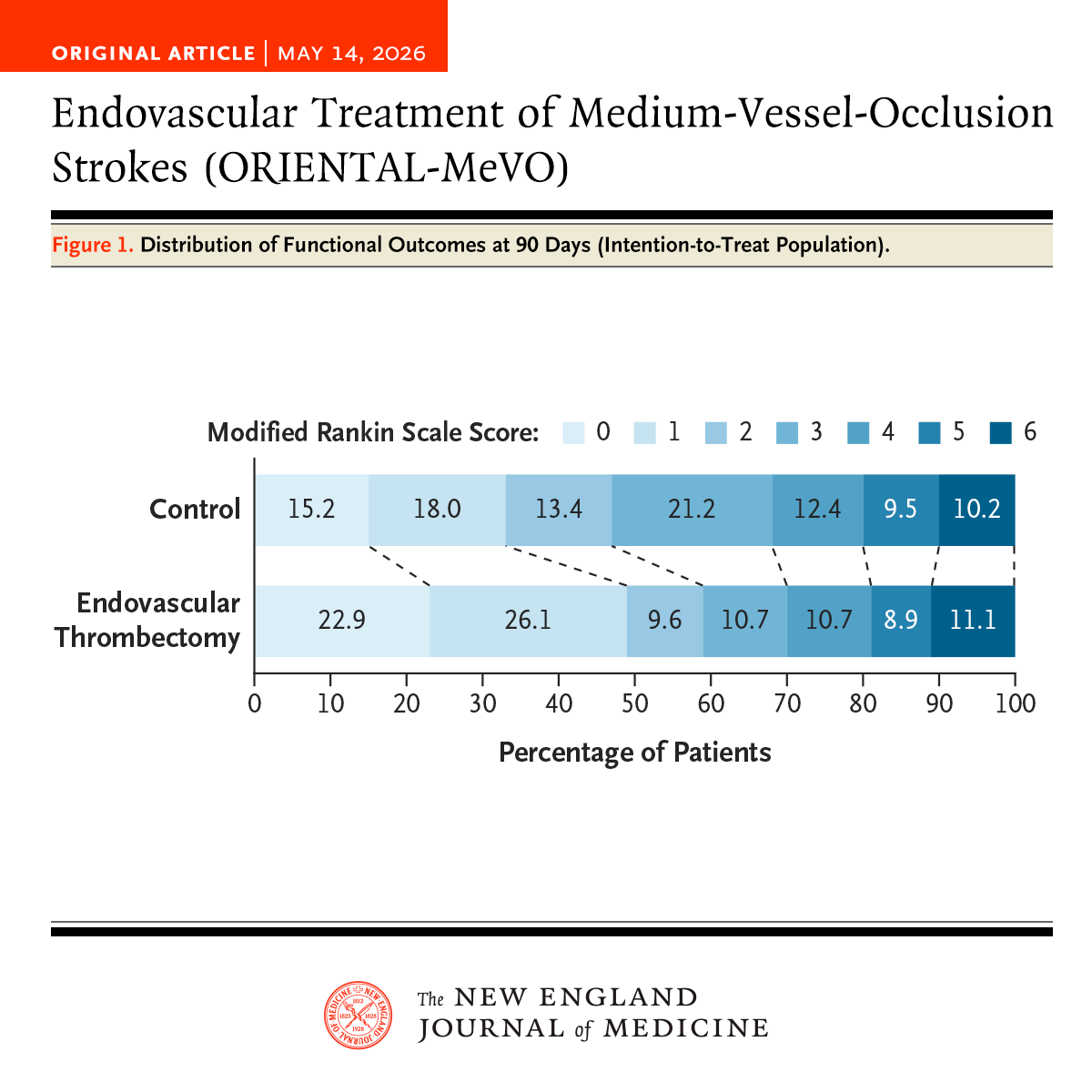
Among patients with stroke due to medium-vessel occlusion, thrombectomy led to functional independence at 90 days (in 58.6% of patients, vs. 46.6% with medical management) but also to a higher risk of intracranial hemorrhage. Full ORIENTAL-MeVO trial results: https://t.co/FvyLPQz4CV
Editorial: Endovascular Therapy for Medium-Vessel Occlusion Stroke — Narrowing the Target Population https://t.co/hnLi0DvzuF
🧠⚡ 15 DE MAYO — DÍA MUNDIAL DE LA TROMBECTOMÍA MECÁNICA
La trombectomía mecánica (TM) consolida en 2026 su posición como la intervención más coste-efectiva de la neurología cerebrovascular. Cinco aspectos clave bajo la evidencia actual:
1️⃣ EFICACIA FUNDACIONAL — HERMES: NNT 2.6
El meta-análisis HERMES (5 RCT, n=1.287) estableció OR 2.49 (IC95% 1.76–3.53) para independencia funcional (mRS 0–2) a 90 días. NNT = 2.6 para reducir un grado de discapacidad — la cifra más baja registrada en terapia de reperfusión cerebrovascular.
2️⃣ VENTANA EXTENDIDA 6–24 h — PARADIGMA “TISSUE-BASED”
DAWN y DEFUSE-3 redefinieron la selección: ya no es el reloj, es el tejido. Mismatch clínico-radiológico o core por perfusión TC/RM (<70 mL) permite tratar wake-up strokes y ventanas tardías con beneficio sostenido.
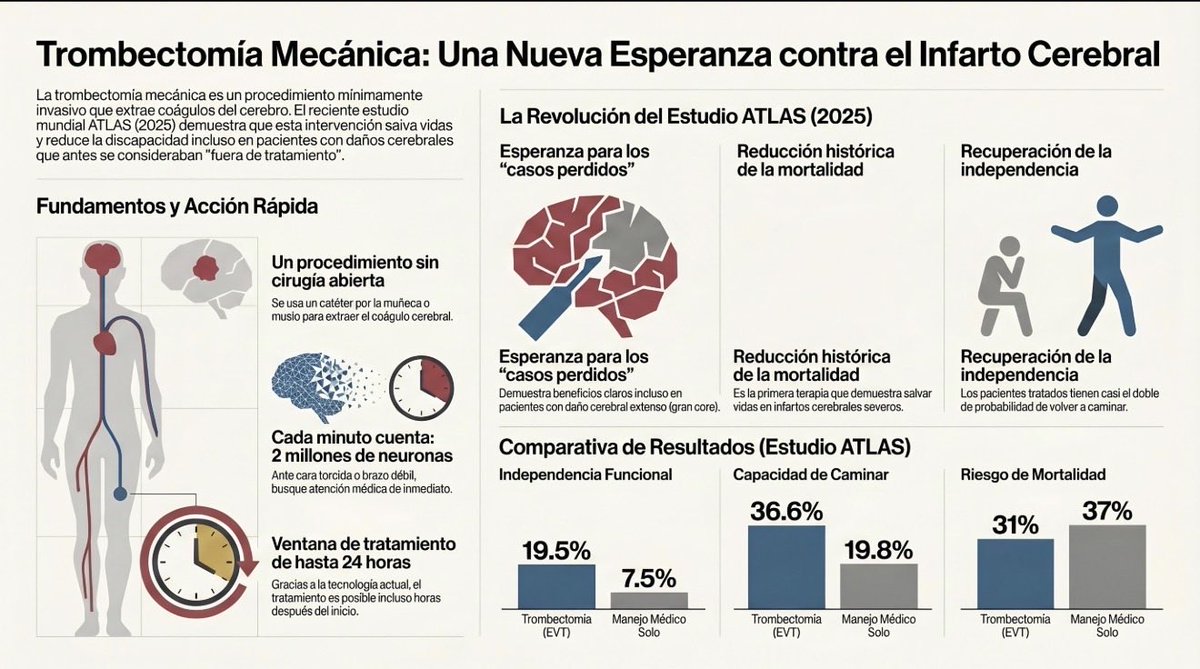
3️⃣ ATLAS — LA REVOLUCIÓN DEL GRAN CORE (n=1.886) 🔥
El meta-análisis ATLAS de los 6 RCT (RESCUE-Japan LIMIT, ANGEL-ASPECT, SELECT2, TENSION, TESLA, LASTE) demuestra de forma definitiva el beneficio en infartos de gran core:
• aGenOR 1.63 (IC95% 1.42–1.88), p<0.0001
• mRS 0–2: 19.5% vs 7.5% (EVT vs manejo médico)
• Independencia ambulatoria (mRS 0–3): 36.6% vs 19.8%
• Mortalidad reducida: 31% vs 37% — primera terapia de reperfusión que SALVA VIDAS en gran core
• Beneficio incluso con ASPECTS 0–2 (ventana temprana) y core de hasta 150 mL
• NNT 4.2 para mejorar ≥1 punto mRS; NNT 5.7 para deambulación independiente; NNT 14.6 para mortalidad
4️⃣ OCLUSIÓN BASILAR — CLASE I (AHA/ASA 2026)
ATTENTION y BAOCHE consolidaron la TM en oclusión basilar (NIHSS ≥10, ≤24 h) como Clase I, con reducción significativa de mortalidad y dependencia severa.
5️⃣ FIRST-PASS, TIEMPO Y TENECTEPLASA
Cada minuto = ~1.9 millones de neuronas. First-pass effect (mTICI 2c–3 al primer pase) y door-to-puncture <60 min son predictores independientes de mRS 0–2. La Guía AHA/ASA 2026 posiciona la tenecteplasa 0.25 mg/kg como trombolítico de primera línea pre-TM.
❓ ¿Sabías que… gracias al meta-análisis ATLAS, la trombectomía mecánica es hoy la primera y única terapia de reperfusión cerebral que ha demostrado REDUCIR MORTALIDAD en pacientes con gran core isquémico — incluso con ASPECTS 0–2 y volúmenes de hasta 150 mL — derribando definitivamente el dogma de que “el daño establecido no se trata”?
—
Dr. Manuel Moquillaza | Neurólogo Intervencionista | Coordinador de Neurología y NeuroIntervencionismo / Clínica Ricardo Palma | Primer y Único Centro Avanzado de ICTUS del Perú
#TrombectomíaMecánica #ATLASMeta #LargeCoreStroke #NeurointervencionismoPerú #WorldThrombectomyDay
💊Early DOAC initiation is safe and non-inferior to delayed treatment regardless of infarct volume
❌⏱️No evidence that anticoagulation initiation should be delayed beyond 4 days on the basis of infarct size
Read the paper here!👇
https://t.co/3P82y5V7hu @UCLStrokeRes
📊After ICH, recurrent ICH & ischaemic stroke occur at similar rates:
🩸Recurrent ICH: 2.1/100 person-yrs
🧠Ischaemic stroke: 2.0/100 person-yrs
👉Limited evidence remains for other major adverse cardiovascular & cerebrovascular events
Read more👇
https://t.co/XvfvI0XNwq
🧠In patients with large hemispheric infarction after EVT, decompressive craniectomy was associated with ⬇️reduced mortality
Read more here👇
https://t.co/F4xPckEkXr
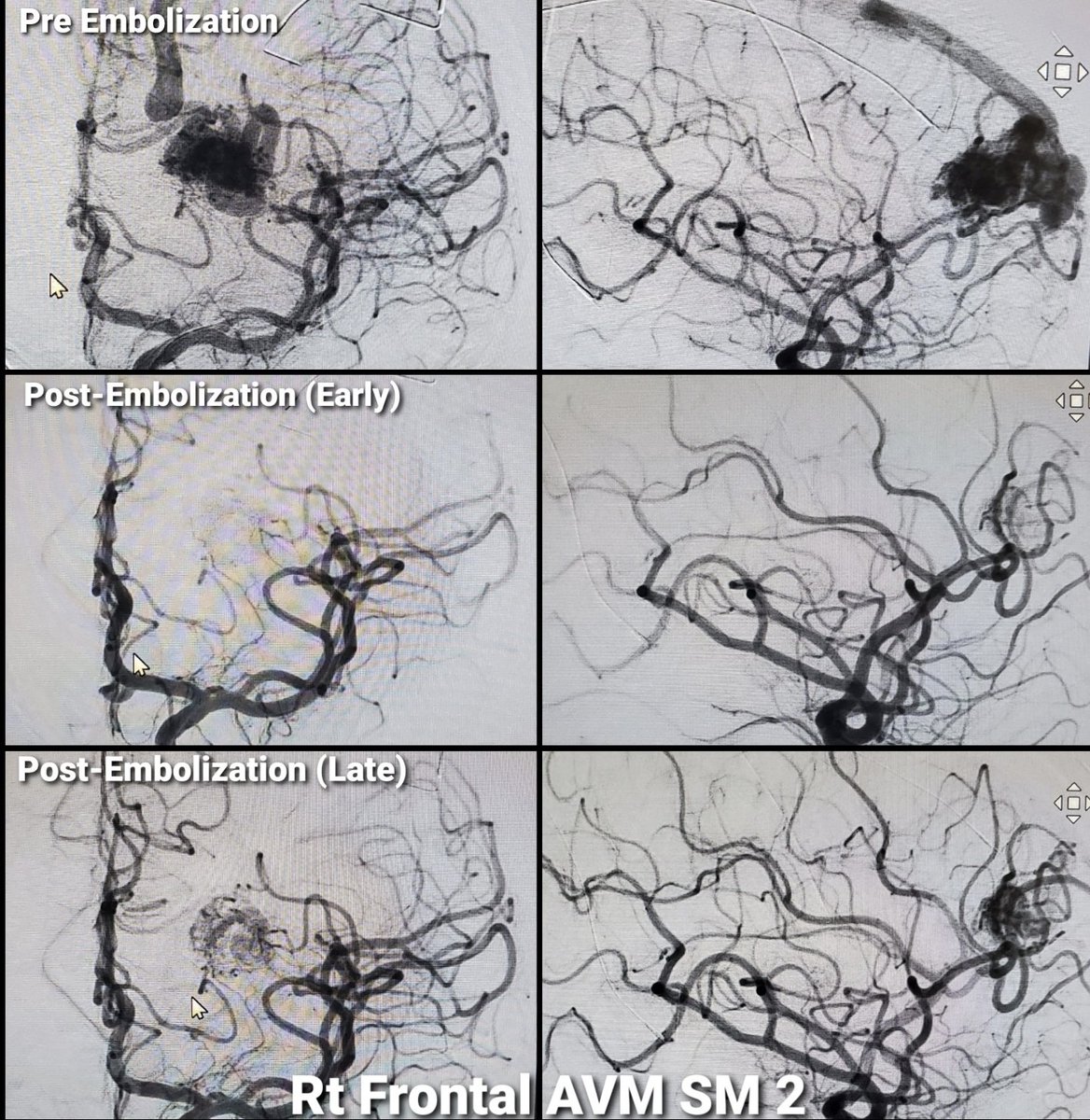
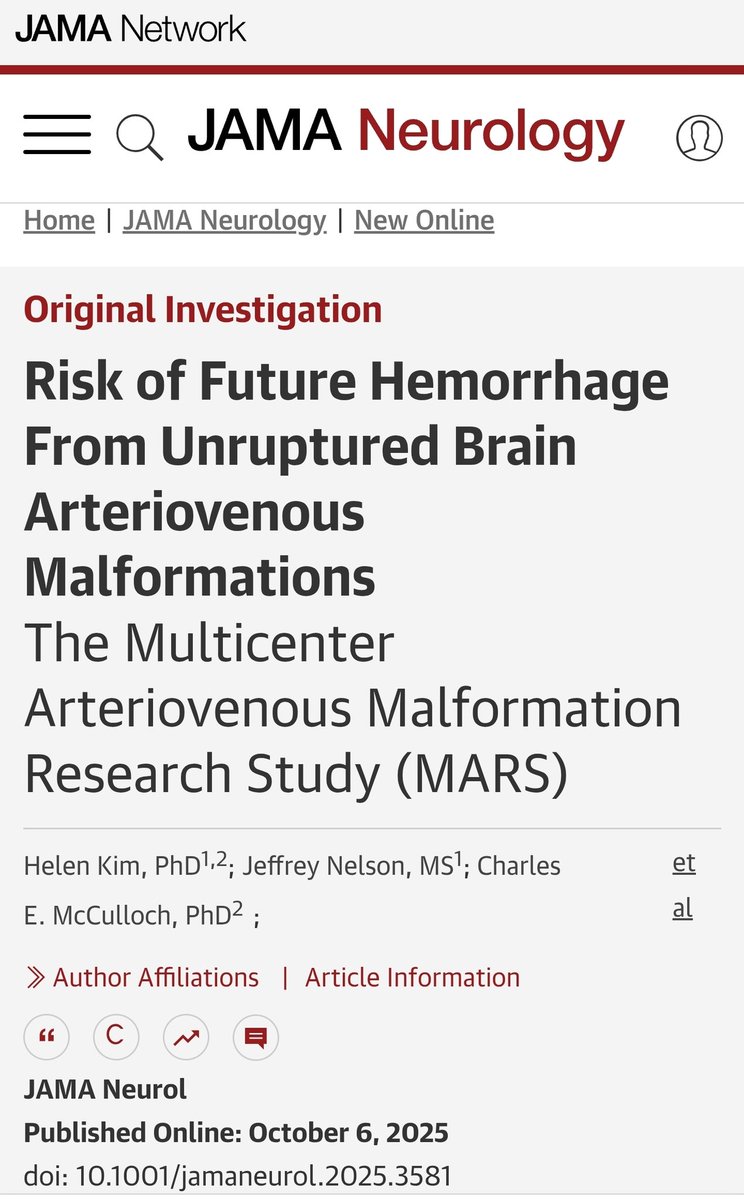
What do you quote as the incidence of #AVM rupture to your patients?
Old school: “105 – age” rule of thumb → lifetime risk
Practice: 2–4%/yr
MARS study (@JAMANeuro, Oct 2025):
3,030 pts → 159 bleeds / 11,339 person-years
= ~1.4%/yr (95% CI 1.2–1.6)
Risk ↑ with:
Older age
Associated aneurysms
Deep supratentorial /cerebellar AVM
About 1–2/100 patients bleed each year = More precise data for counseling.
Full article: https://t.co/BIXZRZR2r0
Thoughts: @PascalJabbourMD@elghanemmoh@AmeerEHassan@_AdnanSiddiqui@TareqKass@AlAlBayati1
🧬💊Prasugrel may be an effective alternativeStudy finds Clopidogrel is less effective in patients with CYP2C19 Loss of Function genotype and:
🫀Cardiovascular disease
🧠Minor stroke or TIA
💊Prasugrel may be an effective alternative
Read more here!👇
https://t.co/huo2LFcVA1
How to treat orthostatic hypotension in Parkinson and Parkinsonism? Dizziness on standing? Melissa Armstrong nails it in one slide during her plenary lecture this morning at MDS Hawaii. @movedisorder @FixelInstitute
#STROKE: In a secondary analysis of the INSPIRES clinical trial, dual antiplatelet therapy was superior to aspirin alone with respect to the prevention of new stroke within 90 days among CYP2C19 loss-of-function noncarriers. #AHAJournals https://t.co/cy6bK1uwwm
Acute confusional migraine: Proposal for inclusion in the International Classification of Headache Disorders – 4th edition (ICHD-4)
https://t.co/sARpi16WxM
#migraine#headache#brain#pain#neurology#neuroscience
New in Cephalalgia!
The opening of KATP channels activates meningeal nociceptors underlying migraine pain. These findings reveal a mechanism for migraine induction and highlight KATP channels as promising therapeutic targets.
https://t.co/6JuyYQN5Ky
#migraine#headache#brain #pain #neurology #neuroscience
Could the Parkinson’s drug levodopa prime the brain to respond better to intensive rehabilitation following a stroke or injury? Enter the idea: Let’s give dopamine pills after a stroke? Spoiler alert: This new large, randomized trial published in JAMA revealed no added benefit in recovery. The authors were hoping for neuroplasticity. Neuroplasticity means the brain’s ability to rewire itself and to form new connections. Engelter and colleagues describe the results of the ESTREL randomized clinical trial which tested whether adding levodopa to rehabilitation would improve recovery after stroke.
Key Points:
- The ESTREL trial included 610 folks w/ stroke across 13 stroke centers in Switzerland.
- The folks in the trial were randomized to levodopa or placebo and of course both got standardized rehabilitation.
- At 3 months there was no significant difference in motor function recovery between the levodopa and placebo groups.
- There was only a 0.9-point adjusted mean difference on the 100-point Fugl-Meyer scale.
- Safety outcomes showed no meaningful differences between groups.
- There were similar rates of serious adverse events and of mortality (death).
My take: The idea of using levodopa to boost dopaminergic signaling in the brainand to enhance motor recovery is not new. It is cool these authors had the courage to put it to a test. Though it didn’t work, how might it have worked? We don’t know, but we should think about motor learning, neuroplasticity, synaptic plasticity and how reward, as well as motivation, may play a role. Here are 5 points that resonated w/ me. 1- Stroke recovery depends heavily on task-oriented intensive rehabilitation. 2- Adding levodopa to standard therapy did not boost recovery outcomes in this large and carefully run study. 3- Folks receiving levodopa had similar safety profiles compared w/ placebo. 4- Prior smaller studies hinted at possible benefits, however this large trial shows no ‘routine role’ for levodopa in stroke rehab. 5- The search for effective drugs to enhance brain repair after stroke continues. Could we use levodopa for other symptoms and syndromes beyond movement disorders?
https://t.co/zzf8Wz2hrR @ParkinsonDotOrg@FixelInstitute@SfNtweets@HeartandStroke
Hay 18 factores que podrían ayudar a prevenir el 65 % de las demencias. Los 4 nuevos factores incorporados a la lista incluyen la pobreza, los choques de riqueza, desigualdad de ingresos y el VIH. Los aspectos socioeconómicos adquieren gran importancia.
https://t.co/vfqvdUwFKi
22-28 September marks Migraine Awareness Week 2025.
Migraine is far more than “just a headache.” This year, let’s work together to change that perception.
💡 Migraine means disruption
💡 Migraine means missing out
💡 Migraine means feeling let down
Join us in spreading the word and reshaping how migraine is understood. Together, we can raise awareness and support the millions worldwide living with migraine.
The video brought to you by the IHS Communication Committee and the IHS Education Committee.
#MigraineAwarenessWeek #Migraine #IHS
Air pollution and Lewy body dementia: A wake-up call. A new study published in Science revealed that fine particle pollution (PM2.5) does not simply worsen general dementia risk. It may directly promote Lewy body dementia (LBD).
Key Points:
- α-synuclein is a protein naturally found in the brain that helps nerve cells communicate, however when it clumps together abnormally it can damage brain cells and lead to diseases like Parkinson’s and Lewy body dementia.
- PM2.5 refers to tiny air pollution particles, about 30 times smaller than the width of a human hair, that can be breathed deep into the lungs and eventually reach the brain.
- Long-term PM2.5 exposure in 56 million US Medicare beneficiaries increased hospitalizations for Lewy body dementia more than for Parkinson’s without dementia.
- In mice, PM2.5 triggered brain atrophy, memory loss and α-synuclein pathology.
- Pollution particles reshaped α-synuclein into a new toxic strain (PM-PFF) that mimicked human LBD and seemed to be associated w/ spreading cognitive (thinking) deficits.
My take: In my opinion this paper is a blockbuster everyone should read as it it builds on a drip drip drip series of papers showing that air pollution is critically important in neurodegenerative diseases. Here are 5 points that resonated w/ me: 1- Air pollution is not only a lung and heart risk, it is also a brain risk. 2- Fine particles (PM2.5) can trigger toxic brain protein changes that are tied to Lewy body dementia. 3- Chronic exposure may raise the chance of memory problems and hospital stays. 4- Cleaner air could protect both brain health and public health. 5- Research on prevention and therapies targeting these pollution-driven protein changes will be critical for us to drive a 'movement' toward prevention.
https://t.co/Kwxxki2eLu @FixelInstitute@ParkinsonDotOrg@ScienceMagazine@movedisorder@SfNtweets@lewybodyny@LewyBodyWarrior
#FlashbackFriday!
💊Intensive blood pressure lowering for 24hrs after endovascular thrombectomy (EVT) may negatively impact outcomes, particularly in patients who received intravenous tissue plasminogen activator before EVT
Read more below👇
https://t.co/RLZ6BNeBYv @jaeseob_yun