SF vs NYC
I moved back to NYC recently after a stretch in SF.
A few things surprised me, and one of them changed how we hire.
1. SF is genuinely ahead. When it comes to anything to do with tech, there’s no competition.
My first time in the Bay was summer 2015 and everyone was talking about two things, Tesla and Bitcoin. Right now everyone there is talking about hardware and longevity. Can’t say the same for NYC.
If you’re in a season of life where being at the absolute forefront of tech is a must, then you should do everything in your power to move to SF.
But when the moment passes, SF moves on quickly.
Barely anyone I know talks about stablecoins in SF these days. So have to be prepared to ride those waves.
2. From a founder standpoint, the hiring situation is interesting.
I think NYC is the better option right now to build a team.
In SF you're bidding for engineers against Anthropic, OpenAI and Meta, all of them trading at trillion dollar valuations.
I've heard the same story from a lot of SF founders. You hire someone great, and a year later they have an offer you can't come close to matching.
Also a lot of engineers live in SF because they want to start a company. Which means they're hacking on their own thing at night and they're less committed to yours than you think.
3. NYC is different. People live in NYC because they want to live there.
There's life outside of work and the talent is also genuinely very strong.
Ramp scaled their fintech hub there on exactly this, 25 year olds who just wanted to be in NYC. We're taking a similar stance and our retention has been really good.
4. What I didn't expect: how much I like not being surrounded by tech.
In SF everyone works in tech. A lot of things that look social are de facto networking sessions with VCs, founders, or engineers who want to be founders, which after a while I found was a turnoff.
I play padel in NYC and I've made a lot of friends on the court. None of them know what I do. We’ve never once talked about work. Most of them are in finance and I couldn't tell you much more than that. That’s been an unexpected breath of fresh air.
In short, SF is the melting pot of tech. NYC is the melting pot of everything else.
For what it's worth I'd still rather live in SF. No city in the world matches the Bay for both opportunity and access to nature imo -- I do miss the hikes.
I'd just build the team in NYC.
P.S. any padel players in the city hmu!
En 1986, un ingeniero japonés obsesionado con los coches metió un Ferrari Testarossa descapotable en un videojuego. No era un juego de carreras, ya que no había rivales. Solo una carretera, una chica al lado y música a todo volumen. Se llamaba Out Run. Tira del hilo 🧵👇🏽👇🏽👇🏽
Have spent almost a week in Santiago Chile. Some observations:
-This city is very beautiful, particularly Providencia and eastward. Its clean, orderly, and safe. There's a healthy amount of greenery, including palm trees, which reminds of places Ive been in Florida or California. Streets are spacious, yet there are many meaningful places to shop and navigate.
-It appears child friendly. Admittedly I dont see too many children (Chile has a terribly low fertility rate, the lowest in South America). But when I do see parents with children there is a carefree attitude. There are plenty of places to accomodate them and nobody seems worried.
-The atmosphere is calm. There isnt as much of a "honking culture" here and people dont drive as aggressively as Colombia. People generally wait at crosswalks for the greenlight, even if there aren't cars.
-The people here are different. It's hard to describe them, visually and behaviorally. They have a disposition akin to east asians and northern europeans - friendly but tempered...respectfully mindful of the civil order. The metro is generally calm and quiet, similar to Japan - and you sense the expectation. Yet, there is still the latent warmth and some of intrinsic disorderly liveliness characteristic of Latin America.
-People generally dress well. There is a contingent of people that dress "emo" or similar to mid-2000s American teenagers. Some dress like young adults in the American 90s. Strange, but common enough to comment on. American music and brands are popular here, but Ive found that common mostly everywhere Ive travelled.
-The restaurants are excellent. Ive heard some complain about the food scene in Chile. I don't understand... I like it even as someone that spent a few months in Bogota. I do think it's funny the abundance of a restaurant chain from America called "Chilis" which I haven't seen in other parts of LATAM yet. Smart play on their part.
-There is a meaningful concentration of Orthodox churches in the city, particularly Providencia, where there are Russian, Antiochian, and Greek churches. This is very unique for Latin America where Orthodoxy is very unknown and you may typically have only 1 church in a major city (if you are lucky). The Antiochian church was packed on Sunday and the community seemed strong. Among the churches, there is at least 1 open every day which can very nice.
Overall a lovely experience. We head to Algorrobo tomorrow to see penguins and then to Conception.
Recommend following @mageeclegg to learn more about this great country, which I thankfully have from him.
Opinión al margen: Chile muchas veces se siente como un país que históricamente fue hecho por y para abogados
Tiene un sesgo demasiado fuerte a preguntas del tipo "está jurídicamente permitido?" y poco a "qué resultado queremos conseguir y cuál es la regla mínima necesaria para que funcione bien?"
Esto lo he visto muuuuchas veces: tenemos una cultura que intenta hacer el mundo seguro escribiendo mejores reglas, en vez de construir mejores sistemas. Esto, desde el punto de vista práctico (no solamente ingenieril/científico), es un despropósito para el desarrollo como país.
Demasiada confianza en expertos que escriben reglas desde arriba, demasiada aversión a experimentar, mucha protección al statu quo, poca tolerancia a la prueba y error. El resultado, en un mundo más global y tecnológicamente avanzando tan rápido, podría ser un sistema estable en apariencia pero frágil: porque evita pequeñas fallas y cambios durante años hasta que eventualmente enfrenta una falla grande, como lo que implica el desafío de la IA, o el desafío que llevamos años tratando de salir de la "trampa del ingreso medio".
🌪️ Tromba marina frente al sector Pingueral, en dirección a la playa Villarrica, comuna de Tomé, región del Biobío.
Aún no tenemos la confirmación de que la tromba marina haya pasado a tornado.
En desarrollo…
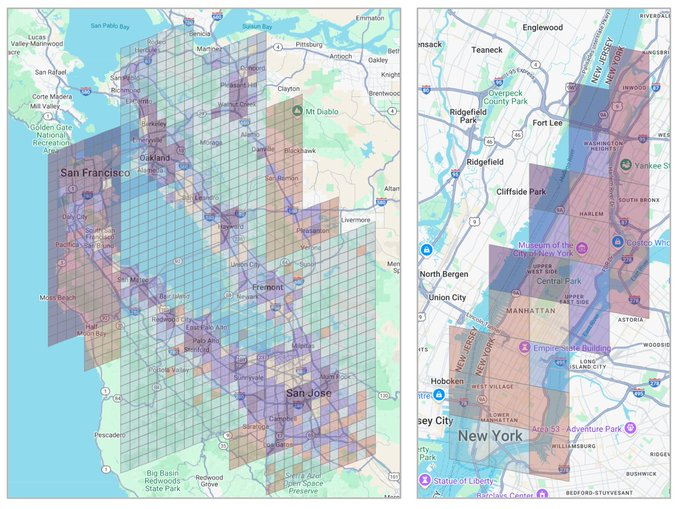
Google trained an AI to predict your neighbourhood's income by counting the coffee shops, bus stops, and high-rises on a map. Nobody told it what income was.
The model is called S2Vec, and it was published by Google Research as part of their Earth AI initiative. It takes the built environment (every building, road, park, and business in an area) and converts it into a layered image. Three coffee shops and one park in a grid cell become pixel values. The AI then reads that image the same way a computer vision model reads a photograph.
The training method is the part that matters. S2Vec uses masked autoencoding: you show the model a patch of a city with chunks missing, and it learns to fill in the gaps. Show it a cluster of high-rise apartments next to a subway station, mask out a section, and it predicts a grocery store belongs there.
Do that millions of times across the globe and the model learns the deep spatial grammar of how cities organise themselves. No human ever labels a region as "financial district" or "suburban residential." The model figures out those groupings on its own from the geometry of what's built where.
The output is an embedding, a string of numbers that acts as a mathematical fingerprint for any location on Earth. Feed those embeddings into a prediction task and S2Vec can estimate population density, median income, and carbon emissions for regions it has never seen before.
On zero-shot geographic extrapolation (predicting for regions entirely absent from training data) S2Vec was typically the best-performing individual model.
It matched or beat satellite imagery baselines like RS-MaMMUT and outperformed GEOCLIP on socioeconomic prediction. The best results came from combining S2Vec with satellite image embeddings. Built environment data alone couldn't capture vegetation, terrain, or transportation patterns well enough for environmental tasks like tree cover and elevation. But fused together, the two modalities outperformed everything else.
The standard approach to geospatial ML has been hand-crafting indicators for every new problem. Predicting air quality meant building a bespoke feature set. Estimating housing prices meant building another one. S2Vec replaces that with a single general-purpose representation that transfers across tasks.
The training data is map features, not satellite pixels.
That distinction is pretty important to understand. It means: map data updates faster, costs less to process, and covers built infrastructure at a resolution satellite imagery can't always match.
A satellite sees rooftops. S2Vec knows there are three cafes, a pharmacy, and a bus stop underneath them.
Google's broader Earth AI pipeline now has three foundation models working in parallel.
1. PDFM for population dynamics.
2. RS-MaMMUT for satellite imagery.
3. S2Vec for the built environment.
Stack them and you get a system that can read a neighbourhood the way a local understands it.
More info on it here: https://t.co/vVJlLlfhc7
Estuve con un par de founders chilenos en las oficinas de Fintual. Su compañía de IA es, sin duda, top mundial.
Me sentí como si no hubiera hecho nada aún.
Es bueno cada cierto tiempo sentirse así: sentir que falta casi todo aún por hacer y que no hay límites para crecer.
My entire life changed when I learned to recognize things that don’t matter. The world will pressure you to care about every single thing. To chase every problem. To take every slight personally. To have opinions on everything. Reject that trend. Focus on a few, ignore the rest.
Of all the amazing things @DollyParton did, this is one of my favorites: Her Imagination Library charity has given away over 300 million books to kids and families across America and around the world.
https://t.co/pDIMGtEvA4