Senior Lecturer (Assistant Prof.) @HebrewU Psych. Studying belief updating and placebo with models and brains. Trying to make science more open & reproducible.
Now out @NatureComms! https://t.co/5AHORDIlLJ
With @bogpetre (co-first) @torwager@Na_Friedman@fMRIstats@martaceko we show with fMRI & N=392 that placebo analgesia is driven by changes in brain systems related to affective & cognitive processes, not nociceptive pain processing
Our beliefs shape our response to treatment. Pretty amazing, right? @SIPSplacebo But do placebo effects operate via low-level perceptual or high-level cognitive and affective processes? Preprint w/ @bogpetre@martacek@fMRIstats@Na_Friedman@torwager https://t.co/PHexnHYyJ3 🧵👇
Also, excited and grateful that #ISCOP2026 committee accepted our not-so-conventional symposium, “Cognition Under the Skin.”
We’ll explore how cognition shapes downstream bodily processes, from pain & trauma to symptom dynamics & inflammation.
It’s going to be fascinating!
And alongside that: we examined how expectations are formed from multi-value social cues,
and how they shape both pain and visual perception.
Integrating behavior, neuroimaging, and computational modeling.
https://t.co/iAlhH4k1Ym
Predictive processing models posit top-down influences of internal models on brain processing at multiple levels, including sensory processing. But they don't specify the details. How deep does predictive information penetrate into perception? What are the limits? New paper on prediction in pain and vision in PLoS Computational Bio, with @rotembot and @fMRIstats
https://t.co/Q1WiMaZQUM
Read this #openaccess#PapersoftheWeek pick from @rotembot et al. and @NatureComms about placebo treatment’s effect on brain systems related to affective and cognitive processes, as well as its lack of evident effect on nociceptive pain https://t.co/be3vaGoSgk #PRF
Read this #openaccess#PapersoftheWeek pick from @rotembot et al. and @NatureComms about placebo treatment’s effect on brain systems related to affective and cognitive processes, as well as its lack of evident effect on nociceptive pain https://t.co/WXKTUJ1cme #PRF
Now out @NatureComms! https://t.co/5AHORDIlLJ
With @bogpetre (co-first) @torwager@Na_Friedman@fMRIstats@martaceko we show with fMRI & N=392 that placebo analgesia is driven by changes in brain systems related to affective & cognitive processes, not nociceptive pain processing
Our beliefs shape our response to treatment. Pretty amazing, right? @SIPSplacebo But do placebo effects operate via low-level perceptual or high-level cognitive and affective processes? Preprint w/ @bogpetre@martacek@fMRIstats@Na_Friedman@torwager https://t.co/PHexnHYyJ3 🧵👇
The #Dartmouth Brain Imaging Center and Cluster on the #Neural Code are expanding!
We have openings for permanent, high-level research staff positions:
- DBIC Staff #fMRI#physicist
- Neural Code Cluster Research Scientist/Research Asst Prof
Please RT, and find me at OHBM!
🚨WP🚨
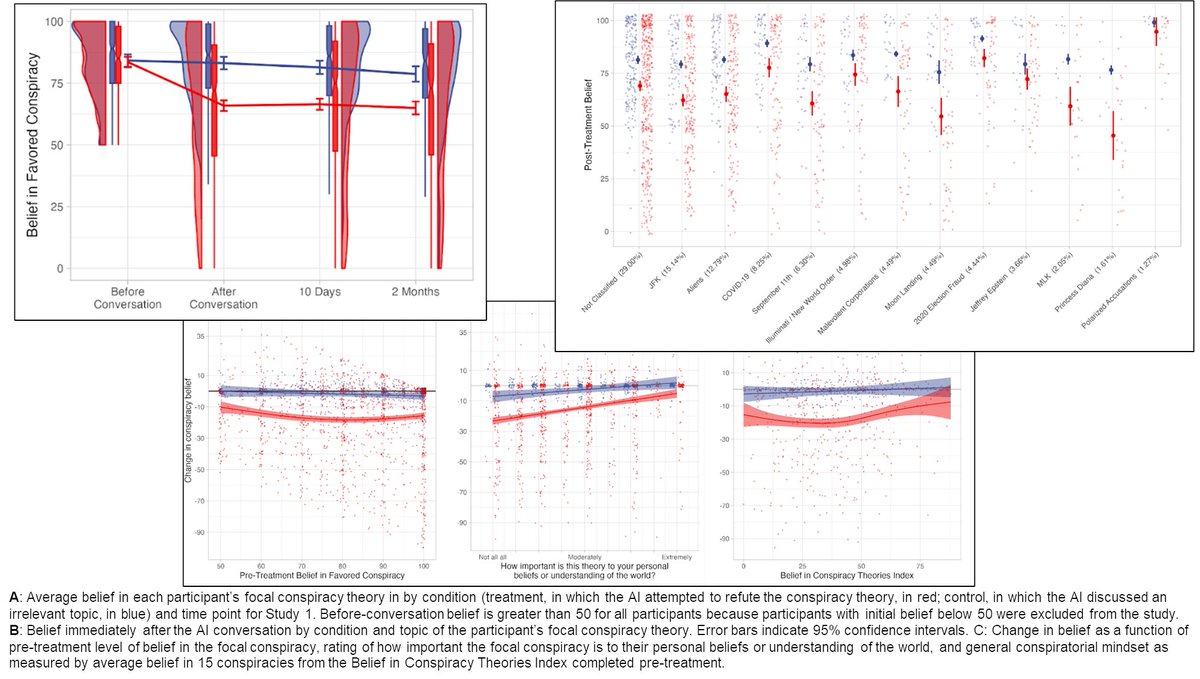
Conspiracy beliefs famously resist correction, right?
WRONG: We show brief convos w GPT4 reduce conspiracy beliefs by ~20pp (d~1)!
🡆Tailored AI evidence rebut specific arguments offered by believers
🡆Effect lasts 2+mo
🡆Works on entrenched beliefs
https://t.co/4VI0mzRqD9
It was a pleasure talking with @fMRI_today about analytical variability #narps https://t.co/mQ9j8ZHanG, promoting open & reproducible science (https://t.co/o0XcwCRyPG; https://t.co/jXqMOxpmxx; https://t.co/nOrjh2GXqn), placebo effects https://t.co/PHexnHYyJ3, #OHBM, & much more!
🎙 Join us in this Neurosalience episode with @rotembot and @fMRI_today, where they dive into the nuances of neuroimaging analysis—from the impact of shared data to the intriguing interplay between brain perception and pain.
https://t.co/3jOyd11GN7
** I am hiring a research assistant! **
Interested in mind-body treatments for chronic pain? Brain imaging studies of pain and emotion? Statistical methods and AI?
Come join our team in beautiful Denver Colorado!
Now accepting applications: https://t.co/N7oyMtqdmv
please RT
After 5 years of collecting data on this project--the largest placebo neuroimaging study to date--it's wonderful to be able to take fMRI correlates of placebo analgesia to the next level of scale!
Seeing chronic back pain as due to the mind or brain can help heal it.
Check out our paper published today in JAMA Network Open, using natural language methods to study patients' **pain attributions**
https://t.co/v4519JHXKb
Tweet thread: 1/n
individual differences, surprising reversed neural placebo-induced responses in the transfer condition, and more.
As always, data and code are publicly shared, take a look and use them @openscience! Data @OpenNeuroOrg https://t.co/Fw1wZ1ZjAX, code https://t.co/VY76SSa4qz (end)
Our beliefs shape our response to treatment. Pretty amazing, right? @SIPSplacebo But do placebo effects operate via low-level perceptual or high-level cognitive and affective processes? Preprint w/ @bogpetre@martacek@fMRIstats@Na_Friedman@torwager https://t.co/PHexnHYyJ3 🧵👇
placebos mainly operate via higher-level processes, and transfer between pain modalities. These findings open new directions for how to harness placebo effects and placebo-like processes to improve clinical care. Read our preprint for more https://t.co/PHexnHYyJ3, including (10)