Apocalyptic bird nest.
A Russian glide bomb knocks down a tree in Donbas. From the shattered branches rolls out a tiny bird’s nest.
Made of drone fiber-optic cable.
Source: Oleg Malchenko
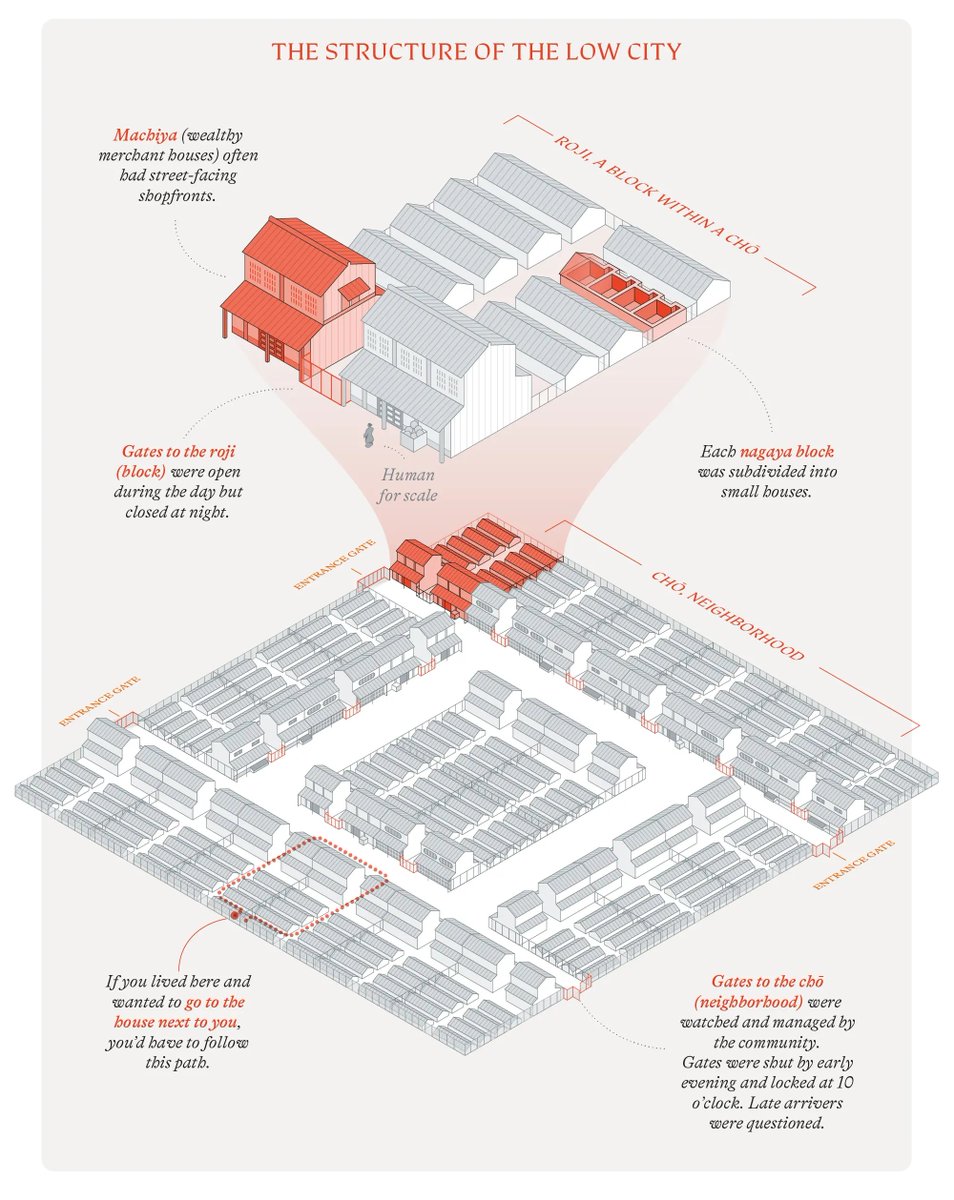
Premodern societies tended to be rent by terrible wars. In the early modern period, tens of millions died in wars in Europe, India and China. Just one society found a kind of solution: Japan. Between 1603 and 1853, Japan enjoyed near-perfect peace. The ruling Tokugawa family achieved this through creating what might be seen as the largest prison in the history of the world, the city of Edo (modern Tokyo).
https://t.co/29RvgozjUc
Most of Japan was governed by about 260 nobles, called ‘daimyo’ (see first map). To secure their loyalty, the government required that the daimyo leave their families permanently in Edo, essentially as hostages to the state. Most daimyo women thus never saw the domains over which their husbands and sons ruled. The daimyo were also required to alternate years in Edo personally.
The result was that most of the surface area of Edo was given over to daimyo palaces, or to accommodation for the hundreds of thousands of samurai retainers they brought with them (see second map). This was arranged through an elaborate zoning system, probably the largest use of zoning before modern times.
Edo was extraordinarily top-heavy socially: about half of its population were samurai. Samurai were theoretically a warrior class, but since Japan was at peace, they did little real work apart from gentlemanly occupations like calligraphy. Their main income came in the form of tiny hereditary stipends from their daimyos or the government.
These stipends were fixed in perpetuity around 1600, declining gradually with inflation over the next quarter of a millennium. Most samurai thus lived in dignified but extreme poverty, their income determined by the favour in which one of their ancestors had stood centuries earlier.
The commoner population was also tightly controlled. Commoner Edo was divided into some 1,500-2,000 fenced and gated blocks. These were then subdivided into gated alleys lined with small houses (see third map). The Low City was thus divided up by tens of thousands of internal checkpoints, all of which closed at night. Edo was not under threat of attack in the Tokugawa period and the city as a whole was not fortified. The purpose of this immense labyrinth of walls and gates was to control and monitor the movement of the population.
Prisons are useful things, and the Tokugawa system was a kind of success, making Japan the most peaceful society on earth. But it is also a disconcerting reminder of the power of rent-seekers, and how a whole city can be warped by the political exigencies they create. Edo is a particularly striking case of this, but it is far from alone.
Man goes to doctor. Says he's depressed about AI. He fears the permanent underclass.
Doctor says, "Treatment is simple. Read Gary Marcus. LLMs are stochastic parrots—they can't reason out of distribution."
Man bursts into tears. "But doctor..." he says, "I am in distribution!"
I don’t know how this claim has gone so viral.
This was actually completely intentional by Novo.
Novo Nordisk does not operate in an “oops. lawyer forgot the $250 CAD fee” manner.
This is, with all due respect, a shallow read of Novo’s actual corporate strategy.
(1/)
There's a lot of interesting discussion about fertility rates on X at the moment. At @OurWorldInData, my colleague @sophiamersmann and I just built a new population simulation tool to help inform the conversation.
Yes, yes, yes, combined arms and all that...
I read these opinion pieces being published by West Point and I wonder if these well-credentialed authors have really been paying attention. *The article was written by Canadian tankers btw.
Drones are NOT just the "next TOW." Why?
1. Remote UAS controller not at risk: A TOW or Javelin team is right there in the line of fire (or at least line-of-sight vulnerable). An FPV pilot can be kilometers back, often in a dugout or even further with fiber-optic relays. This removes the “suicide mission” calculus that limited massed ATGM use. Ukrainian operators routinely cycle through dozens of sorties per day from relative safety.
2. Cost differential & scalability: A heavy FPV runs ~$500–1,200. A T-90M is ~$3.8–4.5 million. Russian analysts themselves ran the numbers in early 2026: one T-90M = ~3,200 heavy FPVs; one BMP-3 = ~870. Ukrainian FPVs have accounted for an estimated 50–65% of Russian tank losses as of early 2025 (Forbes/OSINT tracking), with some T-90M batches showing ~50% of kills as final FPV strikes. Even at a pessimistic 20–43% hit rate per sortie (per Ukrainian veteran accounts), you’re still talking single-digit thousands of dollars to mission-kill a multimillion-dollar vehicle. TOWs/Javelins never offered that exchange ratio at scale.
3. Drones can (in fact) hold ground: We’re just entering the nightmare phase now. Right now drones excel at denial (exactly what the article says—they restrict mobility without controlling terrain). But with fiber-optic, AI/autonomous navigation, and loitering munitions, we’re already seeing the shift to persistent presence. Autonomous “last-mile” navigation has pushed success rates from ~10–30% to 70–80% by cutting out constant radio links and operator skill ceilings. Swarms + AI target recognition + reusable platforms (some Ukrainian systems now resupply themselves) start looking like cheap, attritable area-denial forces that don’t need 24/7 human babysitting. We’re not there for true “holding” yet, but the trajectory is clear and the article underplays it.
4. Automation - human-in-the-loop obsolescence: Already happening faster than most Western armies admit. Fiber-optic drones are unjammable; AI-enabled ones handle navigation and terminal guidance independently. Ukrainian sources in 2025–2026 report this is slashing both drone losses and required operator skill. The article’s “evolutionary” framing treats this as just better guidance systems. It’s not—it’s the removal of the vulnerable link that made past guided weapons (TOW, Hellfire, etc.) manpower-intensive and detectable.
5. Area denial is insanely economical in manpower & cost: One well-trained FPV section (a handful of operators + production teams) can paralyze a mechanized battalion’s movement. Compare that to the crew, logistics, and fuel for equivalent ATGM teams or attack helicopters. Russian analysts themselves are now questioning whether tanks remain cost-effective precisely because of this.
6. Skill curve: Training a competent FPV pilot takes weeks. A tank crew or even a Javelin gunner takes months/years plus expensive platforms for live-fire practice. Ukraine has flooded the battlespace with operators from a civilian gamer/drone-racing pool. The article notes that poorly trained crews suffer more, but the flip side is that anyone can become a lethal drone operator extremely quickly. That’s not true for traditional mechanized warfare.
7. Dev cycle speed: Attritable = sprint. Bespoke = crawl. FPV airframes, warheads, EW countermeasures, and AI modules are iterating in weeks/months because losing a $700 drone is trivial. Tank armor packages, APS, or new IFV designs take years and billions. Ukraine’s drone ecosystem (modular 7–10 inch FPVs that can swap ISR/strike/relay roles on the fly) proves this. The article acknowledges rapid advance but treats it as historically normal. It isn’t—not at this price point and iteration speed.
*The authors correctly note that drones have helped create a static, attritional battlefield reminiscent of 1916. Where they err is in presenting this as a failure of drone warfare or proof that "combined arms" simply needs better integration. For the defender—Ukraine, outgunned in traditional metrics—this stasis is the win. Drones didn't just deny maneuver to the attacker; they made large-scale Russian armored advances prohibitively expensive in blood and treasure, freezing the front and preserving Ukrainian sovereignty. A static line where your country still exists is not "limited strategic effect." It is survival against long odds. History's tank-killers (Saggers, TOWs, Javelins) never achieved this scale of denial at this cost ratio. Drones did.
The Cold War and GWOT are gone people. Adjust your thinking.
Joined a new AI-native company this week and it’s kind of wild how different it feels already.
The laptop arrived, I logged in, and an agent basically took over from there. It set up my dev env, pulled repos, fixed dependency issues, got permissions approved, pointed me at the backlog, linked the architecture docs, and surfaced the Slack debates I actually needed to read before touching production.
When I needed context on something, I asked the agent and it found the exact thread from months ago explaining why a decision was made, who owned it, the related Linear issues, and the PRs connected to it.
I’ve only been here 3 days but it honestly feels like I’ve worked here for a year because the usual friction and scavenger hunt for context just isn’t there anymore.
We should probably stop calling this “onboarding” and rename it to “mounting” because this feels a lot more like mounting a distributed filesystem called “institutional memory” than slowly getting drip-fed context over 6 months.
We stopped everything to write an answer (link below) to Paul Krugman's two posts of today (one informal, one with a simple model) arguing that Europe is broadly not falling behind the United States.
The change measured by the Draghi report, he argues, is mostly due to growth in the technology industry, which has distorted GDP numbers without actually leading to higher standards of living. We should believe our eyes when we walk around France and walk around Mississippi.
Krugman is wrong. The measures he uses understate European stagnation. This matters enormously. Divergence with the United States is the strongest evidence for reform in Europe.
1. The growth numbers
Krugman compares the United States, France, and Germany at purchasing power parity in current prices. On that measure, France's and Germany's position relative to America has been roughly constant since 2000.
But current price comparisons miss productivity gains in sectors where prices fall. If America produces twice as much software while the price of each unit halves, the value of American software output looks unchanged even though the volume has doubled.
Most economists therefore use constant prices, which fix the base-year PPP level and apply each country's real output growth on top of it. American output growth has concentrated in tech, where prices have fallen tremendously as productivity rises. In terms of the volume of things produced, America has pulled away from Europe.
2. Is it all the tech industry?
Krugman concedes this tech divergence but says it is not welfare-relevant. The American growth lead is an accounting artefact of measuring more iPhones at base-year prices, not a sign that Americans are actually richer, because Europeans buy the same iPhones at the same world prices.
This is not the right way to think about the world today, as an earlier Paul Krugman would have argued.
His model assumes tradable goods, interchangeable workers, marginal-cost pricing, and no profits. Each assumption fails.
Most of what households buy is non-tradable: housing, healthcare, childcare, education. When American tech firms bid workers from haircutting to coding, American haircut wages rise. Germany has no growing tech sector to do the bidding, so German wages stay flat.
Technology is not priced at marginal cost. Apple's margins are around 40 percent. Anthropic's inference margins are at 70 percent. The major platforms enjoy network effects, switching costs, and lock-in that hold prices well above what a competitive market would deliver. A large share of the productivity gains in technology stays as profit.
A lot of the value of American technology dominance shows up in equity, not in wages. Apple, Microsoft, Nvidia, Alphabet, Meta, and Amazon together are worth $21 trillion, more than the entire combined stock market value of all European stock markets. Around 60 percent of US equity is held by American households. The median French or Spanish household holds almost no equity.
The median employee at Meta, a company with almost 80,000 employees, earned $388,000 in 2025.
This advantage is not going to go away. Krugman's own 1991 paper, cited in his Nobel prize, showed that comparative advantage in modern industries is produced by increasing returns to scale, specialized labor markets, supplier networks and the agglomeration of suppliers, workers, and ideas in particular places. Once an industry concentrates somewhere, the concentration is self-reinforcing. Europe is being pushed away from the next round of technology industries (AI!).
3. What about inequality?
Another retort is that GDP per capita hides substantial inequality, and so even if America is rich on average, this is mostly due to the super wealthy.
But despite the US's high pre-tax income inequality, it also achieves higher median incomes than Europe, in part because of such a high base, and in part because it actually redistributes more than many European countries.
The cleanest comparison is median equivalised disposable household income: income after cash taxes and transfers, adjusted for household size and purchasing power. According to the OECD's 2021 numbers, the median American earns 30 percent more than the median Dutchman, about 31 percent more than the median German, and about 52 percent more than the median Frenchman.
4. What about hours worked?
Krugman points out that while American GDP per person is higher, most of this is because Americans work more. For this divergence to be an hours worked story, Americans must work more relative to Europeans now than they did in 2000.
The opposite has happened. Birinci, Karabarbounis, and See in a 2026 NBER paper show that about half of the American-European hours gap that existed in the 1990s has reversed by the end of the 2010s. Americans work fewer hours per person than they did in 2000, while most Europeans work more.
5. Is America not a bad place to live?
Walk around Alabama and France: surely the former cannot be substantially richer than the latter?
American cities often have poorer centres and richer suburbs or exurbs. European cities preserve richer and more attractive historic cores. A visit to a city as a tourist in America compared with a city in France will leave one having seen different spots on the income distribution. Americans in Europe go to the nicest and richest European cities.
Rather than a walking around test, do a driving around test. Go to the periphery of any modern American city and see a level of new-built material wealth that is extremely uncommon in Europe, with thousands of enormous four- or five-bedroom homes. In the South, in places like Nashville and Austin, drive around the downtowns to see hundreds of luxury apartment buildings springing from the ground. This construction boom is replicated virtually nowhere in Europe today.
The other question is generational. Housing often costs more in Europe than in the United States, despite the quality of the housing stock generally being much better. Europe has nice city cores but these are inaccessible to young Europeans.
Consider the salaries available to entry-level workers. The starting pay for a London police officer is $57,000. In Washington, DC, $75,000. The entry-level Deloitte consultant job in Madrid pays around €28,000, roughly $33,000 per year. In Charlotte, the entry-level Deloitte job pays $63,000.
There are many things to dislike about life in America. But relative to 25 years ago, the gap in material wealth has shifted dramatically in America's favor.
https://t.co/VOpQ32R5tg
1. German rules mean restaurants can force Google to delete reviews
2. But Google can say how many reviews it removes
3. Consumers update and assume the removed are 1*
4. Restaurants have no incentives to delete reviews?
We've been thinking a lot at Stripe about the Coasean lens on AI:
- The obvious near-term effect is reduced transaction costs within companies: shared context, systems of record, aligned incentives etc.
- But inter-company transaction costs also reduce sharply: agents are great at discovery, make it trivially easy to integrate; make contracting much more straightforward; agent-to-agent commerce.
- On net, we think second effect bigger in medium term: fewer people per firm, more output per firm, just more firms, and more coordination happening through market-like mechanisms
the craziest part now is that the modern computer probably has to be entirely reinvented, from scratch. pretty much like how jobs & co brought apple ii to market.
like not improved. not given a chatbot sidebar or something but really from the ground up like the iphone redefined what it meant to be a pocket computer.
the current paradigm for computers was built around a human staring at a screen, moving a cursor, opening apps, managing windows, naming files, remembering where things live, & manually translating intent into interface actions.
that made sense when the human was the runtime. but in an ai native world, it starts to look kinda ridiculous.
you can see this ridiculousness when you use computer use agents… they are useful sure, but they’re also obviously transitional. they’re teaching ai to operate machines designed for humans, which is clever, but also kind of absurd. it’s like making a robot hand so it can use a doorknob instead of asking why the door needs a knob at all. yes i know humans also need to use a door knob, but maybe in the future humans don’t need to use a computer, or at least what we think of a computer today at all.
this all leads to some interesting questions:
- what is a file when the system understands context?
- what is an app when intent can route itself?
- what is a desktop when work can be decomposed, executed, monitored, & summarized by agents?
- what is a browser when the agent can retrieve, compare, transact, & remember?
- what is an operating system when the primary user is no longer just a person, but a person plus a swarm of delegated intelligences? or no person at all.
the old computer assumed navigation.
the new computer has to assume a new kind of intention. the old computer organized information. the new computer has to try to organize agency.
we’re still in the hacky middle stage at the moment with sidebars, copilots, agents clicking through legacy ui, & automation layers sitting on top of 40 year old metaphors.
the new computer is likely one where memory, context, identity, permissions, tools, agents, & interfaces are native primitives. this means desktop, mobile, browser, apps, files, folders deserves another first principles look.
I liked @alexolegimas's essay too, but I think the argument smuggles in a lot of likely false assumptions about the stability of preferences in a wildly different environment.
New essay on the economics of structural change and the post-commodity future of work.
1. Almost any question about the impact of advanced AI on the economy needs to start at the same place: what is still scarce? Answer that, and the analysis becomes pretty straightforward. This essay explores what becomes scarce if AI really can replicate most of what humans do in production, and what this mean for the future of jobs.
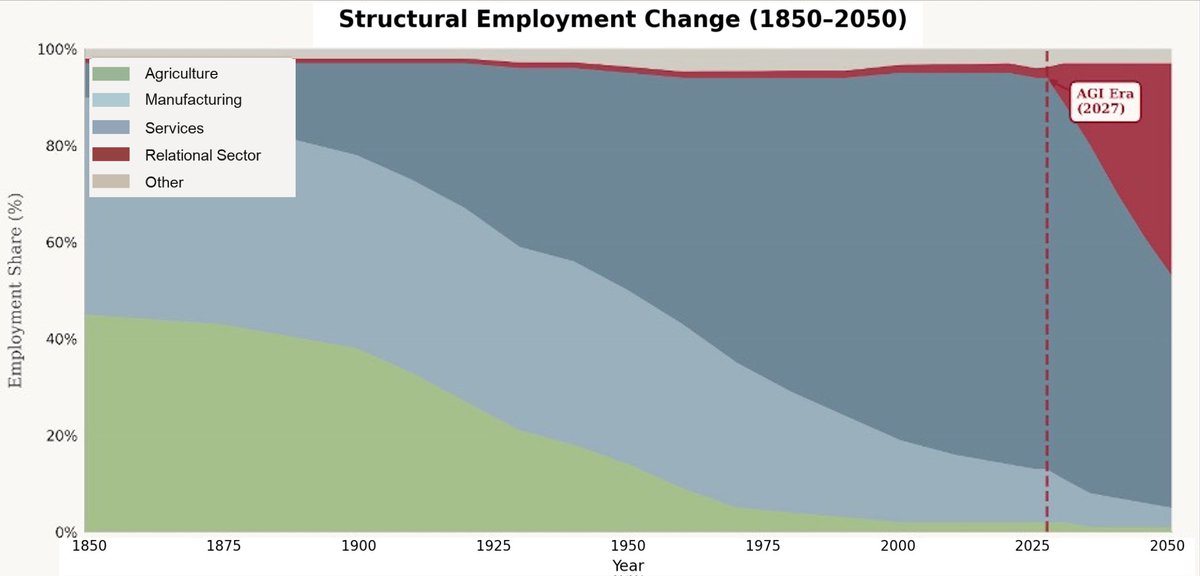
2. My conjecture, working through the economics: labor reallocates across sectors, and the sector it reallocates to has properties that keep labor a meaningful share of the economy. Ultimately this is about the structure of demand itself. For this, we have to go back to Girard, Augustine and Rousseau: once people's base needs are met, their preferences shift to comparative motives (e.g., status, exclusivity, social desirability). This motive is inherently non-satiated.
4. The key paper is Comin, Lashkari, and Mestieri (Econometrica 2021). As people get richer, they don't buy proportionally more of everything. They shift spending toward sectors with higher income elasticity. They estimate income effects account for 75%+ of observed structural change.
5. The ironic consequence: the sector that gets automated becomes a smaller share of the economy, not a larger one. Agriculture got massively more productive and its share of employment collapsed. Manufacturing too. The "stagnant" sectors absorb the spending and the jobs.
6. So the question is: which sectors have high income elasticity in a post-AGI world? I argue it's what I call the relational sector. Categories where the human isn't just an input into production, it is part of the value.
7. Why does the relational sector have high income elasticity? Because human desire has a mimetic, relational dimension. We don't just want things for their intrinsic properties. We want what others want, and we want it more when others can't have it. Girard, Rousseau, Augustine, and Hobbes all saw this.
8. In work with Kristóf Madarász, we showed this experimentally: WTP roughly doubles when a random subset of others is excluded from the good. And in new work with Graelin Mandel, AI involvement kills the premium. Human-made art gains 44% from exclusivity; AI-made art only 21%.
9. This all comes together for the core argument. The sector that absorbs spending as AI makes commodity production cheap is one where human provenance is part of the value, and demand for it grows faster than income. Exactly the profile that keeps labor meaningful.
10. To be clear about the claim: I'm NOT saying aggregate labor share must rise. It may fall. The claim is about sectoral composition, i.e., where expenditure and employment go once commodities get cheap, and the fact that the sector that will absorb reallocated labor maps to a substantial component of human preferences and desire.
11. If you're interested in the formal model, a linked companion technical note works out all the economics.
Read the essay here: https://t.co/NcjVgn2o8g
When you build a big fat solar farm in the Chinese desert, you might as well have some fun with the layout of the panels. This is real! Check it out on GoogleMaps: https://t.co/BCSnssOFYN
Many public discussions center around trends and statistics that are not real at all.
For over a decade, there was widespread public discourse about the causes of high and rising maternal mortality in the US.
But, as I've written about before , CDC analyses showed that the apparent rise from 2003 to 2017 was due to a change in measurement https://t.co/pBBcRoDoXQ , when a pregnancy checkbox was added to death certificates, which flowed directly into maternal mortality counts in most cases. Rather than mortality rising, the rate had been stable. Many deaths had been previously missed, and many other countries were undercounting maternal deaths.
This isn't an isolated case.
- People often cite the IHME's estimate of childhood height having fallen in the UK over the past decade. Looking at the data sources, it missed one of the key sources of data on height - a national dataset measuring the height and weight of almost all schoolchildren in the UK, which showed no decline (that data wasn't publicly available until an FOIA request) - and instead the IHME estimates were likely extrapolated based on a global model and smaller, less reliable surveys. https://t.co/dOxnt7ewPD
- I often hear claims about disruptive science having declined over time based on a highly influential paper in Nature. https://t.co/pTAlXnvanB But the key results were affected by a coding bug, which would have showed a decline simply due to this artefact https://t.co/0EXvL55Zer
- The idea that interstate migration in the US has collapsed has led to lots of concern about dynamism and unemployment. But recently, it's been shown that much of the apparent decline was a statistical artefact of how the survey filled in missing responses, causing it to systematically overcount non-movers. Correcting this shows only a very slight decline over time https://t.co/CeIp2kchWL
- The dramatic rise in autism diagnoses, which has spurred lots of commentary about pesticide use and vaccines, actually reflects changes in how autism was defined. In the 1960s, autism described severely disabled, mostly nonverbal children: if a child was verbal or succeeding at school, they were excluded from the diagnosis by definition. The criteria then widened across successive editions of the DSM. Alongside it, it became much easier to get assessed, from requiring a specialist with months-long waiting lists to something that could be done in a few appointments. https://t.co/0L1Y4tKCUd
--
I think this is a persistent problem of people undervaluing data quality and measurement. It may sound dull or academic to care about these issues, but numbers and statistics are a big part of public discussions. They can be the premise of debates that can go on for years and sometimes even decades, and mislead people about social and policy interventions to fix them.
So before spending time arguing about the causes and consequences of a trend or statistic and what should be done about it, it's worth digging into the data to see if it supports the premise at all.
I suspect there are many other discussions affected by this too. Are there others I've missed?