@FutureAZA DoJo3 is not necessarily a chip. It’s a system that Elon has been talking about, using AI5, AI6, AI7 chips to implement to process training data.
@grantisvibing@SawyerMerritt@Tesla@xai I think so. Elon loses direct control over AI which is far bigger and more important than Tesla. He becomes hindered by shareholder demands.
See all my photos from Starship Flight 7 + order prints → https://t.co/SbCH8Won4M
Print sales help me continue to travel to capture the most exciting moments in spaceflight - such as capturing both New Glenn and Starship Flight 7 within ~15.5 hours - thanks for the support!
🚨 FSD Supervised is coming to Europe in 2025 and the end of the Autopilot “nag” might be worldwide! 🚨
As we look ahead to Tesla’s FSD Supervised launch in Q1 2025 for Europe and China, I wanted to dive into how these developments tie into the ongoing work of the @UNECE GRVA and what this means for Tesla drivers.
You might remember my earlier posts about the GRVA’s workshops on autonomous driving systems, like the test drives of FSD v12 in Troy, Michigan and the hands-on feedback from experts like the Swedish Transport Administration. There’s been a lot of movement on the DCAS (Driver-Control Assistance Systems) front lately, and it’s all pointing toward one thing: we are getting closer to a world wide release of FSD (Supervised)🙌
The Path to FSD (Supervised) wide release: Key Updates
With Tesla’s announcement that FSD Supervised will be rolling out in Q1 2025 for Europe, the latest regulatory updates couldn’t be more timely. The WP.29/GRVA is making rapid progress, particularly with the DCAS legislation (UN Reg. No. 171) that is laying the groundwork for FSD Supervised in Europe.
The GRVA's System-Initiated Manoeuvres (SILC) guidelines are a big deal. These updates will allow FSD (Supervised) to make autonomous lane changes, merging, and other manoeuvres without needing prior driver confirmation. It’s a massive step forward for hands-off driving on European roads.
Even bigger is the conversation around HOR (Hands-On Request). One of the most exciting developments is the proposed amendments to withhold HOR on highways—essentially, getting rid of that annoying “nag” telling you to keep your hands on the wheel. This could mean no more HOR, at least on highways, unless the system detects a boundary. 🚫✋
#FSD in Europe: What to Expect in 2025
So, how does all this regulation work connect to Tesla’s upcoming release? Well, the DCAS framework that’s being finalized will directly influence @Tesla's FSD Supervised in Europe. Tesla will need to comply with the new UNECE requirements, including guidelines around system transparency (clearly showing what actions the car will take) and driver intervention capability.
For us, this means we’ll see a system that’s not only technically compliant but also incredibly advanced. In fact, FSD Supervised is expected to launch with no more mandatory driver confirmation for lane changes and other actions—a major win for Tesla’s autonomy goals. The HOR may still apply in some situations, but Tesla’s advanced Eye-on-Request monitoring might eventually eliminate it altogether, just like we’re hoping for in the U.S.
The Future: What’s Next for FSD?
I’ve been following this regulatory journey for a while now, and one thing’s clear: the UNECE and Tesla are working faster and more efficiently than ever before. Just like I mentioned in my latest regulation post, we’re seeing regulators not only keep up with the rapid pace of innovation but even helping to speed it up.
The upcoming GRVA sessions in September will finalize some of these critical changes, and it’s only a matter of time before we’re driving with FSD Supervised—and yes, potentially without the nag altogether! The way things are moving, 2027 might be the year we see FSD Unsupervised hit European roads. Imagine that—full autonomy, no driver required. 🚘🤖
As we get closer to these milestones, I’ll keep you posted on all the latest developments. For now, get ready for an exciting 2025. FSD is coming, and it’s coming fast! ✌️
Disclaimer: I am not a regulatory professional so I can make interpretation mistakes.
#Tesla #FSD #FSDSupervised #DCAS #UNECE #AutonomousDriving #NoMoreNag
@lemonodor@DJSnM Wow, very impressive! I’m surprised they got her on the ground with such little information going between them. Whatever training she had must have helped a lot.
Regarding stopping, FSD should be capable of stopping using regen only (I would enable that feature), but many times FSD decides to start stopping up to 3 sec too late, and then aggressively stops 3 car lengths behind the stopped car in front. Who does that? Where did that training data come from? Generally speaking, FSD needs to increase its advanced planning from 5 sec to more like 10 sec. This would fix lane changes to accommodate merging cars and other situations.
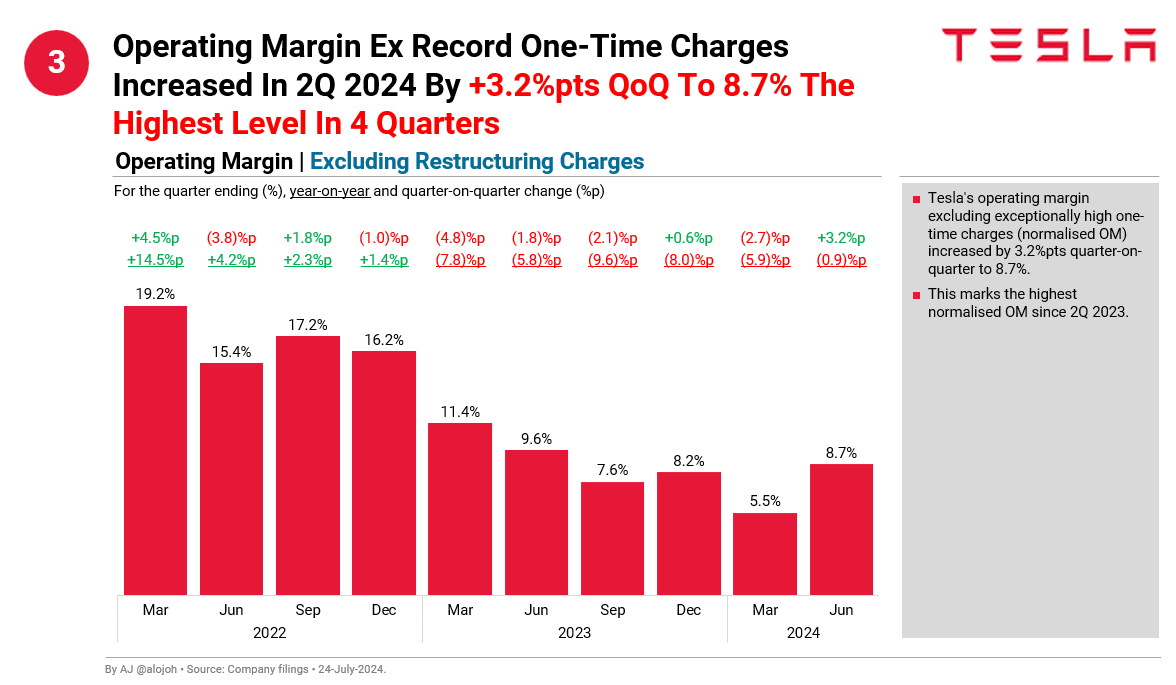
Here is another false narrative I see popping up everywhere about Tesla's 2Q: "margins decreased". This is NOT true. ALL top level margins INCREASED. This is what matters at the end of the day. Auto margins are not driving EPS!
TSLAQ is cherry-picking by focusing on low level margins (like automotive excluding credits etc) but ignore the top level margin improvments.
This is like looking at Nvidia's gaming graphics card margins and ignoring Nvidia's overall gross margin or operating margin.
Here are the facts:
1. Total gross margin improved +0.6%pts to 18.0%.
2. Operating margin improved +0.8%pts to 6.3%.
3. Opertaing margin excluding exceptionally high one-time restructuring charges improved by a shocking +3.2%pts to 8.7%(!).
Please like/repost for maximum reach to fight the FUD. Thanks.
@ValueAnalyst1 Not a fan of the idea because initially charger-less homes will use SCs as their primary charger for some time. I think this will not produce a good experience since despite being free it will require more time and effort than a gas station would.
@Neil_X10@Tesla@OpenAI@xai I remember Elon said he tried to get the AI talent to join Tesla but they refused because they wanted to join and be part of a startup company. So he created a startup to get them. You imply intent that does not exist.