Workflows are the biggest upgrade to Claude Code’s capabilities since skills and subagents.
I dove deep into it with @sidbid to figure out best practices, examples and more. I’m particularly excited about the non-technical tasks it enables for Claude Code.
I just got back from SF and I FEEL INSPIRED.
I spent 5 days with frontier AI model teams, AI startup founders, and 3 billionaires.
My takeaways:
1. I had lunch with 3 billionaires. All of them are buying SaaS companies and rebuilding them agent-first. They were deeply inspired by Bending Spoons and Ryan Cohen's eBay deal. Buy the company, cut the headcount, rebuild the tech, add agents, add features, make more valuable experience, raise prices.
2. The frontier model companies are hungry for usage data from the field. They can see API calls and token counts. They can't see the actual workflows. If you're deep in a niche using these models in ways the model companies haven't seen, that understanding is incredibly valuable. Usage intelligence is the new alpha.
3. Consumer AI is massively underbuilt. Every billboard in SF is either B2B inference infrastructure or vertical agent companies. The entire city is optimized for enterprise. Meanwhile you have companies like Cal AI doing $50M ARR in 18 months as a consumer app. I met with a cool few teams doing consumer AI (@paulscherer / @ekuyda)
4. MCP came up in literally every conversation. The companies exposing their product as MCP endpoints are getting pulled into deals they never pitched for. The ones that aren't are becoming invisible to agents. This is the new SEO. If agents can't find you, you don't exist. Building products for agents is the new zeitgeist in general.
5. Not uncommon for hot seed rounds to be $25-50 million valuations. I saw a Series A at $450 million
6. If I had a dollar every time someone mentioned "forward-deployed engineer" this trip I could have funded a seed round. It's the hottest role in SF right now. The person who sits between the agent and the customer, making sure everything actually works.
7. The mood around open source shifted. A year ago it felt like open source was chasing the frontier models. Now founders are telling me Gemma and DeepSeek are good enough for 80% of what they need at a fraction of the cost. The "which model do you use" conversation is being replaced by "which model for which task." Model loyalty kinda feels dead.
8. Voice agents came up more than I expected. Multiple founders told me voice is the interface for the next billion users. The billion people who will never type a prompt will absolutely talk to one.
9. The Obsidian community in SF is weirdly intense. Multiple founders showed me their vaults unprompted. Like showing someone your home gym. It's a flex now. The quality of your knowledge base (second brain?) is becoming a status symbol among builders.
10. Maybe it was just the people I met but the age of the founders is shifting. I met more founders over 40 this trip than any trip before and more founders under age 21 than ever before. Founders getting older and younger at the same time.
11. I spoke to a lot of fast-growing startups, VCs and frontier models who are hiring content creators right now.
12. The restaurant scene in SF is actually better than it's been in years. Founders are going out more. Alcohol is out, not surprisingly.
13. SF doesn't feel like the only place anymore. We all have access to the same frontier models. We all read the same X feed. A founder in NYC or Lagos is calling the same APIs as a founder in SoMa. So in the past it felt like SF was always lightyears ahead, doesn't feel that way anymore. It's okay not to live in SF and have BIG DREAMS.
14. The coworking spaces in SF are half empty but the coffee shops are packed. People want to be around people. I had a few startup ideas here....
15. Walking around the Mission I noticed something: the street-level businesses, the taquerias, the barbershops, the laundromats, none of them use any AI at all.
16. I heard the phrase "agent debt" for the first time. Like technical debt but for agents. When you hack together an agent workflow fast and never clean it up, the system prompts conflict, the memory gets polluted, the tools overlap. 6 months later the agent is doing weird things and nobody knows why lol.
17. Met a few people who carry two phones now. One for personal. One that's basically an agent terminal running Telegram or iMessage connections to their agent fleet.
It's always amazing to get that dose of inspiration in SF. I FEEL INSPIRED.
But I'm so happy to be back home, locked in and building.
We're 12-18 months into a shift that will take 15 years to play out. The urgency in every conversation was real.
What an incredible time to be building.
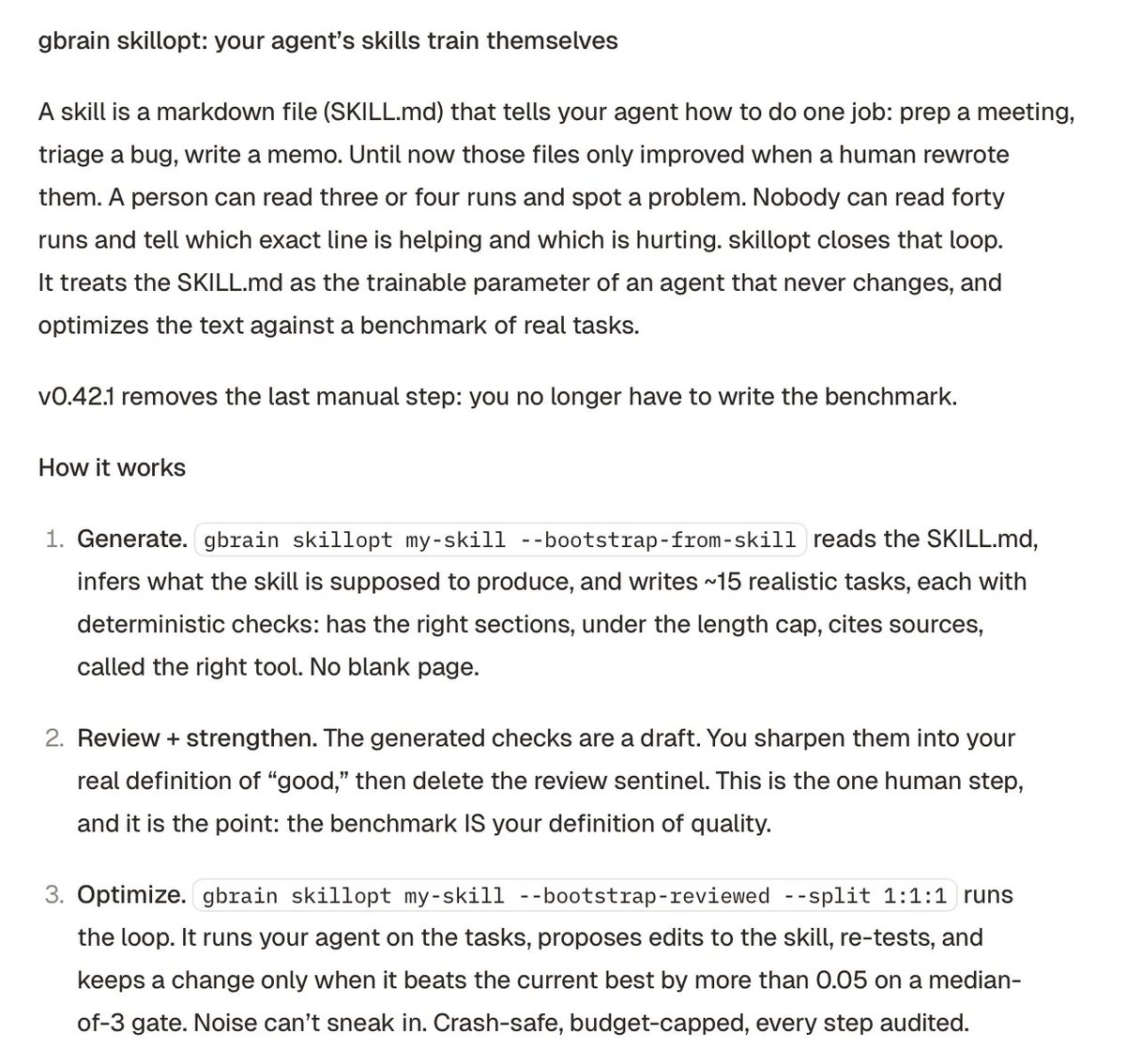
GBrain v0.42.1 just dropped and it implements a version of Microsoft's SkillOpt paper that automatically improves your markdown skill files.
Ours does a special step: it writes the benchmarks for you. It's now live in GBrain.
Varick Agents was founded on a core belief: AI SaaS does not solve enterprise problems.
Large businesses need AI that is custom tailored to their exact processes, workflows, and departmental needs. AI SaaS built to serve everyone effectively serves no one completely. You might get 70% of the way there, but enterprise doesn't care about 70%. They care about 100%.
The only path to 100% is custom, forward deployed engineering, working directly with teams to transform the entire company from the inside out.
This is why Varick has been successful. We go into companies and transform them entirely. We don't add tech debt. We don't stack another SaaS subscription. And we never force migration away from the systems you're already deeply invested in.
If that sounds like what your company needs, let's talk: https://t.co/o36tlVZnuv
This is insane...
This guy just completely open-sourced his ENTIRE Claude Skills vault.
15+ skills for social media - Instagram, Substack, X, and much more.
So much free value.
https://t.co/G6j2ci6o0D
I spent the entire week building 3 Hermes agents from scratch.
The full architecture:
4 separates Gbrains as the foundation:
-1 shared brain (company knowledge base, shared among the 3 agents)
-3 private brains (role-specific working memory)
3 separate Hermes profiles:
-CFO
-Ops
-Marketing
Agent/brain mapping:
CFO -> Finance brain + Shared brain
Ops -> Ops brain + Shared brain
Content -> Content brain + shared brain
What feeds the Shared brain:
-Context repo (company docs, offers, brand voice, ICPs, team roles, etc.)
-Call/meeting transcripts (syncs every 2 hours)
-Gmail (syncs every 2 hours)
-Google Calendar (syncs daily)
Cron jobs handle the syncs which makes upkeep hands off for me.
Each Hermes profile owns its own config, .env, SOUL.md, memory, logs, sessions, home dir, Telegram bot, and gateway process.
Local wrapper scripts force GBrain routing to the right private + shared brain.
I created the 3 separate profiles to have role separation. Each profile is a specialist in a specific role but all 3 share the same business context underneath.
We’ve automated every single thing we can @every with AI agents.
And yet there’s way more human work to do than ever. We’ve gone from 4 -> 30 human employees since GPT-3.
I wrote a report on the structural reasons: how AI makes expert competence cheap, why that drives up demand for experts, and why the dynamic only intensifies as we approach AGI.
After Automation: https://t.co/Lb7SUCduAg
In a recent batch talk, YC General Partner @t_blom broke down how to build a self-improving, AI-native company.
He walks through how to create recursive, self-improving AI loops, and why founders who get this right will run companies that improve while they sleep.
00:00 — Companies Are Roman Legions
00:54 — Copilots Are the Wrong Mental Model
01:55 — Extract the Domain Knowledge
02:24 — The Recursive Self-Improving Loop
04:12 — The Holy Shit Moment at YC
05:50 — Self-Optimizing Product and Support Loops
06:29 — Burn Tokens, Not Headcount
07:23 — Middle Management Is Over
08:05 — Make Everything Legible to AI
09:40 — Regenerating the YC User Manual
11:19 — Software Is Ephemeral, Context Is Valuable
12:18 — Where Humans Still Matter
there's definitely a before-river and after-river shopify.
a lot of people talk about having fully accessible agents in their organization, but i wish they could sit in and see just how effective it is at shopify.
a couple things that made it instantly magical at shopify:
1. shopify is still a fully remote company. everything is documented, structured, categorized, and made for easy read/write. our vault, internal tooling, hell, even perf tools feel second to none. not because we nerd out over it (we do) but because it's a necessity given how spread out the team is.
2. shopify is run by an engineer. culture is set at the top. shopify, at its core, is an infra company. down to the very details of our culture, you'll find nerdy eng tidbits. there are a lot of amazing things about ai, but one of the best is that coding and interacting with files is in its "dna". when you have a company that is designed and operates sorta like well-written software, it enables something like River to have a tidal effect pretty immediately.
you can see this with how natural the adoption has been. making it part of public channels in slack and just launching it, you see everyone start playing with it, and witness use cases exploding.
it's transformed how people work and, the best part is, it's currently the worst it'll ever be.
if you nerd out about this stuff and want a front row seat to see how bleeding edge companies apply ai, i would find a way to get a seat at shopify.
Here are 10 GitHub repos that quietly print money while you sleep.
1. Cal. com
Open-source Calendly. Fork it, white-label it, sell to dentists and lawyers for $200/month. The founders hit $5M ARR in 3 years doing exactly this.
Repo → https://t.co/haz8ihRsHm
2. Plausible Analytics
Privacy-first Google Analytics. Self-host it, resell to agencies for $50/month per client. Two founders bootstrapped this to 7 figures.
Repo → https://t.co/RFrcpqTBQ7
3. Ghost
Open-source Substack with 100% margin. 1,000 readers at $5/month equals $60,000 a year. Forever.
Repo → https://t.co/Z1MdZ5Zapg
4. n8n
Open-source Zapier. Sell automation services for $500-$2,000 per setup. n8n raised $14M because the agency model behind it works.
Repo → https://t.co/hdycABGGc1
5. Supabase
Free Firebase replacement. Build a SaaS in a weekend, charge $29-$99/month. They raised $116M for a reason.
Repo → https://t.co/dFB2QvafA7
6. Medusa
Open-source Shopify. Take 5% on every sale forever. Zero rev share to Shopify.
Repo → https://t.co/uEuCK6zuZO
7. AppFlowy
Open-source Notion. Sell self-hosted to enterprises worried about data privacy. They raised $30M because this market is massive.
Repo → https://t.co/IDMykTCkMU
8. Coolify
Open-source Vercel and Heroku. Charge developers $20/month to manage their deployments. Replace their $200 Vercel bill.
Repo → https://t.co/N5Fk22qraT
9. Listmonk
Open-source Mailchimp. Send unlimited emails for the cost of an AWS bill. Resell to agencies at 10x markup.
Repo → https://t.co/NS6Uukcklw
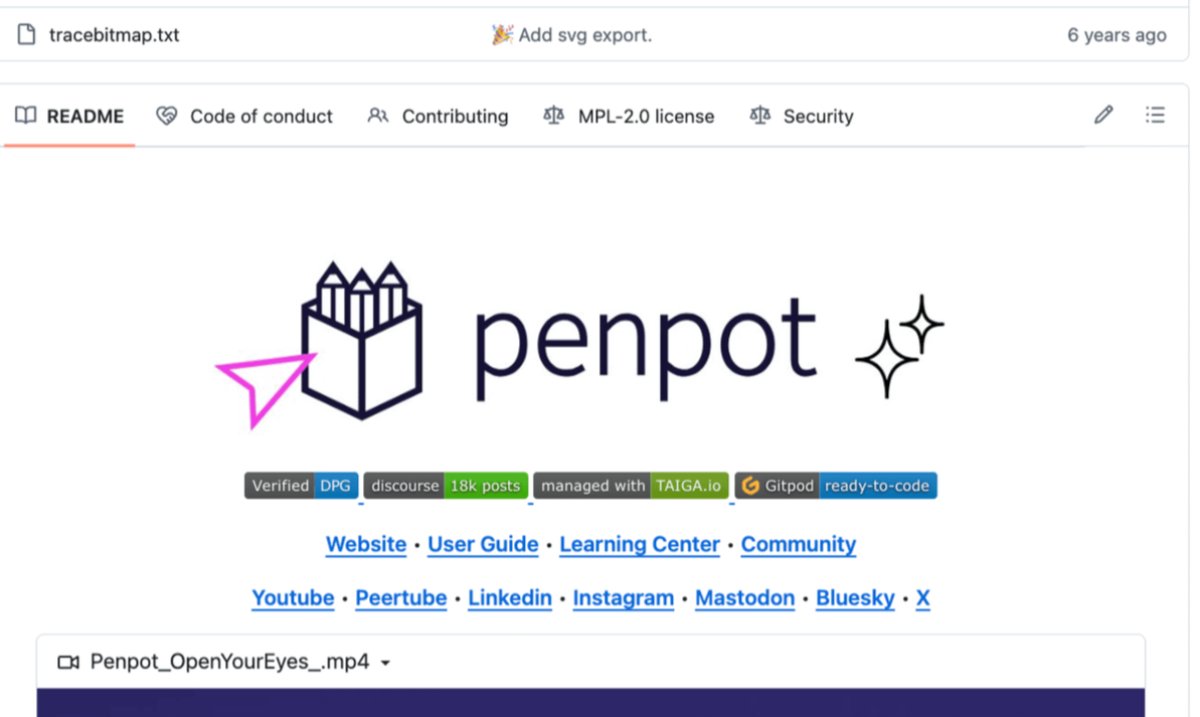
10. Penpot
Open-source Figma. Sell self-hosted design tools to agencies who refuse to upload client files to the cloud.
Repo → https://t.co/Lx1CYUP4p4
The difference between developers who build features and developers who build businesses is one decision.
Pick one of these. Fork it this weekend. Ship it next week.
The founders behind these repos already proved the model.
Save this. Share it with the developer in your life who deserves to break free.
100% free. 100% open source.
BREAKING: ANTHROPIC JUST OPEN SOURCED THE ENTIRE WALL STREET WORKFLOW.
DCF models. LBO models. Equity research reports. Merger analysis. KYC checks.
All of it. Free. On GitHub.
It connects Claude directly to:
-> Bloomberg, FactSet, S&P Global, Morningstar, PitchBook
-> Builds real Excel models with live formulas and sensitivity tables
-> Drafts CIMs, IC memos, earnings reports, and buyer lists
-> Runs PE due diligence, GL reconciliation, and NAV tie-outs
This is not a chatbot wrapper.
These are production agents that own entire financial workflows.
The kind firms pay $50,000 to $500,000 per year in software to run.
Now it is a one-line Claude Code plugin install.
19.8K GitHub stars. Apache-2.0 License. 100% Open Source.