This guy built over 1,000 homes for squirrels and fitted some of them with cameras so he could see how they live
Welcome to the cutest reality TV show out there
Writer: Ian
I and Piyush Doshi highlight in today's Economic Times how of every ₹100 of profit generated by an MNC in India, only about ₹56 stays here. No other large emerging economy performs this poorly. China keeps 91%, Indonesia 96%, and Brazil 88%. The plain truth is, in the global economy, India works for wages, while others earn royalties. Indian labour, factories and consumers generate enormous value. But assets that command a premium - brands, patents, platforms, proprietary technology - are owned elsewhere. It is time to change that through focused reforms and R&D spend by the private sector. Indian Maharaj must command royalties not just wages.
https://t.co/NclkuI5F2L
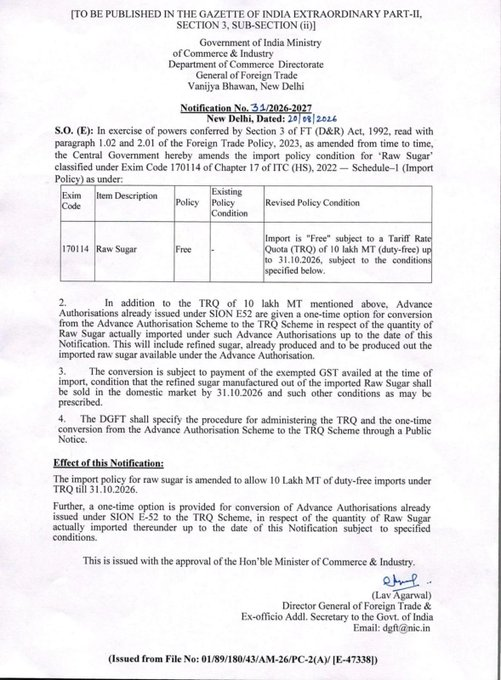
India is going to import 1 million tonnes of raw sugar - that too duty-free.
This itself is an import of Rs. 4,000 Crores + duty loss of another Rs. 4,000 Crore.
Thank you, Gadkari ji, for transforming India from a sugar exporter to a sugar importer.
As founders we get tunnel vision about focusing on the next thing to do. But sometimes it’s good to stop and see how far we have come.
This post from @Fintech03 made me reminisce how far we have travelled. And how far we still have to go…
back to the grind 🚀
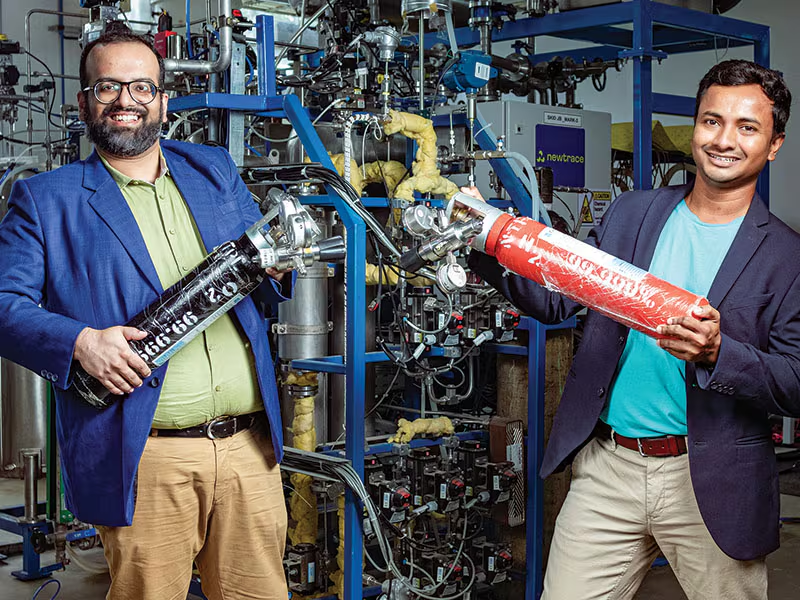
Two scientists, a fluid mechanics PhD and a nanomaterials fellow, building membrane chemistry that only 3 other companies on Earth can do, sitting quietly in a 20MW pilot plant in Bengaluru while the world argues about whether green hydrogen will ever be commercially real.
A few might be thinking what is Green Hydrogen?
Green hydrogen is nothing but hydrogen made by splitting water using renewable electricity instead of fossil gas. It is one of the few credible paths to decarbonizing steel, fertilizer, shipping, and heavy industry.
But the electrolysers that do this splitting have a dirty secret: the membranes inside them need to be highly selective for ions while staying chemically stable, which makes them expensive to manufacture and most designs lean on rare earth metals and complex materials that keep costs stubbornly high.
This is the actual reason green hydrogen has stayed a subsidy dependent science project instead of a real industry.
To solve this exact problem Newtrace was born 5 years ago.
2 people, real scientific depth, not repackaged engineers, Prasanta Sarkar holds a PhD in fluid mechanics from Université Grenoble Alpes, and Rochan Sinha is a J.N. Tata fellow with a background in nanomaterials and electrochemistry, both having cut their teeth in renewable energy systems in Europe before coming back to build this in India.
They rebuilt the electrode and membrane chemistry from scratch. The manufacturing costs cut by ~30%, with the rare earth metals eliminated entirely from the process.
Newtrace has a near-commercial prototype running and operates a 20MW pilot facility, and is building toward 1MW electrolyser systems today, scaling to 10MW by 2027.
They have raised $1M pre seed in 2022 led by Speciale Invest and Micelio Fund, then $5.6M seed in 2023 and most recently $6.3M raised specifically to commercialize their electrolyser electrode technology and push down green hydrogen production costs further.
Peak XV Partners and Aavishkaar Capital are in the cap table, serious climate tech literate money, not just government grant chasers.
Why this matters for Bharat......
- Steel, fertilizer, and shipping are exactly the industries where Bharat cannot simply "go electric", they need actual clean hydrogen as an input, not just clean power.
- Every electrolyser India imports today is a strategic dependency, the same story as solar cells and semiconductors before this.
If Newtrace's cost down chemistry scales, Bharat will build exportable IP in the one segment (electrode/membrane tech) that is genuinely defensible and globally scarce, at a moment when the government's own National Green Hydrogen Mission and rare earth corridor push are explicitly trying to create exactly this kind of domestic deeptech champion. 🙏🙏
Last week I posted a new paper with Patrick Norrick: “Terra Incognita: The Economics of a Shrinking World.”
We chose the title deliberately. No society in history has experienced the fertility levels now seen in South Korea, China, Thailand, Colombia, Chile, and many other countries. Our knowledge of the causes (and of the economic consequences) remains far more limited than most public discussion acknowledges. Much of what we write is, at best, educated conjecture.
The paper also struggles against a space limit. We wrote 20,000 words, far from the 250,000 or so we would need to address some issues in more detail (if I had the time and resources to hide away for a year, I could do that, but not now). That means some ideas are only sketched.
Nonetheless, we emphasize several important points.
First, fertility has fallen very fast everywhere: rich and poor countries, east and west, north and south, conservative and liberal societies, religious and non-religious societies (with the exception of the Jewish population of Israel; fertility has also collapsed among the Muslim population within the pre-1967 borders), you name it. Even in sub-Saharan Africa we see fast and unprecedented drops in fertility (alas, from a high initial level).
Second, and this is really interesting, the fertility collapse has been concentrated in poor and lower-middle-income countries much more than in rich countries. By now, income per capita and fertility are positively correlated within OECD countries. We conjecture this will hold globally in a few decades.
Third, and related to the second point, the fertility collapse has been concentrated among poor and lower-middle-income women within countries. In countries such as the U.S., the rich and highly educated now have more children than the poor and less educated.
Fourth, we document why we do not understand the data from the U.N. World Population Prospects. See, for example, Tables A.1 and A.2.
Fifth, we explain why some proposed mechanisms struggle when confronted with the data.
A more subtle point is at work here. Many commentators do not seem to understand the difference between proximate causes and ultimate causes. Yes, births might have gone down because fewer women are in long-run relationships. That is the proximate cause. But you need to explain why fewer women are in long-run relationships (the ultimate cause), and saying that they spend more years in school, to take one example, does not get us very far. Why do they spend more years in school? Once you start down the whole chain of reasoning, things become much harder than they seem.
The paper can be found here:
https://t.co/VrCHr0lBPa
Comments always welcome!
We are talking about 11,000 vetted, peer-reviewed scientists warning us about fact that we are in a global climate emergency.
Their findings carry a bit more weight than
Trump's "It's a hoax" or Bob down the pub saying
"It's just summer".
When I worked at Apple, I remember seeing code that was 15 years old. Every file had a comment at the top with the date and the author’s name. You’d open a file and read through it, sometimes touching a feature no one had touched in a decade.
Everything felt very permanent, like a house made of bricks. Everyone who made a brick put their name on it before slotting it into the house. Even in a massive company, you were proud of your bricks. Each one fit so satisfyingly into the bricks around it.
When someone was renovating a room you had worked on years ago, they’d reach out and say, “I found this brick with your name on it. Can you tell me what it was doing here?”
Sometimes old bricks would get taken out during a renovation, but they were usually kept in a pile in the corner to reuse in the future.
Now you can will whole houses and neighborhoods into existence. You don’t even see the bricks go in. They just tumble in from the sky. You walk into the new house and wave your hands to push walls back, throw up a chimney, or drop in a kitchen.
It's so fucking cool. But you forget what a brick feels like.
And it’s hard to know how sad to be about that. The houses are better, they go up faster, and building them increasingly feels like magic.
Still, every once in a while you miss holding a brick.
This one triggered people on all sides, so let me expand:
1) agents have gotten way slower, more verbose, more paranoid, idiosyncratic
2) yet they still (or even more often) make massive blunders.
3) This is more costly now. Opus will take a day to build something totally incoherent, even after a very clear plan
4) meanwhile sol is hyper focused on the nearterm goal, can be steered, but cannot regain its original trajectory
5) they write too many dumb tests, catch too many errors, build too many guardrails
6) which makes the codebase slower to parse, harder to read, slower to build, costlier for them to work in
7) they solve all of these problems with MORE complexity. Let’s multithread your tests, let’s create a fast running CI script, let’s create more packages, more repos.
8) so the loop goes on
9) many (most!) codebases at this point are worse off than they were 18 months ago.
10) oh just have another loop refactor everything? Another loop clean up the tests? Spend twice as many tokens tearing things down that were put up yesterday? That’s the solution?
11) this doubles the change requests of the already verbose code. Oh just get code rabbit? Greptile my PRs? All I need is a factory?
I mean, don’t get me wrong. We’re past the point of no return. The only way out is through, I just hope we get there.
How can we extract richer signals from AI Feedback?
Introducing LLM-as-a-Verifier✨— a simple verification scaling framework that achieves SOTA on agentic benchmarks 🚀
The key idea:
- Use fine-grained scoring granularity (e.g., 1-20 instead of the standard 1-5 scale)
- Take the expectation over the full logprob distribution of score tokens
- Scale repeated evaluation and criteria decomposition
You can use these fine-grained signals for more effective test-time scaling, RL, and agent monitoring! It achieves SOTA across Terminal-Bench V2, SWE-Bench Verified, RoboRewardBench, and MedAgentBench 👑
Advised by @Azaliamirh@istoica05@drmapavone@chelseabfinn
🧵👇
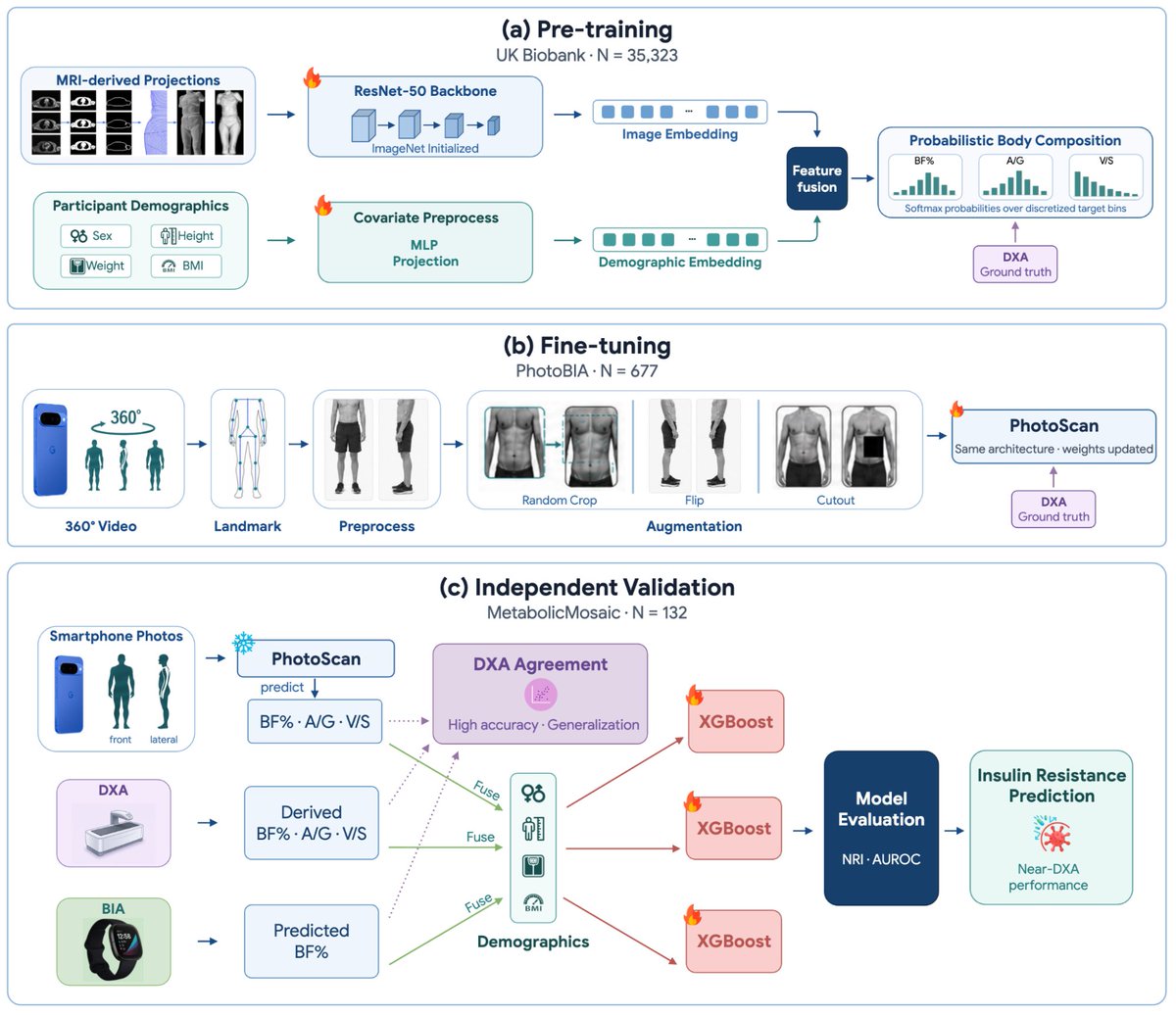
Today on the blog, we demonstrate the feasibility of a deep learning approach estimating body composition from smartphone photos, to predict insulin resistance with accuracy comparable to DXA scans in a clinical research setting. Read more →https://t.co/S6LV44N1wJ
those are some rough comments on the lastest claude models. sadly, i find a lot of my own experience in there. claude used to be the "easy to talk to" model. maybe claude 6 gets back to its roots.
https://t.co/sxPVnGmyht
More than 150 years ago, scientists discovered what they termed a “greenhouse effect”, demonstrating for the first time that water vapour and carbon dioxide trapped heat.
Theoretical concerns were soon raised that we might, through the practice of burning fossil fuels and releasing carbon, have inadvertently been altering our climate since the start of the industrial revolution.
In 1938 a British scientist published the first observational study suggesting that human carbon emissions were, indeed, heating the planet.
By the late 1950s, the science about global warming was so well established that legendary Hollywood film maker Frank Capra was hired to make a documentary, The Unchained Goddess, intended to educate the public about what then seemed a relatively far-off threat.
The film explained that the release by factories and vehicles of some six billion tons of carbon dioxide into the atmosphere each year – a paltry sum by today’s standards – was “unwittingly changing the world’s climate”.
In the 1970s scientists working for the oil companies privately confirmed to their employers that their research showed continued fossil fuel burning would dangerously raise global temperatures. The oil companies kept the information tightly under wraps for decades.
By 1982 an Exxon team had produced a chart predicting – though again confidentially – the increases in CO2 levels in the atmosphere over time. When the chart came to light in 2019, scientists realised that the team had, in fact, correctly plotted contemporary CO2 levels – at 415 parts per million – in what was then 37 years into the future.
The Exxon team had also correctly predicted what effect this would have on global temperatures: a disastrous rise of just below 1ºC.
In 1988 Nasa scientist James Hansen testified to the US Senate that he was 99 per cent certain global warming was already under way. His sounding of the alarm sparked for the first time headlines in mainstream media.
In response, the fossil fuel industry began aggressively funding “independent” think-tanks to spread disinformation, and create doubt about the established science.
In 2026, after more than a century of evidence-based warnings, all those predictions have been fully and catastrophically borne out – with heat records being toppled almost daily across western Europe. Drought and wild fires are the result.
And this isn’t even the worst of it. Things are going to get a whole lot hotter, and lot scarier, in the years and decades ahead.
Yet here we are, a century on, still hearing variations of the same arguments of denial promoted in the mainstream from the terminally dim-witted and serially dishonest.
This is an extract from my latest article Thatcher warned in 1989 of a climate crisis. She did nothing. Nor will her successors. Find a link to the full article in the reply post below ⬇️
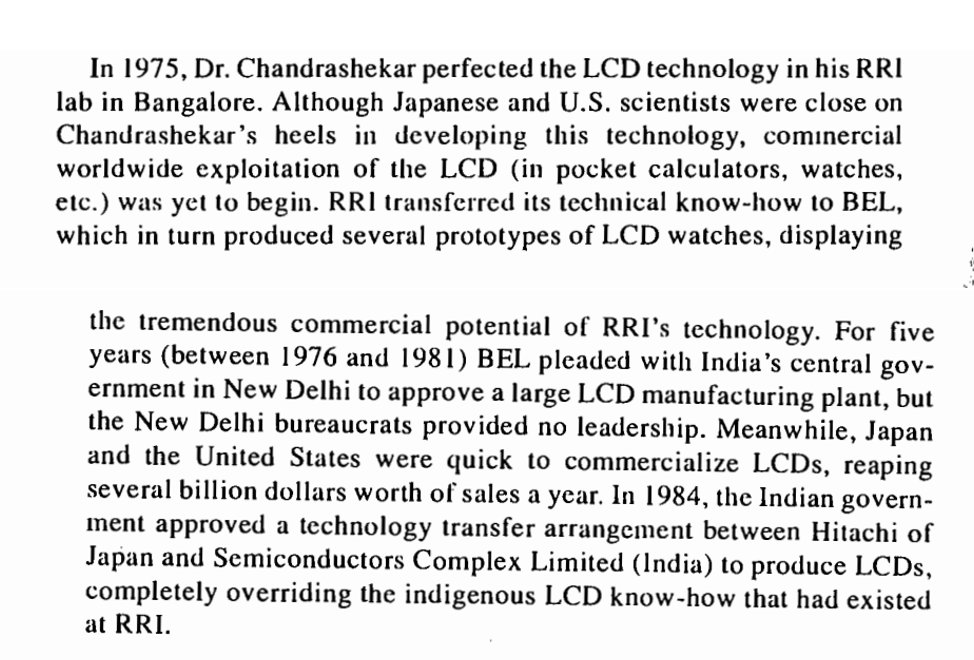
In the grandeur of semi-con, let's not forget how India missed the LCD bus. 👇
We literally developed the tech (Dr S Chandra, Raman Research Institute) indigenously at least few years before the Japs bought the tech from Americans & improvised it. Just to put things into perspective - Sharp Corpn paid $3 million to RCA for the patent on LCDs in the 70s and turned it into $30bn over the next 20 years.
Bureaucracy & complacency have killed many nations. It should serve as a lesson to all governments & corpns.
e.g. RCA in USA the pioneers of the LCD tech got intoxicated from the early success in TVs & under-mined the opportunities that existed in other areas such as watches & calculators which Japan capitalised.