We're well into the process of converting the Messaging app included in GrapheneOS into a modern app. We'll be making a new release later today with a completely overhauled user interface written in Android Compose. We've made a massive amount of other improvements and bug fixes beyond that too.
In the longer term, we plan to add support for RCS including support for the standard end-to-end encryption (E2EE) via Messaging Layer Security (MLS). Currently, RCS including E2EE is available on GrapheneOS via Google Messages. We want to avoid the need to use Google Messages for RCS eventually.
RCS on Android is currently implemented with code across the OS, Google Messages and Google Play services. Our plan is to start by making an equivalent to the portion in Google Messages. It would initially require sandboxed Google Play for RCS activation, etc. but we plan to implement that too..
RCS isn't an open platform in practice. It isn't even as open as SMS/MMS. It heavily depends on proprietary Google and carrier infrastructure in practice. We can start by replicating Google's approach and then we can work on only using carrier services for carriers where it's actually supported.
We're also going to be overhauling or fully replacing the rest of the AOSP apps in the near future. AOSP Gallery is incredibly outdated and is being entirely replaced. AOSP Keyboard may be similar. We recently hired a bunch of new people and will be hiring more so our progress will be accelerating.
In the past, our focus was nearly entirely on the base OS rather than bundled apps with alternatives available. We've heavily ramped up the resources we're investing into the bundled apps. We'll also be scaling up our work on the base OS too. More donations will enable us to hire even more people.
@ChShersh Please post a follow up the honeymoon period is over 😸 Keeping the underlying arch system up to date and stable is a very engaging task and not everyone likes it.
@the_ganguly@VivanVatsa That's because most of us are used to reading, writing and even thinking in English. It's not easy to break away from that but with practice, the script won't matter. I have many Japanese friends who feel the opposite. Writing english feels cumbersome to them 😃
कुण्डलिया
जन्मभूमि-मन्दिर महा श्रद्धा भगति अटूट।
फिर भी होने दी गई राम-धाम में लूट॥
राम-धाम में लूट शाह-मोदी चुप साधे।
न्यास संघ सब मौन बचन ना बोलें आधे।
कहे ‘मिश्र’ कविराय राम को जो आराधे।
उसके रिस को जन्मभूमि-मन्दिर ही बाधे॥
Fork your dependencies, trim them to only your use case, never update unless it breaks for your users. I’ve been vocal about this for 10+ years. I’ve always said that updating is way riskier than latent bugs (which can be tracked and CVEs monitored).
If you are updating a dependency, it’s on you to analyze every single commit in the full transitive set of dependencies. If you dont see anything compelling, dont update!
I remember at HashiCorp once in awhile an engineer would try to update a dep or replace a DIY lib with an external one and id always ask “show me the commit we need.” Dont update for the sake of it.
Feeling pretty swell about this mentality with all the supply chain attacks happening.
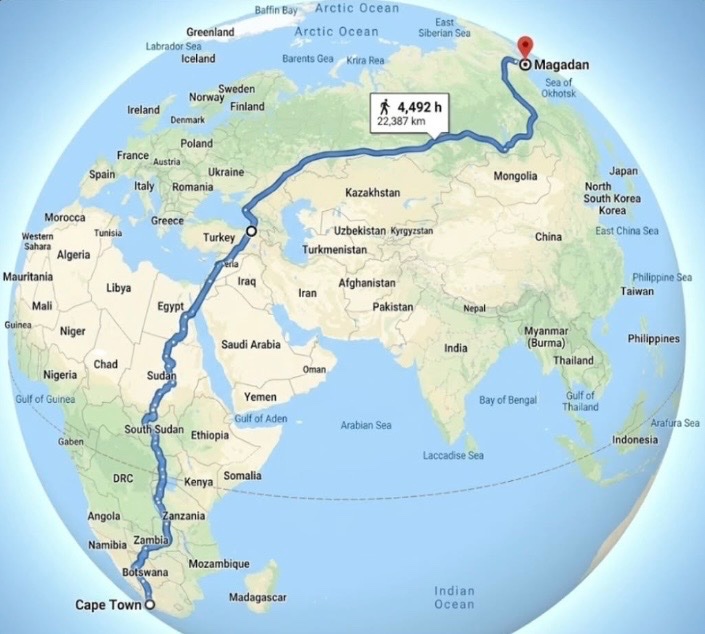
The longest road in the world that a person can walk...
The longest theoretically walkable road on Earth stretches from Cape Town to Magadan, spanning roughly 22,387 km (13,910 miles) without the need for any boat or air travel. The route passes through about 17 countries, crossing Africa, the Middle East, Central Asia, and into Siberia via connected roads and bridges.
Even at an ambitious pace of 12 hours of walking per day, the journey would take around a year to complete. At a more moderate schedule of 8 hours per day, it would extend to roughly a year and a half of continuous travel.
“उत्तिष्ठत जाग्रत प्राप्य वरान्निबोधत।” – उठो! जागो! और जब तक अभीप्सित लक्ष्य की प्राप्ति न हो जाए, तब तक बराबर उसकी ओर बढ़ते जाओ।
-- स्वामी विवेकानन्द
It is this discussion and presentation that is full of confusions and misconceptions.
(1) Firstly, it is halanta, not halant. 🤦♂️ The pronunciation and the subtitles in the clip are wrong and the spelling in the post is wrong as well. And all this in a discussion/post on schwa deletion. The irony!
(2) Halanta is not schwa deletion. Halanta means [a word/sequence] ending in a consonant. The term is also used for a pure consonant (without a vowel) and often used, though it is a misnomer, for the virāma sign (्) to show absence of a vowel. The halanta/virāma sign (्) means the vowel is not to be pronounced at all, ever. Schwa deletion, on the other hand, is the conditional deletion or elision of a schwa that is present after a consonant in speech, especially informal speech.
To summarise,
Halanta/virāma sign = total absence of vowel (vowel not present, not pronounced)
Schwa deletion = omission of a vowel in speech (vowel present but usually not pronounced, may be pronounced in some situations)
(3) Schwa deletion does not always happen in Hindi. Terminal and medial schwas are deleted under specific conditions which involve morpheme boundary, sequential constraints, origin of word, style of speech (formal/casual), and tempo of speech (slow/normal). Schwas are not deleted in Hindi in slow speech, literary speech/speech with high vocabulary, recitation of metrical poetry. Schwas are often retained in Hindi songs whenever required by the metre or the rhythm.
(4) Schwa deletion is not limited to Hindi in India. Medial and final schwa deletion occurs in most major Indo-Aryan languages (Punjabi, Hindi, Gujarati, Bengali, Marathi, Konkani, Dhivehi, etc.) with varying degrees. To single out native Hindi speakers is plain ignorance. Even the Wikipedia article on schwa deletion is titled Schwa deletion in Indo-Aryan languages.
(5) It is wrong, rather ludicrous, to say native Hindi speakers do not “get” the concept of schwa deletion. This is like saying native Punjabi speakers do not “get” the concept of voiced aspirates because spoken Punjabi has lost voiced aspirates or native Kannada speakers do not “get” the concept of aspiration because native Kannada words rarely have aspirates. A layperson does not understand linguistics, be it a native Hindi speaker or a speaker of another language.
Two more misconceptions about schwa deletion in Hindi:
(6) Schwa deletion is not intentional. It is a natural process for native speakers during informal/fast speech. Native Hindi speakers do not find it wrong when the words are pronounced with the schwas in slow speech, metrical poetry, songs, etc. Schwa deletion is a part of vowel deletion, a linguistic phenomenon seen in many Indian languages. Spoken Kannada also exhibits medial vowel deletion.
(7) Schwa deletion in Hindi is not the influence of Persian/Arabic or Urdu. Schwa deletion was present in Old Hindi (~10th century CE) as a short-vowel deletion rule, shown by B.G. Misra. Its presence in many other Indian languages shows a Middle Indo-Aryan origin.
References
Choudhury, M.; Basu, A.; Sarkar, S. (2004). A Diachronic Approach for Schwa Deletion in Indo-Aryan languages.
Dhore, M.L.; Dixit, S.K.; Dhore, R.M. (2012). Optimizing Transliteration for Hindi/Marathi to English Using only Two Weights.
Misra, B.G. (1967). Historical Phonology of Modern Hindi (1967).
Misra, N. (2021). Vowel Deletion in Spoken Kannada.
Ohala, M. (1983). Aspects of Hindi Phonology.
Panday, A.C. (1979). Some Aspects Of Hindi Phonology.
Pandey, P.K. (1980). Hindi Schwa Deletion.
समता के संवर्धन के लक्ष्य से विश्वविद्यालय अनुदान आयोग के प्रस्तावित विनियम समता के कल्पवृक्ष का नहीं अपितु विषमता के विषवृक्ष का बीज हैं। वर्तमान रूप में इनके क्रियान्वयन से देश में सामान्य वर्ग और अन्य वर्गों के विद्यार्थियों के बीच वैमनस्य बढ़ेगा। देश जुड़ेगा नहीं, बँटेगा।
जाति-आधारित भेदभाव की प्रस्तावित व्याख्या ही सामान्य वर्ग में आनेवाली जातियों के विरुद्ध जाति के आधार पर भेद-भाव है। ये कैसी विडम्बना है? इस व्याख्या को सर्वव्यापक बनाने की आवश्यकता है। “जन्म अथवा जाति के आधार पर [किसी के भी विरुद्ध] किया गया भेदभाव जाति-आधारित भेदभाव है” ऐसा विनियम बनाने में क्या जाता है?
भेदभाव के झूठे आरोप लगाने वालों पर दण्डात्मक नियन्त्रण का प्रावधान होना ही चाहिए।
प्रभुता के मद में चूर सत्तारूढ पक्ष और मौनव्रत धारण किए हुए प्रधानमन्त्री नहीं जागे तो उनकी राजनीतिक हानि अवश्य होगी।
विषम विनियमों से समता नहीं आएगी। समता आएगी ऐसे विनियमों और विधानों से जो निष्पक्ष हैं। आशा है भूलें सुधारी जाएँगीं।
जिनका चित्त विश्वास से भरा होता है वे अपने संपर्क में आने वाले प्रत्येक व्यक्ति पर विश्वास करते हैं, और एक दिन वे संसार पर विश्वास करते-करते स्वयं पर अविश्वास करने लगते हैं ! यह विश्वासी चित्त के लिए सर्वाधिक कठिन काल होता है।
इसलिए हमारे दिव्य संतों ने हमें जगत की अपेक्षा जगदीश्वर पर विश्वास करने का परामर्श दिया। परमात्मा पर पूर्ण विश्वास इस कठिन काल में विश्वासी व्यक्तियों के विश्वास की रक्षा करता है। परिणामस्वरूप वे पूर्ववत बिना विचलित हुए अपने संपर्क में आने वाले प्रत्येक व्यक्ति को विश्वास से पूर्ण करते रहते हैं।
पूज्य कबीरदास जी ने कहा है- “काह भरोसा देह का, बिनस जात छिन माहिं।
साँस-साँस सुमिरन करो, और यतन कछु नाहिं।” इस शरीर पर क्या भरोसा, यह पल भर में नष्ट हो जाता है। हर साँस में नाम जपो, यही एकमात्र उपाय है।~#आशुतोष_राना 🙏💐🤗
For our FM @nsitharaman@FinMinIndia@PMOIndia to act. This is not what our PM @narendramodi promised us. Our Ministers are failing our PM in ensuring citizens and tax payers are treated with respect, dignity as also promised by our constitution. Please ACT
Excellent video by @virsanghvi on the corrupt and boorish behaviour of @Delhicustoms. Put some body cams on them and make it a punishable offence to not wear name badges. You’ll see their manner improve instantly.