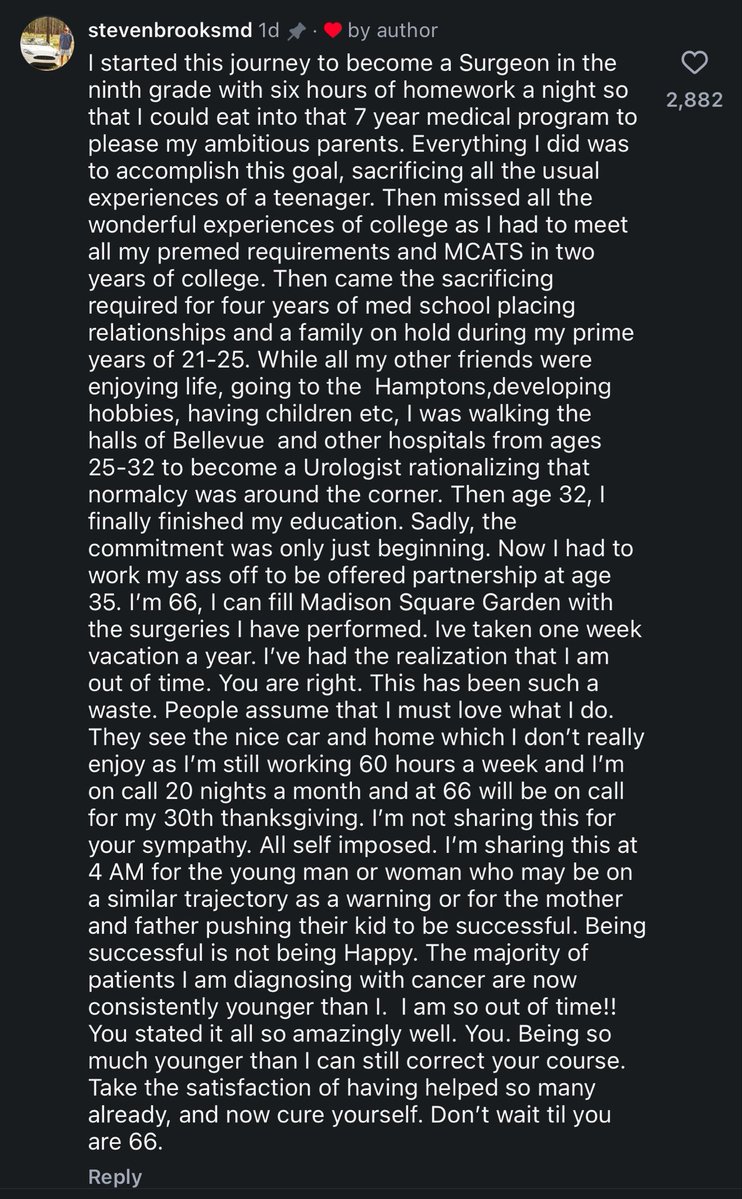
Burnout & moral injury in medicine have affected so many health care workers. As a mid-career physician, here’s what I’ve learned to combat it - I hope others find it to be helpful.
In Search of Joy and Meaning in Modern Medicine @JCOOP_ASCO https://t.co/NnR5cSbtPT
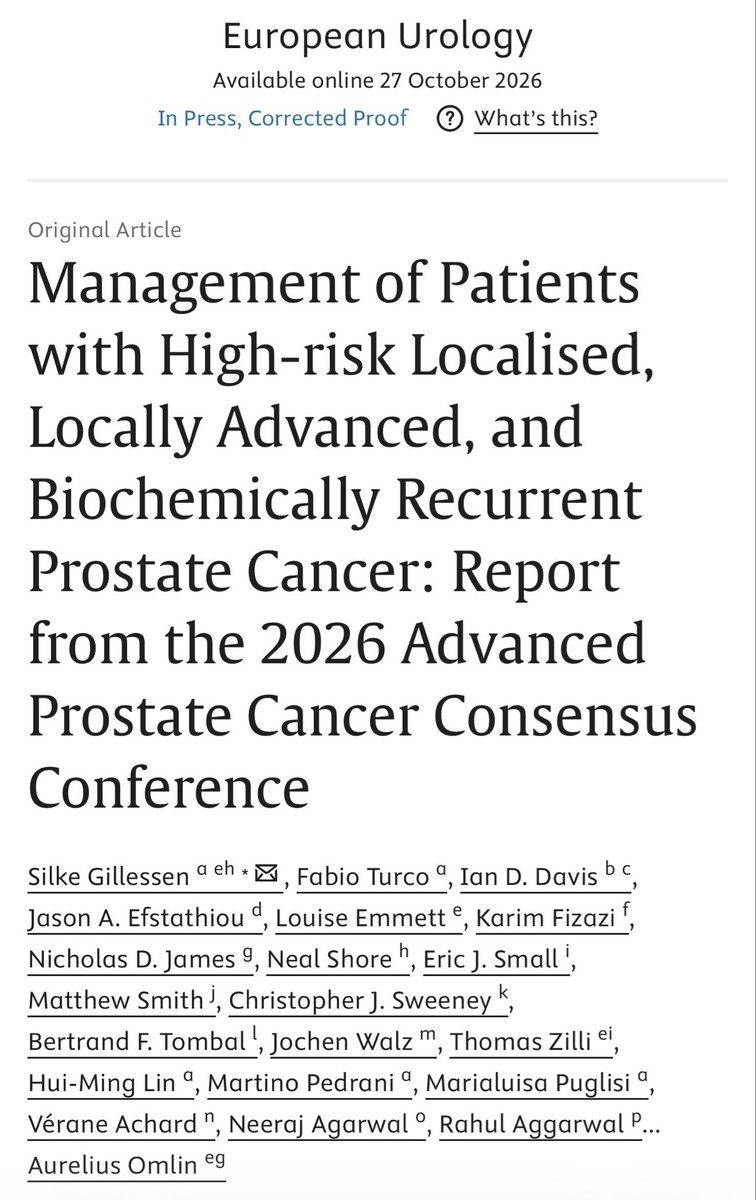
Amazing APCCC prostate consensus statement out today on early prostate cancer. Experts from around the world come together in Lugano to address the most contravercial issues. @Silke_Gillessen@neerajaiims@DrChoueiri@OncoAlert https://t.co/yplVhh2X3c
@jryckman3@Soum_Roy_RadOnc@ChapinMD@piet_ost@TonyFelefly I’m no expert either! Though I would be surprised if a spurious PSA elevation would go that high. Esp with such adverse pathology I’d be more concerned about subclinical cancer.
Virtually walking the halls at #ASTRO2026 as a medical oncologist, I keep coming back to the same thought: radiation oncology is quietly rewriting what “definitive local therapy” can look like.
The unveiling of Accela from @SiemensHealthineers is more than another linac. Single-breath-hold SBRT, multi-site treatments in ~60 seconds, imaging-to-beam-off in under 90 seconds. Speed that actually changes biology and logistics, not just throughput. Patients spend less time on the table. Targets have less chance to move. Adaptive workflows become practical rather than aspirational.
What strikes me most as a simple.medonc is the accumulating evidence that SBRT is matching surgery in more and more settings: early lung cancer, localized prostate (PACE-A data here this week), selected oligometastases, small HCC. Every time we add a tumor type to that list, we spare someone anesthesia, a wound, weeks of recovery, and the cascade of complications that still follow even “minimally invasive” operations.
Surgery will always have its place. But the risk-benefit conversation is shifting. For older, frail, or multi-morbid patients, the ones I see every clinic day, the non-invasive option is no longer a consolation prize. It is often the more thoughtful one.
The field is not just getting more precise. It is getting faster, smarter, and more humane. That is worth paying attention to, even from the medical oncology side of the hallway. Well done my fellow radoncs!!
🚨Medical students attending #ASTRO2026 — come meet us!!
Join @ClevelandClinic Radiation Oncology for a meet & greet to learn more about our program, meet our residents and faculty, and hear what life is like at Cleveland Clinic!
🗓️Sunday, Sept. 27 | 3:15-4:15pm
📍Booth 1635
I’ve learned that the choice is not simply between prestige and money. This generation of physicians may be willing to trade prestige for better financial opportunities, and some may be willing to trade financial gain for passion, and purpose. But what they are increasingly unwilling to trade away is autonomy, quality of life, and the feeling of being valued.
Prestige may attract people, purpose may keep them but respect, autonomy, and being valued are what make them stay.
🚨 GETUG-AFU 18: Does RT dose escalation improve survival in high-risk prostate cancer?
Phase III | N=505
High-risk non-metastatic prostate cancer
Long-term ADT + 80 Gy vs 70 Gy EBRT
📈 At 9.5-year median follow-up:
• 10-y PFS: 83.6% vs 72.2%
HR 0.56, p<0.0001
• 10-y OS: 77.0% vs 65.9%
HR 0.61, p=0.004
• 10-y prostate cancer-specific survival: 95.6% vs 90.0%
HR 0.48, p=0.009
✅ No meaningful increase in grade ≥3 toxicity:
Acute 24% vs 25%
Late 8% vs 7%
⚠️ Important caveat: only 92 progression events occurred vs 197 planned, and the 10-year PFS analysis was post hoc. OS and cancer-specific survival therefore need cautious interpretation.
Verdict: Strong long-term signal supporting adequate RT dose escalation with long-term ADT in high-risk disease, but not a clean licence to extrapolate 80 Gy conventional fractionation into every modern hypofractionated regimen.
@ASCO@oncoalert #ProstateCancer #RadOnc
🚨Medical students interested in #radonc please join us virtually to meet our amazing residents and learn all about CCF Rad Onc and the upcoming application cycle! We’re so excited to meet you! ☢️🌟
RSVP HERE: https://t.co/BnIvRSFLc7
From our paper https://t.co/PdY7obp42Q, RE vertebral body compression fracture (VCF) after spine SBRT —
tl;dr: The risk of VCF requiring intervention (kypho or stabilization) at 2y post spine SBRT was 11% for 24x1, 3.1% for 10x3, and 2% for 9x3.
Let's keep adding context, but from a different angle:
EviCore was formally created in 2014/2015 through a merger of MedSolutions and CareCore National.
The oldest EviCore radiotherapy guidelines I personally have archived is from 2019. I believe this was close to, if not THE first...but they make this difficult to find (for obvious and shady reasons).
But we can say with certainty that EviCore themselves deemed LDRT for osteoarthritis "medically necessary" at least as far back as 2019.
So what changed?
Well, though LDRT started its journey of rediscovery in America in 2020/2021, it was still relatively unknown to the public and uncommonly performed in American clinics.
Because LDRT, you know, actually works - more and more of us started to offer it, and patients have the ability to like...talk to each other.
In my own practice, for example, I have never once advertised. All of my LDRT patients are word of mouth self-referrals, or referrals from local doctors after they saw me treat their other patients.
Naturally, as this happened across the country, the public took notice.
In 2025, the radiotherapy professional society ASTRO made benign disease/LDRT the theme of their yearly conference.
As you can see from the Google Trends data, Americans searching for "low dose radiation therapy" really took off in early 2025 - and kept going.
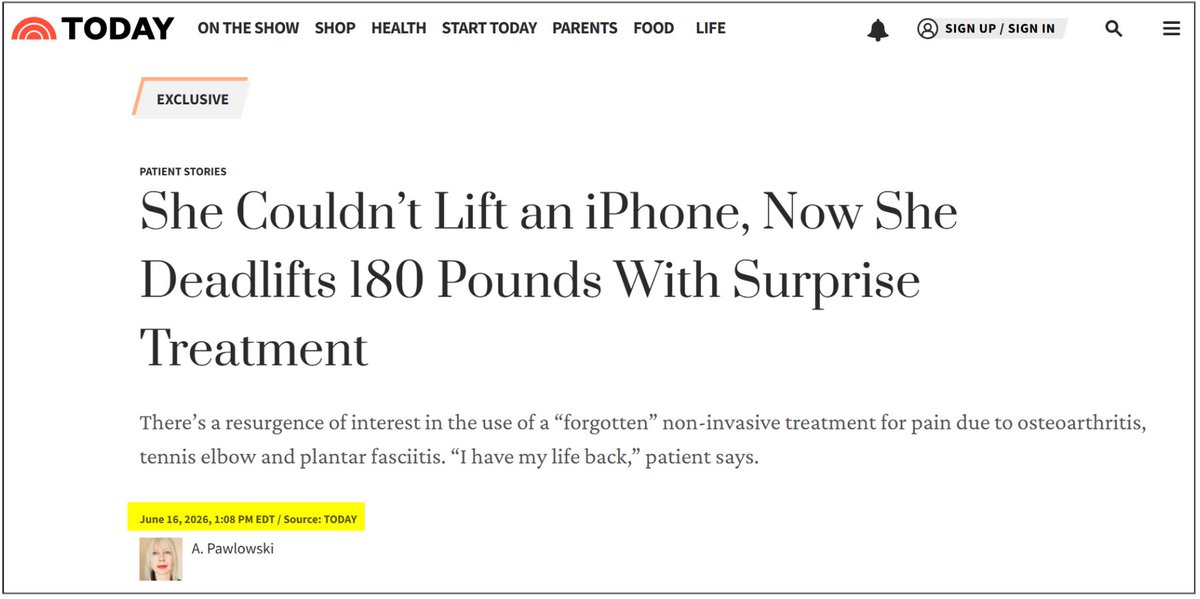
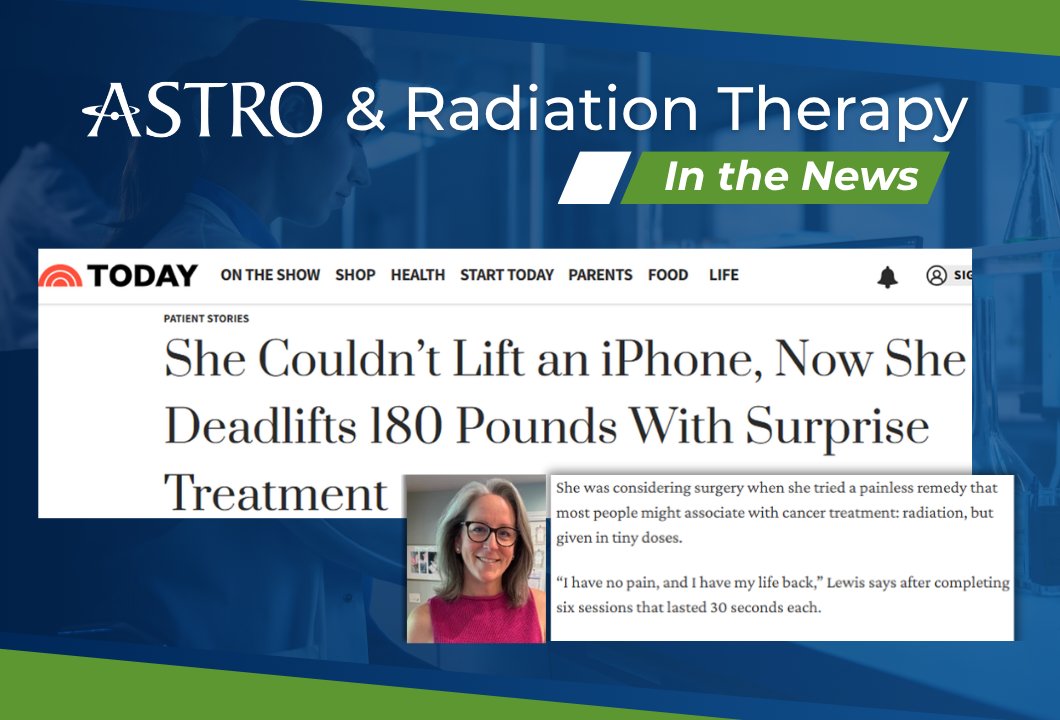
Recently, this culminated in an article appearing on NBC's "Today" website, authored by @LaVarsovienne.
It was a classic, feel-good story of LDRT literally making a person, well...feel good.
This article was published on June 16th, 2026, at 1:08PM.
As seen in the Google Trends data, June 2026 is currently the absolute pinnacle of public interest in LDRT.
Which makes sense. "Today" is a massive, international platform. A lot of people saw it.
Almost certainly the people at EviCore saw it.
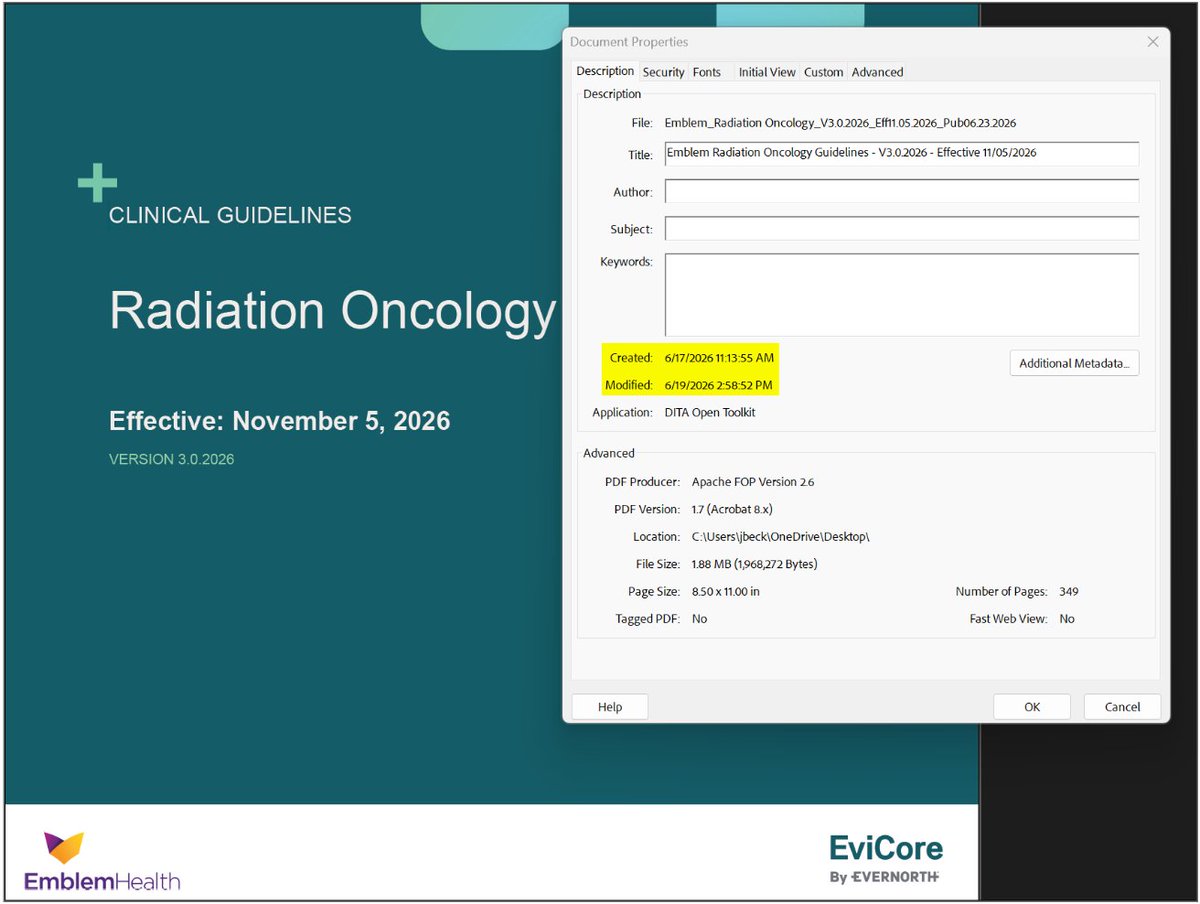
Which is why the PDF metadata of EviCore's latest guidelines - the one where they abruptly reverse course on LDRT - is extremely interesting.
What are the chances that this PDF was created on June 17th, 2026, at 11:13AM?
As in: 22 hours after one of the biggest platforms in the world runs a story on the benefits of LDRT, the largest benefits manager in the country creates the PDF of their newest guidelines, reversing course on covering this exact treatment, after explicitly covering it for nearly a decade?
Based on a fraudulent AI slop meta-analysis paper?
Really?
I mean sure, it COULD be a coincidence.
Or it could be that EviCore had already drafted most (all?) of this new version, saw this "Today" article drop on a Tuesday, internally said "nope, shut it down", and within 24 hours created this nonsensical non-coverage.
That's quite a coincidence for a company known to utilize their own AI platforms to make immediate, slash-and-burn decisions.
Within that context, it could be considered a consistent pattern of behavior.
Has anyone re-read that @statnews investigation into EviCore lately? The one from last year?
It's certainly compelling!
I’ve treated over 1,000 patients with low-dose radiation for benign musculoskeletal conditions. Effective this November, EviCore will classify the treatment as not medically necessary for nearly all of them.
Some context on how EviCore got here.
In 2019, EviCore’s own published criteria stated: “Policy: Radiation therapy is medically necessary” for plantar fasciitis and osteoarthritis, citing response rates near 80% with durability at 48 weeks. That position held through early 2026. The new guideline describes the same literature as a “paucity of evidence.” No reconciliation of the two positions has been published.
The cited sources don’t support the reversal either. The DEGRO guideline EviCore references recommends LDRT for refractory Kellgren 2–3 knee OA and grades plantar fasciitis radiotherapy at evidence level 1b, recommendation A. The 2024 VA evidence review found uncertainty on specific outcomes, not nonnecessity, and its literature search ended April 2023. The review is currently being updated as you are reading this.
Since that cutoff: a randomized, multicenter, sham-controlled trial presented at ASTRO 2025 showed 70% response with 3 Gy versus 42% with sham (p=0.014) in knee OA — the study design the earlier skepticism specifically called for. And the American Radium Society published multispecialty Appropriate Use Criteria, developed with rheumatologists and orthopedic surgeons, defining when LDRT is and isn’t appropriate.
I’ve applied strict evidence standards in my own AUC work, including voting against favorable ratings when randomized controlled data was lacking. This isn’t a plea for blanket coverage. It’s a request for basic consistency: an evidence review should account for the strongest available trial, accurately represent its cited sources, and explain what changed.
The patients affected are refractory with failed conservative care, often not surgical candidates. Categorical noncoverage removes even individualized review for the exact population every cited guideline identifies as appropriate.
Comment and appeal pathways are open through the November effective date. Our societies are engaged. If you treat these patients, now is the time to document and submit.
Sharing more widely how low dose radiation therapy is used for other health issues like tennis elbow, plantar fasciitis, osteoarthritis and more.....thank you @TODAYshow for bringing this info to more people. Great work #radonc@RTendulkarMD !!
ASTRO & Radiation Therapy in the news:
https://t.co/UCImGLAHLv
Learn more about Radiation Therapy: https://t.co/PI3vliKmKZ
Read about Functional Radiation Medicine: https://t.co/vKWDb64ac6
@TODAYshow@RTendulkarMD@CleClinicMD