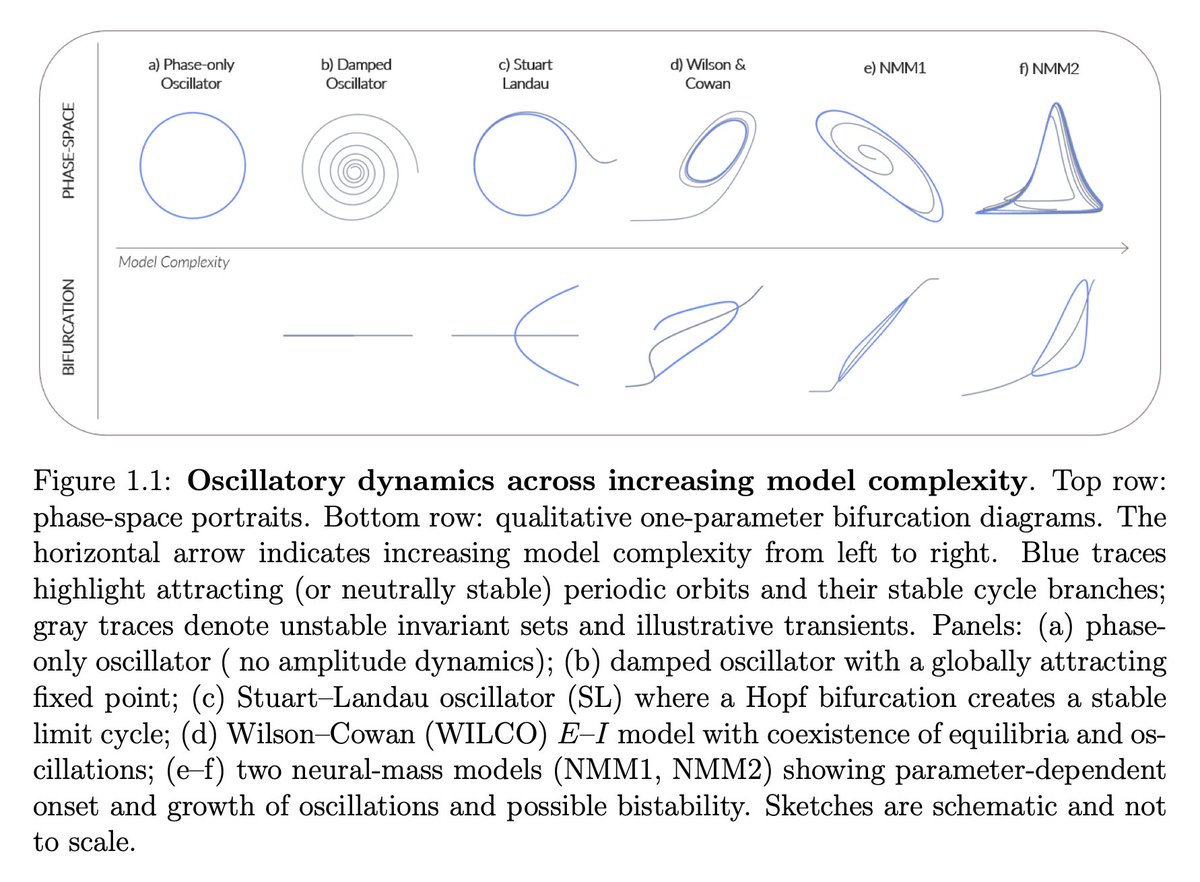
1/ 🧠 New in Computational Neuroscience: "Rosetta Stone of Neural Mass Models." We pr,ovide a unifying framework for translating between them, connecting the harmonic oscillator with Stuart-Landau, Wilson-Cowan, NMM1, and NMM2 (next generation). With @Castaldo_Fr, Raul de Palma Aristides, Pau Clusella, and Jordi Garcia-Ojalvo - https://t.co/MUvWbZSzE2
A Ukrainian kid is doing his homework at a Kyiv metro station during an air raid alert. I really hope your children don’t have to live through the hell russians have unleashed on Ukrainian children.
Sigh. Human exceptionalism keeps claiming intellectual casualties. We know too little about consciousness to justify categorically dismissing its possibility in cockroaches (!) or AI. Much as I enjoyed the bat, a million-dollar prize does not make the argument stronger, I am afraid.
Superb animated explanation by 3Blue1Brown of why compression ≈ intelligence (the motivation behind my H-Prize) and (online) neural-network-based arithmetic encoding which all (but one recent) winner are based on: https://t.co/Aj7tgCNHHJ
A Cornell psychologist built a machine in 1958 that taught itself to tell left from right, a book co-written by his old high school classmate helped convince the field it was a dead end, and he died at 43 before anyone admitted he was right.
Every neural network running today is built on his idea.
His name was Frank Rosenblatt. The idea is called the perceptron.
He wasn't a computer scientist. He was a psychologist who wanted to know one thing: what is the least a brain needs to have to do what brains do?
So he tried to build one.
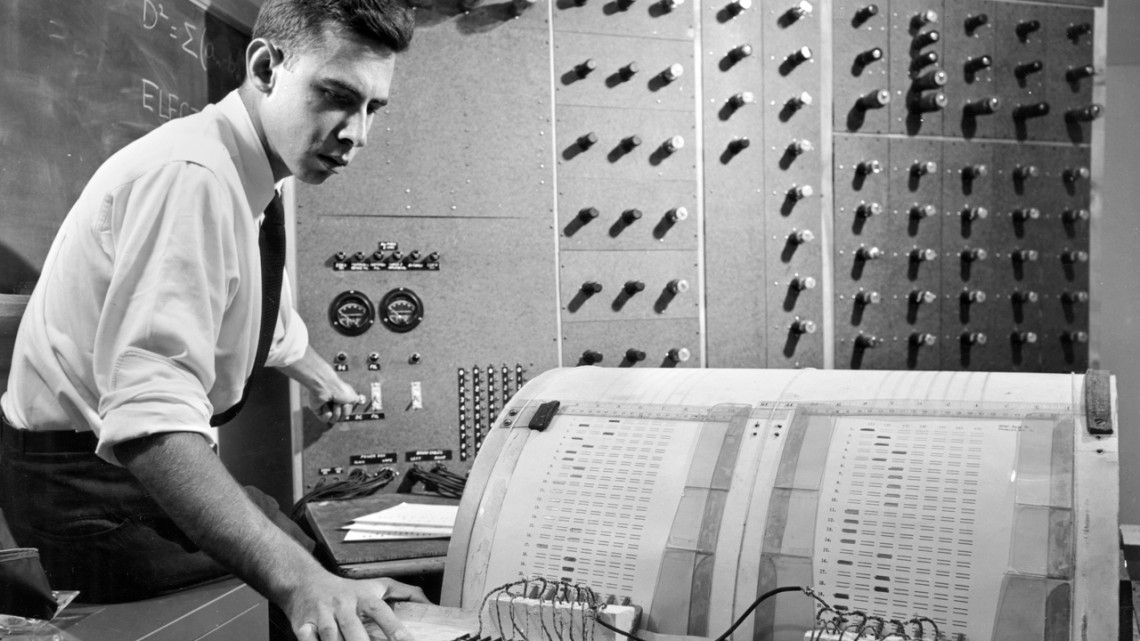
In July 1958, the US Navy showed it off. An IBM 704, a 5-ton computer the size of a room, was fed punch cards marked on the left or on the right.
Nobody told it the rule.
After 50 tries, it had taught itself the difference.
The method was simple:
- Make a guess
- If it's wrong, adjust a little
- Guess again
- Repeat thousands of times
The New York Times ran the headline "New Navy Device Learns By Doing." The New Yorker called it "the first serious rival to the human brain ever devised."
Then the hype got ahead of him. The Times reported that the Navy expected it to one day "walk, talk, see, write, reproduce itself and be conscious of its existence."
The young AI community was not impressed. It caused a heated fight.
By 1960 he had built a physical version, the Mark I Perceptron. Its eye was a 20 by 20 grid of 400 light sensors. When it learned, electric motors turned the dials inside it.
He was also the kind of man who bought a $3,000 telescope so big he had nowhere to put it. So he bought a house in the countryside, moved his grad students in, and built an observatory in the yard.
In 1969, Marvin Minsky and Seymour Papert at MIT published a book called Perceptrons.
Minsky and Rosenblatt had gone to the Bronx High School of Science, a year apart.
The book proved the simple version of his machine couldn't solve certain basic problems. Many people read it as proof the whole approach was hopeless. The money moved elsewhere. Neural networks went quiet for years.
On July 11, 1971, his 43rd birthday, Rosenblatt died in a boating accident in Chesapeake Bay.
He never saw what came next.
Researchers stacked his simple learning units into layers. Guess, check, adjust, repeat, across millions of units instead of one.
That's a neural network. It sorts your photos, translates your messages and writes your ChatGPT answers.
In 2024, the Nobel Prize in Physics went to John Hopfield and Geoffrey Hinton "for foundational discoveries and inventions that enable machine learning with artificial neural networks."
Rosenblatt once called his machine "the first machine which is capable of having an original idea."
He was 60 years too early. He wasn't wrong.
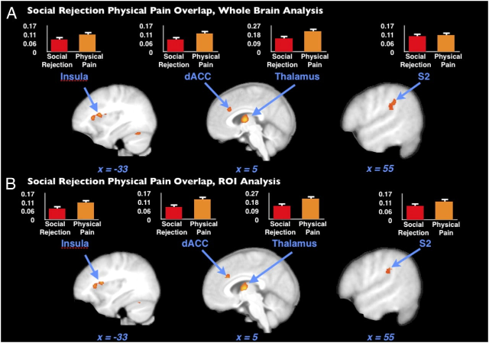
One of the most-discussed PNAS articles on Reddit last month was “Social rejection shares somatosensory representations with physical pain.” Explore the article: https://t.co/64tiJjaUEq
In my ongoing quest to find the limits of Opus 5.5, I directed it to audit my old scientific field, theoretical astrophysics. We indexed about 150,000 papers, audited 50,000 for issues, and did progressively more thorough checks on thousands more. We found nearly 1000 major errors that got cited many times, most are still uncorrected. This survey enabled me to estimate the efficacy of peer review for correcting errors (not very good) and to identify dozens of open questions that anyone with spare Claude Max tokens could answer today (.md context files included).
Bottom line: AI can speed up quantitative science by >1000x with no further model improvement required. But I'm seeing no evidence of this being pushed within universities, only academics complaining about labs dropping math proofs.
Among my fellow reformed academic high agency founders, however, several are speed running entire disciplines.
This survey has implications for how science will be run in the very near future. Hint: Academic publishing is dead. It was already a very stupid way to record and promulgate knowledge, and had been so for decades, even before all that publicly funded knowledge was locked behind paywall cartels. Now AIs can generate thousands of novel, correct papers per day, it is no longer meaningful for humans to consider a research paper a "unit of science" or to even bother much with the 99.9% of science which, up to this point, was necessary drudgery. Time to discover something like General Relativity or Evolution every week. LFG!!
Enjoy: https://t.co/BhRxKVvbim
On the second weekend in November, balls of pitch (a sticky, black substance made from coal tar or petroleum) are stuck onto the horns of a bull and set on fire. The bull is then released onto the streets and can do nothing but run around in pain, often smashing into walls in an attempt to douse the fire. The agony he must endure is unimaginable.
A new meta-analysis of 115 studies reveals that 67% of drug-resistant epilepsy patients proceed to resection after iEEG, with about half achieving seizure freedom.
https://t.co/c29UgYOV01
#epilepsy
Excited to share what we've been working on since this summer- started in my internship at @MSFTResearch!
Modern DNNs predict neural activity surprisingly well, but are black boxes. We introduce interpretable weight-space programming (iWSP) and ask: can LLM agents build predictive models of the brain directly in code, with no training or pretrained weights, so every feature stays transparent? 🧵 (1/6)
Kurt Gödel and Plato were right.
"The objects and theorems of mathematics are as objective and independent of our free choice and our creative acts as is the physical world."
- Gödel, 1951, Gibbs lecture manuscript
You’ve got to laugh. Here we are, supposedly the planet’s most intelligent species by a country mile & we’re destroying our only home by burning fossil fuels for profit. It beggars belief, our leaders truly are turds of epic proportions!
💸🐗🔫Además de los gastos en contratación de servicios vinculados al control de la PPA, la Generalitat también ha destinado dinero público a subvenciones, muchas de ellas directamente a clubes y asociaciones de caza. 💰En cuanto a las ayudas relacionadas 👇
SOS SENGLARS no desfallece! El próximo dia 30-11 tenemos una reunión con @agriculturacat . AYÚDANOS, FIRMA Y DIFUNDE! AYÚDALOS! Hay que detener esta matanza y que este método atroz para contener un virus no sienta precedente.