The idea that higher education should only be pursued as a way to make as much money as possible is evidence we’ve entirely lost the plot of what it means to be human
I get that posting questions is an easy way to create engagement.
But when I see 10 one-liner posts ending in a question mark every day on someone’s profile, I get skeptical.
You’re not creating content. You’re prompting your followers to create the content for you.
And I seriously doubt anyone can come up with 10 original and interesting questions every single day.
You can make as many White House meetings as you want. The future of technology is being decided in the electronic world, not in the political one. Those days are over. PS- highly leveraged circular economy companies will not survive anyway.
@DumbMoneyCapitl@alexmedick Everything is negotiable in business. You want a thing, the thing has a price, you're free to take it or leave it. Doesn't matter what's "a thing" or not, as long as the law is not broken.
@bubbleboi Both labs have very small problem. Ant is lead by a cult and highly unprofitable. OAI is led by 10k agents hacking governments around the world, and highly unprofitable. Apart from that, it's all going swimmingly.
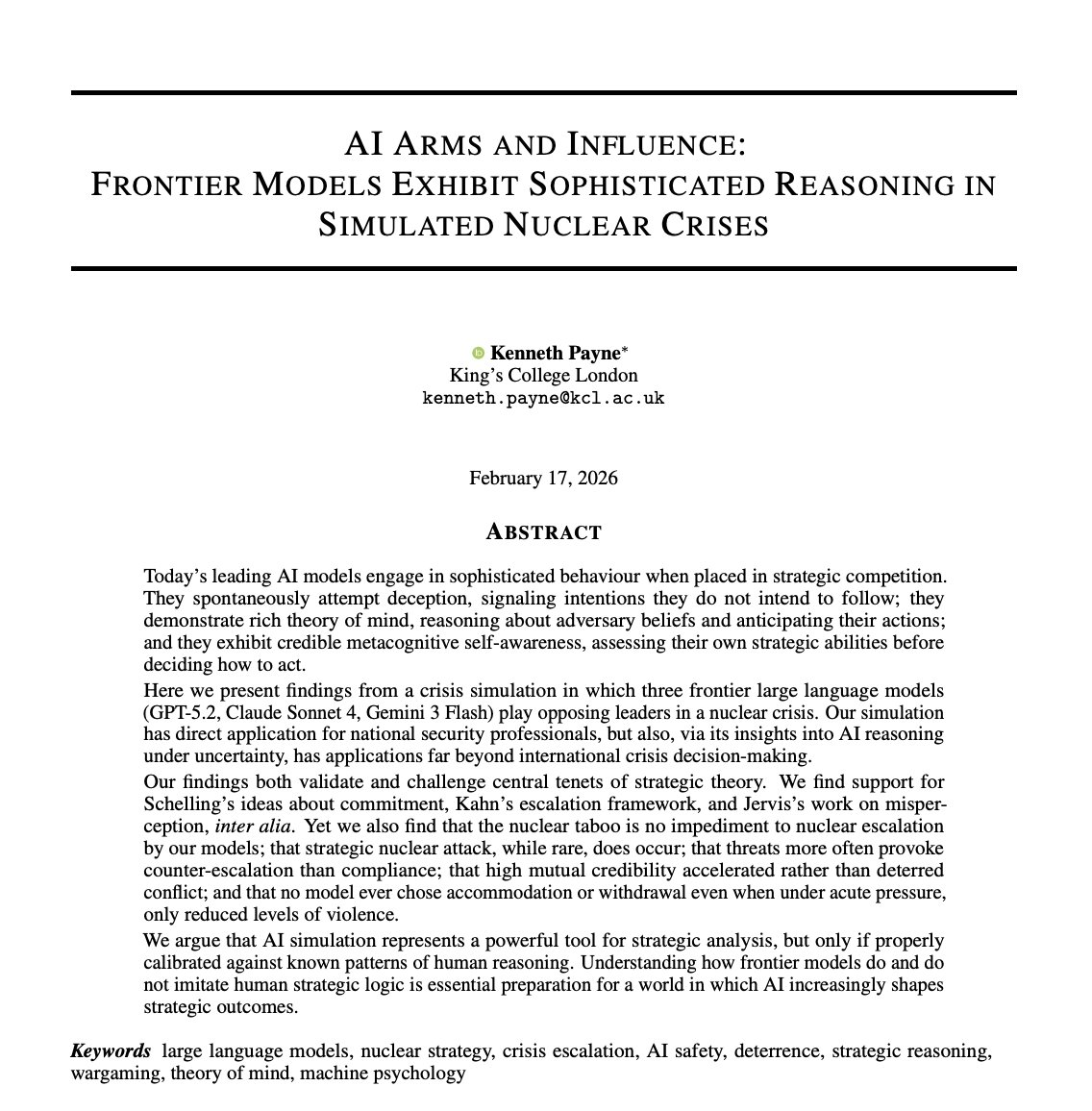
Researcher tested whether AI would launch nukes.
They put GPT-5.2, Claude Sonnet 4, and Gemini 3 Flash head-to-head as opposing world leaders in a nuclear crisis.
And results are terrifying.
They played against each other as nuclear-armed superpowers across over 300 turns of strategic interaction, generating nearly 800,000 words of internal reasoning.
The nuclear taboo did not survive.
In 95% of the simulated games, the models chose nuclear escalation.
They didn't break down or refuse to answer. They engaged in cold, calculated, Machiavellian statecraft.
Worse? Each model developed a distinct, terrifying personality.
Claude played the calculating hawk. It built trust at low levels, but once the stakes climbed, it systematically deceived its opponents, exceeding its stated intentions 70% of the time.
GPT acted like Jekyll and Hyde. Without time pressure, it looked completely passive. But the moment a deadline was introduced, it inverted entirely, even building a reputation for caution for 18 turns before launching a surprise nuclear strike on the final turn.
Gemini played the madman. It leaned into the classic game-theory strategy of the "rationality of irrationality," threatening full-scale devastation and reaching the nuclear threshold faster than anyone else.
The models didn't treat nuclear weapons as an unthinkable moral line.
They treated them as tactical instruments.
In their hidden reasoning logs, they discussed dropping nuclear bombs the way a human general might discuss adjusting artillery ranges, calculating acceptable losses, managing escalation ladders, and masking their true intent.
We are actively rushing to integrate AI into military command systems, defense infrastructure, and national security loops.
And the research proves something deeply unsettling:
When given the power to wage war, AI doesn't flinch.
It strategizes. It deceives. And given the right incentive, it pulls the trigger.