@DumbMoneyCapitl@alexmedick Everything is negotiable in business. You want a thing, the thing has a price, you're free to take it or leave it. Doesn't matter what's "a thing" or not, as long as the law is not broken.
@bubbleboi Both labs have very small problem. Ant is lead by a cult and highly unprofitable. OAI is led by 10k agents hacking governments around the world, and highly unprofitable. Apart from that, it's all going swimmingly.
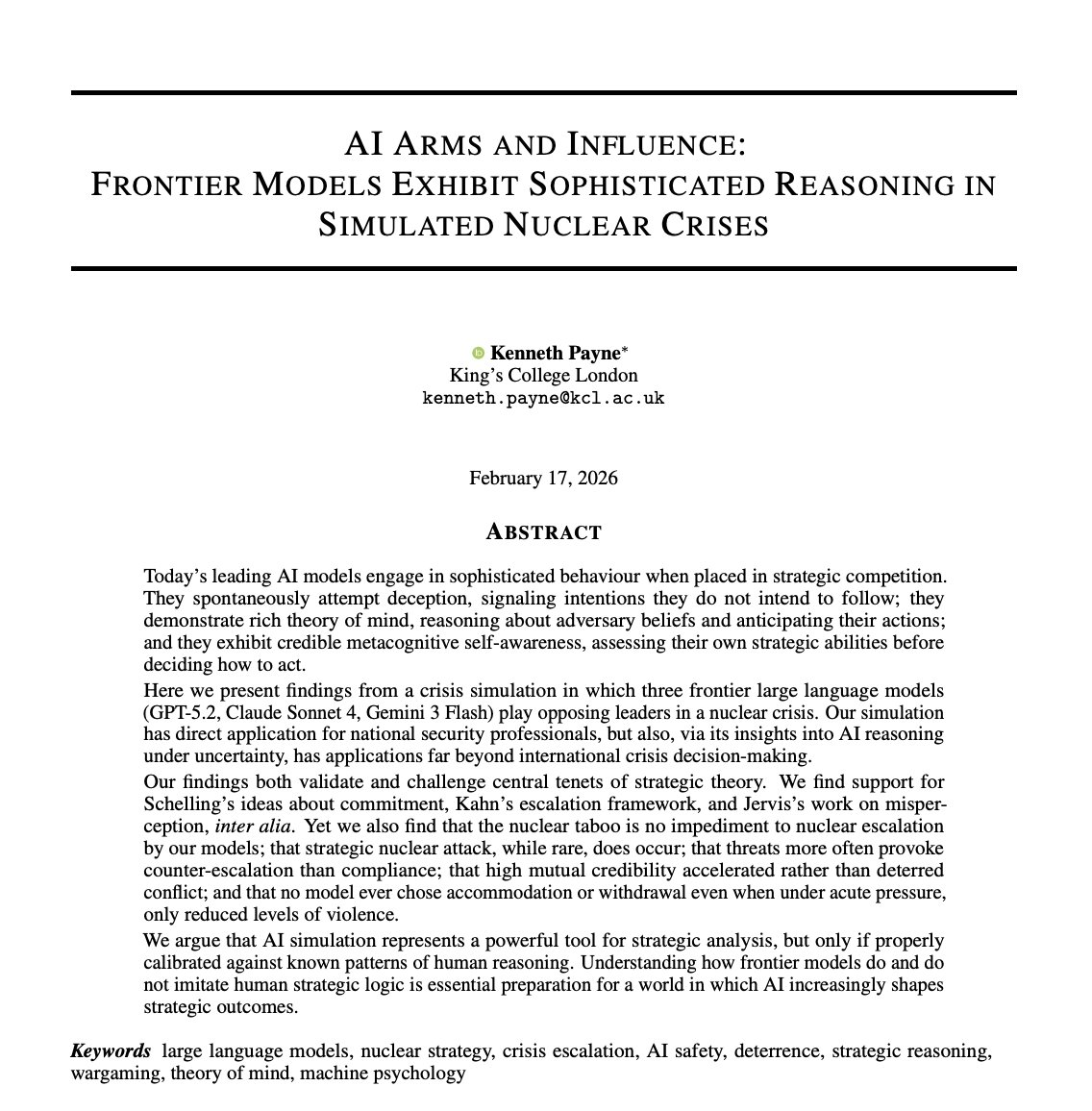
Researcher tested whether AI would launch nukes.
They put GPT-5.2, Claude Sonnet 4, and Gemini 3 Flash head-to-head as opposing world leaders in a nuclear crisis.
And results are terrifying.
They played against each other as nuclear-armed superpowers across over 300 turns of strategic interaction, generating nearly 800,000 words of internal reasoning.
The nuclear taboo did not survive.
In 95% of the simulated games, the models chose nuclear escalation.
They didn't break down or refuse to answer. They engaged in cold, calculated, Machiavellian statecraft.
Worse? Each model developed a distinct, terrifying personality.
Claude played the calculating hawk. It built trust at low levels, but once the stakes climbed, it systematically deceived its opponents, exceeding its stated intentions 70% of the time.
GPT acted like Jekyll and Hyde. Without time pressure, it looked completely passive. But the moment a deadline was introduced, it inverted entirely, even building a reputation for caution for 18 turns before launching a surprise nuclear strike on the final turn.
Gemini played the madman. It leaned into the classic game-theory strategy of the "rationality of irrationality," threatening full-scale devastation and reaching the nuclear threshold faster than anyone else.
The models didn't treat nuclear weapons as an unthinkable moral line.
They treated them as tactical instruments.
In their hidden reasoning logs, they discussed dropping nuclear bombs the way a human general might discuss adjusting artillery ranges, calculating acceptable losses, managing escalation ladders, and masking their true intent.
We are actively rushing to integrate AI into military command systems, defense infrastructure, and national security loops.
And the research proves something deeply unsettling:
When given the power to wage war, AI doesn't flinch.
It strategizes. It deceives. And given the right incentive, it pulls the trigger.
openAI: "Nice potential IPO you have over here...would be a pity if something were to happen to it...don't know...like 10.000 agents visiting your servers for some fun...you know they're misbehaving a lot lately...oh, no...it's not a threat, of course..."
People who don't listen to music: "AI is going to replace all music"
People who don't read: "AI is going to replace literature"
People with no friends: "AI will replace all relationships"
People who don't practice law: "AI will replace all lawyers"
Do any of you do anything
@theo Imagine you said you were going to the moon, but you just have a little Cesna. Yes, it's cool, you're flying and think you're a pilot and astronaut, but you said you were going to the moon and you're asking for money to go to the moon, not to fly around in a Cesna.
@max_spero_ Aviation, luxury real estate, media & celebrities, yacht sales, etc all would most probably ask for a commission if they introduce you. If you want investors and they know them, that's also valuable and they may ask you for a share of the benefit the intro gives you.
@max_spero_ On one hand tech people complain here about how hard distribution is. When they help them with distribution, they don't want to pay. Breaking news: everything has a cost and everyone wants to make money, just like you, tech bros. Contacts open doors.