A GUY MAKING $100K/MONTH WITH AI JUST SHOWED HIS ENTIRE SETUP. IT'S ONE FOLDER OF NOTES AND NOTHING ELSE
no framework. no $500 course. he opens his screen and it's just obsidian - a plain notes app - wired into claude
here's what he did:
-> he pulled claude's memory files out of their default folder and dumped them into one vault
-> had claude rename and merge them: 107 messy files collapsed into 17 clean ones
-> every folder gets one master note that links to all the others
that last part is the whole trick
the agent reads the master note, follows the links and by the time it's done it has read every file in the folder. one instruction, full context
here's the part most people miss:
everyone's trying to make the AI smarter. he made the AI's memory smaller
fewer files, better organized, all linked. the agent isn't scanning hundreds of notes anymore - it walks a path you built
that's why his agent actually finishes jobs instead of forgetting what it was doing halfway through
then he goes one step further:
at the end of every session, the agent writes its own daily note. what it did, when, indexed at the top so it can find it again in seconds
so he never re-explains anything. the agent looks up what it already did
now he types "create a campaign for this offer" and walks away. it reads the product notes, reads the process notes, and comes back with the campaign done
you don't need any of the complicated agent tools people are selling you. you need structure and instructions
save this. the people winning with AI aren't using better models. they're just the only ones who bothered to organize what it remembers
🚨BREAKING: Iran just dropped another AI LEGO video…
And somehow, it’s a more accurate summary of the U.S. government than anything coming out of the U.S. government.
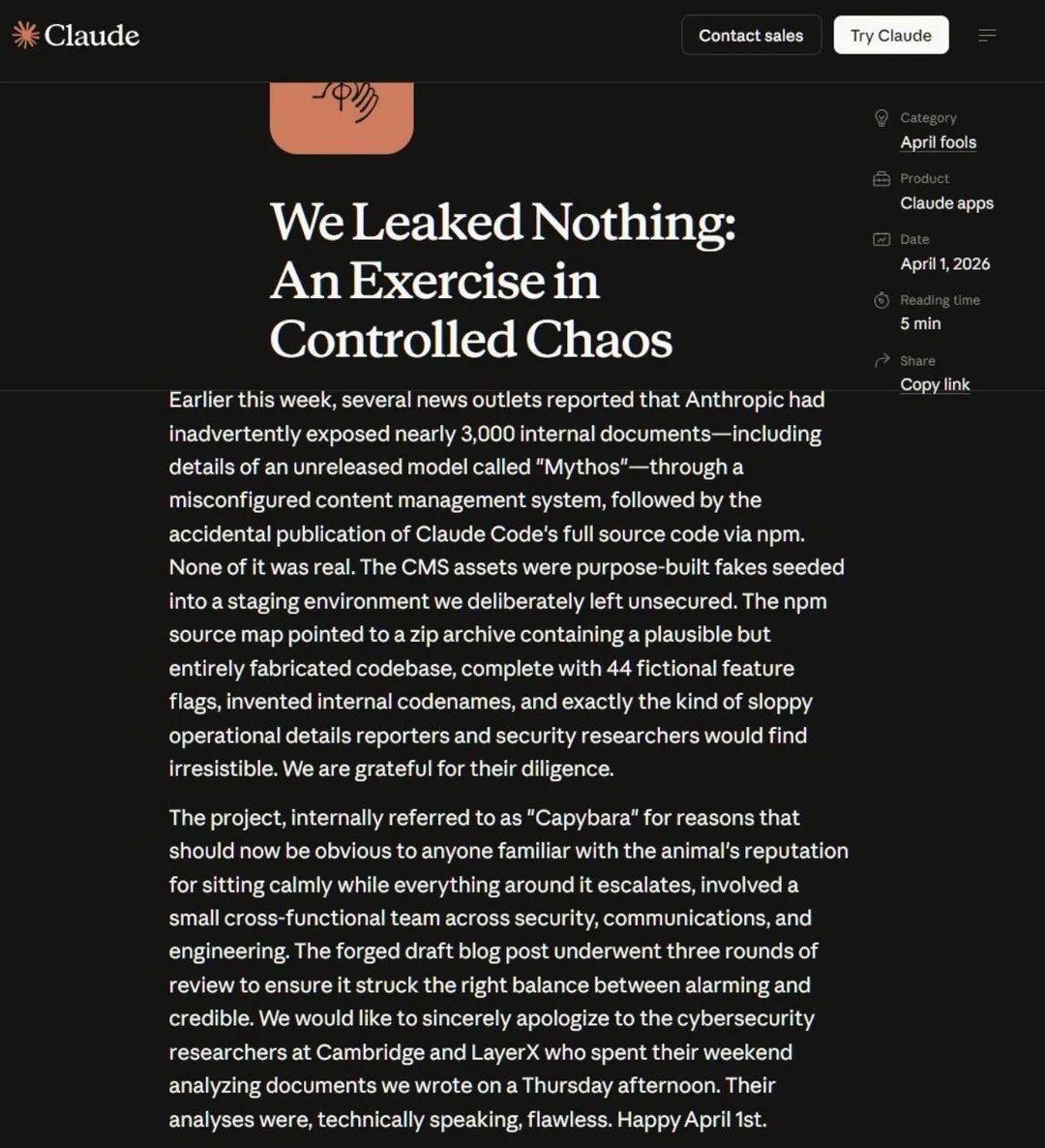
ANTHROPIC JUST ADMITTED THE ENTIRE CLAUDE CODE LEAK WAS FAKE
IT WAS AN APRIL FOOLS PRANK
> the "leaked" source code was fabricated
> the Mythos model benchmarks were made up
> the 3,000 internal documents were planted on purpose
anthropic deliberately seeded fake assets in a staging environment they intentionally left unsecured.
the npm source map pointed to a completely fabricated codebase 44 fictional feature flags. invented codenames. just enough sloppy details to make it irresistible to post about
the tamagotchi pet system. the undercover mode. the engineer named ollie. all fake.
they called the project "Capybara" internally
because capybaras sit calmly while everything around them escalates
they even apologized to cybersecurity researchers at Cambridge and LayerX who spent their entire weekend analyzing documents written on a Thursday afternoon
anthropic just pulled off the greatest april fools in tech history.
well played
Reverend Jesse Jackson called on each of us to be heralds of change, to be messengers of hope; to step forward and say “Send me” wherever we have a chance to make an impact.
How fortunate we were that Jesse Jackson answered that call. What a great debt we owe to him.
GPT-5.4 is here.
Native computer-use capabilities.
Up to 1M tokens of context in Codex and the API.
Best-in-class agentic coding for complex tasks.
Scalable tool search across larger ecosystems.
More efficient reasoning for long, tool-heavy workflows.
https://t.co/xuLt562S9b
Warren Buffett: "My dad was always very forgiving of my misbehavior. He'd just say, 'I know you can do better.' That was very powerful stuff… because I could do better. I knew it and he knew it. It's nice to have somebody have faith in you."
This 40-minute Peter Thiel lecture will teach you more about business than a 2-year MBA program:
Summary:
• Value Creation and Capture:
A valuable company must both create value (X dollars) for the world and capture a percentage (Y%) of that value.
X (total value created) and Y (share captured) are independent variables; a company can succeed with either a large X and small Y or vice versa.
• Monopoly vs Perfect Competition:
Monopolies are stable, profitable, and create long-term value, unlike perfectly competitive industries where profits are eroded away.
The airline industry exemplifies a highly competitive market with very low profit margins despite large revenues, contrasted with Google’s search business that is smaller in revenue but much more profitable due to monopoly power.
Thiel argues there are only two types of businesses: monopolies and perfectly competitive firms, with very few in between.
• Market Size and Perception Lies:
Companies distort their market descriptions depending on their position.
Monopolists exaggerate market size by describing their market as a vast union of many different sectors to avoid regulatory scrutiny.
Non-monopolists minimize market size, describing it narrowly to appear unique and attract investment.
Example: A restaurant owner might claim to serve a tiny niche market (e.g., British food in Palo Alto) to claim uniqueness, while Google describes itself broadly as a technology or advertising company to dilute monopoly perception.
Successful startups begin by dominating a small market and then expand outward.
Examples include Amazon starting as an online bookstore, PayPal targeting eBay power sellers, and Facebook launching initially at Harvard.
Starting with a large, broad market is often a sign of misunderstanding the market and leads to intense competition and failure (e.g., many clean tech companies).
• Last Mover Advantage:
The greatest value lies in being the company that dominates a market long-term, not necessarily the first mover.
Most of the value of tech companies comes from future cash flows many years ahead, emphasizing durability over short-term growth.
• Historical Perspective on Innovation and Value Capture:
Throughout history, many scientific and technological breakthroughs created large societal value (X), but the innovators rarely captured substantial financial value (Y close to zero).
Examples include great scientists like Einstein and industries such as railroads or early aviation, where competition or structural factors prevented wealth capture.
Two main categories where value capture was successful:
1. Vertically integrated monopolies (e.g., Ford, Standard Oil) require complex coordination and capital investment.
2. Software businesses, benefiting from near-zero marginal costs and rapid adoption.
• Psychological and Cultural Aspects of Competition:
Society often romanticizes competition, seeing losing as a personal failure, but Thiel argues that competition itself is a form of losing, as it destroys value and capital.
Human nature is mimetic (imitative), leading to overcrowded markets and irrational competition.
Real success comes from escaping competition by finding unique, overlooked opportunities.