🚀Introducing Motus, the open-source agent infrastructure that learns in production.
Existing agent infra serves static agents: the harness, model, and workflow are fixed after deployment. But static agents degrade over time. The harness goes stale, new models go unincorporated, context drifts, and latency compounds.
Motus closes this gap by learning from every trace (failures, latency, cost, and task outcomes) and using those signals to continuously optimize agent harness, model orchestration, context memory, and end-to-end latency.
Early results: higher accuracy than any single frontier model at 2.3× lower cost (Terminal-Bench 2.0, SWE-bench Verified), with 52% lower latency and 45% better memory recall.
Open source under Apache 2.0. Works with any agent SDK. Deploy with one command.
https://t.co/C4u6JUzige
https://t.co/QIfKIikZQb
@charles_irl@rahulgs@akshat_b@_dcw02@modal We wrote a concurrent work that also explored the policies around using dLLMs as drafters: https://t.co/g9IJbYNmD5. TLDR: dLLM’s acceptance rate is not necessarily higher, but its ability to unmask multiple tokens in each forward pass allows them to generate longer drafts cheaply
Introducing DeepConf: Deep Think with Confidence
🚀 First method to achieve 99.9% on AIME 2025 with open-source models! Using GPT-OSS-120B even without tools, we reached this almost-perfect accuracy while saving up to 85% generated tokens.
It also delivers many strong advantages for parallel thinking:
🔥 Performance boost: ~10% accuracy across models & datasets
⚡ Ultra-efficient: Up to 85% fewer tokens generated
🔧 Plug & play: Works with ANY existing model - zero training needed (no hyperparameter tuning as well!)
⭐ Easy to deploy: Just ~50 lines of code in vLLM (see PR below)
📚 Paper: https://t.co/jnBnRzQczh
🌐 Project: https://t.co/kGq1kATTu0
joint work with: @FuYichao123 , xuewei_wang, @tydsh
(see details in the comments below)
[1/N] 🚀 Excited to introduce my first work at @Princeton:
LessIsMore – a training-free sparse attention method tailored for efficient reasoning in LRMs, achieving lossless accuracy with high sparsity up to 87.5% and 1.1x avg decoding speedup compared to Full Attention on reasoning tasks like AIME-24. (More details in 🧵)
💻 Code: https://t.co/5e4QC2A6S2
📄 arXiv: https://t.co/yXyTqRjPe0
🔍 HF Daily Paper: https://t.co/yXyTqRjPe0
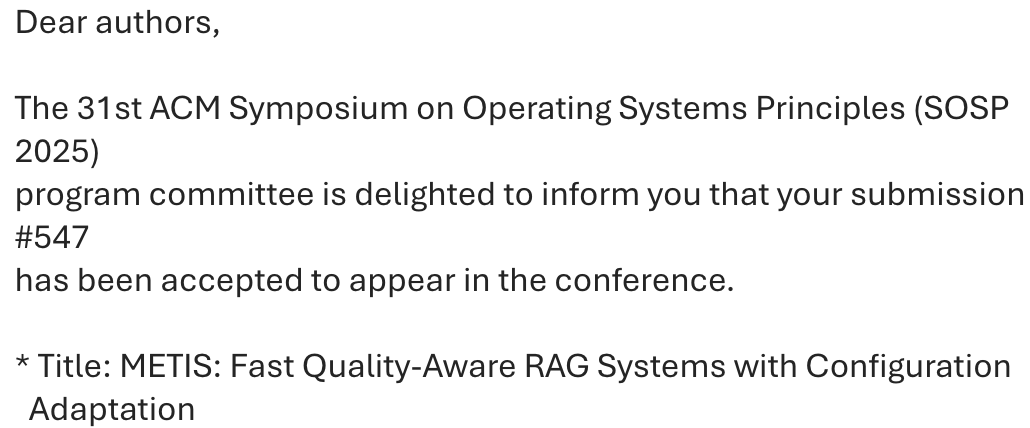
With RAG and agents becoming ubiquitous in LLM systems, tuning quality and performance JOINTLY is essential to achieve the best LLM quality-of-experience.
Our paper at SOSP this year, addresses this exact tradeoff!🔥
A quick update on the future of the `transformers` library!
In order to provide a source of truth for all models, we are working with the rest of the ecosystem to make the modeling code the standard.
A joint effort with vLLM, LlamaCPP, SGLang, Mlx, Qwen, Glm, Unsloth, Axoloth, Deepspeed, IBM, Gemma, Llama, Deepseek, microsoft, nvidia, internLM, Llava, AllenAI, Cohere, TogetherAI.....
I'm too lazy to write a real promo post or make a poster. But! 🤓👆I will be at MLSys presenting our work this Thursday in Session 10. This stemmed from an amazing collaboration with Zhuang, Zhen, Can, @ZancatoLuca, @yidawang from AWS, and @tri_dao and Ravi from Princeton. Come say hi -- happy to chat!
Marconi: Prefix Caching for the Era of Hybrid LLMs
Marconi improves caching for hybrid LLMs with policies optimizing reuse likelihood and compute savings, achieving 34.4× higher token hit rates and significantly reducing latency.
Congrats to @ruipeterpan and the entire team for the recognition of Marconi at MLSys. Hybrid mamba-transformer LLMs are getting more popular, and the change in compute / cache size ratio changes the way you should cache and schedule requests






![LijieyYang's tweet photo. [1/N] 🚀 Excited to introduce my first work at @Princeton:
LessIsMore – a training-free sparse attention method tailored for efficient reasoning in LRMs, achieving lossless accuracy with high sparsity up to 87.5% and 1.1x avg decoding speedup compared to Full Attention on reasoning tasks like AIME-24. (More details in 🧵)
💻 Code: https://t.co/5e4QC2A6S2
📄 arXiv: https://t.co/yXyTqRjPe0
🔍 HF Daily Paper: https://t.co/yXyTqRjPe0](https://pbs.twimg.com/media/GyIKgWnXEAAjdrM.jpg)